
 Worksheets
KMT Bank
Total questions: 112
Worksheet time: 3hrs 33mins
A hypothetical gas that perfectly fits all the assumptions of the kinetic molecular theory is known as
real gas
ideal gas
imaginary gas
perfect gas
Which of the following is not true about the volume of a gas?
Most of the volume is empty space.
The volume is occupied by particles in continuous, rapid, random motion.
The volume is about 10 times greater than that occupied by an equal number of particles in the liquid or solid state.
Generally, the volume can be easily changed
Which of the following is an assumption of the kinetic-molecular theory of gases?
Collisions between gas particles are inelastic.
Gases consist of closely spaced particles.
Gas particles move around in an orderly manner.
The temperature of a gas depends on the average kinetic energy of the gas particles.
Which of the following is the equation needed to calculate the kinetic energy, KE, of a moving particle?
KE = 1/2 mv2
KE = 2mv
KE = mv
KE = 1/2 m2v
If a gas has the same temperature throughout, which gas molecule has the highest average velocity?
O2
H2O
H2
Xe
Which condition is necessary for most gases to behave nearly ideally?
high pressure
high temperature
low compressibility
low expansion
Which of the following is not a physical property of gases?
absence of definite volume
large density
high compressibility
fluidity
Rates of effusion of different gases are proportional to their...
polarity.
particle charge.
particle velocities.
compressibility.
Which states of matter are fluid?
gases and liquids
liquids and solids
gases only
liquids only
Which gas deviates the most from ideal behavior?
CH4
H2O
Cl2
He
For a fixed amount of gas at a constant temperature, the volume increases as the pressure...
remains steady.
increases.
decreases.
fluctuates.
The pressure exerted by a gas does not depend on
temperature.
volume.
number of moles present.
the identity of the gas.
The energy of movement is ___.
potential energy
kinetic energy
mechanical energy
The more energy that particles have, the ___ they move.
slower
faster
The force of attraction between molecules is ___.
intermolecular forces
bridge forces
chemical bonds

These properties describe a ___.
solid
liquid
gas

These properties describe a ___.
solid
liquid
gas

These properties describe a ___.
solid
liquid
gas
Collisions in which particles transfer all their kinetic energy to other particles are called ___.
elastic
inelastic
Which one of these is NOT an Ideal Gas Assumption?
Gas particles are hard, round spheres.
Gas particles are strongly attracted to one another.
Gas particles do not take up space.
Gas particles collide perfectly elastically.
Liquid particles have more energy than ___ particles.
solid
gas
The particles of ___ generally have the least amount of energy.
solids
liquids
gases
Which temperature scale is based on the phase changes of water?
Fahrenheit
Celsius
Kelvin
Degrees
Which temperature scale cannot have negative numbers
Fahrenheit
Celsius
Kelvin
Degrees
Forces of attraction or repulsion between molecules are called:
Electronegativity
Covalent Bonds
Ionic Bonds
Intermolecular Forces
Phase of matter where particles are held in place by intermolecular forces
Plasma
Solid
Liquid
Gas
Phase of matter where particles move around each other while being slightly attracted to each other through intermolecular forces
Plasma
Solid
Liquid
Gas
Phase of matter where particles have enough kinetic energy to break intermolecular forces and spread apart greatly
Plasma
Solid
Liquid
Gas
Phase of matter where particles have so much kinetic energy they break down into electrons and ions
Plasma
Solid
Liquid
Gas
A space entirely devoid of matter is called:
A Black Hole
A Vacuum
Outer Space
Pressure
Pressure is caused by:
Gas molecules colliding with surfaces
Gas molecules reacting with each other
Gas molecules colliding with each other
Gravity
In this phase of matter, particles do NOT stop moving. Instead they vibrate in place
Plasma
Solid
Liquid
Gas
The energy of motion is known as ___.
potential energy
kinetic energy
mechanical energy

The pressure of each flask is given in atmospheres (atm). Flask 1 has the lowest pressure, and Flask 4 has the highest. Knowing what causes gas pressure, which of the following statements is true?
Flask 1 contain the most molecules
Flask 2 contain the most molecules
Flask 3 contain the most molecules
Flask 4 contain the most molecules

Which of the following statements is true?
Gases do not move in straight line
Gas particles are spaced so far apart that most of the volume of gas is empty space
Gas particles are not in constant motion
Gas particles attract each other
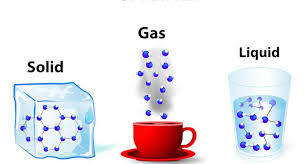
Which of the following is true regarding the kinetic molecular theory of gases?
Gas particles are attracted to one another.
Gases consist of closely spaced particles.
Gas particles move around in an orderly manner.
The temperature of a gas depends on the average kinetic energy of the gas particles.
Adding heat to a solid makes the particles move...
Particles in a solid are not moving
Slower
At the same rate as before the heat was applied
Faster
The particles in a gas are ______ away from each other than the particles in a solid
farther
closer
the same distance

This one is tricky!
The temperature of each flask is given in Kelvin (K). Think about how temperature affects the motion of gas particles. Now think about what causes gas pressure....
Which of the following statements is correct?
Flask 1 has the lowest pressure
Flask 3 has the lowest pressure
Flask 2 has the lowest pressure
Flask 4 has the lowest pressure
Which among the following is NOT true regarding the Kinetic Molecular Theory of gases?
Gases particles move in straight lines.
Gas particles are closely packed and their motion is orderly.
Gas particles are in constant motion.
Gas particles do not attract or repel each other.

Which type of motion in the figure best represents the movement of gas particles?
Motion 1
Motion 2
Motion 3
Motion 4
What happens to matter as its temperature increases?
The average kinetic energy of its particles decreases
The average thermal energy of its particles decreases
The particles gain kinetic energy
The particles lose potential energy
Gas pressure is caused by ______.
gravity.
gas molecules colliding with each other.
gas molecules colliding with surfaces of the container.
gas molecules reacting with each other.
Define entropy
energy of particles
how free particles are to spread out
the way heat relates to other types of energy
friction in action
Define kinetic energy
energy of motion
static energy
stored energy
energy use
Which picture best illustrates the particle arrangement in a solid?


Which picture best illustrates the particle arrangement in a liquid?
Which picture best illustrates the particle arrangement in a gas?
Which best describes the movement of particles in a solid?
free to flow, constant volume
free to flow, volume changes
vibrates in place,
volume changes
vibrates in place, constant volume
Which best describes the movement of particles in a liquid?
free to flow, constant volume
free to flow, volume changes
vibrates in place,
volume changes
vibrates in place, constant volume
Which best describes the movement of particles in a gas?
free to flow, constant volume
free to flow, volume changes
vibrates in place,
volume changes
vibrates in place, constant volume
Which best describes the kinetic energy of particles in a gas?
lowest amount of energy
more energy than solids but less than liquids
more energy than solids or liquids
less energy than solids but more than liquids
Which best describes the kinetic energy of particles in a solid?
lowest amount of energy
more energy than solids but less than gases
more energy than solids or liquids
less energy than solids but more than liquids
Which state of matter has the greatest entropy?
solid
liquid
gas
none, they're all the same
What happens to the temperature of a substance when the volume is constant but heat is continuously added?
it decreases
it stays constant
it increases
How is temperature related to the movement of particles?
directly
indirectly
What happens at absolute zero?
particles move slower
particles stop moving
particles move faster
particles are unaffected
What temperature (in Celsius) is absolute zero?
0
-100
-200
-273

The Kinetic Molecular Theory of Matter is the idea that solids, liquids, and gases can be understood as the motion of what?
electricity
particles
gravity
data

Fill in the blank: Postulate #1 of the KMT states that gases consist of large numbers of tiny particles that are _________ in comparison to their size.
far apart
close together
heavy
light

Fill in the blank: Postulate #2 of the KMT states that the particles of a gas are in constant rapid ________.
degeneration
deceleration
acceleration
motion

All collisions between gas particles and between particles and container walls are what kind of collisions?
inelastic
kinetic
elastic
potential

There are no forces of __________ between gas particles.
attraction
repulsion
reactions
chemicals

What determines the temperature of a gas?
How hot or cold the gas is
The total kinetic energy of the gas particles
The average kinetic energy of the gas particles
The average potential energy of the gas particles

Chemistry is the study of what?
Love
Time
Space
Matter

What is one property of a solid?
Low density
Don't mix well
Compressible
Fluid

What is one property of a liquid?
Compressible
Mix well
low density
tightly-packed particles

The process of a gas becoming a liquid is known as what?
Sublimation
Condensation
Evaporation
Melting
According to the Kinetic Molecular Theory a liquid's (SELECT ALL THAT APPLY)
particles are held close together by intermolecular forces
particles are in constant motion
particles are vibrating in place and closely packed
particles are not moving
The properties of liquids include (SELECT ALL THAT APPLY)
definite volume
take the shape of the container
can flow
are relatively incompressible
can diffuse and have surfacre tension
Which of the following is an assumption of the kinetic-molecular theory of gases?
Collisions between gas particles are inelastic.
Gases consist of closely spaced particles.
Gas particles move around in an orderly manner.
The temperature of a gas depends on the average kinetic energy of the gas particles.
Which of the following is an assumption of the kinetic-molecular theory of gases?
Collisions between gas particles are inelastic.
Gases consist of closely spaced particles.
Gas particles move around in an orderly manner.
The temperature of a gas depends on the average kinetic energy of the gas particles.
Which states of matter are fluid?
gases and liquids
liquids and solids
gases only
liquids only

1. Kinetic refers to _______________
Force
Energy
Motion
Acceleration

SLOW DOWN FOR MATH
You have a gas that has a pressure of 2 ATM and a volume of 10L. What would be the new volume if the pressure was changed to 1 ATM?
0.2 L
20 L
It would stay at 10L
15 L

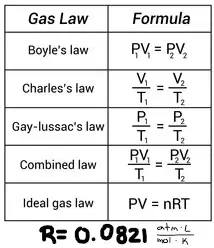
SLOW DOWN FOR MATH
If I have 4 moles of a gas at a pressure of 5.6 atm and a volume of 12 liters, what is the temperature?
205 K
200 K
2046 K
2000 K
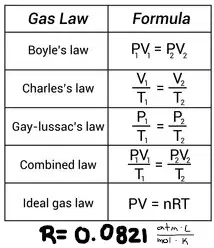
SLOW DOWN FOR MATH
Consider a sample of oxygen gas at 27° C with a volume of 9.55L at a pressure if 2.97 atm. The pressure is changed to 8.25 atm and the gas is heated to 125° C. What’s the new volume?
___ L
Round to 3 significant figures and use 273 K = 0 C
4.56 L
15.9 L
16.0 L
5.00 L
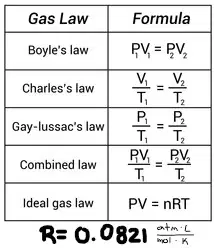
SLOW DOWN FOR MATH
If I have 5.6 liters of gas in a piston at a pressure of 1.5 atm and compress the gas until its volume is 4.8 L, what will the new pressure inside the piston be?
1.75 atm
1.8 atm
1.3 atm
1.29 atm
Collisions in which particles transfer all their kinetic energy to other particles are called ___.
elastic
inelastic
The more energy that particles have, the ___ they move.
slower
faster
If a hairspray can is heated, what can be expected of the pressure of the gas inside the can?
The pressure will increase
The pressure will decrease
The pressure will remain constant
The pressure will equalize
What is 50 °C in Kelvin?
223
323
100
50
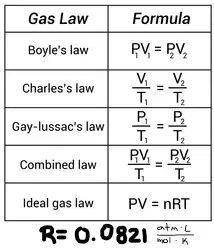
SLOW DOWN FOR MATH - STOICH!
The density of an unknown gas is 2.00 grams per Liter at 3.00 atm and 127oC. What is the molar mass (g/mol) of this gas?
(step 1 - find n (# of moles); step 2 - find g/mol)
6.95 g/mol
21.9 g/mol
0.0914 g/mol
0.288 g/mol
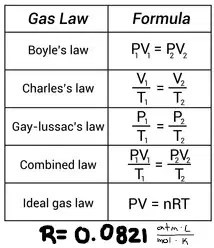
SLOW DOWN FOR MATH
A sample of 0.010 mole of oxygen gas is confined at 127°C and 0.80 atm. What would be the pressure of this sample at 27°C and the same volume?
0.10 atm
0.20 atm
0.60 atm
0.80 atm
Liquid particles have more energy than ___ particles.
solid
gas

As matter changes state from liquid to solid, the atoms have ____ kinetic energy.
more
less
the same
Which of the following is an assumption of the kinetic-molecular theory of gases?
Collisions between gas particles are inelastic.
Gases consist of closely spaced particles.
Gas particles move around in an orderly manner.
The temperature of a gas depends on the average kinetic energy of the gas particles.
Which states of matter are fluid?
gases and liquids
liquids and solids
gases only
liquids only
Match the following units to their names.
Volume
L
Temperature
K
Pressure
atm
Moles
mol
Which one of these is NOT an Ideal Gas Assumption?
Gas particles are hard, round spheres.
Gas particles are strongly attracted to one another.
Gas particles do not take up space.
Gas particles collide perfectly elastically.


