
 Worksheets
Reproduction System
Total questions: 38
Worksheet time: 19mins
Name
Class
Date
1.

Letter A is indicating the ...
a)
prostate gland
b)
testis
c)
epididymis
d)
seminal vesicle
e)
ductus (vas) deferens
2.

Letter J is indicating the ...
a)
epididymis
b)
testis
c)
prostate gland
d)
seminal vesicle
e)
ductus (vas) deferens
3.

Letter K is indicating the ...
a)
testis
b)
prostate gland
c)
epididymis
d)
ductus (vas) deferens
e)
scrotum
4.

Letter F is indicating the ...
a)
urethra
b)
prostate gland
c)
epididymis
d)
seminal vesicle
e)
scrotum
5.

Letter B is indicating the ...
a)
testis
b)
prostate gland
c)
epididymis
d)
ductus (vas) deferens
e)
scrotum
6.

Letter L is indicating the ...
a)
prostate gland
b)
epididymis
c)
seminal vesicle
d)
ductus (vas) deferens
e)
scrotum
7.

Number 4 is indicating the ...
a)
ovaries
b)
vagina
c)
uterus
d)
cervix
e)
uterine (Fallopian) tubes
8.

Number 6 is indicating the ...
a)
ovaries
b)
vagina
c)
uterus
d)
cervix
e)
uterine (Fallopian) tubes
9.

Number 2 is indicating the ...
a)
ovaries
b)
vagina
c)
uterus
d)
cervix
e)
uterine (Fallopian) tubes
10.

Number 1 is indicating the ...
a)
ovaries
b)
vagina
c)
uterus
d)
cervix
e)
uterine (Fallopian) tubes
11.

Letter A is indicating the ...
a)
secondary follicle
b)
primary follicle
c)
corpus luteum
d)
ovulated oocyte
e)
zona pellucida
12.

Letter F is indicating the ...
a)
secondary follicle
b)
primary follicle
c)
corpus luteum
d)
ovulated oocyte
e)
zona pellucida
13.

Letter J is indicating the ...
a)
secondary follicle
b)
primary follicle
c)
corpus luteum
d)
ovulated oocyte
e)
zona pellucida
14.

Number 4 is indicating the ...
a)
rete testis
b)
epididymis
c)
seminiferous tubules
d)
ductus (vas) deferens
e)
prostate
15.

Number 9 is indicating the ...
a)
rete testis
b)
epididymis
c)
seminiferous tubules
d)
vas deferens
e)
prostate
16.

Number 5 is indicating the ...
a)
rete testis
b)
epididymis
c)
seminiferous tubules
d)
vas deferens
e)
prostate
17.

What is happening in the circled area?
a)
ovulation
b)
menstruation
c)
fertilization
d)
implantation
18.
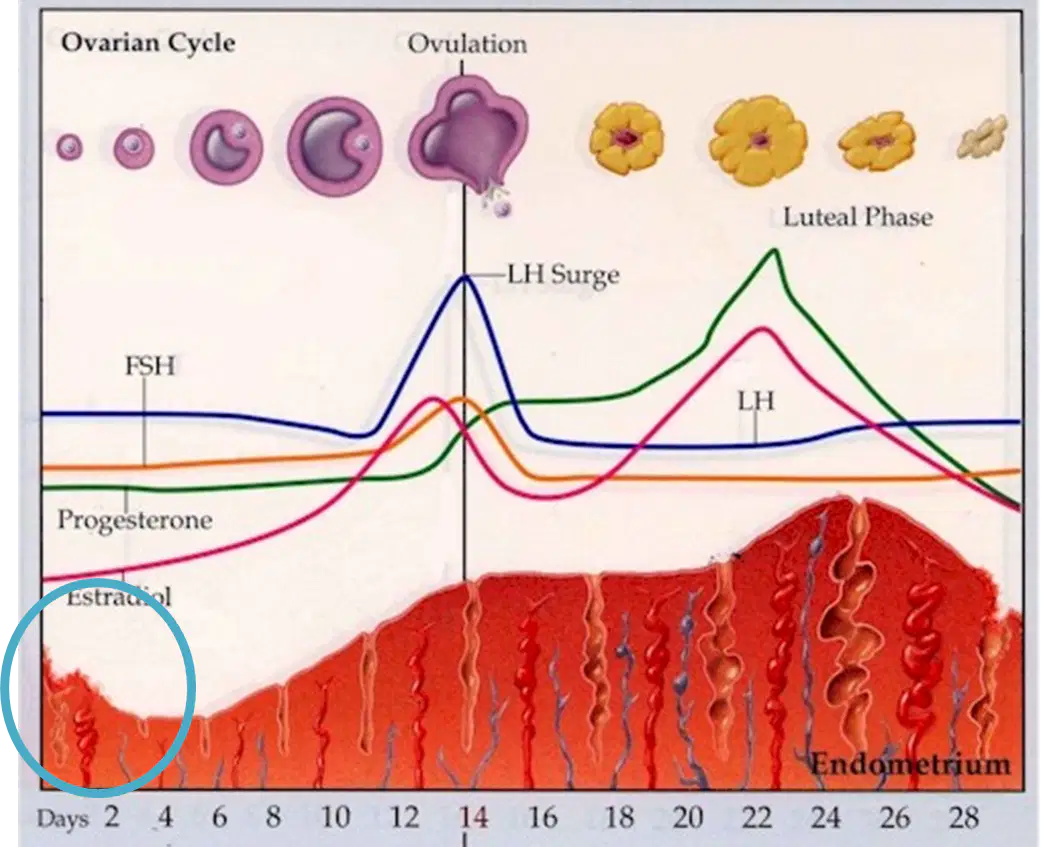
What are the colored lines on the diagram showing?
a)
chances of getting pregnant
b)
changes in hormone levels
c)
number of eggs produced
d)
changes in menstrual flow
19.
Sperm are formed in tightly coiled tubes called ...
a)
ductus deferens
b)
seminiferous tubules
c)
epididymis
d)
seminal vesicles
20.

Which number is where fertilization most likely occurs?
a)
2
b)
4
c)
7
d)
8
21.
The ducts or tubes responsible for receiving the ovulated oocyte and providing the site for fertilization are the ________.
a)
ductus deferens
b)
uterine (fallopian) tubes
c)
vagina
d)
uterus
22.

What is occuring at #8?
a)
fertilization
b)
implantation
c)
ovulation
d)
ejaculation
23.
An oocyte is viable up to ________ after ovulation.
a)
2 hours
b)
24 hours
c)
48 hours
d)
7 days
24.
The developing embryo attaches to the uterine wall about ____ after ovulation.
a)
2-4 hours
b)
20-24 days
c)
48 hours
d)
7-10 days
25.
Sperm can live for up to ________ after ovulation.
a)
2 hours
b)
24 hours
c)
48 hours
d)
7 days
26.
The split of the zygote or embryo that creates identical twins happens at ...
a)
the first division cycle
b)
within hours of fertilization
c)
up to 9 nine days after fertilization
d)
after the placenta has formed
27.
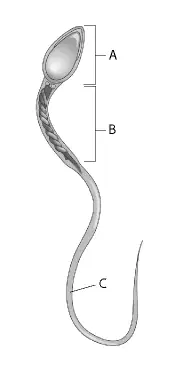
In Figure 34–2, which part of the sperm cell contains mitochondria necessary to power its trip through the reproductive system?
a)
all of these
b)
A
c)
B
d)
C
28.
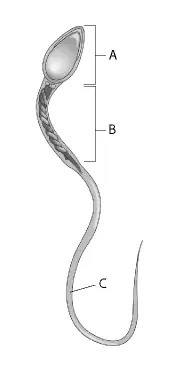
Which part of the sperm cell shown in Figure 34–2 contains enzymes vital to fertilization?
a)
all of these
b)
A
c)
B
d)
C
29.
The innermost mucosa layer of the uterus is called the ________.
a)
perimetrium
b)
endometrium
c)
perineum
d)
myometrium
30.
Burrowing of the fertilized egg into the lining of the uterus is called ________.
a)
ovulation
b)
implantation
c)
menstruation
d)
fertilization
31.
Menstruation does not occur if the....
a)
uterine lining thickens
b)
egg implants
c)
estrogen level falls
d)
progesterone level falls
32.
Which of the following is a function of the placenta?
a)
mixing the blood of the mother and the fetus
b)
providing nutrients to the fetus
c)
protecting the fetus from drugs, such as alcohol, in the mother’s body
d)
cushioning and protecting the fetus
33.
During the process of fertilization, which step happens first?
a)
The sperm’s nucleus enters the egg cell.
b)
Enzymes break down the protective layer of the egg cell membrane.
c)
A sperm attaches to a binding site on the egg cell membrane.
d)
The cell membrane of the egg cell changes.
34.
Which of the following is NOT a phase in the menstrual cycle?
a)
ovulation
b)
implantation
c)
menstruation
d)
fertilization
35.
Trace the pathway that sperm travels.
a)
epididymis, rete testis, ductus (vas) deferens, seminiferous tubule,
b)
seminiferous tubule, epididymis, ductus (vas) deferens, urethra
c)
seminiferous tubule, ductus (vas) deferens, epididymis, urethra, rete testis
d)
ductus (vas) deferens, epididymis, seminiferous tubule, seminal vesicles
36.
___ are born with all the gametes they will ever have.
a)
males
b)
females
c)
males and females
d)
No humans
37.
The structure that keeps progesterone levels high until the placenta begins functioning.
a)
pituitary gland
b)
corpus luteum
c)
epididymis
d)
fimbriae
38.
The mammary glands are modified ________.
a)
sebaceous glands
b)
sweat glands
c)
ceruminous glands
d)
lacrimal glands
100 %

