
 Worksheets
Electrostatics Review
Total questions: 60
Worksheet time: 2hrs 30mins
A neutral object becomes (a) charged if electrons are removed.

Two conducting spheres A and B, are placed on insulating stands as shown. A negatively charged balloon is brought near A. With the balloon still nearby, the two spheres are separated by moving the insulating stands. What is the resulting charge on A and B?
A: Positive
B: Positive
A: Negative
B: Positive
A: Negative
B: Negative
A: Positive
B: Negative
Reorder the following to show the progression of steps in Charging by Induction.


The diagram on the right is an example of (a)
A solid conducting sphere is given a positive charge Q. How is the charge Q distributed in or on the sphere?
It is concentrated at the center of the sphere.
It is uniformly distributed throughout the sphere.
Its density decreases radially outward from the center.
Its density increases radially outward from the center.
It is uniformly distributed on the surface of the sphere only

Choose the correct sign of the charge on Can I and Can J?
Can I (a)
Can J (b)

A negatively charged balloon will be attracted to a neutral wooden cabinet due to polarization. Which one of the following diagrams best depicts why this occurs? (a)

Choose the direction of electron flow in the diagram shown?
(a)

The electrostatic interaction between three objects is as shown. Which of the following is a possible combination of the correct charges on each? Choose all answers.
A: Positive
B: Positive
C: Positive
A: Neutral
B: Positive
C: Positive
A: Negative
B: Positive
C: Negative
A: Positive
B: Neutral
C: Positive
A: Neutral
B: Negative
C: Negative
Which of the following is constant for an object
in uniform circular motion?
Kinetic energy
Velocity
Acceleration
Displacement
Linear momentum

A block of mass 2 kg is suspended from a rope,
as shown above. If the tension in the rope is 10 N,
the acceleration of the block is most nearly
zero
2 s2m up
2 s2m down
5 s2m up
5 s2m down
A ball is dropped and bounces off the floor.
Its speed is the same immediately before and
immediately after the collision.
Which of the following is true about the collision
between the ball and the floor?
The ball’s momentum is conserved.
The ball’s momentum changes direction but
not magnitude.
The ball’s momentum changes magnitude but
not direction.
The impulse delivered to the ball by the floor
is zero.
The impulse delivered to the floor by the ball
is zero.
When an object gains electrons it becomes __________
Neutral
Positively charged
Negatively charged
An atom of oxygen has 8 protons and 10 electrons, this means the atom is ____________
positively charged because it has excess electrons
negatively charged because it has excess electrons
positively charged because it has a deficiency of electrons
negatively charged because it has a deficiency of electrons
What is the end result of charging by contact?
Both object have the same charge, so they will attract one another
Both object have the same charge, so they will repel one another
Both object have the opposite charge, so they will attract one another
Both object have the opposite charge, so they will repel one another
When two objects are rubbed together, there is a transfer of electrons. How do you determine which object acquires the transferred electrons?
Always transfer from the bigger to the smaller object, to make it even
Transfer is based on the initial charge of the two objects
Transfer is based on how much electron affinity that each object has
Always transfer from the more negative to the more positive object
When a charged object contacts another object (one is usually a conductor), there is a transfer of electrons. How do you determine which object acquires the transferred electrons?
Always transfer from the bigger to the smaller object, to make it even
Transfer is based on the initial charge of the two objects
Transfer is based on how much electron affinity that each object has
Always transfer from the more negative to the more positive object

Materials that easily loose or accept electrons are considered
Good conductors
Good insulators
Good anti-static agents
Good for storing charge


Which has more charge?
Proton
Electron
Neither


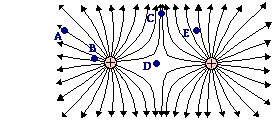
which is the field for opposite charges


Use the following information to answer the question:
Object A is NEGATIVELY charged.
Object A and Object B attract.
Object B and Object C repel.
Object C and Object D attract.
What type of charge could Object D possess?
ONLY Positive
ONLY Negative
Positive or Neutral
Negative or Neutral
Positive or Negative or Neutral

What is the triboelectric series?
Like the World Series: objects compete for electrons
A series of events that create a static charge
A list of materials arranged by strength of electron affinity
A number to show how well an object conducts electrons
The triboelectric series is used to determine the charge of an object in which type of method of charging?
Charging by Conduction
Charging by Convection
Charging by Induction
Charging by Friction
The electrical force between two objects is 144 N. If the charge on BOTH of the objects is doubled AND the distance between them is tripled, the force between them will be:
96 N
32 N
64 N
192 N
A charge of 9.88*10-6 C exerts a repelling force of 1645 N on a second charge of 2.30*10-6 C. Calculate the distance between the two charges.
0.204 m
1.24*10-4 m
0.011 m
1.38*10-14
An object with a charge of 8.1*10-4 C creates an electric field A test charge of +1.2*10-6 C experiences a force of 0.20 N. Calculate the electric field strength.
0.00405 N/C
246.9 N/C
1.6*105 N/C
1.35*1010 N/C
Which has more charge?
Proton
Electron
Neither
which is the field for opposite charges
Use the following information to answer the question:
Object A is NEGATIVELY charged.
Object A and Object B attract.
Object B and Object C repel.
Object C and Object D attract.
What type of charge could Object D possess?
ONLY Positive
ONLY Negative
Positive or Neutral
Negative or Neutral
Positive or Negative or Neutral
What is the triboelectric series?
Like the World Series: objects compete for electrons
A series of events that create a static charge
A list of materials arranged by strength of electron affinity
A number to show how well an object conducts electrons
The triboelectric series is used to determine the charge of an object in which type of method of charging?
Charging by Conduction
Charging by Convection
Charging by Induction
Charging by Friction
The electrical force between two objects is 144 N. If the charge on BOTH of the objects is doubled AND the distance between them is tripled, the force between them will be:
96 N
32 N
64 N
192 N
A charge of 9.88*10-6 C exerts a repelling force of 1645 N on a second charge of 2.30*10-6 C. Calculate the distance between the two charges.
0.204 m
1.24*10-4 m
0.011 m
1.38*10-14
An object with a charge of 8.1*10-4 C creates an electric field A test charge of +1.2*10-6 C experiences a force of 0.20 N. Calculate the electric field strength.
0.00405 N/C
246.9 N/C
1.6*105 N/C
1.35*1010 N/C

