
 Worksheets
PSPhysics Exam Practice
Total questions: 158
Worksheet time: 2hrs 11mins
motion
act of moving from one place to another
friction
a force that resists motion
energy
ability to do work
work
force needed to move an object through a distance
potential energy
stored energy
(a) compares the force produced by a machine with the force applied to the machine.
Newton's Laws of Motion explain the relationship between (a) .
(a) is the energy an object has because it is moving.
Two factors that must me considered when measuring work:
1 - the (a) applied
2 - the (b) through which the force acts
This law states that for every action there is an equal and opposite reaction.
1st Law of Motion
2nd Law of Motion
3rd Law of Motion
Law of Inertia
This law states that acceleration produced by a force on a body is directly proportional to the magnitude of the net force, is in the same direction as the force, and is inversely proportional to the mass of the body.
1st Law of Motion
2nd Law of Motion
3rd Law of Motion
Law of Inertia
This law states that an object at rest stays at rest until acted upon by another force; it stays in motion in a straight line at a constant speed until acted upon by another force.
1st Law of Motion
2nd Law of Motion
3rd Law of Motion
Law of Inertia
The tendency of things to keep traveling in the same direction at the same speed unless forced to change
inertia
gravity
friction
mass
The attraction, pulling, force between any object with mass.
inertia
gravity
friction
mass
The measure of EVERYTHING (atoms) which make up an object
inertia
gravity
friction
mass
Force is
push or pull on object
the weight of an object
an imaginary line which an object moves around
every action has an opposite but equal reaction
Motion is
push or pull on object
the act of something changing position
an imaginary line which an object moves around
every action has an opposite but equal reaction
Matter is
anything that has mass and takes up space
the act of something changing position
an imaginary line which an object moves around
every action has an opposite but equal reaction
A change in velocity [speed and/or direction] is ...
Traveling
Acceleration
Velocity
Newton's first law
The measure of speed and/or direction of a specific object ...
Traveling
Acceleration
Velocity
Newton's first law

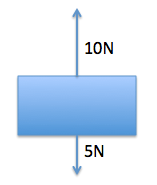
What unit do scientists use to measure force?
Newton
Grams
Meters
Meter per second per second
The moon has a smaller mass than the Earth. If you were able to travel to the moon your weight would...
Increase
Decrease
Stay the same
Vary with day and night
Suppose that an astronaut throws a baseball in outer space at a location far from significant influences of gravity and air resistance. One would expect that the baseball would ____.
eventually stop since all objects ultimately "lose their steam"
eventually stop as its inertia slowly becomes used up
continue in motion with the same speed and direction
either a, b, or c -- depending on whether the astronaut continues to push it
Inertia depends on ______
Velocity
Speed
Distance
Mass

What is the standard unit of measurement for velocity?
s2m
sm
minft
mph
What is the equation for calculating kinetic energy?
21mv2
FΔx
vm
mgh
What is the equation for calculating gravitational potential energy?
21mv2
FΔx
vm
mgh
Which of these things affects potential energy?
height
speed
What is the standard unit of measurement for work?
Joule
Kilogram
Watt
Meter
Which of these things affects kinetic energy?
height
speed
gravity
The statement that "the energy within a system remains constant and cannot be created or destroyed, only transformed" best sums up _________.
Something Dr. Dame likes to say
Life
Law of Conservation of Energy
The scientific method
Newton's Third Law
Which is the best example of kinetic energy?
A car parked on a steep hill
A tennis ball rolling across the court
A picture hanging on the wall
A piece of coal before it's burned
What is energy?
The force to move an object
The motion of an object
The ability to do work
Magic rays of sunshine that come down when you're feeling blue

What is the unit for mass?
kilogram (kg)
meter (m)
Newton (N)
Joule (J)

What is the unit for distance?
kilogram (kg)
meter (m)
Newton (N)
Joule (J)

What is the unit for force?
kilogram (kg)
meter (m)
Newton (N)
Joule (J)

A bicyclist pedaling is a type of...
kinetic energy
potential energy

An archer with her bow drawn is a type of...
kinetic energy
potential energy

A baseball thrown to second base is a type of...
kinetic energy
potential energy

Sitting in the top of a tree is a type of...
kinetic energy
potential energy

The wind blowing through your hair is a type of...
kinetic energy
potential energy

If we double (x2) the height of an object, its potential energy will...
quarter (x1/4)
halve (x1/2)
double (x2)
quadruple (x4)
If we triple (x3) the height of an object, its potential energy will...
become 1/4 the original
become 1/3 the original
triple (x3)
quadruple (x4)
If we halve (x1/2) the height of an object, its potential energy will...
become 1/4 the original
become 1/2 the original
double (x2)
quadruple (x4)
Kinetic energy is _____ proportional to the _____ of velocity.
directly, amount
directly, square
directly, cube
inversely, square
If we double (x2) the speed of an object, its kinetic energy will...
quarter (x1/4)
halve (x1/2)
double (x2)
quadruple (x4)
If we triple (x3) the speed of an object, its kinetic energy will...
become 1/9 the original
become 1/3 the original
triple (x3)
become 9x the original (x9)
If we halve (x1/2) the speed of an object, its kinetic energy will...
become 1/4 the original
become 1/2 the original
double (x2)
quadruple (x4)
What is needed to calculate work?
time and distance
speed and distance
force and direction
acceleration and velocity
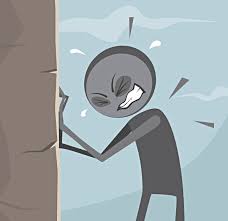
Is this an example of work?
Yes
No

Is this an example of work?
Yes
No!
Energy is
stored work
is destroyed when used
can not be changed into another form of energy
measured in newtons
_____________ is the rate of doing work.
Conservation of energy
Joules
Energy
Power
Power is measured in ___________.
meters
joules
newtons
watts
The law of Conservation of Energy says________
energy is constantly created
energy can not be created or destroyed instead it changes from one form to another
energy can not change forms
You pull down on a rope attached to a fixed pulley.
What direction will the weight at the end move?
Up
Down
if two or more pulleys are connected, a heavy load can be lifted with ____ force.
MORE
LESS


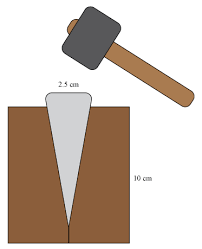

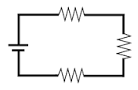


Electrons flow in the same direction as the current.
True
False

A PC monitor is usually covered in dust because:
The room needs cleaning
The dust is attracted by magnets in the monitor
The dust is attracted by static charges on the monitor
When a piece of metal becomes positively charged it has: (a)
When a piece of metal becomes negatively charged it has:
Gained electrons
Gained protons
Lost protons

When two balloons with the same charge are brought near each other they:
repel
attract
do nothing

When you walk across a nylon carpet, you become positively charged. When you then touch a metal handle you receive a shock because:
Electrons jump from you to the handle
Protons jump from you to the handle
Electrons jump from the handle to you

What does point C represent?
Amplitude
Trough
Crest
Wavelength
A wave that has the vibration parallel to the direction of the wave is called:
Longitudinal
Transverse
A wave that has the vibration perpendicular to the direction of the wave is called:
Longitudinal
Transverse

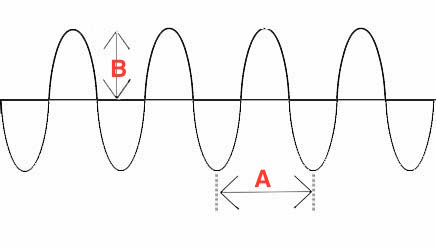
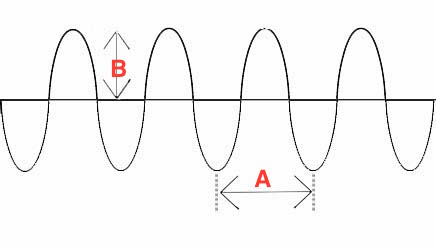
What does point A represent?
Amplitude
Wavelength
Crest
Trough
Waves transfer _______.
particles
matter
energy
Examples of this type of waves include water waves, waves on a string/jump rope, and light waves.
transverse
longitudinal
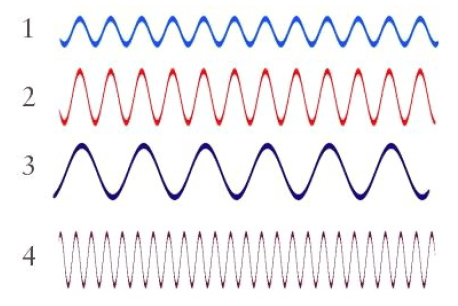
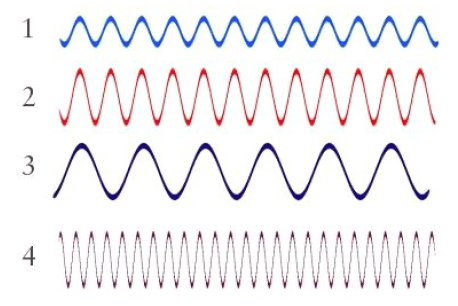
Frequency is measured in _______.
Hertz (Hz)
Meters per second
Meters
Newtons

In a longitudinal wave, a ____ is an area where the particles are spread apart and a ____ is an area where the particles are close together.
crest, trough
compression, rarefaction
rarefaction, compression
trough, crest

Examples of ________ waves include visible light, xrays, ultraviolet, and radio waves.
transverse
longitudinal
Waves that can travel through empty space are called _____ waves. Waves that require a medium to travel, such as air or water, are called _____ waves.
mechanical, electromagnetic
electromagnetic, mechanical
crest, trough
compressional, rarefactional
how does diffraction work
it goes through water and air
is a beam of light stopping at a wall
it bounces off of light
is the bending of light as it passes around the edge of an object


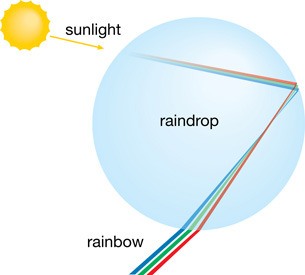
Why does white light from the sun form a colorful rainbow when it passes through water droplets in the atmosphere?
The droplets of water in the air have different densities
Different-sized water droplets refract white light at different angles
The colors that make up white light refract at different angles
White light diffracts when it encounters water

What is the main difference between refraction and diffraction?
Refraction is a phenomenon that affects light; diffraction is a phenomenon that affects sound.
Refraction involves the bending of light; diffraction involves the bending and spreading of light, usually around an obstacle.
Refraction usually happens in the atmosphere; diffraction usually happens closer to the earth's surface.
Refraction involves changes to the density of light; diffraction involves changes to the speed of light.

When light bounces off a mirror it is ________.
absorbed
reflected
corrected
refracted
When light hits an area and bounces back it is called:
echo
refraction
reflection
absorbing

Refraction is when light__________.
Is bounced by an object or material.
Changes speed as it travels in different materials which causes bending.
When light speeds up to over 300,000 km/s


The substance that a wave is passing through
medium
frequency
wavelength
gravy

Sonar and echolocation use ----- to detect objects under water.
Refraction
Reflection

absorption
diffraction
reflection
refraction
transmission

absorption
diffraction
reflection
refraction
transmission
Refraction occurs when waves enter a new (a) and change (b) .

The image depicts which of the following wave behaviors?
Resonance
Doppler Effect
Interference
Polarization

The two blue and purple waves will undergo _________________ when they meet.
Constructive interference
Destructive interference

The image of the two waves depicts
Constructive interference
Destructive interference
Light waves and sound waves are similar in that...
They are both longitudinal waves
They are both transverse waves
They both transmit energy
They both can travel through space.

Which of the pictured is responsible for black pavement being hot?
Transmission
Reflection
Refraction
Scattering
Absorption

Which type of interaction is this?
reflection
refraction
diffraction

These two waves will ________ interfere and result in a _________ amplitude.
constructively, increased
constructively, decreased
destructively, increased
destructively, decreased
The angle of incidence (incoming ray) will always equal the ray of reflection (outgoing ray).
True
False
What changes as a wave passes through a new medium?
Speed
Wavelength
Amplitude
Direction of the wave

Which type of interference would result if waves A & B overlapped?
Constructive interference
Destructive interference

What type of interaction does this picture represent?
Reflection
Interference
Refraction
Diffraction

Sound waves are of these type
Longitudinal
Transverse
Mechnical
Electromagnetic
The speed of sound is fastest in which of the following media:
Plasma
Gas
Liquid
Solid
The bouncing of a sound wave is:
A rarefaction
A compression
An echo
A vacuum

