wayground logo

Free Printable Worksheets

Font size

S
M
L
XL
Worksheets

t3frmath32023

Total questions: 107

Worksheet time: 7hrs 26mins

Name
Class
Date
1.

A triangle has sides of 8 cm, 12 cm, and 15 cm. Classify the triangle by its angles.

a)

acute

b)

obtuse

c)

right

d)

Not a triangle

2.

A triangle has sides of 4 cm, 7 cm, and 6 cm. Classify the triangle by its angles.

a)

acute

b)

obtuse

c)

right

d)

Not a triangle

3.

A triangle has sides of 41 cm, 9 cm, and 40 cm. Classify the triangle by its angles.

a)

acute

b)

obtuse

c)

right

d)

Not a triangle

4.

A triangle has sides of 11 cm, 8 cm, and 2 cm. Classify the triangle by its angles.

a)

acute

b)

obtuse

c)

right

d)

Not a triangle

5.

  3, 7, and 223,\ \sqrt{7},\ and\ 2\sqrt{2}  are the sides of a triangle.  Classify the triangle by its angles.

a)

acute

b)

obtuse

c)

right

d)

Not a triangle

6.

  13, 10, and  33\sqrt{13},\ \sqrt{10},\ and\ \ 3\sqrt{3}  are the sides of a triangle.  Classify the triangle by its angles.

a)

acute

b)

obtuse

c)

right

d)

Not a triangle

7.

  22, 15, and  27\sqrt{22},\ \sqrt{15},\ and\ \ 2\sqrt{7}  are the sides of a triangle.  Classify the triangle by its angles.

a)

acute

b)

obtuse

c)

right

d)

Not a triangle

8.

A triangle has sides of 8 cm, 21 cm, and 36 cm. Classify the triangle by its angles.

a)

acute

b)

obtuse

c)

right

d)

Not a triangle

9.

A triangle has sides of 16 m, 12 m, and 20 m. Classify the triangle by its angles.

a)

acute

b)

obtuse

c)

right

d)

Not a triangle

10.

  3, 10, and 253,\ \sqrt{10},\ and\ 2\sqrt{5}  are the sides of a triangle.  Classify the triangle by its angles.

a)

acute

b)

obtuse

c)

right

d)

Not a triangle

11.

Find the missing side of the triangle

a)

A

b)

B

c)

C

d)

D

12.

Find the missing side of the triangle

a)

A

b)

B

c)

C

d)

D

13.

Find the missing side. Leave your answer in simplest radical form.

a)

A

b)

B

c)

C

d)

D

14.

Find the missing side. Leave in simplest radical form.

a)

A

b)

B

c)

C

d)

D

15.

Find the missing side. Leave in simplest radical form.

a)

A

b)

B

c)

C

d)

D

16.

Find the missing side. Leave in simplest radical form.

a)

A

b)

B

c)

C

d)

D

17.

Is the triangle acute, obtuse, or right?

a)

A

b)

B

c)

C

18.

Is the triangle acute, obtuse, or right?

a)

A

b)

B

c)

C

19.

Is the triangle acute, obtuse, or right?

a)

A

b)

B

c)

C

20.

Is the triangle acute, obtuse, or right?

a)

A

b)

B

c)

C

21.
In this 45-45-90 triangle, I have been given a leg, so to find the other leg I...
a)
Multiply that leg by 2
b)
Use the same length for the second leg
c)
Multiply that leg by √2
d)
Divide that leg by √2
22.
What is the length of y in this picture?
a)
45
b)
5√2
c)
90
d)
5
23.
In this 45-45-90 triangle, I have been given the length of a leg.  How do I find the length of the hypotenuse?
a)
It is the same length as the given leg.
b)
Multiply that leg's length by √2.
c)
Multiply that leg's length by 2.
d)
Divide that leg's length by √2.
24.
What is the length of x in this 45-45-90 triangle?
a)
4√2
b)
4
c)
8
d)
4√3
25.
I have been given a hypotenuse in this 45-45-90 triangle.  How do I find the length of a leg of the triangle?
a)
Multiply by √2
b)
Divide by √2
c)
It's the same length as the hypotenuse.
d)
Divide by 2
26.
What is the length of y in this 45-45-90 triangle?
a)
8√2
b)
4√2
c)
4
d)
8
27.
Which side is the long leg in this 30-60-90 triangle?
a)
4
b)
u
c)
v
28.
Which side is the short leg of this 30-60-90 triangle?
a)
6
b)
m
c)
n
29.
I have been given the short leg in this 30-60-90 triangle.  How do I find the long leg?
a)
Multiply 4 by 2
b)
Multiply 4 by √3
c)
Multiply 4 by √2
d)
Divide 4 by 2
30.
I have been given the short leg in this 30-60-90 triangle.  How do I find the length of the hypotenuse?
a)
Multiply 4 by 2
b)
Multiply 4 by √3
c)
Multiply 4 by √2
d)
Divide 4 by √3
31.
Determine how to translate triangle A'B'C' to triangle ABC.
a)
(x+2, y-5)
b)
(x+2, y-9)
c)
(x-2, y-9)
32.
Determine where X' would be if you translated X 3 units to the left and 9 units down.
a)
(-4, 4)
b)
(-10, 2)
c)
(-4, -5)
d)
(-1, 5)
33.
How do you represent a translation Algebraically? 
a)
(-y, -x)
b)
(x + a, y + b)
c)
(-x , -y)
d)
(ax, by)
34.
Determine where T' would be if you translated 3 units to the right and 6 units up.
a)
(5, 1)
b)
(2, -5)
c)
(-1, 1)
d)
(8, -2)
35.
How is trapezoid ABCD translated to trapezoid A'B'C'D'?
a)
Translated 5 units to the right and 5 units down
b)
Translated 8 units to the right and 5 units down
c)
Translated  5 units to the right and 8 units down
d)
Translated 4 units to the right and 5 units down 
36.
Where would point J' be if you translated point 5 units to the left and 2 units up?
a)
(5, 3)
b)
(3, -5)
c)
(-5, 3)
d)
(-3, 5)
37.
How was B translated to B'
if B' (4, -2)?
a)
Translated 6 units to the right and 2 units down
b)
Translated 2 units to the left and 6 units down
c)
Translated 2 units to the right and 6 units down
d)
Translated 2 units to the right and five units down
38.

Flipping a figure is a ...

a)

Rotation

b)

Reflection

c)

Dilation

d)

Translation

39.
Which answer shows a reflection across the x-axis?
a)
d
b)
c
c)
b
d)
a
40.
Is the picture being reflected in the y-axis or x-axis?
a)
y-axis
b)
x-axis
41.
Identify the transformation from ABC to A'B'C'.
a)
90o clockwise rotation
b)
90o counter clockwise rotation
c)
Reflection across the y-axis
d)
Reflection across the x-axis
42.
If you were to rotate ABCD 180°  about the origin, what would the coordinate of A' be?
a)
(-5, 5)
b)
(-3, -5)
c)
(-5, 3)
d)
(-3, 3)
43.
If you were to rotate ABCD 180°  about the origin, what would the coordinate of A' be?
a)
(-5, 5)
b)
(-3, -5)
c)
(-5, 3)
d)
(-3, 3)
44.
If you were to rotate ABCD 180° about the origin, what would the coordinates of B' be?
a)
(0, 0)
b)
(-6, -5)
c)
(-1, 3)
d)
(-6, 2)
45.
Rotate the point (-3,-4) around the origin 180 degrees. State the image of the point.
a)
(-4,-3)
b)
(-4,3)
c)
(4,-3)
d)
(3,4)
46.
What is this picture an example of? 
a)
An angle
b)
A cat vertex 
c)
Rotation 
d)
Dilation
47.
The image A'B'C' is a rotation of ABC.
a)
True
b)
False
48.
What type of rotation does this represent (from red to blue)?
a)
270⁰ clockwise
b)
360⁰
c)
90⁰ counterclockwise
d)
180⁰
49.
Triangle A is rotated 90° clockwise with the origin as the center of rotation to create a new figure. Which rule describes rotating 90° clockwise?
a)
(x,y)→(y, -x) 
b)
(x,y)→(-x,-y)
c)
(x,y)→(-y,x)
d)
(x,y)→(x,y)
50.
Triangle A is rotated 270° counterclockwise with the origin as the center of rotation to create a new figure. Which rule describes rotating 270° counterclockwise?
a)
(x,y)→(y, -x) 
b)
(x,y)→(x,y)
c)
(x,y)→(-y,x)
d)
(x,y)→(-x,-y)
51.
Triangle C is rotated 180° clockwise with the origin as the center of rotation to create a new figure. Which rule describes rotating 180° clockwise?
a)
(x,y)→(y, -x) 
b)
(x,y)→(-x,-y)
c)
(x,y)→(x,y)
d)
(x,y)→(-y,x)
52.
Triangle B is rotated 90° counterclockwise with the origin as the center of rotation to create a new figure. Which triangle shows the new location?
a)
A
b)
B
c)
C
d)
D
53.
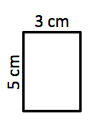
What is the area of the rectangle?
a)
15 sq cm
b)
15 cm
c)
d)
16 cm
54.
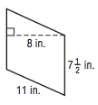
Find the area. 
a)
88 inches2
b)
60 inches
c)
88 inches 
d)
60 inches2
55.
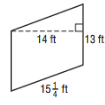
Find the area. 
a)
27 feet2
b)
213.5 feet
c)
182 feet2
d)
2775.5 feet
56.
Find the Area
a)
27
b)
198.25
c)
182
d)
2775.5
57.
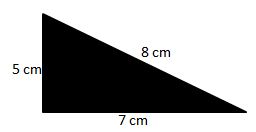
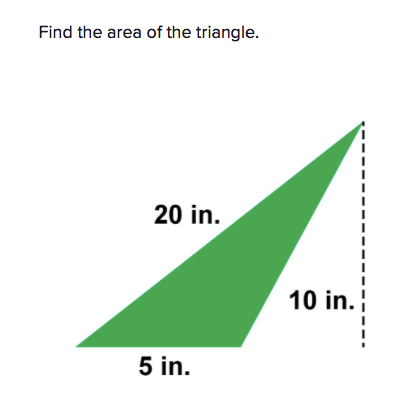
Find the area of this triangle.
a)
20 cm2
b)
35 cm2
c)
40 cm2
d)
17.5 cm2
58.
Find the area
a)
50 square inches
b)
100 square inches
c)
200 square inches
d)
25 square inches
59.
a)
2 in3
b)
1 in3
c)
3 in3
d)
4 in3
60.
a)
210 in3
b)
260 in3
c)
2160 in3
d)
2610 in3
61.
a)
25.7 cm3
b)
24.7 cm3
c)
26.7 cm3
d)
28.7 cm3
62.
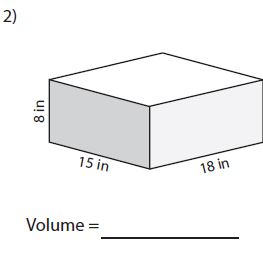
What is the formula used to find the volume of a rectangular prism?
a)
V = Lw
b)
V = Lwh
c)
V = 1/2bh
d)
V = 2∏r
63.

what is the difference between the apothem and radius?

a)

they're the same thing

b)

radius- line from the center of a polygon to a vertex

c)

apothem- line drawn from the center of a polygon to bisect a side

d)

radius- 1/3bh

64.

What does the green line represent in the picture of the hexagon?

a)

the apothem

b)

the perimeter

c)

an angle

d)

grass

65.
A line from the center of a regular polygon at right angles to any of its sides.
a)
apothem
b)
radius
c)
permimeter
d)
area
66.

what is the central angle of a hexogon?

a)

52

b)

60

c)

90

d)

360

67.

Find m<OHM

a)

30°

b)

60°

c)

90°

d)

45°

68.

What is the RADIUS of this square?

a)

7√2 in

b)

14 in

c)

7 in

d)

49 in

69.

What is the PERIMETER of this hexagon?

a)

2√3 in

b)

2 in

c)

16 in

d)

24 in

70.
Find the area
a)
96 cm2
b)
48 cm2
c)
36 cm2
d)
48 cm
71.
Find the area of the pentagon
a)
58.12
b)
47.02
c)
76.08
d)
38.04
72.
Find the area of the shaded region.
a)
13.5
b)
54
c)
67.5
d)
13.5
73.

What is the measure of ∠PTQ?

a)

100°

b)

140°

c)

180°

d)

120°

74.

What is the measure of arc YZX?

a)

231

b)

255

c)

168

d)

200

75.
Find the measure of arc JH
a)
93
b)
130
c)
120
d)
95
76.
In a circle (or congruent circles), the measure of an arc is:
a)
equal to half of the measure of its corresponding central angle
b)
equal to the measure of its corresponding central angle
c)
equal to the measure of its circle's radii
d)
only calculated by taking the square root of dragon taxis
77.
Solve for the missing angle.
a)
45o
b)
90o
c)
22.5o
d)
128o
78.

Given BD is the diameter of the circle, what is the measure of arc AB?

a)

140

b)

142

c)

180

d)

153

79.

What is correct value for x?

a)

125o

b)

155o

c)

80o

d)

360o

80.

AD and CG are diameters of Circle B, how would you classify arc CD?

a)

Minor Arc

b)

Major arc

c)

Semi-Circle

d)

Full circle

81.

What is the area of this circle?

a)

b)

c)

16π

d)

π

82.

What is the area of this circle?

a)

25π

b)

10π

c)

π

d)

83.

What is the area of this circle?

a)

12π

b)

c)

144π

d)

36π

84.

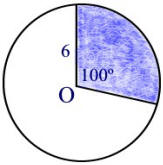
Find the area of the shaded sector of circle O. The radius is 6 inches and the central angle is 100°. Express answer as an exact value

a)

5π/3

b)

10π/3

c)

10π

d)

40π

85.

What is the area of the shaded region? Round to the nearest hundredth.

a)

1.26

b)

452.39

c)

9.42

d)

113.10

86.

What is the area of the shaded region? Round to the nearest hundredth.

a)

8.37

b)

2.09

c)

33.49

d)

4.19

87.

What is the area of the shaded sector? Round your answer to the nearest hundredth.

a)

19.28

b)

163.85

c)

655.39

d)

None of these

88.

FIND THE SECTOR AREA OUTLINED IN BOLD

a)

A

b)

B

c)

C

d)

D

89.

Given the measurements in the diagram, find the total area of the shaded regions.

a)

10.47 cm2

b)

17.45 cm2

c)

26.18 cm2

d)

8.33 cm2

90.
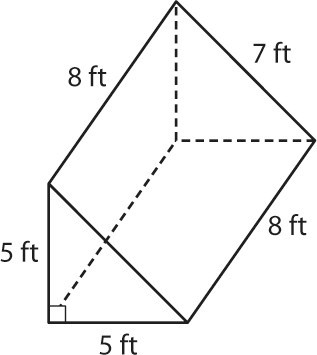
Find the total surface area of the prism.
a)
48 square inches
b)
64 square inches
c)
88 square inches
d)
76 square inches
91.
Find the total surface area of the prism.
a)
161 square feet
b)
1,700 square feet
c)
75 square feet
d)
186 square feet
92.
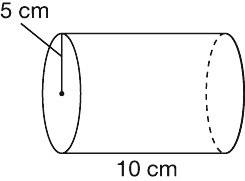
Find the surface area of the cylinder.
a)
471.24 square centimeters
b)
157.08 square centimeters
c)
314.16 square centimeters
d)
296.72 square centimeters
93.
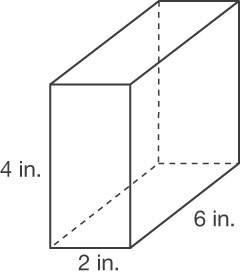
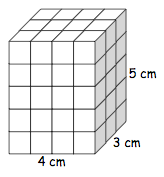
Find the surface area of the rectangular prism.
a)
94 cm. squared
b)
60 cm. squared
c)
12 cm. squared
d)
19 cm. squared
94.
A cylindrical candle has a diameter of 4 inches and a height of 7 inches. What is the total surface area of the candle?
a)
113π
b)
276π
c)
88π
d)
36π
95.
Kayla’s grandfather is building a toy box that is 2ft tall, 2 ½ ft wide and 4 ft long. If the wood cost $3 per square foot, what is the least amount Kayla’s grandfather can spend on the wood for the toy box?
a)
$15.33
b)
$138
c)
$78
d)
$60
96.
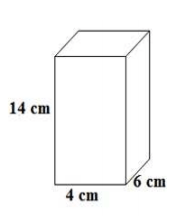
Campbell Soup is creating a new soup label. If a can has a height of 6 in and a diameter of 4 in, how much material does Campbell need for each soup label? Use 3.14 for π.

What is the surface area of the label?
a)
150.72 in2
b)
100.48 in2
c)
24 in2
d)
75.36 in2
97.
What is the surface area of this figure?
a)
3000 cm 2
b)
164 cm 2
c)
236 cm 2
d)
328 cm 2
98.
a)
S.A. = 206 in.2
b)
S.A. = 120 in.2
c)
S.A. = 180 in.2
d)
S.A. = 194 in.2
99.
A classroom, in the shape of a rectangular prism, has two walls that are each 20 feet long, and two walls that are 25 feet long.  The height, from the floor to the ceiling, is 9 feet.  You need to paint the walls of the room with two coats of paint.  How much area will you paint, after applying BOTH coats of paint?
a)
810 ft²
b)
1620 ft²
c)
1310 ft²
d)
1360 ft²
100.

The volume of a cone is  615.44 ft3.  615.44\ ft^3.\ \  It's radius is  7 ft.7\ ft.  Find the height.

a)

h=12 fth=12\ ft  

b)

h=28 fth=28\ ft  

c)

h3.5 fth\approx3.5\ ft  

d)

h = 14 fth\ =\ 14\ ft  

101.

The volume of a cone is   2,307.9 mm32,307.9\ mm³  and the height is  5 mm5\ mm .  What is the radius? Round to the nearest whole number.

a)

r=147 mmr=147\ mm  

b)

r=47 mmr=47\ mm  

c)

r= 441 mmr=\ 441\ mm  

d)

r=21 mmr=21\ mm  

102.

If the volume is  330 in3330\ in^3  , what is the height?

a)

10 in

b)

240 in

c)

22 in

d)

11 in

103.

If the volume is  294 m3294\ m^3  what is the height of the pyramid?

a)

10.5 m

b)

2 m

c)

3.5 m

d)

21 m

104.
Find the volume.
a)
4620
b)
5390
c)
735
d)
539
105.

The volume of a cone is  8π ft3.  8\pi\ ft^3.\ \  It's radius is  2 ft.2\ ft.  Find the height.

a)

h=6 fth=6\ ft  

b)

h=4 fth=4\ ft  

c)

h=10 fth=10\ ft  

d)

h = 7 fth\ =\ 7\ ft  

106.

What is the formula for the VOLUME of a PYRAMID?

a)

Bh

b)

4/3(pi)r3

c)

1/3Bh

d)

1/3(pi)r2h

107.

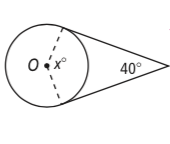
Assume that lines that appear to be tangent are tangent. O is the circle. What is the value of x?

a)

90

b)

140

c)

220

d)

360