Wayground logo

Free Printable Worksheets

Font size

S
M
L
XL
Worksheets

Semester 2 Review Questions

Total questions: 100

Worksheet time: 1hrs 21mins

Name
Class
Date
1.

Which type of electromagnetic waves can travel the furthest, have the longest wavelengths and the lowest frequency?

a)

Gamma Rays

b)

Ultra-violet

c)

Infrared

d)

Radiowaves

2.

Which electromagnetic waves are used in devices such as heat lamps and TV remote controls?

a)

Ultraviolet rays

b)

Infrared Rays

c)

Microwaves

3.

How much of the electromagnetic spectrum is made up of visible light?

a)

A small portion of it

b)

Most of it

c)

All of it

d)

None of it

4.

Which section of the electromagnetic spectrum is the ONLY part humans can see?

a)

X-Rays

b)

Gamma Rays

c)

Visible Light

d)

Ultraviolet Rays

5.

Which wavelengths of the EM spectrum are dangerous to life?

a)

radio, micro and gamma

b)

gamma, infrared, and UV

c)

Infrared, UV and X Rays

d)

UV, X rays and Gamma

6.
Electromagnetic energy travels in waves. When we describe electromagnetic waves, we often talk about the wave’s length and frequency. Which of these statements accurately describes the relationship between the wavelength and frequency of an electromagnetic wave?
a)
If wavelength increases, frequency increases.
b)
If frequency decreases, wavelength increases.
c)
If frequency remains constant, wavelength increases.
d)
If wavelength remains constant, frequency increases.
7.
Latif wakes up one morning and sees that it is foggy outside. Which term best describes the fog he sees?
a)
opaque
b)
reflective
c)
translucent
d)
transparent
8.
Heather puts a straw into a glass of water. She notices that the straw appears to be broken when she looks through the glass and the water from the side. Which term bestexplains why the straw looks like it is broken?
a)
absorption
b)
refraction
c)
scattering
d)
transmission
9.
During a thunderstorm, Sanjay saw lightning and then heard thunder 5 s later. Why does he see the lightning before he hears the thunder?
a)
He would have seen the lightning and heard the thunder at the same time.
b)
Sound travels faster than light.
c)
Light travels faster than sound.
d)
There is no reason.
10.
A dolphin makes a noise underwater that is too high-pitched for humans to hear. What type of wave is this?
a)
water 
b)
electromagnetic
c)
mechanical
d)
microwave
11.
In which of these situations would light slow down?
a)
from glass to air
b)
from ice to water
c)
from plastic to air
d)
from a vacuum to air
12.
Which of the following is NOT a cause of a wave changing direction?
a)
Reflection
b)
Refraction
c)
Radiation
d)
Diffraction
13.
Light waves are mechanical waves.
a)
True
b)
False
14.
Which of the following is the bending of a wave, which changes its speed.
a)
Reflection
b)
Diffraction
c)
Refraction
d)
Frequency
15.
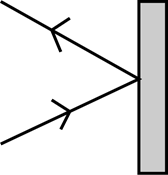
The picture best represents
a)
Refraction
b)
Reflection
c)
Diffraction
d)
Interference
16.

In what context would would light travel even faster than through air?

a)

Through vacuum/empty space

b)

Through glass

c)

Through water

d)

Through a solid

17.

In a vacuum/empty space, the speed of light...

a)

can vary

b)

is always 300,000 km/s

c)

is slower than the speed of light through a medium

d)

is slow

18.
A student placed a pencil in a cup of water.  The pencil appears broken because light-
a)
always travels in a straight line
b)
bends when it passes through water
c)
makes the water in the glass evaporate
d)
reflects the pencil on the water's surface
19.
The illustration shows a light ray striking an object.
In the illustration, the light ray striking the object is-
a)
absorbed
b)
stopped
c)
reflected
d)
refracted
20.
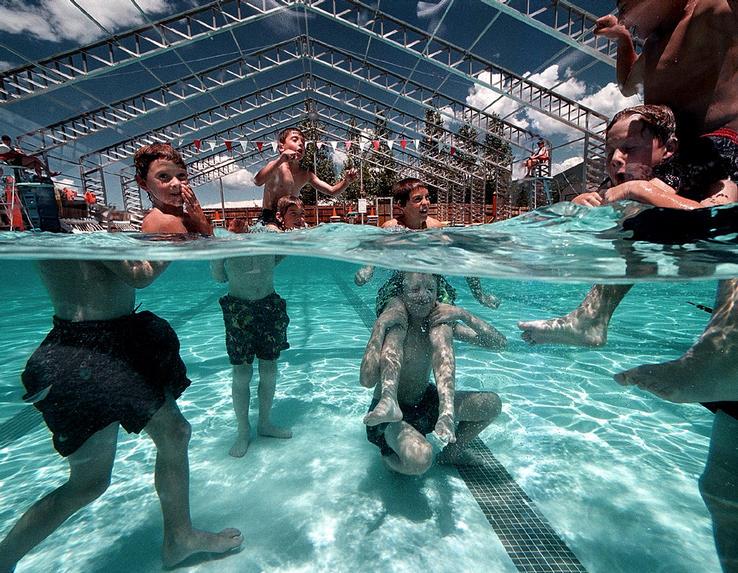
Why does the lower part of the child appear so much different in size from the upper part?
a)
The light rays that travel through water and then into air are refracted.
b)
The light rays that travel through water and then into air are enlarged.
c)
The light rays that travel through air and then into water are reflected.
d)
The light rays that travel through air and then into water are reduced.
21.
The change in ________ of light causes it to bend
a)
speed
b)
distance
c)
length
d)
color
22.
During a thunderstorm, Sanjay saw lightning and then heard thunder 5 s later. Why does he see the lightning before he hears the thunder?
a)
He would have seen the lightning and heard the thunder at the same time.
b)
Sound travels faster than light.
c)
Light travels faster than sound.
d)
There is no reason.
23.

When light goes from glass into water, the speed of the light...

a)

slows down

b)

stays the same

c)

speeds up

24.

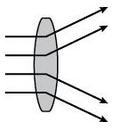
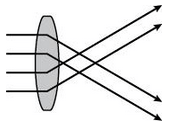
Which lens represents the path light takes through a diverging lens?

a)
b)
c)
d)
25.

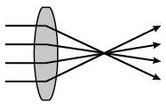
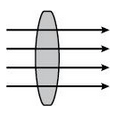
Which figure represents the path light takes through a converging lens?
a)
b)
c)
d)
26.

The side view mirrors on your car help shrink the image on both sides of the car, allowing you to see a larger field of view. What type of mirror is this?

a)

a convex mirror

b)

a concave mirror

c)

a convex lens

d)

a concave lens

27.
What does the word "converging" mean?
a)
to separate
b)
to come together
c)
parallel 
d)
perpendicular
28.
Is a convex lens thicker or thinner in the middle?
a)
Thicker 
b)
Thinner 
29.

Is a concave lens thicker or thinner in the middle?

a)

Thicker

b)

Thinner

30.
White light is made up of:
a)
red, yellow, and blue
b)
no colors
c)
all colors
d)
red, green, and blue
31.

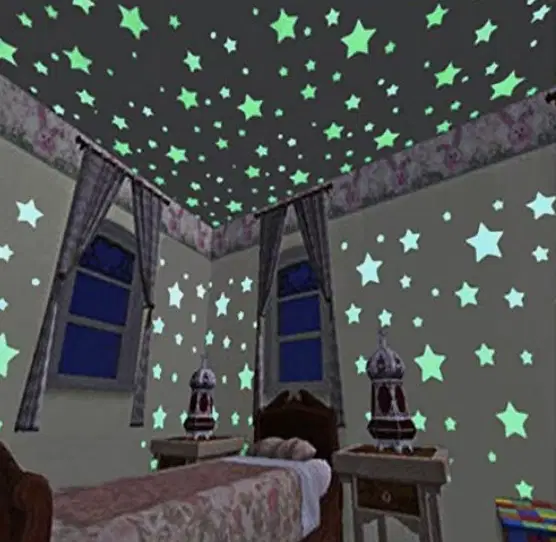
A student has stars in her bedroom that glow in the dark after being charged energy from light absorption. The material the stars are made up are

a)

bioluminescent

b)

fluorescent

c)

phosfluorescent

d)

chemiluminescent

32.

Indian river lagoon in Florida is one place on Earth that has a type of phytoplankton that can glow in the dark through a chemical process know as

a)

fluorescence

b)

bioluminescence

c)

phosfluorescence

d)

neon glow

33.

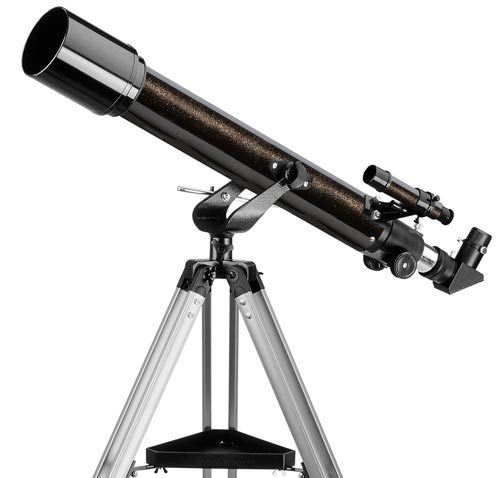
A refracting telescope uses _______ to focus light.

a)

Lenses

b)

Mirrors

c)

Lasers

d)

Water

34.

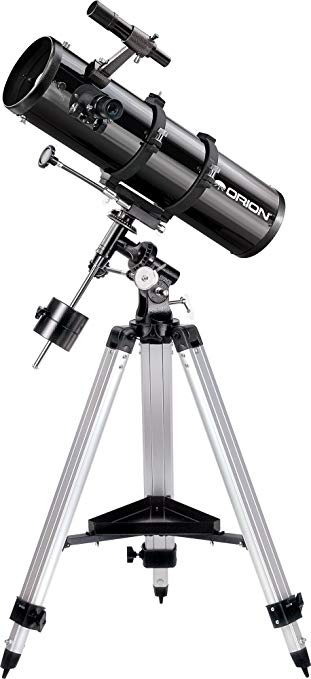
Reflecting telescopes use _______ to focus light.

a)

Lenses

b)

Flat mirrors

c)

Curved Mirrors

d)

A lens and lasers

35.
The brightness of a star as seen from Earth is its 
a)

apparent brightness (magnitude)

b)

absolute brightness (magnitude)

c)

parallax.

d)

reflective brightness.

36.
The absolute brightness of a star depends on its
a)
distance and temperature.
b)
size and temperature.
c)
color and temperature.
d)
distance and color.
37.

What is the brightness of Rigel as seen from Earth?

a)

-1.46

b)

-8.1

c)

0.12

d)

0.85

38.

Which star is the brightest?

a)

Sirius

b)

Alderban

c)

Rigel

d)

Sun

39.
Which of the following best describes a star?  A star is a celestial body ---
a)
composed of rock and metal with a very high density
b)
that is too big to be an asteroid, but too small to be a planet.
c)
that rotates on an axis and revolves around the Sun
d)
composed of gases that emit light due to nuclear reactions
40.
What is the name of the largest stars?
a)
Protostars
b)
Supergiants
c)
Red Giants
d)
Dwarf Stars
41.
Use the Hertzsprung-Russell Diagram to answer the following question.  Betelgeuse is a _____
a)
Hot and Bright Star
b)
Cool and Bright Star
c)
Hot and Dim Star
d)
Cool and Dim Star
42.
In the diagram given, what happens as we move to the left?
a)
Stars Get Larger
b)
Stars get Colder
c)
Stars get hotter
43.

Glowing gases, like that of a hot star, produces or gives off light in specific frequencies. The resulting spectrum has bright lines against a dark background and is called

a)

emission spectrum

b)

absorption spectrum

c)

continuous spectrum

44.

A gas can also absorb parts of light that shine through it. This gas blocks some of the light at specific frequencies producing dark lines and is called a

a)

emission spectrum

b)

absorption spectrum

c)

continuous spectrum

45.

TRUE or FALSE: Absorption and Emission spectra can be used to determine the elements within a gas cloud (like those found on outer layers of stars).

a)

TRUE

b)

FALSE

46.

Which common constellation known as the Great Bear is useful for finding the north star and is always visible in the northern hemisphere?

a)

Ursa Minor

b)

Ursa Major

c)

Polaris

d)

Andromeda

47.
The term Zodiac refers to ...
a)

the light from Saturn's rings

b)

the head of the Celestial Empire

c)

a method for making astrological predictions

d)

a group of constellations lying near the ecliptic line

48.

How does a meteor compare to a meteorite?

a)

A meteor is moving through Earth's atmosphere and the meteorite actually lands on Earth

b)

Meteors are made up of Carbon and meteorites are made of ice

c)

A meteorite is moving through the Earth's atmosphere and the meteor actually lands on Earth

d)

They are the same thing

49.

The orbital speeds of planets closer to the Sun will be faster than planets farther away because.....

a)

The gravity decreases as the distance between the objects increase.

b)

The gravity increases as the distance between the objects decrease.

c)

The gravity increases as the mass of the object increases.

d)

The gravity between the objects decrease as the objects warm up.

50.

How does the motion of planets change as they get nearer to the sun?

a)

they speed up

b)

they slow down

c)

they change orbit direction

d)

they stop orbiting

51.
Planets that have no solid surface and are made of gases such as hydrogen and helium are called:
a)
Gas Giants
b)
Terrestrial Planets
52.
Which choice shows the correct order of the planets?
a)
Mars, Venus, Earth, Mercury, Jupiter, Saturn, Uranus, Neptune
b)
Earth, Venus, Mars, Mercury, Jupiter, Saturn, Uranus, Pluto
c)
Mercury, Venus, Earth, Mars, Jupiter, Saturn, Uranus, Neptune
d)
Saturn, Venus, Mars, Mercury, Jupiter, Neptune Mercury, Uranus
53.

Why do some stars appear brighter in the sky than others?

a)

Some stars are bigger, so they appear brighter.

b)

Some stars are closer to Earth so they appear brighter.

c)

Some stars are burning at a hotter temperature, therefore appear hotter.

d)

All of the options listed are correct.

54.

The color of a star determines it's temperature. What color are the hottest stars?

a)

Blue Stars

b)

Orange Stars

c)

Red Stars

d)

Yellow Stars

55.
Stars can take different paths due to having different _____________
a)
temperature
b)
mass
c)
brightness
d)
color
56.
After the main sequence, a low mass star becomes a
a)
black dwarf
b)
protostar
c)
red giant
d)
supergiant
57.

Our sun is known as a middle-aged, stable star. Also known as a ____________________.

a)

Gas Giant

b)

Nebula

c)

Pulsar

d)

Main Sequence Star

58.

Planets orbit the Sun in a shape called _?_.

a)

a circle

b)

an ellipse

c)

a focus

d)

an oblong

59.

An ellipse is drawn around two points called _?_.

a)

dots

b)

points

c)

foci

d)

axis

60.

What has an eccentricity of zero?

a)

a straight line

b)

a large ellipse

c)

circle

d)

a small ellipse

61.

Where is the planet moving faster?

a)

around segment A

b)

around segment B

c)

around either segment - the speed doesn't change

d)

impossible to know

62.

While traveling around its orbit, during which segment does a line from the planet to the sun sweep through the most area of space?

a)

The area between A, B and the Sun is the largest.

b)

The area between G, H and the Sun is the largest

c)

the areas are equal in size

d)

There is not enough information to determine the areas

63.

The diagram below shows a moon revolving around a planet in an elliptical orbit. At which position is the moon traveling fastest?

a)

location 1

b)

location 2

c)

location 3

d)

location 4

64.

Which planet of those shown, because of its position, will take the least amount of time to revolve around the Sun?

a)

Mercury

b)

Venus

c)

Earth

d)

Mars

65.

According to Kepler's 3rd law, the square of the time it takes a planet to orbit (T) is directly related to the cube of half the distance across the orbital ellipse (a). This means the further away from the sun a planet orbits, _?_.

a)

the larger the constant k is.

b)

the smaller the constant k is.

c)

the longer the orbital period is.

d)

the shorter the orbital period is.

66.

The period of Jupiter is 4,344 days. This tells you how long it takes _?_.

a)

Jupiter to orbit the sun.

b)

Jupiter to rotate one time on its axis.

c)

the sun to orbit Jupiter.

d)

Earth to orbit Jupiter.

67.

Why is Earth’s year shorter than Jupiter’s year?

a)

the gravitational pull of Jupiter’s moons

b)

the shape of Earth’s orbit around the Sun

c)

the smaller distance between Earth and the Sun

d)

the mass and density of Jupiter

68.

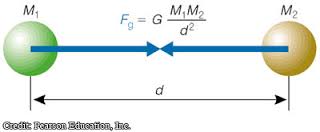
If I double the mass of one object, but don't change anything else... What happens to the gravitational force between two objects?

a)

Doubles

b)

Quadruples

c)

Cut in Half

d)

4x Smaller

69.

What states that "every object in the universe attracts every other object"?

a)

Newton's Law of Universal Gravitation

b)

Newton's First Law of Motion

c)

Physics

d)

Inertia & gravity

70.
Complete the following statement: The farther away two planets are the _______ the gravitational force between them.
a)
more
b)
same
c)
dosen't matter
d)
less
71.
It takes more force to accelerate the iron man on the left than the iron man on the right because the iron man on the left has more mass. This best describes
a)
Newton's first law, the law of inertia
b)
Newton's second law, the law of acceleration
c)
Newton's third law, the law of action reaction 
d)
The law of universal gravitation
72.
The formula 
? = mass x acceleration
or 
? = m x a 
is used to find 
a)
Force
b)
Velocity
c)
Momentum
d)
Gravity
73.
For every action, there is an equal and opposite reaction.
a)
Newton's
1st
Law of Motion
b)
Newton's
2nd
Law of Motion
c)
Newton's
3rd
Law of Motion
74.
a)
1st
b)
2nd
c)
3rd
75.
If an object is stationary (not moving) the forces acting upon it are _____________
a)
unbalanced
b)
weak
c)
balanced
d)
Hulk Smash!
76.
What is Newton's First Law
a)
F=ma
b)
Every action has an equal and opposite reaction
c)
An object at rest stays at rest, an object in motion stays in motion. 
d)
Friction 
77.
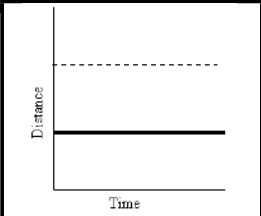
What does this graph represent?
a)
Constant Speed
b)
Acceleration
c)
Not moving
78.
How long did it take this object to travel 10 m?
a)
0 s
b)
10 s
c)
15 s
d)
20 s
79.
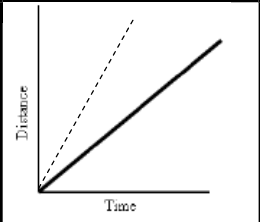
What does this graph represent?
a)
Constant speed
b)
Acceleration
c)
Not moving
80.

Use the graph above and pick the most accurate description of the object's motion

a)

object is moving at constant speed

b)

object is speeding up

c)

object is at rest

d)

object is slowing down

81.

Use the picture above to choose the most accurate description of the object's motion

a)

object is at rest

b)

object is slowing down

c)

object is moving at a constant speed

d)

object is speeding up

82.
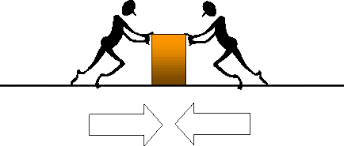
What is the net force?
a)
40 N left
b)
0 N Balalnced
c)
400 N right
d)
40 N right
83.
What is the magnitude (size) and direction of the net force?
a)
15 N to the left
b)
15 N to the right
c)
1 N to the left
d)
1 N to the right
84.
Name the missing force...
a)
frictional force
b)
weight force
c)
thrust
d)
buoyant force
85.
Name the missing force...
a)
thrust
b)
frictional force
c)
normal force
d)
weight force
86.
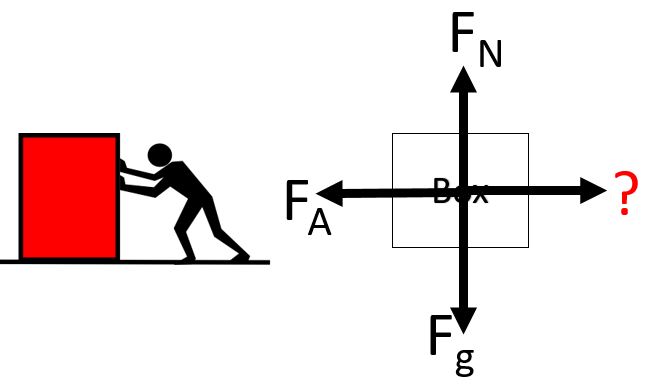
Name the missing force...
a)
weight force
b)
normal force
c)
applied force
d)
frictional force
87.
Which type of energy transformation occurs when a flashlight shines?
a)
chemical → thermal → electrical
b)
chemical → electrical → light
c)
thermal → chemical → light
d)
chemical → electrical → chemical
88.
A lamp that plugs into a wall socket draws energy which flows through a thin wire in the bulb causing it to glow. What energy transformations are taking place?
a)
chemical → light → electrical
b)
mechanical → sound → light
c)
thermal → solar → electrical
d)
electrical → thermal → light
89.
Some students observing a classroom device being used, noticed the below energy transformations. 
Electrical → Mechanical → Sound
Which device were the students most likely observing?
a)
A triple beam balance measuring an object’s mass.
b)
A pencil sharpener plugged into a wall outlet.
c)
A projector displaying a diagram on the screen.
d)
A working flashlight used to light up a dark corner.
90.
Which type of energy transformation occurs when a flashlight shines?
a)
chemical → thermal → electrical
b)
chemical → electrical → light
c)
thermal → chemical → light
d)
chemical → electrical → chemical
91.
When water falls through a dam and turns a turbine connected to a generator, electricity is produced. This electricity is often used to light our homes and offices. Which of the following shows the energy transformations that occurs?
a)
electrical → light → mechanical
b)
chemical → mechanical → electrical
c)
mechanical → chemical → light
d)
mechanical → electrical → light
92.
A lamp that plugs into a wall socket draws energy which flows through a thin wire in the bulb causing it to glow. What energy transformations are taking place?
a)
chemical → light → electrical
b)
mechanical → sound → light
c)
thermal → solar → electrical
d)
electrical → thermal → light
93.
The Theory of the Conservation of Energy states -
a)
Energy can be created, just not destroyed. It changes its form from one type to another.
b)
Energy can never be created nor destroyed. It can only change its form from one type to another.
c)
The total energy in our Universe changes, as different forms of energies can be transformed from each other under certain circumstances.
d)
Energy transformations do not passively occur in our lives, rather we actively make use of energies and transform energies.
94.
Which of the following shows an energy transformation from chemical energy to electrical to light energy?
a)
A bolt of lightning lights the night sky.
b)
A candle glows brightly in the dark.
c)
A fire in a fireplace lights up a room.
d)
A battery causes a flashlight to shine.
95.
People get energy from the food that they eat and transform that energy as they move. Which energy transformations occur as a student rapidly rubs the palms of his hands together?
a)
mechanical to thermal to electrical
b)
chemical to mechanical to thermal
c)
mechanical to chemical to sound
d)
chemical to sound to electrical
96.
Which statement best explains why the lamp does not glow? 
a)
Circuit 1 is an open circuit.
b)
 Circuit 1 is a closed circuit.
c)
 The negative terminal of Circuit 1 is connected to the cell.
d)
The positive terminal of Circuit 1 is connected to the cell.
97.
What kind of circuit is this?
a)
Series
b)
Consecutive
c)
Parallel
d)
Training
98.
In a _________ circuit, if one bulb goes out then the entire circuit doesn't work.
a)
Series
b)
Parallel
99.
The unit for current is the 
a)
Volt
b)
Ohm
c)
Electron
d)
Amp
100.

Which is a measure of power required to operate an electrical component? (i.e. a light bulb)

a)

Volt

b)

Watt

c)

Amp

d)

Ohm