wayground logo

Free Printable Worksheets

Font size

S
M
L
XL
Worksheets

End of Year Quizziz

Total questions: 126

Worksheet time: 3hrs 32mins

Name
Class
Date
1.

The distance-time graph below represents the motion of a cart initially moving forward along a straight line.

*During which interval is the cart moving forward at constant speed?

a)

Between points A and B

b)

Between points B and C

c)

Between points C and D

d)

Between points D and E

2.

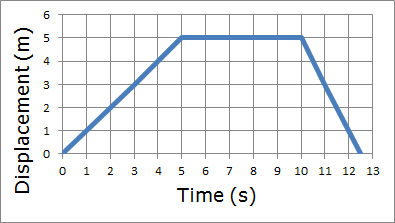
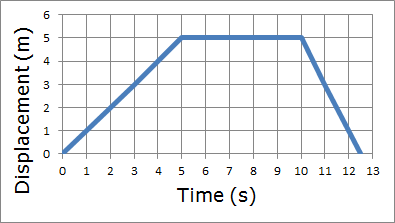
According to the graph how far does the person travel in the first 5 seconds?

a)

2 m

b)

10 m

c)

0 m

d)

5 m

3.
What does this graph represent?
a)
Constant Speed
b)
Acceleration
c)
Not moving
4.
What is the person doing from 5 seconds to 10 seconds?
a)
Walking 
b)
Running
c)
Standing Still 
d)
Walking Fast
5.
What is the average speed of the person during the first 5 seconds?
a)
0 m/s
b)
1 m/s 
c)
3 m/s
d)
6 m/s 
6.
Which of the following is a unit of distance ?
a)
miles/hr
b)
hr
c)
km
d)
min
7.

What is the equation to calculate distance?

a)

distance = speed/time

b)

distance = time/speed

c)

distance = speed/distance

d)

distance = speed x time

8.

The flow of electrical charge per unit time is known as

a)

Voltage

b)

Current

c)

Resistance

d)

Power

9.

This symbol represents a light bulb

a)
b)
c)
d)
10.

In a parallel circuit, the voltage...

a)

is different for each resistor

b)

is the same for each resistor

c)

is equal to the sum of each voltage

d)

is equal to zero

11.
What kind of circuit is this?
a)
series
b)
parallel
12.
What is a Parallel circuit? 
a)
Has only one path 
b)
Has more than one path 
c)
Allows energy to travel through easily 
d)
Has only one light bulb
13.

Students constructed a circuit using different-colored lightbulbs. What will happen if Switch 3 is closed and the other switches are left open?

a)

Only the white bulb will operate

b)

None of the bulbs will operate

c)

Only the white and yellow bulbs will operate

d)

Only the red and blue bulbs will operate
14.
What does evolution mean?
a)
To change something
b)
To change and adapt over time
c)
To lose some original features
d)
To improve ssomething over time
15.
What is survival of the fittest?
a)
It is where the fittest die out and therefore reproduce and pass on their genes
b)
It is where the fittest die out and therefore can't reproduce and pass on their genes
c)
It is where the fittest don't die out and therefore can't reproduce and pass on their genes
d)
It is where the fittest don't die out and therefore reproduce and pass on their genes
16.
Genetic differences between organisms of the same species
a)
Variation
b)
Adaptation
c)
Behavior
d)
Environment
17.

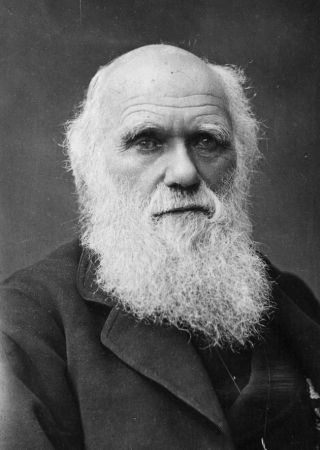
Who developed the theory of evolution?

a)

Charles Darwin

b)

Mike Tyson

c)

George Washington

d)

Patton Manning

18.
Which of the following explains the revolution of a planet?
a)
The Earth revolves around the sun once per day.
b)
The Earth revolves around the sun once per year.
c)
The moon revolves around the sun once per day.
d)
The Earth rotates on it's axis once per day.
19.
Which of the following planets most likely has the highest temperature?
a)
Earth
b)
Mars
c)
Mercury
d)
Neptune
20.
What celestial body is at the center of our solar system?
a)
Earth
b)
Moon
c)
Milky Way
d)
Sun
21.
What is the correct order from largest to smallest?
a)
galaxy, universe, planet, sun
b)
planet, sun, galaxy, universe
c)
universe, galaxy, sun, planet
d)
sun, galaxy, universe, planet
22.
What is an example of one Earth day?
a)
The Earth moves away from the sun.
b)
The Earth rotates once on its axis.
c)
The Earth revolves once on its axis.
d)
The Earth moves closer to the sun.
23.

Organisms living in hot, dry areas are more likely to survive if they:

a)

wash regularly

b)

do not waste water

c)

have thick hair

d)

do not have sharp claws

24.

An ecosystem is:

a)

plumbing and wiring in a house that uses less water and energy than older systems

b)

all the different physical environmental factors that affect a habitat

c)

all the different types of organisms in a habitat

d)

All the organisms in a habitat together with the physical environmental factors.

25.

1 At a certain lake, the community is smaller in winter because:

a)

some of each species of animal have died

b)

some species of birds have migrated

c)

more animals have arrived for the winter so that they can keep warm together

d)

there is more ice on the lake and so less room for the organisms.

26.

What do lizards eat?

a)

mice

b)

grasshoppers

c)

hawks

d)

grass

27.

What might happen if all the rabbits died?

a)

There would be more hawks because there are fewer rabbits in competition with them.

b)

There would be fewer lizards because the hawks would eat more of them.

c)

There would be less grass because the grasshoppers would eat it.

d)

There would be more snakes because they would not compete with the rabbits.

28.

The arrows in a food chain show:

a)

the flow of energy

b)

the loss of energy

c)

how animals use energy to move around in a habitat

d)

how plants make their own energy.

29.

Which of the following food chains does the pyramid of numbers represent?

a)

grass rabbit fox

b)

grass sheep fox

c)

lettuce slug thrush hawk

d)

oak tree caterpillar bird

30.

Using the food web, choose the organisms in the correct order.

a)

microscopic plants > water fleas > small fish > perch

b)

microscope plants > perch > water flease > small fish

c)

perch > waterboatmen > small fish > tadpoles

d)

microscopic plants > tadpoles > water boatman > perch

31.

What word describes the movement of many animals from one part of the world to another?

a)

hibernation

b)

changing

c)

tourism

d)

migration

32.

What is the type of variation shown in the bar chart?

a)

continuous

b)

discontinuous

c)

identical

d)

incomplete

33.

Which piece of scientific equipment would you use to measure the volume of a liquid

a)

Beaker

b)

Test tube

c)

Measuring cylinder

d)

Balance

34.

What is the function of a thermometer?

a)

Measure the temperature

b)

Measure the time

c)

Measure the volume

d)

Measure the mass

35.

round 65.3859 to three decimal places

(a)  

36.

Calculate the mean of 8, 15 and 13

a)

10

b)

11

c)

12

d)

13

37.

Calculate the mean of 120, 106, 108 and 114

a)

110

b)

112

c)

114

d)

116

38.

Calculate the mean of 10.2, 10.5 and 10.8

a)

10.5

b)

10.6

c)

10.7

d)

10.8

39.

Calculate the mean of 25, 31 and 28

(a)  

40.

What is the Independent Variable

a)

The variable that stays the same

b)

The variable that changes

c)

The variable that you measure

41.

What is the dependent variable?

a)

The variable that stays the same

b)

The variable that you change

c)

The variable that you measure

42.

What is the control variable?

a)

The variable that stays the same

b)

The variable that changes

c)

The variable that you measure

43.
What is the definition of an element?
a)
A pure substance
b)
A pure substance like water
c)
A pure substance, containing only one type of atom
d)
A substance that only has one atom
44.
What are all materials made up of?
a)
Particles
b)
Carbon
c)
Wood
d)
Ions
45.
What are the correct properties to describe a solid?
a)
Can flow, can be compressed
b)
Can't flow, can't be compressed, has no fixed shape
c)
Can't flow, can't be compressed, has a fixed shape
46.
What are the correct properties to describe a liquid?
a)
Can't flow, can't be compressed, has no fixed shape
b)
Fills the shape of the container, can't flow
c)
Fills the shape of the container, can flow, cannot be compressed
47.
What are the correct properties to describe a gas?
a)
Can't flow, can't be compressed, has no fixed shape
b)
Fills the shape of the container, cannot be compressed
c)
Can flow, fills the shape of the container and can be compressed
48.
Which change of state describes the change from a liquid to a solid?
a)
Melting
b)
Freezing
c)
Boiling
d)
Evaporation
49.
Which change of state describes the change from a solid straight to a gas?
a)
Melting
b)
Freezing
c)
Boiling
d)
Sublimation
50.
If a substance had a melting point of 100⁰C, what state would it be in at room temperature?
a)
Solid
b)
Liquid
c)
Gas
51.
If a substance had a melting point of -12⁰C and a boiling point of 200⁰ what state would it be in at room temperature?
a)
Solid
b)
Liquid
c)
Gas
52.
If a substance had a boiling point of -12⁰C, what state would it be in at room temperature?
a)
Solid
b)
Liquid
c)
Gas
53.
If a substance had a melting point of 54⁰C boiling point of 68⁰C, what state would it be in at room temperature?
a)
Solid
b)
Liquid
c)
Gas
54.
What terms describes the movement of particles from a high concentration to a low concentration?
a)
Evaporation
b)
Melting
c)
Diffusion
d)
Freezing
55.
Can diffusion occur in solids?
a)
Yes
b)
No
56.
What is the correct chemical symbol for sodium?
a)
NA
b)
nA
c)
na
d)
Na
57.
What is the correct chemical symbol for magnesium?
a)
M
b)
Mg
c)
Mn
d)
MN
58.
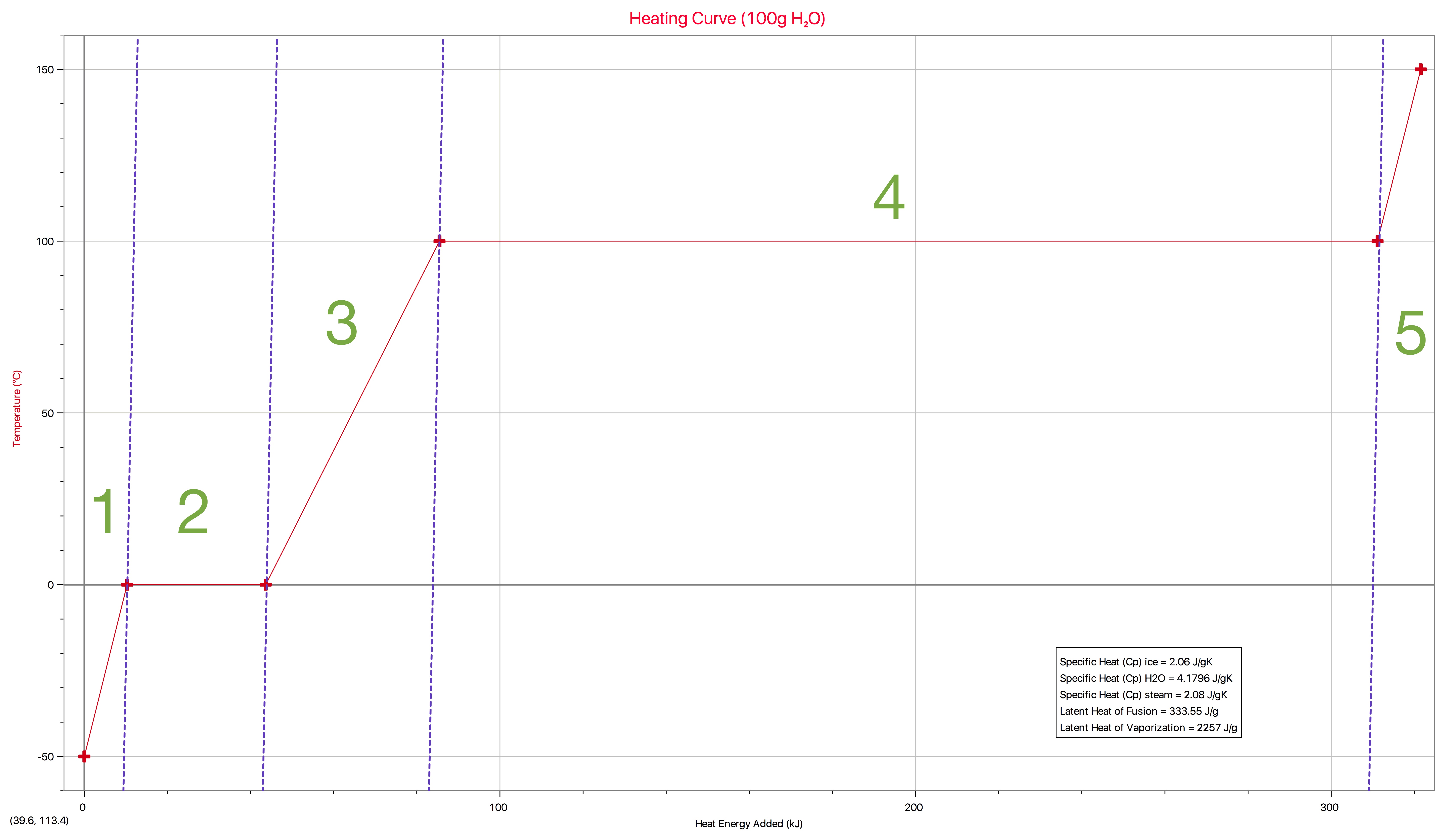
In which region(s) of the graph does a phase change occur?
a)
Region 1, 3, & 5
b)
Region 2 & 4
c)
Region 1 only
d)
Region 1 & 2
59.
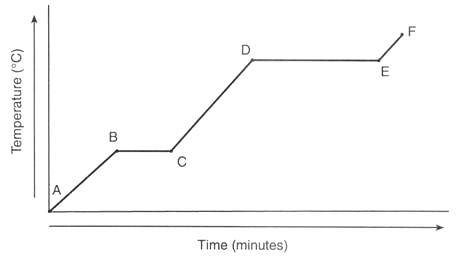
Describe the substance between letters C and D. 
a)
Gas
b)
Liquid
c)
Melting
d)
Evaporating
60.
An extremely strong acid would have a pH of...
a)
1
b)
7
c)
9
d)
14
61.
A neutral substance would have pH of...
a)
8
b)
7
c)
6
d)
14
62.
If a solution is neither acidic or basic it has a pH of _____________.
a)
1
b)
13
c)
6
d)
7
63.
Indicators change color in the presence of a(n) _______________.
a)
acid or base
b)
buffer
c)
water molecule
d)
ester
64.

What is the meaning of the above hazard warning symbol?

a)

Corrosive

b)

Explosive

c)

Toxic

d)

Radioactive

65.
What is the hazard shown in this hazard sign?
a)
Fire
b)
Goku
c)
Flammable
d)
Inflammable
66.
What is the hazard shown in this hazard sign?
a)
Explosive
b)
Corrosive
c)
Irritant
d)
High level Irritant
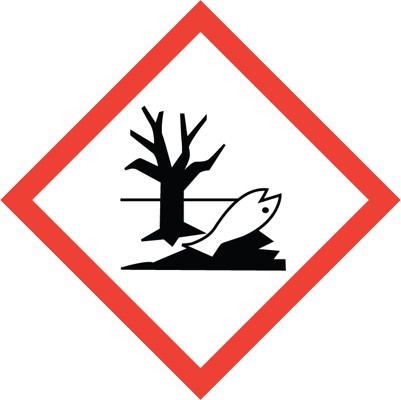
67.

This symbol tell us the chemical it is labelling is:

a)

Harmful to the environment

b)

Dangerous

c)

Toxic

d)

Poisonous

68.
What elements make up Copper sulphate? CuSO4
a)
copper, sulphate
b)
copper, sulphur
c)
copper, sulphur and oxygen
d)
copper and oxygen
69.

How can we prevent sodium from reacting?

a)

By keeping it under a layer of oil.

b)

By galvanising it.

c)

By keeping it cool.

d)

By heating it.

70.
acid + metal ----->
a)
salt + hydrogen
b)
salt + water + carbon dioxide
c)
salt + water
d)
salt + carbon dioxide
71.

As you move left to right on a row or period what happens?

a)

Atomic number increases by 1

b)

Electrons decrease

c)

Number of shells decrease

d)

Nothing

72.

Elements in the same group have __________

a)

Similar Properties

b)

Same number of shells

c)

Similar Mass

73.

What is photosynthesis?

a)

Plants producing seed.

b)

Plants making food.

c)

Plants dispersing seed.

d)

Plants attracting pollinators.

74.

What are produced from photosynthesis?

a)

Carbon dioxide

b)

Glucose

c)

Oxygen

d)

Water

75.

What are needed for photosynthesis?

a)

Carbon dioxide

b)

Glucose

c)

Oxygen

d)

Water

76.

What else are needed for photosynthesis?

a)

Light

b)

Soil

c)

Nutrient

d)

Chlorophyll

77.

State the word equation of photosynthesis. (                  +                 ) (                 +                 )\left(\ \ \ \ \ \ \ \ \ \ \ \ \ \ \ \ \ \ +\ \ \ \ \ \ \ \ \ \ \ \ \ \ \ \ \ \right)\rightarrow\ \left(\ \ \ \ \ \ \ \ \ \ \ \ \ \ \ \ \ +\ \ \ \ \ \ \ \ \ \ \ \ \ \ \ \ \ \right)  

[Type the answer in correct order will do, no need to type any symbol]

(a)  

78.

Which letter shows the chlorophyll?

a)

B

b)

C

c)

D

d)

E

e)

F

79.

Which letter shows the part that controls the activities of cell?

a)

B

b)

C

c)

D

d)

E

e)

F

80.

Which letter shows the vacuole of plant?

a)

B

b)

C

c)

D

d)

E

e)

F

81.

Which part of the cell is needed in photosynthesis?

a)

B

b)

C

c)

D

d)

E

e)

F

82.

Which nutrients help in photosynthesis?

a)

Nitrogen

b)

Magnesium

c)

Phosphorus

d)

Potassium

83.

Name A.

(a)  

84.

Choose the letter that show the male parts of the flower.

a)

B

b)

E

c)

H

d)

I

85.

Choose the letter that show the female parts of the flower.

a)

A

b)

C

c)

G

d)

K

86.

Which part produces the pollen?

a)

A

b)

D

c)

F

d)

I

87.

State the function of B.

(a)  

88.
Non-living factor that affects an ecosystem
a)
biotic factor
b)
abiotic factor
c)
food chain 
d)
biome
89.
What is the original source of almost all energy in most ecosystems?
a)
carbohydrates
b)
sunlight
c)
water
d)
carbon
90.
The air we breathe is only ____% oxygen.
a)
10
b)
21
c)
78
d)
90
91.

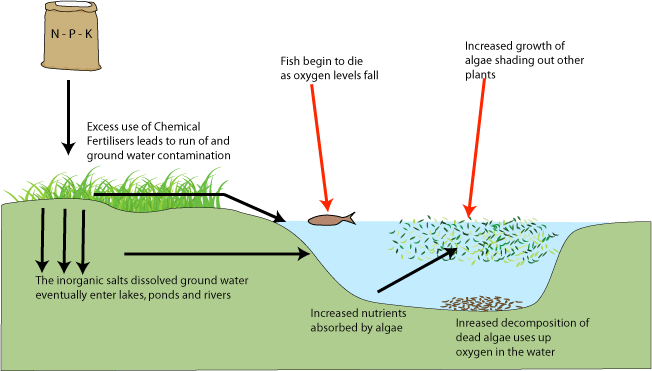
Leaching is...

a)

When acid rain harms plants

b)

When fertilizers are stuck in soil, harming plants

c)

When fertilizers are washed away by rain, ending up in rivers/streams

d)

When fertilizers are taken up into the plant to be used for chemical processes

92.

Nitrates that have been leached are used by...

a)

The ocean

b)

Fish

c)

Clams

d)

Algae and green plants

93.

What are the dangers of excessive growth of algae and plants

a)

They might take up too much room

b)

They block sunlight for other organisms

c)

They do not harm other organisms

d)

Other organisms eat them and they are toxic

94.

Eutrophication is caused by

a)

excess nutrients building up in the water.

b)

industrial point-source pollution.

c)

unlined landfills and septic tanks.

d)

wastewater from homes mixing with drinking water.

95.

How does eutrophication cause the death of aquatic organisms

a)

the build up of carbon dioxide in the water

b)

the lack of nitrogen in the water

c)

the lack of carbon dioxide in the water

d)

the lack of oxygen in the water

96.

In eutrophication, dissolved oxygen levels decrease because

a)

bacteria use it as they decompose organic material

b)

algae uses it during photosynthesis

c)

it reacts with hydrogen to form H2O (water)

d)

fish use it up as they consume algae

97.

An increase in the amount of nutrients in a lake is known as

a)

calcification

b)

cellular respiration

c)

eutrophication

d)

photosynthesis

98.
The unit for current is the 
a)
Volt
b)
Ohm
c)
Electron
d)
Amp
99.
What is the unit for resistance?
a)
Volts
b)
Amperes
c)
Ohms
100.
Which formulas represents Ohm's law?
a)
V=IR
b)
R=IV
c)
I=RV
101.
What is a closed path for electrons to flow through?
a)
static electricity
b)
circuit
c)
amperes
102.
As the resistance in a circuit increases, the electric current __________.
a)
increases
b)
decreases
c)
stays the same
103.
Which statement best explains why the lamp does not glow? 
a)
Circuit 1 is an open circuit.
b)
 Circuit 1 is a closed circuit.
c)
 The negative terminal of Circuit 1 is connected to the cell.
d)
The positive terminal of Circuit 1 is connected to the cell.
104.

Which of these will repel each other?

a)

Negatively charged balloon and positively charged sphere.

b)

Negatively charged balloon and neutral sphere.

c)

Negatively charged balloon and negatively charged sphere.

d)

Negatively charged balloon and neutral wall.

105.
What type of circuit is pictured?
a)
series
b)
Parallel
106.
What kind of circuit is this?
a)
Series
b)
Consecutive
c)
Parallel
d)
Training
107.
If the battery produced 12.6 Volts and what would be the current flow be for a 6 Ohm resistor
a)
2.1 Amps
b)
2.4 Amps
c)
1.71 Amps
d)
15 Amps
108.

which ones aren't contact forces?

a)

tension

b)

air resistance

c)

lift

d)

friction

e)

gravitational force

109.

which is the correct formula for weight?

a)

weight x mass = gravitational field strength

b)

mass ÷ gravitational field strength = weight

c)

mass x gravitational field strength = weight

110.

what is weight measured in?

a)

newton meters

b)

grams

c)

newtons

d)

kilograms

111.

QUESTION:


A car has a mass of 10,000 kg. What is the WEIGHT of the car?


(Use 10n/kg as the value of gfs)

a)

1,000 N

b)

100,000 N

c)

10,000 N

d)

100 N

112.

what is a resultant force?

a)

the overall effect of more than two forces acting on an object

b)

the overall effect of weight acting on an object

c)

the overall effect of more than one force acting on an object

113.
What would be the effect on the particles if more heat is supplied to the system?
a)
They would slow down
b)
They would stop moving
c)
They would speed up
d)
There would be no effect
114.

Which of these is NOT a force?

a)

Friction

b)

Normal

c)

Weight

d)

Electrical resistance

115.
1. A _________is a simple machine with a fulcrum and a rigid bar.
a)
Pivot
b)
Lever
c)
Wedge
116.
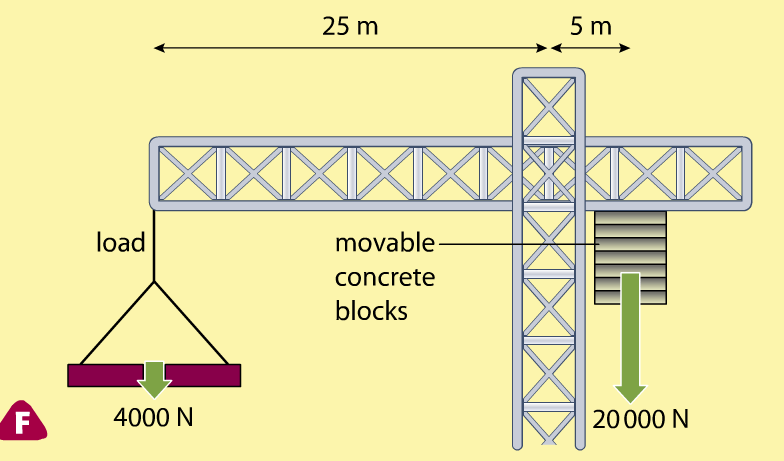
What is the anticlockwise moment acting on this crane?
a)
80,000Nm
b)
100,000Nm
c)
120,000Nm
d)
140,000Nm
117.
What is the moment acting on the seesaw?
a)
1.6Nm
b)
15Nm
c)
16N
d)
4Nm
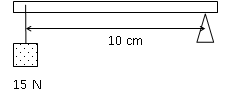
118.
What is the moment produced by the 15 N?
a)
15 Nm (clockwise)
b)
150 Nm (anti - clockwise)
c)
1.5 Nm (anti - clockwise)
d)
0.15 Nm (clockwise)
119.
A seesaw is unbalanced with two people of different masses sitting equal distances from the center. Which of the following will result in equilibrium?
a)
The larger person moving further away from the center.
b)
Moving the smaller person closer to the center.
c)
Moving the smaller person further from the center.
d)
Making the larger person do nothing.
120.
The easiest way to open a heavy door  is by applying the force
a)
Near the hinges
b)
In the middle of the door
c)
At the edge of the door far from the hinges
d)
At the top of the door
121.

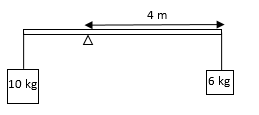
Two masses of mass 10.0 and 6.0 kg are hung from massless strings at the end of a light rod. The rod is virtually weightless. A pivot (fulcrum) is placed off center and the system is free to rotate. If the 6.0 kg mass is 4.0 m away from the pivot, how far away is the 10.0 kg mass if the system is not rotating?

a)

0.42 m

b)

2.4 m

c)

4.8 m

d)

4.2 m

122.

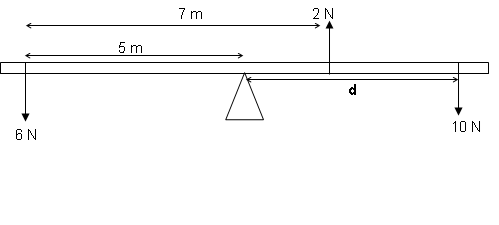
Assuming the system is in equilibrium, calculate the missing distance d

a)

3.4 m

b)

2.8 m

c)

4.4 m

d)

1.6 m

123.

The diagram shows a beam. Without any weights, the beam balances at its centre.

Three weights are hung as shown.

At which point does a load of 2 N balance the beam?

a)

A

b)

B

c)

C

d)

D

124.

A nut can be loosened more easily with

a)

a short spanner because a larger turning effect can be produced.

b)

a long spanner because a larger turning effect can be produced.

c)

a long spanner because a larger force can be produced.

d)

a short spanner because a larger force can be produced.

125.

The figure below shows a man lifting a heavy rock using a steel bar. He pushes downwards on the end of the bar with a force F.


Which pivot positions allows the force F to be as small as possible?

a)

A

b)

B

c)

C

d)

D

126.

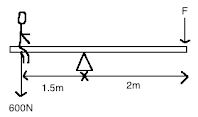
A boy of weight 600N sits on the see-saw as shown at a distance of 1.5m from the pivot. What is the force F required at the other end to balance the see-saw?

a)

450 N

b)

350 N

c)

4.5 N

d)

200 N