
 Worksheets
Animal Kingdom
Total questions: 150
Worksheet time: 1hrs 15mins
Mammals are amniotic vertebrates.
True
False
There are living examples of oviparous mammals.
True
False
Marsupials are mammals that lay eggs and incubate them in a bag called "pouch".
True
False
Mammals are ectothermic.
True
False
All mammals have their bodies fully covered with hair.
True
False
All mammals species possess mammary glands.
True
False
Some bird species bear teeth.
True
False
Birds are oviparous and reproduce externally.
True
False
Birds have their skin covered in feathers and scales.
True
False
Birds are vertebrate tetrapods.
True
False
Birds are amniotic vertebrates.
True
False
Birds are viviparous.
True
False
Birds can keep their body temperature constant.
True
False
Birds are descendants of the dinosaurs.
True
False
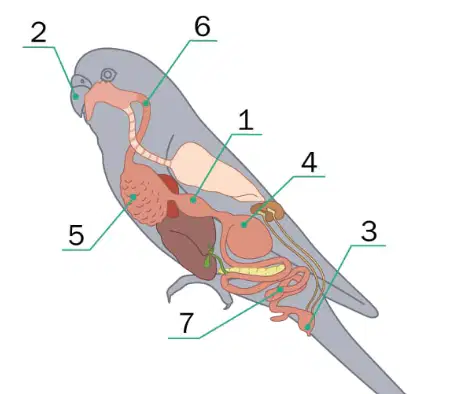
Which is number 1?
Gizzard
Crop
Stomach
Cloaca
Esophagus
Which is number 4?
Gizzard
Crop
Stomach
Cloaca
Esophagus
Which is number 5?
Gizzard
Crop
Stomach
Cloaca
Esophagus
Which is number 3?
Gizzard
Crop
Stomach
Cloaca
Esophagus
Which is number 6?
Gizzard
Crop
Stomach
Cloaca
Esophagus
Reptiles' eggs have a tough shell and a membrane called amnion.
True
False
Reptiles are amniotic tetrapods.
True
False
Reptiles have watertight skin.
True
False
Reptiles cannot regulate their internal temperature by means of physiological processes.
True
False
Reptiles are viviparous.
True
False
Reptiles have their bodies covered in scales.
True
False
Reptiles breathe using lungs and through their skin.
True
False
Reptiles depend on the aquatic environment in order to reproduce.
True
False
They are characterized by being limbless.
Chelonii
Sauria
Ophidia
Crocodilia
Reptiles which possess a bony shell.
Chelonii
Sauria
Ophidia
Crocodilia
Reptiles which are characterized by being limbless.
Chelonii
Sauria
Ophidia
Crocodilia
Reptiles which, in general, do not have teeth.
Chelonii
Sauria
Ophidia
Crocodilia
Reptiles which have no eyelids, so they can't blink.
Chelonii
Sauria
Ophidia
Crocodilia
Reptiles which live partly in aquatic environments and partly on land.
Chelonii
Sauria
Ophidia
Crocodilia
Reptiles which have no external ears.
Chelonii
Sauria
Ophidia
Crocodilia
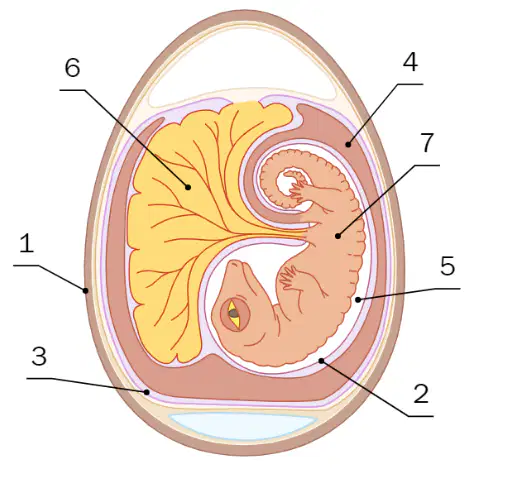
Which is number 3?
Chorion
Amnion
Yolk sac
Allantois
Shell
Which is number 2?
Chorion
Amnion
Yolk sac
Allantois
Shell
Which is number 6?
Chorion
Amnion
Yolk sac
Allantois
Shell
Which is number 4?
Chorion
Amnion
Yolk sac
Allantois
Shell
Which is number 1?
Chorion
Amnion
Yolk sac
Allantois
Shell
Adult amphibians do not depend on the aquatic environment to survive.
True
False
During one of their developmental stages, amphibians have a tail.
True
False
Young amphibians depend on the aquatic environment to survive.
True
False
The skin of amphibians is covered in scales.
True
False
Amphibians are ectothermic.
True
False
Adult amphibians breathe through their lungs and skin.
True
False
Amphibians develop through metamorphosis.
True
False
Amphibians that have the ability to regenerate some of their limbs.
Anura
Gymnophiona
Urodela
Amphibians that are mostly oviparous and reproduce externally.
Anura
Gymnophiona
Urodela
Amphibians which adults have no limbs.
Anura
Gymnophiona
Urodela
Cartilaginous fishes have several gills.
True
False
Cartilaginous fishes have several gills.
True
False
Fishes have the ability to keep their body temperature constant.
True
False
Fishes breath through gills.
True
False
Bony fishes have the gill covered by an operculum.
True
False
Fishes are mostly viviparous.
True
False
Fishes reproduce by internal fertilization.
True
False
Which type of fish is the one that doesn't have scales?
Chondrichthyes
Osteichthytes
Agnathans
Which type of fish is the one which gills are covered by an operculum?
Chondrichthyes
Osteichthytes
Agnathans
Which type of fish is the one that doesn't have a jaw?
Chondrichthyes
Osteichthytes
Agnathans
Which type of fish is the one that has swim bladder?
Chondrichthyes
Osteichthytes
Agnathans
Which type of fish is the one which skeleton is totally or partially made u of bony tissue?
Chondrichthyes
Osteichthytes
Agnathans
Echinoderms need to shed their skeleton to be able to grow.
True
False
Echinoderm larvae are bilaterally symmetrical
True
False
All echinoderms are marine animals.
True
False
Echinoderms have no head.
True
False
Echinoderms use tube feet for locomotion or to attach to the substrate.
True
False
Echinoderms have no nervous system.
True
False
Sexual reproduction in echinoderms is via external fertilization.
True
False
In echinoderms, the anus and mouth are the same orifice.
True
False
Most adult echinoderms exhibit radial symmetry.
True
False
These echinoderms have no arms and are bilaterally symmetrical.
Asteroidea
Crinoidea
Echinoidea
Holothuroidea
Ophiuroidea
These echinoderms have a central disc and 5 or more highly mobile, articulated arms, with a groove running along the bottom surface of each arm.
Asteroidea
Crinoidea
Echinoidea
Holothuroidea
Ophiuroidea
These echinoderms have no arms and are radially symmetrical.
Asteroidea
Crinoidea
Echinoidea
Holothuroidea
Ophiuroidea
These echinoderms have a central disc and 5 or more highly mobile, articulated arms with no groove running along the bottom surface of their arms.
Asteroidea
Crinoidea
Echinoidea
Holothuroidea
Ophiuroidea
Among these branched-armed echinoderms, there are sessile animals that feed on suspended matter.
Asteroidea
Crinoidea
Echinoidea
Holothuroidea
Ophiuroidea
Crustaceans are the most widely diverse group of arthropods.
True
False
Arthropods need to shed their external skeleton to be able to grow.
True
False
Arthropods are, by far, the most widely diverse phylum of the animal kingdom.
True
False
All arthropods have antennae.
True
False
All arthropods have antennae.
True
False
All terrestrial arthropods breathe through their lungs.
True
False
The only arthropods bearing wings belong to the class of insects.
True
False
All arthropods have appendages to move about and are protected by an exoskeleton.
True
False
These arthropods have a distinct head, thorax and abdomen.
Arachnids
Crustaceans
Insects
Myriapodes
Their body plan consists of cephalothorax and abdomen and bear two pairs of antennae.
Arachnids
Crustaceans
Insects
Myriapodes
These arthropods have cephalothorax and abdomen, but no antennae.
Arachnids
Crustaceans
Insects
Myriapodes
These arthropods are characterized by having appendages called "chelicerae".
Arachnids
Crustaceans
Insects
Myriapodes
These arthropods have three pairs of legs.
Arachnids
Crustaceans
Insects
Myriapodes
Their body consists of multiple segments.
Arachnids
Crustaceans
Insects
Myriapodes
These arthropods are mostly marine and breathe through gills.
Arachnids
Crustaceans
Insects
Myriapodes
This is the most widely diverse group of arthropods.
Arachnids
Crustaceans
Insects
Myriapodes
These arthropods have four pairs of legs.
Arachnids
Crustaceans
Insects
Myriapodes
These mollusks lack a distinct head.
Bivalves
Cephalopods
Gastropods
Their foot has projections in the form of tentacles.
Bivalves
Cephalopods
Gastropods
These mollusks have a muscular foot to creep along the ground and may have an external shell.
Bivalves
Cephalopods
Gastropods
It's the class of mollusks with the largest number of species.
Bivalves
Cephalopods
Gastropods
These organisms are filter-feeders.
Bivalves
Cephalopods
Gastropods
This class of mollusks only live in marine habitats.
Bivalves
Cephalopods
Gastropods
These organisms lack radulas.
Bivalves
Cephalopods
Gastropods
It's the only class of mollusks which includes terrestrial organisms.
Bivalves
Cephalopods
Gastropods
Their eyes are highly developed.
Bivalves
Cephalopods
Gastropods
The most common vital strategy of mollusks is parasitism.
True
False
Most bivalves are viviparous.
True
False
Most mollusks are terrestrial.
True
False
Mollusks are soft-bodied organisms, generally surrounded by a protective shell.
True
False
Mollusks have a nervous system.
True
False
Marine mollusks breathe through the skin and have no respiratory system.
True
False
The shell of the mollusks is secreted by the animal itself.
True
False
Many annelids have a head equipped with sensory receptors.
True
False
Many annelids have a head equipped with sensory receptors.
True
False
Annelids are worms formed of multiple segments distributed across their body.
True
False
Most annelids are terrestrial.
True
False
Some species of annelida breathe through their skin, while others are equipped with external gills.
True
False
Almost all annelids are parasitic worms.
True
False
Although they may seem equal, the segments in annelids are completely different.
True
False
Setae are internal organs typical of annelids.
True
False
Parasitic organisms that feed on the blood of vertebrate animals.
Polychaeta
Oligochaeta
Hirudinea
Have a differentiated head, setae and parapodia.
Polychaeta
Oligochaeta
Hirudinea
These annelids are terrestrial or marine and are characterized by an organ called clitellum.
Polychaeta
Oligochaeta
Hirudinea
Feather duster worms and bristle worms belong to this class.
Polychaeta
Oligochaeta
Hirudinea
Leeches belong to this class.
Polychaeta
Oligochaeta
Hirudinea
Earthworms belong to this class.
Polychaeta
Oligochaeta
Hirudinea
The body of nematodes is flattened.
True
False
Nematodes lack a nervous system.
True
False
Nematodes have internal fertilization.
True
False
In many nematode species, the male is much smaller than the female.
True
False
Nematodes are oviparous.
True
False
All nematodes are parasitic.
True
False
Planaria are free-living platyhelminthes.
True
False
All platyhelminthes are either marine or parasitic.
True
False
There are no platyhelminthes that parasitize humans.
True
False
Planaria exclusively reproduce sexually.
True
False
Platyhelminthes do not require a respiratory system because oxygen reaches all their cells by diffusion.
True
False
Platyhelminthes have two openings, one serving as anus and the other as mouth.
True
False
Most platyhelminthes are parasitic, such as tapeworms.
True
False
Many cnidaria alternate the medusa and polyp stages in their life cycle.
True
False
Corals are cnidaria which have the medusa stage in their life cycle.
True
False
All cnidaria are aquatic organisms.
True
False
Cnidocytes are the cells of cnidaria involved in food digestion.
True
False
The bodies of cnidaria are completely covered by stinging cells.
True
False
Cnidaria are carnivores.
True
False
Sea anemones are cnidaria that only have the polyp stage in their life cycle.
True
False
Polyps and medusas have both nerve cells and sensory receptors.
True
False
Sponges are the only animals that do not have a nervous system.
True
False
Sponges feed on particles floating freely in the water.
True
False
Spicules provide structural support to sponges' bodies.
True
False
Choanocytes are cells that create a water flow by rapidly moving their flagellae.
True
False
Sponge cells group together to form specialized organs.
True
False
Sponges have a digestive system and lack a respiratory system.
True
False
The osculum is the cavity through which water enters the sponge.
True
False

