wayground logo

Free Printable Worksheets

Font size

S
M
L
XL
Worksheets

Module 2 and 3 Summary

Total questions: 150

Worksheet time: 1hrs 15mins

Name
Class
Date
1.

Which organelle is responsible making food (Glucose) using sunlight?

a)

Ribosomes

b)

Nucleus

c)

Chloroplast

d)

Mitochondria

2.

Select all that are raw materials for Photosynthesis.

a)

Water

b)

Carbon Dioxide

c)

Oxygen

d)

Sunlight (Light Energy)

e)

Glucose (Sugar/food)

3.

Select all that are products of Photosynthesis.

a)

Water

b)

Carbon Dioxide

c)

Oxygen

d)

Sunlight (Light Energy)

e)

Glucose (Sugar/food)

4.

What is the green pigment that "traps" sunlight?

a)

Chlorophyll

b)

Chloroplasts

c)

Photosynthesis

d)

ATP

5.

Which organelle stores water for use in photosynthesis?

a)

Chloroplast

b)

Golgi

c)

Vacuole

d)

Canteen

6.

Is Oxygen a Raw Material (Ingredient) or Product of Photosynthesis?

a)

Product

b)

Raw Material

c)

Niether

d)

What's Photosynthesis?

7.

Is Glucose (C6H12O6) a Raw Material (Ingredient) or Product of Photosynthesis?

a)

Product

b)

Raw Material

c)

Niether

d)

What's Photosynthesis?

8.

Is Water (H2O) a Raw Material (Ingredient) or Product of Photosynthesis?

a)

Product

b)

Raw Material

c)

Niether

d)

What's Photosynthesis?

9.
Which organelle performs PHOTOSYNTHESIS?
a)
Chloroplast
b)
Mitochondria
10.
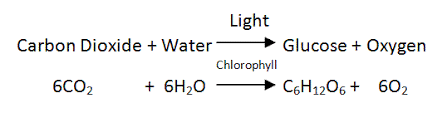
Which of the following is the correct equation for PHOTOSYNTHESIS?
a)
CO+ light + H2O --> O+ Sugar
b)
CO+ sugar + H2O --> O+ light
c)
O2 + light + H2O --> CO+ Sugar
d)
CO+ O2 + H2O --> Light+ Sugar
11.
What is the ultimate ORIGINAL source of energy for living things
a)
Sugar
b)
Sun
c)
Moon
d)
Carbon Dioxide
12.
What is photosynthesis?
a)
The process in which humans eat their food
b)
When a photographer takes a photo.
c)
To get your pictures from the photo lab.
d)
The process in which plants make their food.
13.

The glucose made in photosynthesis can be used for respiration to

a)

to produce oxygen for the plant

b)

make more glucose

c)

provide energy for the plant

14.

The glucose made in photosynthesis can converted into starch for

a)

storage

b)

rapid use

c)

to prevent decay

15.

The glucose made in photosynthesis can stored in nuts and seeds as

a)

starch

b)

fats and oils

c)

concentrated glucose

16.

The glucose made in photosynthesis can be converted into cellulose, which is needed to

a)

fill chloroplasts

b)

strengthen cells walls

c)

make chromosomes in the nucleus

17.

The glucose made in photosynthesis can be converted into amino acids to make

a)

starch

b)

fats

c)

protein

18.

To make proteins plants need glucose from photosynthesis to make amino acids and

a)

nitrate ions from the soil

b)

nitrates ion from the atmosphere

c)

carbon dioxide from the air

19.

What do plants take in through their roots?

a)

light and heat

b)

water and minerals

c)

carbon dioxide

d)

oxygen

20.
Plants lose most of the water absorbed by roots through the leaves in
a)
reproduction
b)
respiration
c)
transpiration
d)
photosynthesis
21.
What does C6H12O6 represent?
a)
carbon dioxide
b)
glucose
c)
water
d)
chlorophu
22.
What is the name of the structure on a leaf that lets gasses flow in and out?
a)
Stomata
b)
Cell membrane
c)
chlorophyll
d)
chloroplast
23.
What happens to the process of photosynthesis at night?  
a)
the process slows down / stops
b)
the process speeds up
c)
the process still continues at regular speed
24.

Why are plants usually green?

a)

Because the chlorophyll reflects green light

b)

Because the chlorophyll absorbs green light

c)

Because the accessory pigments combine to make green

d)

Because the accessory pigments only absorb green light

25.

What 3 factors are limiting factors of photosynthesis?

a)

Carbon dioxide concentration, Oxygen concentration , Water

b)

Carbon dioxide concentration, Temperature, Water

c)

Temperature, Water, Light intensity

d)

Carbon dioxide concentration, Temperature, Light intensity

26.

The glucose made in photosynthesis is ...

a)

converted into insoluble substances like oils, fats and starch for storage.

b)

used in respiration to release energy

c)

converted into other substances in plants. For example:

Cellulose for cell walls Proteins for growth and repair.

d)

All of the above

27.

Some glucose is used by plants to produce Proteins examples of proteins are

a)

Starch and Fatty Acids

b)

Chlorophyll and Starch

c)

Starch and Enzymes

d)

Enzymes

28.

How do plants use nitrate ions that are absorbed from the soil.

a)

To make fats

b)

To make sugars

c)

To make proteins

d)

To make starch

29.

Plants also need nitrates to make proteins. They obtain these from

a)

The air as nitrate ions

b)

The soil as nitrate ions

c)

The air as nitrogen

d)

The soil as nitrogen

30.
What type of respiration requires oxygen?
a)
Aerobic
b)
Anaerobic
31.
What are the products of anaerobic respiration?
a)
Glucose and oxygen
b)
Carbon dioxide and water
c)
Lactic acid
d)
Carbon monoxide
32.
Which equation shows the reaction for anaerobic respiration
a)
carbon dioxide + water --> glucose and oxygen
b)
glucose + Oxygen --> lactic acid and energy
c)
glucose + oxygen --> carbon dioxide and water and energy
d)
glucose --> lactic acid and energy
33.

what body system exchanges O2 for CO2

a)

respiration

b)

excretion

c)

digestion

d)

nervous

34.
What process is the opposite of aerobic respiration?
a)
anaerobic respiration
b)
cellular respiration
c)
photosynthesis
d)
lactic acid fermentation
35.

Which of the following structure is where cellular respiration occurs in the cell?

a)

nucleus

b)

cytoplasm

c)

mitochondria

d)

vacuoles

36.
What is C?
a)
pancreas
b)
gall bladder
c)
liver
d)
rectum
37.
What is D?
a)
pancreas
b)
gall bladder
c)
liver
d)
large intestine
38.
What is E?
a)
pancreas
b)
gall bladder
c)
liver
d)
large intestine
39.
What is F?
a)
pancreas
b)
gall bladder
c)
liver
d)
stomach
40.
What is G?
a)
pancreas
b)
small intestine
c)
liver
d)
large intestine
41.
What is H?
a)
pancreas
b)
small intestine
c)
liver
d)
large intestine
42.
Food is broken down to supply energy for your body in the ____________
a)
digestive system
b)
endocrine system
c)
excretory system
d)
reproductive system
43.
What happens when the food goes to the small intestine?
a)
nutrients gets into the blood
b)
the food keeps on going
c)
nothing
44.
The organ in orange represents the:
a)
Liver
b)
Lung
c)
Stomach
d)
Pancreas
45.
The red organ is
a)
stomach
b)
small intestine
c)
large intestine
d)
liver
46.
The highlighted organ is the
a)
liver
b)
large intestine
c)
small intestine
d)
stomach
47.
Chewing food is an example of _____________.
a)
chemical digestion
b)
mechanical digestion
48.
Saliva contains this enzyme to start the digestive process.
a)
spit
b)
amylase
c)
hydrochloric acid
d)
sodium bicarbonate
49.
The acid in your stomach used for digestion.
a)
sodium bicarbonate
b)
insulin
c)
hydrochloric
d)
amylase
50.
The main purpose of the large intestine.
a)
absorb hormones
b)
absorb protein
c)
absorb nutrients
d)
absorb water
51.
The organ that stores bile.
a)
gall bladder
b)
stomach
c)
liver
d)
appendix
52.
Bile is made by which digestive organ?
a)
Gallbladder
b)
Stomach
c)
Rectum
d)
Liver
53.
What is the name of the molecule in saliva that chemically digests food?
a)
bile
b)
stomach acid
c)
enzymes
d)
chyme
54.

Enzymes

a)

speed up chemical reactions

b)

slow down chemical reactions

c)

do nothing to a chemical reaction

55.

How does an enzymes shape relate to its function?

a)

the shape of the enzyme has no relation to its function

b)

the enzyme is shaped specially for certain substrates to perform a specific reaction

c)

the enzyme shape acts as a receptor to certain products

d)

the enzyme shape can fit into specific substrates to cease a reaction

56.

A is the

a)

substrate

b)

enzyme-substrate complex

c)

products

57.

B is the

a)

substrate

b)

enzyme-substrate complex

c)

products

58.

C is the

a)

substrate

b)

enzyme-substrate complex

c)

products

59.

An enzyme ________ the activation energy needed for a reaction to occur.

a)

decreases

b)

increases

c)

does nothing to

d)

increases then decreases

60.

The specific location where the substrates bind to the enzyme is called the

a)

specific site

b)

appropriate site

c)

active site

d)

ignition site

61.
Protein digestion begins in the
a)
mouth
b)
esophagus
c)
stomach
d)
liver
62.
Digestion is COMPLETED in the
a)
stomach
b)
liver
c)
small intestine
d)
large intestine
63.

Which enzyme below is involved in the following chemical digestion process?

FATS---->FATTY ACIDS/GLYCEROL

a)

Lipase

b)

Protease

c)

Amylase

d)

Pepsin

64.
Major artery at the top of the heart sends oxygenated blood from the left ventricle to the rest of the body.
a)
aorta
b)
pulmonary artery
c)
inferior vena cava
65.

How many chambers does the heart have?

a)

4

b)

10

c)

3

d)

1

66.

How big is the heart?

a)

Size of a golfball

b)

Size of your fist

c)

Size of your eyeball

d)

Size of your head

67.

When does your heart beat?

a)

Only when you are exercising

b)

Only when you are sleeping

c)

All the time

68.

What side of your chest is your heart on?

a)

Left

b)

Right

69.

How many atria are there?

a)

1

b)

7

c)

2

d)

4

70.

How many ventricles are there?

a)

1

b)

2

c)

10

d)

0

71.

What keeps blood flowing in the right direction?

a)

Atria

b)

Chambers

c)

Valves

d)

Veins

72.

Where does your heart get oxygen?

a)

Lungs

b)

Mouth

c)

Toes

d)

Fingernails

73.

The heart is made of which of the following types of muscles?

a)

Cardiac muscle

b)

Striated muscle

c)

Smooth muscle

d)

None of the above

74.

Your heart always pumps at the same rate.

a)

True

b)

False

75.

Electricity cause your muscles to contract.

a)

True

b)

False

76.

The pulmonary artery is the artery that carries the blood to your heart from your lungs.

a)

True

b)

False

77.

How are arteries and veins different?

a)

One is bigger than the other.

b)

The arteries carry more blood than the veins.

c)

The arteries carry blood away from the heart while veins carry blood to the heart.

d)

The veins carry blood away from the heart while arteries carry blood to the heart.

78.
What type of cells carries oxygen?
a)
red blood cells
b)
white blood cells
c)
neurons
79.
What is the organ "x"
a)
Heart
b)
Lungs
c)
Diaphragm
d)
Trachea
80.
What is tube that is also known as your wind pipe?
a)
esophogus
b)
bronchi
c)
trachea
d)
alveoli
81.
Which side of the heart pumps blood into the lungs?
a)
Right
b)
Left
82.
Which side of the heart pumps oxygen-rich blood to the rest of the body?
a)
Right
b)
Left
83.
______ carry blood to the heart.
a)
Arteries
b)
Veins
c)
Capillaries
d)
Vena Cava
84.
This chamber of the heart RECEIVES blood returning from the body
a)
Right Atrium
b)
Right Ventricle
c)
Left Atrium
d)
Left Ventricle
85.
The _________ PUMPS blood to the lungs.
a)
Right Atrium
b)
Right Ventricle
c)
Left Atrium
d)
Left Ventricle
86.
The _______ RECEIVES blood returning from the lungs.
a)
Right Atrium
b)
Right Ventricle
c)
Left Atrium
d)
Left Ventricle
87.
This chamber of the heart PUMPS blood to the body.
a)
Right Atrium
b)
Right Ventricle
c)
Left Atrium
d)
Left Ventricle
88.

What are the tiny blood cells that help your body form clots to stop bleeding?

a)

Red blood cells

b)

White blood cells

c)

Platelets

d)

Plasma

89.

Which blood components fight infections by attacking bacteria/viruses

a)

White blood cells

b)

Red blood cells

c)

Platelets

d)

Plasma

90.

The colourless/yellow fluid part of blood is called...

a)

oxygenated blood

b)

plasma

c)

deoxygenated blood

d)

arterial blood

91.

The air sacs in our lungs are called:

a)

bronchioles

b)

bronchus

c)

alveoli

d)

tracheas

92.

If fatty deposits form inside the coronary artery, the artery becomes

a)

wider

b)

narrower

93.

Statins are drugs that

a)

reduce blood cholesterol

b)

dissolve the fat inside arteries

94.
Osmosis is the movement of _____ across a membrane.
a)
food
b)
energy
c)
oxygen
d)
water
95.
Permeable means
a)
things can pass through
b)
the concentration levels are different
c)
it is permanent
d)
things are stuck
96.
The picture is an example of...
a)
active tranport
b)
passive transport
c)
diffusion
d)
osmosis
97.
During diffusion
a)
substances (things) moves from high to low concentration
b)
water moves when energy is used
c)
large or oddly shaped molecules move across a cell membrane
d)
water moves from high to low concentration
98.
 In the given scenario what will happen?  An egg with a dissolved shell is placed in pure water for 48 hours.
a)
Water will move in and out of the cell equally, and the cell with neither shrink nor swell.
b)
The egg will gain water and swell.
c)
The egg will lose water and shrink.
99.
 An animal cell placed in a hypertonic (salty) solution will
a)
Stay the same
b)
Shrink- get smaller
c)
Swell- get bigger
100.
The picture  is an example of _________________.
a)
isotonic
b)
diffusion
c)
osmosis
d)
active transport
101.

What three things are needed for a plant to photosynthesise?

a)

Glucose, Oxygen, Sunlight

b)

CO2, Oxygen, Sunlight

c)

CO2, Water, Sunlight

d)

Oxygen, Water, Sunlight

102.

What 3 factors are limiting factors of photosynthesis?

a)

Carbon dioxide concentration, Oxygen concentration , Water

b)

Carbon dioxide concentration, Temperature, Water

c)

Temperature, Water, Light intensity

d)

Carbon dioxide concentration, Temperature, Light intensity

103.

Farmers can use their knowledge of factors limiting the rate of photosynthesis to increase crop yields. What is the best place to grow crops so factors can be controlled?

a)

In a field

b)

In a lab

c)

In a garden

d)

In a greenhouse

104.

Which of the following will increase a farmers crop yield?

a)

Using artificial light to allow photosynthesis to continue

beyond daylight hours.

b)

Using artificial heating to allow photosynthesis to continue at an increased rate.

c)

Releasing additional carbon dioxide into the atmosphere inside the greenhouse also allows photosynthesis to continue at an increased rate.

d)

All of the above

105.

The glucose made in photosynthesis is ...

a)

converted into insoluble substances like oils, fats and starch for storage.

b)

used in respiration to release energy

c)

converted into other substances in plants. For example:

Cellulose for cell walls Proteins for growth and repair.

d)

All of the above

106.

What are the advantages of using insoluble substances such as starch for storage, rather than soluble substances such as glucose

a)

They do not affect the water concentration inside cells

b)

They do not move away from the storage areas in the plant

c)

Both are correct

d)

Neither are correct

107.

Some glucose is used by plants to produce Cellulose, this is used to

a)

build cell membranes

b)

strengthen cell walls

c)

make the nucleus

d)

make ribosomes

108.

Some glucose is used by plants to produce Proteins examples of proteins are

a)

Starch and Fatty Acids

b)

Chlorophyll and Starch

c)

Starch and Enzymes

d)

Enzymes and Chlorophyll

109.

As well as Glucose what is the second product of photosynthesis?

a)

Nitrates

b)

Toffee

c)

Oxygen

d)

Nitrogen

110.

How do plants use nitrate ions that are absorbed from the soil.

a)

To make fats

b)

To make sugars

c)

To make proteins

d)

To make starch

111.

The glucose made in photosynthesis can be used for respiration to

a)

to produce oxygen for the plant

b)

make more glucose

c)

provide energy for the plant

112.

The glucose made in photosynthesis can converted into starch for

a)

storage

b)

rapid use

c)

to prevent decay

113.
The water needed for photosynthesis comes into the leaves through the
a)
upper epidermis
b)
stomata
c)
guard cells
d)
xylem cells
114.
The important gases, carbon dioxide and oxygen, enter and leave the leaf through the
a)
upper epidermis
b)
phloem
c)
stomata
d)
guard cells
115.
Which structures open and close stomata to allow gas exchange but prevent water loss in leaves?
a)
Epidermis
b)
Vascular tissue
c)
Guard cells
d)
Spongy mesophyll
116.
Which structure helps prevent water loss and protects the leaf?
a)
Palisades mesophyll
b)
Spongy mesophyll
c)
Vascular tissue
d)
Cuticle
117.

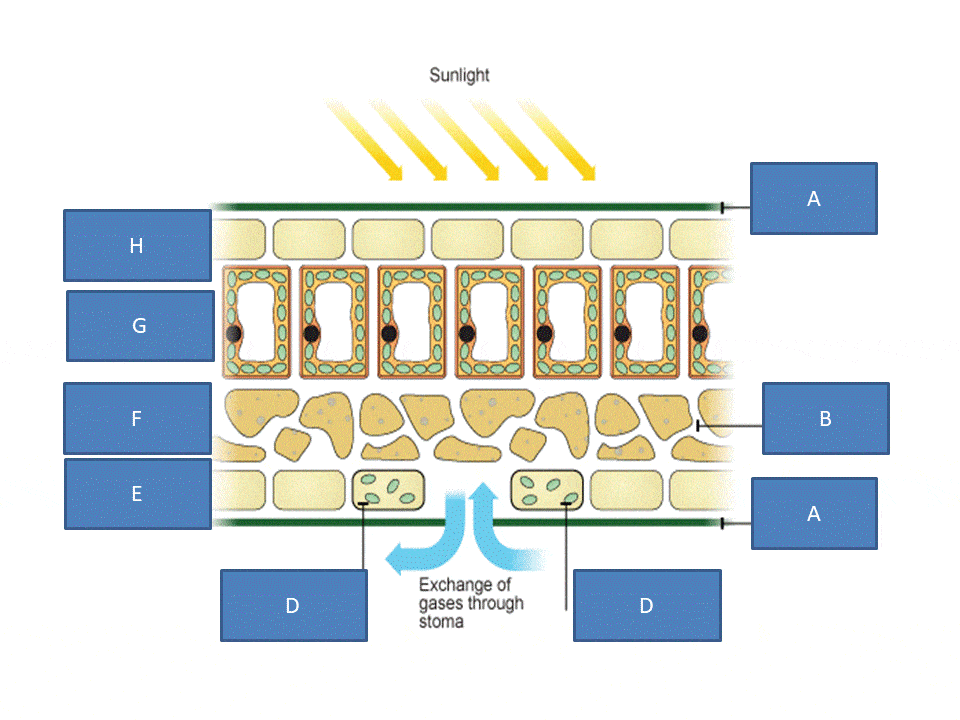
What is the name of the elongated, packed cells (part G) directly under the upper epidermis?

a)

Palisade cells

b)

Guard cell

c)

Spongy layer

d)

Lower epidermis

118.

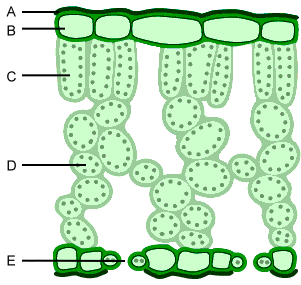
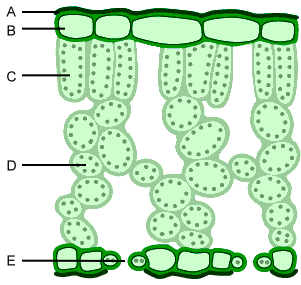
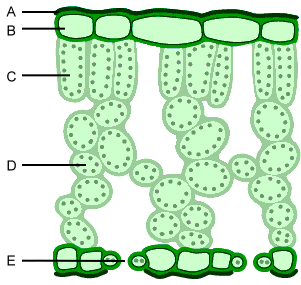
What is letter "A" pointing to?

a)

cuticle

b)

upper epidermis

c)

lower epidermis

d)

palisade mesophyll

119.

What is letter "D" pointing to?

a)

upper epidermis

b)

palisade mesophyll

c)

spongy mesophyll

d)

bundle sheath

120.

Which of the following is pointing to the "guard cell"?

a)

B

b)

C

c)

D

d)

E

121.

Which part of the leaf consists of xylem and phloem?

a)

vascular bundle

b)

bundle sheath

c)

palisade mesophyll

d)

spongy mesophyll

122.

Most photosynthesis occurs in this part of the leaf:

a)

upper epidermis

b)

cuticle

c)

palisade mesophyll

d)

spongy mesophyll

123.

The outermost layer of CELLS of the leaf is the

a)

cuticle

b)

epidermis

c)

spongy mesophyll

d)

bundle sheath

124.

This layer of cells is where photosynthesis occurs within the leaf; there are air spaces within this layer

a)

spongy mesophyll

b)

palisade mesophyll

c)

chloroplast

d)

upper epidermis

125.

The cell organelle where photosynthesis occurs in plant cells is the

a)

chloroplast

b)

mitochondrion

c)

vacuole

d)

nucleus

126.

The vascular tissue which transports sugar (food) in both directions within the leaf is the

a)

xylem

b)

phloem

c)

bundle sheath

d)

chloroplast

127.

Which two layers of the plant contain chloroplasts?

a)

xylem and phloem

b)

upper and lower epidermis

c)

cuticle and upper epidermis

d)

palisade and spongy mesophyll

128.

The majority of the stomata of a leaf can usually be found within the

a)

guard cells

b)

upper epidermis

c)

lower epidermis

d)

cuticle

129.
The leaf has a shiny, waxy cuticle around it to
a)
increase the rate of photosynthesis
b)
attract more light
c)
control water loss
d)
stop carbon dioxide and oxygen gases escaping
130.
The reactants needed for photosynthesis to occur are:
a)
carbon dioxide & water
b)
carbon dioxide & oxygen
c)
oxygen & water
d)
carbon dioxide, oxygen & water
131.
The role of the guard cell is to
a)
help control the temperature of the plant
b)
control how much water enters the leaf
c)
control how much glucose is stored
d)
control the movement of water vapour & gases 
132.
Plants need to take in oxygen gas for respiration
a)
only at night 
b)
only during the day
c)
both during the day & the night
133.
Transpiration helps the plant
a)
make more sugars at night
b)
move water from the roots to the stem and leaves
c)
move sugars from the leaf to be stored in the stem & roots
d)
make more chloroplasts
134.
Water & soluble nutrients move through the plant in 
a)
the phloem cells
b)
the xylem cells
c)
the root hair cells
d)
palisade mesophyll layer
135.
Sugar and the products of photosynthesis move through the plant in 
a)
the phloem cells
b)
the xylem cells
c)
the root hair cells
d)
palisade mesophyll layer
136.
When it is chilly and raining outside, there is no photosynthesis taking place. What is the limiting factor?
a)
Temperature
b)
Rainfall
c)
Carbon Dioxide
137.
What is a limiting factor?
a)
The factor which increases the rate of a reaction
b)
The factor that limits the reaction rate
c)
The factor that limits the rate at which an enzyme is destroyed
138.
Which of these will not affect photosynthesis?
a)
Light
b)
Temperature
c)
Glucose Availability
d)
Carbon Dioxide
139.
If a plant receives more carbon dioxide, what happens to the rate of photosynthesis?
a)
Increases
b)
Decreases
c)
Stays the same
140.
Which of the following would have affect the rate of photosynthesis?
a)
amount of water
b)
carbon dioxide concentration
c)
temperature
d)
all of these
141.

Which lettered graph represents the affect of light intensity on photosynthetic rate?

a)

A

b)

B

c)

C

d)

D

142.

Look at the diagram. Which gas would most likely be found in the greatest amount in the bubbles?
a)
oxygen
b)
nitrogen
c)
ozone
d)
carbon dioxide
143.

Which lettered graph represents the effect of temperature on photosynthetic rate?

a)

A

b)

B

c)

C

d)

D

144.
In what way does plant nutrition differ from human nutrition? 
a)
Plants make their own nutrients; humans must consume theirs.
b)
Plant nutrition consists mainly of protein; human nutrition consists mainly of carbohydrates.
c)
Plants absorb their nutrients from the soil; humans get theirs from food.
d)
Plants cannot make their own food.
145.
The leaves of plants contain a green pigment which absorbs light for photosynthesis. What is this pigment?
a)
Xylem
b)
Leaf
c)
Chlorophyll
d)
Stomata
146.
On this photosynthesis practical, bubbles of gas are produced.  What is this gas?
a)
Carbon dioxide
b)
Hydrogen
c)
Chlorine
d)
Oxygen
147.
What will happen to the photosynthesis rate if you increase the intensity of light?
a)
Photosynthesis rate will increase.
b)
Photosynthesis rate will decrease.
c)
Photosynthesis rate will remain the same.
d)
Photosynthesis will stop.
148.
How does temperature affects photosynthesis rate?
a)
As temperature increases, photosynthesis rate also increases.
b)
As temperature decreases, photosynthesis rate also decreases.
c)
Plants cannot photosynthesis if the temperature is too cold or too hot. 
d)
All of the statements are true.
149.
How is the leaf adapted to do photosynthesis?
a)
The leaf's upper layer is thin and transparent to allow light to pass through.
b)
The leaf's palisade layer has the most chloroplast to absorb the maximum amount of light possible.
c)
The leaf's lower layer has many stomata to allow gases to diffuse.
d)
All of the descriptions above are true.
150.

Where does MOST of the digestion process occur?

a)

Small intestine

b)

Mouth

c)

Stomach

d)

Large Intestine

e)

Colon