wayground logo

Free Printable Worksheets

Font size

S
M
L
XL
Worksheets

Year 9 Chemistry

Total questions: 58

Worksheet time: 34mins

Name
Class
Date
1.
Which is the best definition for an ion?
a)
An atom has a net charge greater or less than zero.
b)
An ion has the same number of electrons as an atom of the same element.
c)
An ion has a net charge greater or less than zero.
d)
There is no difference
2.
If an element has 5 protons and 5 electrons, what is its net charge?
a)
+5
b)
-5
c)
0
d)
-1
3.
The group of an element tells us...
a)
The number of protons
b)
The number of electron shells
c)
The number of valence electrons
d)
The number of total electrons
4.

Sulfuric acid (aq) + Potassium hydroxide (aq) → Potassium sulfate (aq) + Water

a)

Precipitation

b)

Neutralisation

c)

Decomposition

d)

Acid-metal

5.
Acids have pH values of
a)
7
b)
less than 7
c)
more than 7
d)
14
6.
The positive particles of an atom are 
a)
electrons 
b)
positrons 
c)
neutrons 
d)
protons 
7.
the central region of an atom where its neutrons and protons are is its 
a)
nucleus 
b)
electron cloud
c)
core 
d)
center 
8.
an atom with atomic number 6 would have how many protons 
a)
6
b)
12
c)
3
d)
cannot be determined 
9.
When an atom loses a valence electron, it becomes a(n) _____________ ion.
a)
positive
b)
negative
c)
neutral
d)
polyatomic
10.
When an atom gains a valence electron, it becomes a(n) _____________ ion.
a)
positive
b)
negative
c)
neutral
d)
polyatomic
11.
An electron has what kind of charge?
a)
no charge
b)
positive 
c)
negative
d)
it depends
12.
Atoms that gain & lose electrons are called _________
a)
ions
b)
isotopes
c)
radioactive
d)
corrosive
13.
What is the charge of an atom that has lost one electron?
a)
-1
b)
-2
c)
+1
d)
+2
14.
What is the charge of an atom that has gained one electron?
a)
-1
b)
-2
c)
+1
d)
+2
15.
What is the atomic number for an element with three protons?
a)
2
b)
1
c)
3
d)
6
16.
How many neutron are in the atom "K"?
a)
7
b)
2
c)
39
d)
20
17.
What is the number of protons that the element in this image contain?
a)
14
b)
7
c)
15
d)
18
18.
How many neutrons does the isotope of lithium have?
a)
8
b)
3
c)
4
d)
5
19.
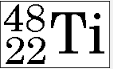
How many protons does this isotope of titanium have?
a)
48
b)
22
c)
26
d)
70
20.
How many neutrons in C-14?
a)
6
b)
7
c)
14
d)
8
21.
How many neutrons does the isotope below have?     89 36Kr
a)
53
b)
36
c)
89
d)
125
22.
How many neutrons does an atom of the isotope Neon-22 have?
a)
12
b)
10
c)
22
d)
20
23.

Isotopes of an element have a different number of...

a)

Protons

b)

Neutrons

c)

Electrons

d)

Mass

24.

Potassium-39 has how many neutrons?

a)

19

b)

18

c)

20

d)

21

25.

Nickel-59 has how many neutrons?

a)

30

b)

31

c)

32

d)

33

26.

Bromine-80 has how many neutrons?

a)

41

b)

42

c)

44

d)

45

27.

12 protons and 13 neutrons

a)

Mg-12

b)

Mg-13

c)

Mg-25

d)

Mg-24.305

28.
The Modern Periodic Table of Elements is arranged by
a)
atomic mass
b)
atomic number
c)
valence electrons
d)
number of isotopes
29.
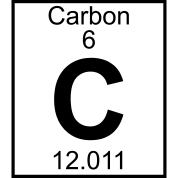
What does the 6 represent?
a)
atomic mass
b)
atomic number
c)
element name
d)
chemical symbol 
30.
What does 12.011 represent?
a)
atomic mass
b)
atomic number
c)
element name
d)
chemical symbol 
31.
These are found on the Periodic Table.
a)
Compounds
b)
Elements
c)
Mixtures
32.

the basic structural unit of matter

a)

atom

b)

matter

c)

element

d)

nucleus

33.

the positively charged subatomic particle contained in the nucleus of an atom

a)

proton

b)

neutron

c)

electron

d)

matter

34.

a subatomic particle, contained in the nucleus of an atom, having the same mass as a proton but no electrical charge

a)

proton

b)

neutron

c)

electron

d)

matter

35.

a negatively charged subatomic particle that orbits the nucleus of an atom

a)

proton

b)

neutron

c)

electron

d)

matter

36.

one or two letters that represent the name of an element

a)

element name

b)

element symbol

c)

atomic number

d)

atomic mass

37.

a grouping of elements based on similar properties, arranged by columns in the periodic table:

a)

group

b)

period

c)

row

d)

isotope

38.

a row on the Periodic Table of Elements

a)

family

b)

period

c)

row

d)

isotope

39.
Most of the mass of an atom is found it its _____.
a)
electron cloud
b)
nucleus
c)
atomic number
d)
empty space
40.

Alpha decay occurs when the nucleus __________ and releases ________.

a)

is very large and unstable.

2 protons and 2 neutrons

b)

has too many protons.

2 protons

c)

has too many neutrons.

2 neutrons

d)

has too much energy.

Helium

41.
Which is an electron?
a)
A
b)
B
c)
C
42.

Gamma decay releases ______ after _____or ____ decay.

a)

a small electron sized particle.

Alpha or beta decay.

b)

a high energy wave.

Alpha or beta decay.

c)

a low energy wave.

Alpha or beta decay.

d)

a high energy particle.

Alpha or beta decay.

43.
What is the number of protons that the element in this image contain?
a)
14
b)
7
c)
15
d)
18
44.

The periodic table is mostly comprised of what type of element?

a)

Metals

b)

Nonmetals

c)

Metalloids

45.

Which elements are to the LEFT of the zigzag?

a)

metals

b)

nonmetals

c)

metalloids

46.

Which elements are colored red?

a)

nonmetals

b)

metals

c)

metalloids

47.
Acid + Metal --> ?
a)
Salt + Water
b)
Salt + Hydrogen
c)
Salt
d)
Hydrogen
48.

Beta decay occurs when ...

a)

electrons convert to neutrons

b)

protons convert to electrons

c)

protons convert to neutrons

d)

the nucleus explodes

49.
Magnesium + sulphuric acid --> ?
a)
magnesium sulfate + water
b)
magnesium sulfate + hydrogen
c)
magnesium chloride + hydrogen
d)
magnesium chloride + water
50.
Zinc + nitric acid --> ?
a)
zinc sulfate + water
b)
zinc sulfate + hydrogen
c)
zinc nitrate + hydrogen
d)
zinc chloride + water
51.
What gas is produced when a metal reacts with an acid?
a)
Water vapour
b)
Acidic gas
c)
Hydrogen
d)
Nitrogen
52.
Which salt will be produced if magnesium react with hydrochloric acid?
a)
Magnesium oxide
b)
Magnesium sulfate
c)
Magnesium sulfide
d)
Magnesium chloride
53.
Metals that react quickly/strongly with water and acids are called?
a)
Reactive
b)
Unreactive
c)
Dangerous
d)
Corrosive
54.
How can you tell that a metal is reacting with water?
a)
Colour change
b)
Bright light
c)
Fizzing
d)
It gets colder
55.
How can you test to show that when a metal reacts with water, hydrogen gas is produced?
a)

Relights a glowing match

b)

A lit match produces a squeaky pop

c)

Puts out a burning match

d)

Is cold to the touch

56.

What is the pH level of acid rain?

a)

less than 5.6

b)

more than 8.2

c)

7

d)

less than 1

57.

What type of reaction occurs when limestone statues breakdown due to acid rain?

a)

Combustion reaction

b)

Oxidation reaction

c)

Neutralisation reaction

d)

Precipitation reaction

58.

Radioactive decay does NOT occur in a(n)

a)

unstable nucleus with too many protons or neutrons

b)

very large unstable nucleus

c)

radioactive isotopes

d)

stable nucleus