
 Worksheets
END OF MODULE 12 TEST
Total questions: 55
Worksheet time: 1hrs 28mins
What is the new volume of the gas if the pressure on 350.0 L of oxygen at 720.0 mm Hg is decreased to 600.0 mm Hg? Report your answer to ONE DECIMAL.
My answer is _ L. (one decimal)
(a)
A gas at a volume of 8.25 liters is at a pressure of 2.00 atm. The volume increases to 16.75 Liters, what must the new pressure be _ atm? Assume temp stays constant. (TWO DECIMALS)
(a)
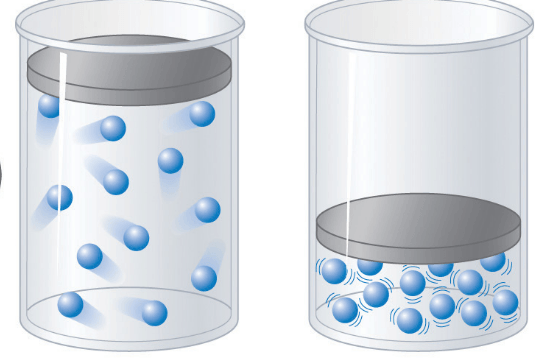
For the problem below, what is the value for the final pressure?
A gas with a volume of 4.0 L at 90.0 kPa expands until the pressure drops to 20.0 kPa. What is its new volume if the temperature doesn’t change?
(a)
Suppose a balloon (volume 250.0 L) is inflated on a jet airplane at an altitude of 45,000 feet. The cabin of the airplane is pressurized to 0.75 atm. When the person with the balloon exits the air craft what will likely happen to the volume of the balloon? (Assume temp is same in and out of the plane).
Stay the same since temp stays constant
Enlarge
Get smaller
Unable to be predicted, too many variables.
The pressure on a sample of gas is increased from 1.0 atm to 3.0 atm. If the new volume is 0.52 L, find the original volume.
(a)
If a gas occupies a volume of 7.0 L at 273 K, what will be its volume at 473 K, assuming constant pressure?
(a)
If the volume of a gas is 4.0 L at 400 K, what will be its volume at 600 K, assuming constant pressure?
(a)
A balloon has a volume of 500 mL at a temperature of 300 K. If the temperature decreases to 150 K, what will be the new volume, assuming constant pressure?
(a)
A gas has a volume of 2.5 L at 10°C. If the temperature is increased to 100°C, what will be its new volume, assuming constant pressure?
(a)
If a gas occupies a volume of 8.0 L at 300 K, what will be its volume at 400 K, assuming constant pressure?
4.3 L
10.7 L
12.6 L
16.0 L
A gas is initially at a volume of 3.0 L at 25°C. If the volume is reduced to 2.3 L, what will be the new temperature of the gas, assuming constant pressure?
16.7°C
25.8°C
19.2°C
75°C
250.6 mL
333.3 mL
524.5 mL
750 mL
Under what conditions is a real gals like and ideal gas?
High temperature, high pressure
Low temperature, high pressure
High temperature, low pressure
Low temperature, high pressure
If I initially have 4.0 L of a gas at a pressure of 1.1 atm, what will the volume be if I increase the pressure to 3.4 atm?
1.29 L
12.36 L
1.29 atm
12.36 atm
If I have 5.6 liters of gas in a piston at a pressure of 1.5 atm and compress the gas until its volume is 4.8 L, what will the new pressure inside the piston be?
(a)
What happens to pressure when temperature decreases
increase in pressure
decrease in pressure
no change

what relationship does this graph show?
temperature and pressure- direct
temperature and pressure- inverse
pressure and volume- direct
pressure and volume- inverse

Which rigid cylinder contains the same number of gas molecules as a 2.0 Liter rigid cylinder containing hydrogen gas?
1.0 L of Oxygen gas
2.0 L of methane gas
1.5 L of ammonia gas
4.0 L of Helium gas
Review: Convert 35.0 L of oxygen gas to grams.
Review: Convert 30 g of NO2 gas to mol.
1.9 mol
2.4 mol
0.76 mol
0.65 mol
Review: Convert 2.0×10²³ molecules of oxygen gas to grams.
2.5 g
10.6 g
2.02 g
If you have 100 L of Argon at a particular temp and pressure, how many atoms of argon are there?
2.78×10¹⁴ atoms
4.8×10²³ atoms
2.69×1024 atoms
266 atoms
If 1.25 mol of N2 occupies 27.0 L at a particular temp and pressure, what volume does 0.89 mol of N2 occupy under the same conditions?
20.0 L
22.5 L
10.0 L
52.2 L
Determine the Celsius temperature of 2.49 moles of gas contained in a 1.00-L vessel at a pressure of 143 kPa. (Use R = 8.314)


If the pressure exerted by a gas at 25 degrees C in a volume of 0.044 L is 3.81 atm, how many moles of gas are present? (Use R = 0.0821)
Calculate the volume that a 0.323-mol sample of a gas will occupy at 265 K and a pressure of 0.900 atm. (Use R = 0.0821)
Determine the Kelvin temperature required for 0.0470 mol of gas to fill a balloon to 1.20 L under .998 atm pressure. (Use R = 0.0821)
A hypothetical gas that perfectly fits all the assumptions of the kinetic molecular theory is known as
real gas
ideal gas
imaginary gas
perfect gas
Which condition is necessary for most gases to behave nearly ideally?
high pressure
high temperature
low compressibility
low expansion
Which of the following is not a physical property of gases?
absence of definite volume
large density
high compressibility
fluidity
Which states of matter are fluid?
gases and liquids
liquids and solids
gases only
liquids only
Under which conditions of temperature and pressure does carbon dioxide behave most like an ideal gas?
A) Low temperature and low pressure
B) Low temperature and high pressure
C) High temperature and low pressure
D) High temperature and high pressure
Under which conditions of temperature and pressure does a sample of neon behave most like an ideal gas?
A) 100K and 0.25 atm
B) 100K and 25 atm
C) 400K and 0.25 atm
D) 400K and 25 atm
One reason that a real gas deviates from an ideal gas is that the molecules of a real gas have
A) a straight-line motion
B) no net loss of energy on collision
C) a negligible volume
D) forces of attraction for each other
Which statement describes the particles of an ideal gas based on the kinetic molecular theory?
A) The gas particles are relatively far apart and have negligible volume.
B) The gas particles are in constant, nonlinear motion.
C) The gas particles have attractive forces between them.
D) The gas particles have collisions without transferring energy.
According to the kinetic molecular theory, the molecules of an ideal gas
A) have a strong attraction for each other
B) have significant volume
C) move in random, constant, straight-line motion
D) are closely packed in a regular repeating pattern
A real gas behaves least like an ideal gas under the conditions of
A) low temperature and low pressure
B) low temperature and high pressure
C) high temperature and low pressure
D) high temperature and high pressure
A sample of chlorine gas is at 300K and 1.00 atmosphere. At which temperature and pressure would the sample behave more like an ideal gas?
A) 0 K and 1.0 atm
B) 150 K and 0.50 atm
C) 273 K and 1.00 atm
D) 600 K and 0.50 atm

