wayground logo

Free Printable Worksheets

Font size

S
M
L
XL
Worksheets

Test Review - Graphing, Phase Changes, Dissolving, KMT

Total questions: 56

Worksheet time: 2hrs 51mins

Name
Class
Date
1.
At higher temperatures
a)
particles in an object have less energy
b)
particles in an object move faster
c)
a gas contracts
2.
What is the phase change of a solid to a liquid?
a)
freezing
b)
melting
c)
boiling
d)
condensation
3.
2. A change of state from a liquid to a solid is called....
a)
Melting
b)
Freezing
c)
Evaporation
4.
Change from gas to liquid...
a)
condensation
b)
evaporation
c)
expansion
d)
movement
5.

change from liquid to gas is called....

a)

expansion

b)

boiling

c)

condensation

d)

sublimation

6.

The particles in a solid are...

a)

Far Apart

b)

Packed Together

c)

Spread Out

d)

Not Moving

7.

What state of matter is pictured?

a)

Solid

b)

Liquid

c)

Gas

d)

Plasma

8.

According the KMT, the particles are in

a)

different states

b)

organized patterns

c)

constant motion

d)

various containers

9.
7. All phase changes (changing states) requires energy to be added or taken away.
a)
True
b)
False
10.
When the temperature of matter increases the particles...
a)
speed up and move closer
b)
speed up and move farther apart
c)
slow down and move closer together
d)
slow down and move farther apart
11.
When the temperature of matter decreases the particles ...
a)
speed up and move farther apart
b)
speed up and move closer together
c)
slow down and move farther apart
d)
slow down and move closer together
12.

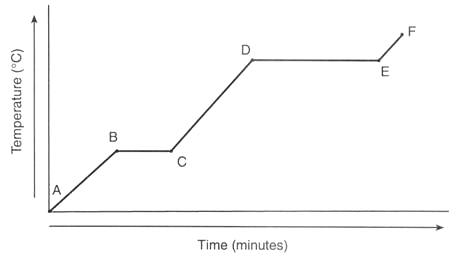
Is the substance gaining or losing energy in this phase change diagram?

a)

Gaining

b)

Losing

13.

Are the particles moving faster or slower as time goes on?

a)

Faster

b)

Slower

14.

What state/phase is the object likely from points A to B?

a)

Solid

b)

Liquid

c)

Gas

d)

Plasma

15.

What is happening to the particles in the substance between points B and C?

a)

Melting

b)

Freezing

c)

Speeding Up

d)

Slowing Down

16.

What is happening to the particles in the substance between points D and E?

a)

Melting

b)

Freezing

c)

Vaporizing

d)

Sublimating

17.

Is the substance gaining or losing energy in this phase change diagram?

a)

Gaining

b)

Losing

18.

Where on the graph are phase changes taking place?

a)

1

b)

2

c)

3

d)

4

e)

5

19.
True or false: melting and freezing occur at the same temperature!
a)
True
b)
False
c)
I don't know
20.

A substance's heating curve is shown in the graph. What is its boiling point? (Diagram B)

a)

100 C

b)

60 C

c)

80 C

d)

20 C

21.
Which axis runs horizontally?
a)
x
b)
y
22.
Which axis runs vertically?
a)
x
b)
Y
23.
What type of graph is this?
a)
Bar Graph
b)
Line Plot
c)
Pictograph
d)
Tally Chart
24.

The following graph is called a _______________

a)

Pie Graph

b)

Stem and Leaf Plot

c)

Disk Looking Thingymabob

d)

Cake Graph

25.
How many students have blue for a favorite color?
a)
11
b)
12
c)
14
d)
17
26.
This type of graph is used to _______
a)
Compare different "groups"
b)
Compare something over time
27.
The Independent/Manipulated Variable goes on the ___ axis
a)
x
b)
y
28.
The Dependent/Responding Variable goes on the ___ axis
a)
x
b)
y
29.
Which type of graph would you create for this data table?
a)
Bar
b)
Line
30.

Which type of graph would you create for this data table?

a)

Bar

b)

Line

c)

Pie

31.
What pressure will produce a volume of 30 mL? 
a)
9.5 atm
b)
19.5 atm
c)
 30 atm
d)
 40 atm
32.
This type of graph is used to _______
a)
Compare different "groups"
b)
Compare something over time
33.

What is the independent variable on this graph?

a)

Year

b)

Number of Visitors

c)

Visitors to a Park

d)

none of these

34.

What is the dependent variable on this graph?

a)

Year

b)

Number of Visitors

c)

none of these

35.

How many people visited the park in 1997?

a)

20

b)

40

c)

60

d)

50

e)

35

36.

What type of graph is this?

a)

Line

b)

Bar

c)

Circle

d)

none of these

37.

What is the independent variable?

a)

Months

b)

Temperature

c)

Highs

d)

Lows

38.

Stirring the solution increases the rate of dissolution (rate of dissolving).

a)

True

b)

False

39.

The smaller the particle size the faster the rate of dissolution (rate of dissolving).

a)

True

b)

False

40.
Which of the following statements is true about how using smaller salt crystals would affect the rate of making a salt solution in water?
a)
Smaller crystals increase the surface area and slow down dissolving.
b)
Smaller crystals decrease the surface area and speed up dissolving.
c)
Smaller crystals increase the surface area and speed up dissolving.
d)
Smaller crystals decrease the surface area and slow down dissolving.
41.

Which will dissolve faster? Crushed table salt or a cube of table salt. Assume they have an equal mass.

a)

crushed table salt

b)

crystal of table salt

42.

What combination would dissolve a solid solute the fastest?

a)

high temperature, no stirring

b)

no heat, no stirring

c)

sugar cube, no heat

d)

high temperature, stirring

43.

Which of the following actions will NOT

increase the rate of dissolution

(dissolving) for solids?

a)

Stirring the solution

b)

Decreasing the temperature

c)

Increasing the surface area of the

solute

d)

Increasing the temperature

44.

smaller substance that becomes dissolved; ex: sugar, salt, powder

a)

Colloid

b)

Solution

c)

Solute

d)

Solvent

45.

bigger substance that does the dissolving; ex: water

a)

Solvent

b)

Solute

c)

Solution

d)

Concentration

46.

What is the freezing/melting point of water of the Celsius scale?

a)

 273oC-273^oC 

b)

 0oC0^oC 

c)

 32oC32^oC 

d)

 273oC273^oC 

47.

What is the boiling point of water on the Kelvin scale?

a)

 0K0^{ }K 

b)

 373K373^{ }K 

c)

 100K100^{ }K 

d)

 212K212^{ }K 

48.

What is the boiling point of water on the Celsius scale?

a)

 0oC0^oC 

b)

 373oC373^oC 

c)

 100oC100^oC 

d)

 212oC212^oC 

49.

Convert

 0 K0\ K  to Celsius

a)

 273oC273^oC  

b)

 273oC-273^oC  

c)

 32oC32^oC  

d)

 32oC-32^oC  

50.

Convert

 0oC0^oC  to Kelvin

a)

 273 K-273\ K  

b)

 273 K273\ K  

c)

 32 K32\ K  

d)

 32 K-32\ K  

51.

Convert

 300 K300\ K  to Celsius

a)

 573oC573^oC  

b)

 37oC37^oC  

c)

 27oC27^oC  

d)

 600oC600^oC  

52.

Convert

 450 K450\ K  to Celsius

a)

 723oC723^oC  

b)

 277oC277^oC  

c)

 177 oC177\ ^oC  

d)

 623oC623^oC  

53.

Convert

 100oC100^oC  to Kelvin

a)

 373 K373\ K  

b)

 273 K273\ K  

c)

 212 K212\ K  

d)

 0 K0\ K  

54.
What is the temperature on the thermometer?
a)
-26°C
b)
-36°C
c)
-32°C
d)
-39°C
55.
The temperature on the thermometer is about?
a)
68°F
b)
23°F
c)
68°C
d)
23°C
56.
What temperature does the thermometer show?
a)
31° C
b)
35° C
c)
32° C
d)
39° C