
 Worksheets
Nervous System
Total questions: 50
Worksheet time: 50mins

Functions include initiating voluntary movement, working memory, personality, and higher cognitive functions such as decision-making and judgment.
Frontal lobe
Parietal lobe
Occipital lobe
Temporal lobe
Responsible for integrating sensory information, including touch, temperature, pressure and pain.
Frontal lobe
Parietal lobe
Occipital lobe
Temporal lobe
Shelton fell off of a ladder while cleaning the windows. He can not stand up without assistance and is unable to catch a ball. Which is the most likely affected part of the brain?
Cerebellum
Cerebrum
Cerebral Cortex
Corpus Callosum
What does the axon carry?
Impulses away from the cell body
Impulses to the cell body
chemicals
messages
What do the motor neurons do?
carry messages from the brain and spinal cord to muscles and glands
carry impulses from skin and sends to organs the to spinal cord and brain
carry impulses from sensory neurons to motor neurons
store messages
This releases neurotransmitters which are sent into the synaptic cleft for receptors on the dendrite to receive.
axon
axon terminal
gene
neuron
The tiny gap between neurons where nerve impulses are sent from one neuron to another. It is where communication occurs between an axon and dendrite.
synapse
axon terminal
impulse
myelin
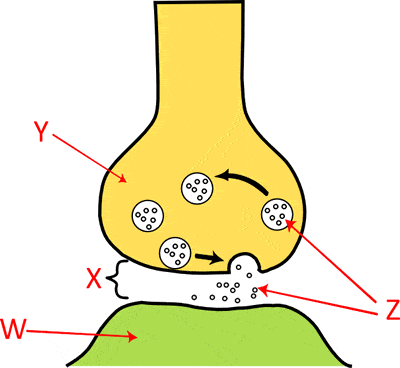
Z
Axon Terminal Button
Neurotransmitters
Dendrite
Synapse
X
Axon Terminal Button
Neurotransmitters
Dendrite
Synapse


Nerve impulses within the neuron are sent in _____ form.
Electrical
Chemical
Electro-chemical
Petrochemical
How many lobes of the brain are there?
2
3
4
5

Damage to the _____ lobe may affect our ability to hear sounds.
Parietal
Frontal
Occiptial
Temporal
Type of synapse which increases the chance of the next neuron firing.
Inhibitory
Excitatory
Neurotransmitters
Neuron
Type of synapse which decreases the chance of the next neuron firing.
Inhibitory
Excitatory
Neurotransmitters
Neuron
A brief electrical charge that travels down the axon of a neuron is called the-
synapse
threshold
action potential
myelin sheath
The longest part of a neuron is most likely to be the -
dendrite
axon
cell body
synapse
The "fight or flight" response during threatening situations is the role of the:
sympathetic nervous system
somatic nervous system
cerebellum
parasympathetic
somatic
peripheral
What are the two divisions of the autonomic nervous system?
central and peripheral
parasympathetic and sympathetic
brain and spinal cord
nerves and ganglia
The sympathetic division is responsible for...
stress
relaxation
resting
What is Reaction Time?
the amount of time it takes to respond to stimulus.
How fast your can run.
How much you can lift.
the ability to do something or act in a particular way.
How can you improve your reaction time?
There is nothing you can do
Lay down on the couch and watch tv all day
Play sports
Sleep less
A pro gamer has a reaction time of 0.15 s. While taking a computer reaction time test, a friend talks loudly to the gamer acting as a distraction. The gamer's new reaction time will likely be...
slower
faster
the same
Voluntary actions are controlled by the ____________.
cranial nerve
spinal nerve
spinal cord
brain
An example of a reflex action includes
Touching a butterfly
Touching a hot stove and pulling your hand away
Your legs moving as you walk

Breathing and heartbeat are controlled by-
your heart.
your brain stem.
lungs.
Neurons that communicate from the brain to the body to move an organ or body part are called -
Sensory Neurons
Motor Neurons
Interconnected Neurons
None of the above
Neurons that are stimulated by external stimuli and communicate the message from the body to the brain are called-
Motor Neurons
Interneurons
Sensory neurons
These type of sensory neurons measure temperature.
Nocireceptors
Pain receptors
Thermoreceptors
Chemoreceptors
A type of sensory receptor that detects chemicals are....
Chemoreceptors
Mechanoreceptors
Thermoreceptors
Nocireceptors
Receptors that detect where your assorted parts are in space are....
Thermoreceptors
Mechanoreceptors
Chemoreceptors
This part of the brain controls thirst and hunger.
cerebellum
brain stem
hypothalamus
hippocampus
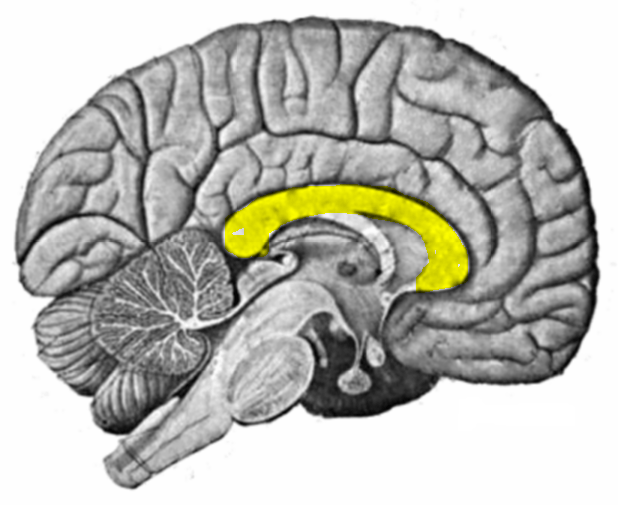
What structure is highlighted in yellow?
Corpus Callosum
Amygdala
Thalamus
Hypothalamus

What structure is highlighted in yellow?
Cerebellum
Brain Stem
Occipital Lobe
Temporal Lobe
What is the peripheral nervous system (PNS) made of?
brain and spinal cord
brain and cranial nerves
nerves that branch out from spinal cord and brain
Nerve impulses within the neuron are sent in _____ form.
Electrical
Chemical
Electro-chemical
Petrochemical

