
 Worksheets
Chemistry- Final Exam Review
Total questions: 105
Worksheet time: 1hrs 15mins
same number of protons, different number of neutrons
atomic number
mass number
isotope
ion
a charged atom
neutral
isotope
ion
nucleus
atomic symbol
capital letter
lowercase letter
2 capital letters
2 lowercase leters
mass number
number of protons
number of electrons
number of protons and electrons
number of protons and neutrons
atomic number
number of protons/stands for an element
number of neutrons
number of electrons
number of protons and neutrons
electrons
no charge, nucleus
positive charge, nucleus
negative charge, shells
negative charge, nucleus
neutrons
no charge, shells
positive charge, nucleus
neutral, no charge, nucleus
negative charge, shells
protons
negative charge, nucleus
positive charge, shells
positive charge , nucleus
neutral charge, nucleus
What is the chemical symbol for carbon?
C
Ca
Cn
Crn

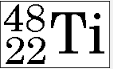
Isotopes of an element have a different number of...
Protons
Neutrons
Electrons
Mass
Potassium-39 has how many neutrons?
19
18
20
21
Nickel-59 has how many neutrons?
30
31
32
33
Bromine-80 has how many neutrons?
41
42
44
45
H2SO4

element
compound
mixture of elements and compounds
mixture of compounds
mixture of elements

element
compound
mixture of elements and compounds
mixture of compounds
mixture of elements

element
compound
mixture of elements and compounds
mixture of compounds
mixture of elements

element
compound
mixture of elements and compounds
mixture of compounds
mixture of elements
How many of each type of atom are in the formula NH3?
1 nitrogen, 3 helium
1 neon, 3 hydrogen
3 nitrogen, 3 hydrogen
1 nitrogen, 3 hydrogen
The number and type of atoms of reactants is equal to the number and type of atoms of products describes which of the following?
Equal mass equation
Unbalanced chemical equation
Law of conservation of energy
Balanced chemical equation
Law of conservation of matter
To maintain at a constant overall total
A strong chemical bond that is formed when atoms share pairs of electrons
The mass of all reactants must equal the mass of all products. Matter is neither created nor destroyed.
The process by which one or more substances change to produce one or more different substances
Covalent bond
The energy that is stored in all compounds and potentially released in chemical reactions
A strong chemical bond that is formed when atoms share pairs of electrons
To maintain at a constant overall total
The process by which one or more substances change to produce one or more different substances
A student mixed baking soda and vinegar to test the law of conservation of mass. The student measured the mass before and after combining the substances. Which statement would they include in their conclusion to show evidence of the law of conservation of mass?
Since a new substance was formed, it does not follow the law of conservation of mass.
The mass of the substance after combining was less because gas was formed and has no mass.
The substance remained a solid, so it follows the law of conservation of mass.
The mass of the substance was equal before and after combining the baking soda and vinegar.
Students want to gather evidence for the claim that the number of atoms present before a chemical reaction is equal to the number of atoms present after the chemical reaction. They decide to react vinegar and baking soda in a sealed plastic bag. Which of the following would provide the evidence the students need?
The mass of the plastic bag, baking soda, and vinegar before the reaction was equal to the mass after the reaction.
Bubbles were produced during the reaction, which meant that a gas was being produced.
The plastic bag did not change in any way, indicating that it was not involved in the reaction.
The mass of baking soda was exactly equal to the mass of the vinegar used to create the chemical reaction.
Which of the following is true regarding the atoms involved in a chemical reaction?
The same number of each type of atom will always be present before and after a chemical reaction takes place.
Some of the atoms present before the reaction will always be lost during a chemical reaction.
Some of the atoms will always be changed into a different type of atom by a chemical reaction.
During a chemical reaction, atoms will always be combined into much larger molecules.
The law of conservation of mass can be demonstrated by a chemical reaction. Which of the following models of a chemical reaction best represents the law of conservation of mass?


During a chemical reaction, atoms ____________ to form new substances.
Change
Switch
Turn into new atoms
Rearrange

How many atoms does this chemical formula have?
4
2
3
1

A subscript is
the number of atoms that each element has in a chemical formula.
at the pharmacy.
the number of molecules.
a compound.
The number of electrons in an atom is equal to ......
the number of protons
the number of neutrons
the atomic mass
Which particle is responsible for chemical reactions?
proton
electron
neutron
no charge

Find the mass of 11.37 mol of BaO. Round to the nearest whole number.
1,354 g
1,740 g
17.40 g
1,684 g

Determine the amount of moles in CuBr that are in 276.9 g of the compound.
3.2 mol
1.7 mol
2.1 mol
1.9 mol

Find the mass of 5.82 mol of MgCl2. Round to the nearest tenth.
552.9 g
436.8 g
55.2 g
555.9 g

Determine the amount of moles of BaCl2 that are in 436 g of the compound.
3.5 mol
2.1 mol
4.6 mol
2.7 mol

Find the mass of 3.8 mol of H2O. Round to the nearest tenth.
57.9 g
54.8 g
68.4 g
62.3 g


What element is represented in this Bohr Model?
Carbon
Hydrogen
Aluminum
Lithium

Electron live in something called __________.
nucleus
orbits
Shells or Energy levels
Valences
How many electrons can go in the first energy level?
2
8
18
32
What is a Lewis Dot Structure?
It shows all of the particles in the atom.
Contains protons and neutrons
Only shows the element symbol and it's outer most electron shell
Contains protons and electrons
What is a drawing of an atom that shows all of the par;cles?
Lewis Dot Model
Dalton Model
Thompson Model
Bohr Model
What is the the outermost shell with electrons?
Shells
Isotope
Orbit
Valence
What is the atom called when there is adding or removing electrons creates atoms with (+) or (-) charges?
isotopes
ions
neutral
stable
What is the chart called where all the elements are organized?
Periodic Table
Valence Chart
Bohr Chart
Lewis Chart
What is the drawing of an atom that only has the symbol and the valence electrons?
Lewis Dot Diagram
Bohr Diagram
Thompson Diagram
Dalton Diagram
Each column of the Periodic Table are known by this number
Period
Group
Family
Transition Metals
What is an isotope?
changing the number of neutrons; same atom with different weights.
adding or removing electrons creates atoms with (+) or (-) charges
par;cle inside nucleus, does not have a charge
resists changing, stays the same

Cations are...
Positive
Negative
Neutral

Anions are...
Positive
Negative
Neutral

A neutral atom of Magnesium (shown in image) will...
Lose 2 electrons when it becomes an ion
Gain 2 electrons when it becomes an ion
Gain 6 electrons when it becomes an ion
Lose 1 electron when it becomes an ion
Think fast! An element has 25 protons and 22 electrons. It has a charge of...
3+
3-
2+
1-


What is the name of this tool?
Triple Beam Balance
Electronic Scale
Food Scale
Spring Scale
Which is the ONE variable that is changed on purpose?
independent
dependent
controlled/constant
no variables are changed on purpose
Identify all of the examples of possible experimental errors. Click ALL that apply.
uncalibrated tools
incorrect use of tool for readings
rounding measurements up or down
lack of precision in reading measurements
The attendance for the basketball game was estimated to be 15,000 people but 12,500 people attended. What was the percent error?
16.67%
20%
2500%
80%
How close a measurement is to the accepted value is called:
Accuracy
Precision
Error
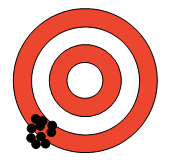
This targeting shows:
What is the basic unit of liquid volume in the metric system?
gram
meter
Liter
cm3
What is the basic unit of length in the metric system?
gram
meter
Liter
cm3
What is the basic unit of mass in the metric system?
gram
meter
Liter
cm3
What tool measures liquid volume?
graduated cylinder
metric ruler
triple-beam balance
thermometer
What tool measures length?
graduated cylinder
metric ruler
triple-beam balance
thermometer

What is the measurement on the graduated cylinder shown?
10.9 mL
20 mL
19 mL
18 mL

What is the measurement on the triple-beam balance shown?
335g
35g
3.5g
305g

What is the measurement on the triple-beam balance shown?
27g
28g
27.7g
2.7g
0.00345
4.56 x 10³
4.5 x 2.34 =

