
 Worksheets
Module H - Unit 1 and 2
Total questions: 184
Worksheet time: 4hrs 37mins
Vesna is studying seasons on Earth. She drew a diagram of Earth to show how it is tilted on its axis. Vesna wants to include the label of Earth’s tilt on her diagram. What angle should Vesna add?
15.5 degrees
30 degrees
45 degrees
23.5 degrees
Which statement explains how a lunar eclipse happens?
The sun casts a shadow on Earth.
The moon casts a shadow on Earth.
Earth casts a shadow on the moon.
A student made a model of a lunar eclipse. Which change will he need to make to the model to change it into a model of a solar eclipse instead?
Move the moon closer to Earth than to the sun. Move the moon between the sun and Earth.
Move Earth between the moon and the sun.
Move the moon between the sun and Earth.
When it is winter, the United States receives the least direct solar energy, as compared with the rest of the year. Why does this happen?
The Northern Hemisphere is closer to the sun.
The Northern Hemisphere is farther from the sun.
The Northern Hemisphere is tilted away from the sun.
The Northern Hemisphere is tilted toward the sun.
Which characteristic is associated with winter as compared to summer?
noon sun lower in the sky
longer days and shorter nights
higher daytime temperatures
more daily hours of sunlight
Kevin travels from the United States to Australia for the winter, but when he gets there it feels more like summer. Which statement explains this?
The Northern Hemisphere is experiencing an equinox.
The Southern Hemisphere is tilted toward the sun, so it is summer in Australia.
The Southern Hemisphere is tilted away from the sun, so it is summer in Australia.
The Southern Hemisphere is experiencing an equinox.
In addition to changes in the number of hours of daylight, what other factor contributes to Earth’s seasons?
time of the day
warm air blowing from the oceans
angle of the sun’s radiation
energy as heat from the moon
A student records the rising and setting times of the moon for a month. She notices that the moon rises and sets 50 minutes later each day. She studies these data to develop an explanation for the change in time. What explains this change in the moon’s rising and setting times?
Earth revolves around the moon.
Earth rotates, and the moon revolves around Earth.
The moon revolves around the sun.
How do the temperatures at Earth’s equator compare with the temperatures at the poles during the year?
The equator is generally cold.
There is less variation in temperature at the equator.
The poles are generally warm
There is more variation in temperature at the equator.
How long does Earth take to complete one trip around the sun, and back to the starting position?
365 1/4 days
24 hours
29 1/2 days

When the moon is waxing, its lighted part appears to ___________.
increase in size
decrease in size
become invisible
become totally visible

Which description best defines the term "season"?
the time it takes Earth to complete one full rotation on its axis
the time it takes Earth to complete one revolution around the sun
a specific time of the year that is characterized by recurring weather conditions
a time of year that is characterized by constantly changing weather conditions

The diagram shows how Earth spins on its axis, causing day and night. Which term describes the movement shown?
tilt
orbit
rotation
revolution

New, full, gibbous, quarter, and crescent describe ______________.
the moon's orbit
phases of the moon
the moon's rotation
stages of a lunar eclipse
One line of evidence of Earth's revolution around the sun is ___________.
the Coriolis effect
Foucault's pendulum
the varying positions of a constellation over a period of weeks
the varying positions of a constellation over a period of hours

The diagram shows the relative positions of Earth, the moon, and the sun. The moon is shown at four possible positions around Earth. Which position of the moon could result in a lunar eclipse?
1
2
3
4
How long does it take Earth to complete one orbit around the sun?
1 day
27 days
60 days
365 1/4 days
Which factor contributes to Earth's seasons?
the time of the day
the energy as heat from the moon
cold or warm air blowing from the oceans
the angle of the sun's rays and the number of hours of daylight
During equinox, the sun's rays strike Earth at a 90 degree angle along the equator. What is the result of the equinox?
An unseasonably warm day occurs in the middle of winter
The hours of darkness are longer than the hours of daylight
The hours of daylight are longer than the hours of darkness
The hours of daylight and the hours of darkness are about the same
The cycle of the moon's phases repeats in a predictable way. About how long does it take to cycle from one new moon to the next new moon?
about one day
about one year
about one week
about one month
The phases of the moon are caused by the relative positions of Earth, the sun, and the moon. Lunar phases refer to the appearance of the illuminated portion of the moon as seen by the observer on Earth. When the moon is aligned between Earth and the sun, which phase is happening?
full moon
new moon
first quarter moon
third quarter moon
The Northern Hemisphere receives more solar energy during one part of the year than it does during other parts of the year. Which statement describes what happens during the year to explain this?
The angle at which sunlight reaches the Northern Hemisphere changes
The distance of the Norther Hemisphere from the sun changes
The amount of energy that is produced by the sun changes
The angle that Earth is tilted on its axis changes

The diagram shows the position of Earth at four different times during the year. In what position would the United States receive the most hours of daylight? (Hint: find the USA on the globe)
A
B
C
D


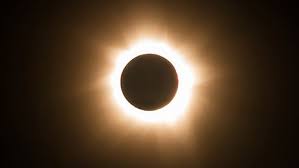


A student made a model of a solar eclipse. How can the student change it to make it into a lunar eclipse?
Move the moon closer to the Earth
Move the moon between the sun and Earth
Move the Earth between the moon and sun
Move the sun between the moon and Earth


If someone observes a full moon like in position 5, what phase will they see in 7 days?
waxing crescent
waxing gibbous
third quarter
waning crescent
Days are caused by...
Earth's tilt
Earth's orbit of the sun
Earth's rotation
Earth's position


Why do we experience the changing of the season on the earth?
distance from the sun
rotation of the earth
change in solar output
tilt of the earth's axis


What causes the phase of the Moon to change each night?
The Moon changes its acutal shape throughout the course of the month.
The alignment between the Earth, Moon, and Sun determines how much of the illuminated half of the moon we see.
The season of the year determines the phase of the Moon.
The closer the Moon is to Earth, the more light the Moon reflects.
How does the amount of daylight hours change from winter to summer?
In the winter the northern hemisphere is pointed towards the sun so it has longer days. In the summer it is pointed away from the sun so it has shorter days
In the winter the northern hemisphere is pointed away from the sun so it has longer days. In the summer it is towards the sun so it has shorter days
In the winter the northern hemisphere is pointed away from the sun so it has shorter days. In the summer it is pointed towards the sun so it has longer days
Why are there more changes in the seasons at the North pole than the equator?
The equator is always closer to the sun so the temperature is always hot.
The equator always gets direct sunlight so there is very little variation while the north pole gets less indirect sunlight and in the winter there is very little daylight
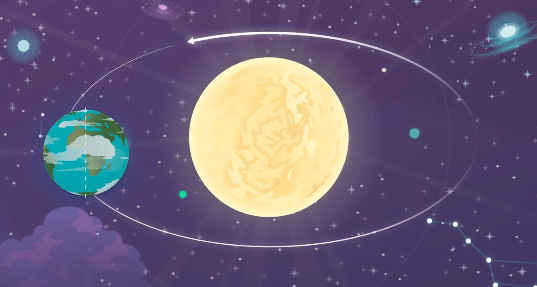


Which phases have less than 1 quarter of the moon visible from Earth?
Waxing Gibbous
Third Quarter
Waxing Crescent
Waning Crescent
New Moon

How many hours of daylight will the Equator experience as shown in the diagram?
24 hrs
15 hrs
12 hrs
0 hrs
How many hours of daylight will the South Pole experience as shown in the diagram?
24 hrs
15 hrs
12 hrs
0 hrs
The Earth spinning on its axis is called?
orbit
revolution
turning
rotation
The Earth rotating on its axis causes?
day & night
year
seasons
moon phases
A gibbous moon is ________________ full.
1/4
1/2
3/4
1/8
If the moon is waxing then it is ________________ in size on the _______________ side.
increasing, right
decreasing, right
increasing, left
decreasing, right
The constellations change with the seasons because the Earth is _________________ around the sun.
rotating
revolving
zig zagging
flying

For a lunar eclipse to occur the __________________ is in the middle of a sun, Earth, moon model/diagram.
moon
Earth
sun
It takes the Earth ____________________________ to orbit around the sun.
27.3 days
29.5 days
1 year/365.25 days
24 hours
The angle of the sun's rays and the number of hours of daylight help cause _____________________.
moon phases
eclipses
seasons
tides
The hours of daylight and the hours of darkness are about the same during a/an ____________________. (12 hours of day to 12 hours of night)
equinox (beginning of spring or fall)
solstice (beginning of winter or summer)
It takes ___________________ to complete one cycle of moon phases meaning from new moon to new moon.
about a one day
about one year
about one week
about one month
A lunar eclipse occurs during a _________________ phase.
full moon
new moon
first quarter
waning gibbous
During which season does the Earth receive the most daylight hours? (tilted toward the sun)
Winter
Spring
Summer
Fall
________________ are a specific time of the year that is characterized by recurring weather conditions.
Phases
Seasons
Tides
Eclipses
Light from the sun is reflected by the moon's surface.
True
False
The path Earth travels as it revolves around the sun is called a/an ____________.
revolution
orbit
rotation
circle
One factor that contributes to Earth's seasons is ________________________________________.
warm air blowing from the oceans
energy as heat from the moon
the angle of the sun's radiation
the time of the day

Point A on the diagram represents the season of ________________________ in the Northern Hemisphere.
Winter
Spring
Summer
Fall
Earth rotates on its axis once every _____________________.
24 hours
29.5 days
365.25 days
27.3 days

Name this moon phase.
Waning Gibbous
Waxing Crescent
Waning Crescent
Waxing Gibbous

What is the correct positions of the Earth, sun, and moon for a full moon to occur?
Earth, sun, & moon
moon, sun, & Earth
Sun, moon, & Earth
Sun, Earth, & moon
The seasons in the Northern and Southern Hemispheres are ______________________.
the same
opposite
similar
When the Earth is tilted away from the sun it is the season of ___________________.
winter
spring
summer
fall
Where on Earth is it always warm with very little variation in temperatures year round?
The North and South Pole
At the equator
In the mid-latitudes
No where

In a solar eclipse the _______________ is in the middle and is in the New Moon phase.
Earth
Sun
Moon
The main reason we have seasons is because ________________________________.
we are closer to the sun in summer
the Earth is tilted on its axis as it orbits the sun
the inside of the Earth is hot
the moon gives off serious heat
The sun, stars, and moon appear to move across the sky in an arc because of ___________________________.
Earth's orbit
Earth's rotation
Earth's revolution


A chunk of rock or iron that is less than 1,000 km (621mi) in diameter and that orbits the sun is call a(n) .....................
asteroid
star
solar system
solar eclipse
A huge ball of very hot, glowing gases in space that can produce its own heat and light is called a(n) ...................
solar system
asteroid
galaxy
star
A group of solar systems that are held together by gravity and classified by shape is called a(n) .........................
solar eclipse
star
galaxy
asteroid
Which planet is closest to the sun?
Uranus
Mercury
Neptune
Earth
How many days does it take the Earth to revolve around the Sun?
30 days
365 days
100 days
40 days
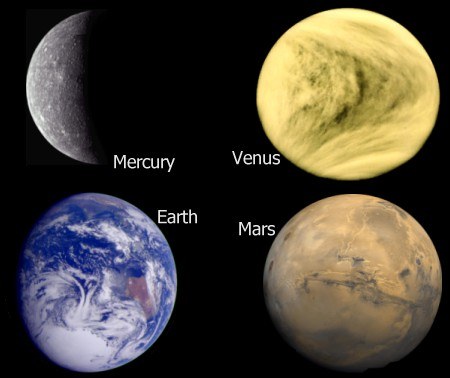
Earth and the other planets closest to the Sun are made mostly of _______
gas
metal
water
rock
One of the main differences between the outer and inner planets is __________.
the inner planets all have water.
the inner planets are much bigger than the outer planets.
the outer planets are gas planets.
the outer planets have rings, and the inner planets don't.
Why does Earth have different seasons?
because of the distance between Earth and the sun
because of the speed of Earth as it rotates on its axis
because of the amount of light blocked by the moon on its axis
because of the tilt of Earth on its axis as it moves around the sun
A ball of ice and dust with a tail of gas and dust pointing away from the sun.
Asteroid
Comet
Moon
Meteor
What is the Moon?
It is a planet
It is a satellite
It is a star
It is a comet
Which planet is an inner planet?
Jupiter
Mars
Uranus
Neptune
Which planet is an outer planet?
Earth
Mercury
Saturn
Venus
A force of attraction between any two objects in space is called _____________.
static electricity
rotation
gravity
orbit
What is the name of our Galaxy?
Saturn
Milky Way
Superman
Wonder Woman
Which property makes Earth unique compared to other planets in the solar system?
It orbits the Sun.
It is a rocky planet
It has liquid water
It rotates on its axis.
Which planet is the largest planet in the solar system and is the fifth planet?
the sun
Uranus
Jupiter
Earth
When Earth spins, it turns around an imaginary line called a(n) .................
rotation
axis
orbit
ellipse
A ____ is a huge system of gas, dust, stars, and objects orbiting stars that is held together by the force of gravity.
galaxy
comet
meteor
gas giant
Why does the sun seem to change position in the sky?
Earth's rotation
Earth's orbit
The sun's rotation
The sun's orbit

A _____________is a small rock that landed on Earth from outer space.
meteor
meteoroid
meteorite
asteroid
Which outer planets have rings?
Just Saturn
Saturn and Jupiter
Jupiter, Neptune, and Saturn
all of them

How many planets are there in the Solar System?
8
7
9
6
The path of one space object takes around the another space object is called ............
a revolution.
a rotation.
an orbit.
a spin.
The study of the objects in space and their properties is known as ......................
geology
astronomy
cartology
paleontology
What are the three shapes that galaxies take?
spiral, circular, elliptical
elliptical, irregular, pancake shaped
spiral, elliptical, irregular
irregular spiral, flat
Why are the observatories built far away from cities?
beacuse of lots of light coming from cities
because of lots of noise coming from cities
because of lack of space in cities
because of spectacular view of mountains
Why do we need to study on the solar system and universe?
to find new planets to live on them
to protect our planets from any danger that might come from space
to discover new life forms to communicate
to have fun and spend money on space studies
Which planet in our solar system resembles (looks similar) our planet Earth?
Venus
Jupiter
Pluto
Mars
Together a star and all the planets and other object orbiting it form a(n)
asteroid
galaxy
solar system
star
A chunk of rock or iron that is less than 1,000 km (621mi) in diameter and that orbits the sun is call a(n)
asteroid
star
solar system
solar eclipse
A huge ball of very hot, glowing gases in space that can produce its own hear and light is called a(n)
solar system
asteroid
galaxy
star
A group of solar systems that are held together by gravity and classified by shape is called a(n)
solar eclipse
star
galaxy
asteroid

What can you conclude from this diagram?
Earth is a satellite of the moon
The sun revolves around Earth
Earth and the moon rotate in different directions
The moon orbits Earth while Earth orbits the sun.
All the planets in the solar system orbit the sun. What is the main difference between the orbits of the inner and outer planets?
The inner planets and outer planets orbit in different directions.
The outer planets take longer to orbit the sun than the inner planets do.
The inner planets travel a greater distance than the outer planets do.
The outer planets rotate as they orbit the sun, and the inner planets do not.

A nebula collapses down into a disk known called:
A compact disk
An irregular cloud
An protostellar disk
An circular disk


How does Newton’s third law of motion relate to the locations and motions of the planets in the star system?
It explains the orbital velocities of the planets as they orbit the star.
It explains the gravitational attraction between the star and each planet.
It explains how the star formed.
It explains why the star is at the center of the system.
Planets are held in their orbit because of their large sizes as well as a certain force that acts over a distance. Which force is responsible for acting on the planets? Choose the correct answer.
nuclear force
nuclear force
magnetic force
gravitational force
The moon revolves around Earth. The moon travels at a speed of about 1 km/s. What keeps the moon in orbit around Earth?
electrical force
gravity
magnetism
nuclear force
Dwarf planets are smaller than planets. What is another way that dwarf planets are different?
They do not orbit the sun.
They have large objects in their orbit.
They are not spherical.
They move more slowly along their orbits.
Early astronomers noticed that some stars in the sky appeared to move together across the sky as constellations. How do astronomers today explain this motion?
Gravitational attraction between the stars keeps them fixed relative to each other as they move.
The sun’s gravity keeps the stars together because they orbit the sun at the same rate.
The stars move around Earth in the same way, so their positions relative to each other stay the same.
The stars appear to move together along a path because of Earth’s rotation on its axis.

Which object exerts the greatest gravitational pull in the diagram?
Planet 1
Planet 5
Planet 3
The Star
A student drew a model of the early stages of the formation of the solar system in which it changes from a spinning nebula to a spinning, flattened disc. Which of these observations can the student use as evidence to support this model?
The space between the orbital paths of the planets is mostly empty.
All planets revolve around the sun in the same direction.
Earth and Venus rotate on their axes in opposite directions.
The orbital paths of the planets are all in the same plane as the sun.
Which unit is used to describe the distances between galaxies in the universe?
Light-years
miles
kilometers
hours

The diagram shows Laplace’s hypothesis explaining the formation of the solar system.
Which of these best explains the first stage in the diagram shown?
This stage shows a large collapsing cloud of gas and dust.
This stage shows the spinning and flattening of a nebula that throws off gaseous material.
This stage shows the collision and fusion of particles forming several large clumps.
This stage shows the contracting and cooling of a cloud.
According to the nebular theory, which planet is most likely to be gaseous rather than rocky?
Mercury, because planets closer to the solar nebula are more likely to be made of gas, like the nebula
Neptune, because as the planets get farther from the solar nebula, their composition is more icy and gaseous
Venus, because it is the warmest planet and so is more likely to be gaseous
Earth, because the atmosphere consists of nitrogen, oxygen, and other gases, so it is a gaseous planet

Newton’s laws of motion and universal gravitation apply to the star and planets. Suppose Planet 3 is similar to Earth. Identify the statements that are true.
Because of gravity, Planet 3, which is smaller than the star, remains in orbit.
The weight of an object measured on Planet 3 is a result of gravity.
The acceleration of an object much less massive than Planet 3 will increase the closer it gets to the planet.
Small objects near Planet 3 experience much less acceleration the closer they get to the surface of the planet.
Which method of data gathering can provide evidence of the formation of the solar system?
reviewing images captured by cameras and telescopes during the formation of the solar system
sending teams of astronauts to each planet to gather samples from the planet
using telescopes, satellites, and probes to observe our solar system and distant star systems and galaxies
sending astronauts to visit the sun and gather samples and record measurements
The Milky Way is approximately 1,000,000,000,000,000,000 km, or 100,000 light-years, across. Which measurement is preferred when talking about distance in galaxies and why?
Because solar systems are related to the stars at their center, distances within galaxies are measured in km.
Because of the distance, galaxies closer to Earth are measured in km, while galaxies farther away are measured using light-years.
Because galaxies are so large, the distances within them are measured in light-years.
Because galaxies exist in only a small region of the universe, they are measured in km.

Students are studying the solar system. They are using the following table to analyze the similarities and differences among the planets.
Choose the answers that correctly describe the planets in the solar system.
Mars and Earth are very close to each other in size.
The largest planets are made of gases.
Saturn and Uranus are about the same distance from the sun.
The planets closer to the sun are relatively small compared with the planets farther from the sun.
Compared with the other planets in the solar system, Earth has the strongest gravitational force.
Which evidence first supported the heliocentric model of the solar system?
determining that planets orbit in elliptical paths with telescopes
mapping of stars using the unaided eye
taking pictures of distant galaxies with satellite-based cameras
observing the surface features of nearby planets and moons with telescopes

