wayground logo

Free Printable Worksheets

Font size

S
M
L
XL
Worksheets

Regents Review 2023

Total questions: 108

Worksheet time: 2hrs 20mins

Name
Class
Date
1.

What is the contour interval of this map?

a)

10

b)

20

c)

30

d)

40

2.
What do contour lines that are farther apart represent?
a)
waterfall
b)
steep area
c)
gentle slope
d)
river
3.
Which direction is the river flowing?
a)
north
b)
south
c)
east 
d)
west
4.
An igneous rock containing large crystals is most likely a(n)
a)
Chemical Rock
b)
Foliated Rock
c)
Extrusive Rock
d)
Intrusive Rock
5.

What is the contour interval of this map?

a)

10

b)

20

c)

30

d)

40

6.
An igneous rock containing large crystals is most likely a(n)
a)
Chemical Rock
b)
Foliated Rock
c)
Extrusive Rock
d)
Intrusive Rock
7.
A metamorphic rock in which the grains line up in parallel bands is a
a)
Clastic Rock
b)
Nonclastic Rock
c)
Nonfoliated Rock
d)
Foliated Rock
8.
As lava cools and crystallizes, what type of rock will form?
a)
Sedimentary
b)
Metamorphic
c)
Extrusive Igneous
d)
Intrusive Igneous
9.
The parent rock of Gneiss is
a)
Marble
b)
Granite
c)
Obsidian
d)
Biotite
10.
Which fossil makes the best index fossil?
a)
Fossil 1
b)
Fossil 2
c)
Fossil 3
d)
None follow all of the rules
11.
Place the following in order starting with the OLDEST
1  Paleozoic
2  Cenozoic
3  Precambrian
4  Mesozoic
a)
1 3 2 4 
b)
3 1 4 2
c)
4 3 2 1 
d)
2 3 1 4
12.
Precambrian Time accounts for ___% of Earth's History.
a)
10%
b)
25%
c)
50%
d)
90%
13.

What is runoff?

a)

The process of sediment moving or being weathered away by wind or water.

b)

Water that moves over Earth's surface, because it doesn't infiltrate the ground.

c)

Water moving from the liquid state to the gaseous state.

d)

Observations described in words or letters.
14.
You are a planetary geologist investigating images of a planet elsewhere in the galaxy. You see gentle U-shaped valleys carved in the planet’s surface. Based on Earth’s geology what would you suspect caused these valleys?
a)
Stream erosion
b)
Glacial erosion
c)
Stream deposition
d)
Marine erosion
15.
How would you expect the sizes of sediments deposited on a mountain to compare to those deposited downriver?
a)
Larger
b)
Smaller
c)
The same
d)
It is impossible to predict
16.
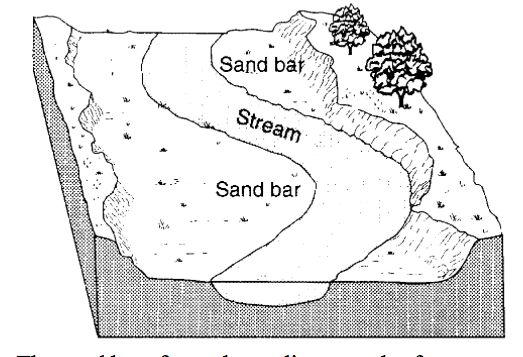
The diagram below shows a portion of a stream. The sand bar formed as a direct result of 
a)
erosion due to a decrease in stream velocity 
b)
erosion due to an increase in stream velocity
c)
deposition due to a decrease in stream velocity
d)
deposition due to an increase in stream velocity 
17.
Sediments are deposited in a river delta because the 
a)
velocity of the river decreased
b)
force of gravity decreased
c)
volume of the river increases
d)
gradient of the river increases
18.
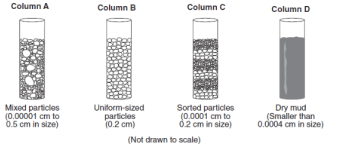
The columns A, B, C, and D shown below contain equal volumes of sediment. When an equal volume of water is added to each column, the greatest rate of infiltration will occur in which column?
a)
A
b)
B
c)
C
d)
D
19.
During a rainstorm, when the soil becomes saturated, the amount of infiltration
a)
decreases and runoff decreases
b)
decreases and runoff increases
c)
increases and runoff decreases 
d)
increases and runoff increases
20.

Which is used to measure wind speed

a)
b)
c)
d)
21.

What is considered the driving force for Earth's climate

a)

Rain

b)

Moon phases

c)

Earth Rotation

d)

The Sun

22.

Which Day receives has the longest daytime in Southern hemisphere?

a)

June 21st

b)

March 21st

c)

December 21st

d)

September 21st

23.

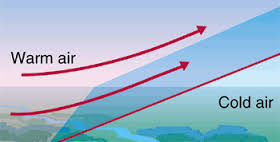
When a warm air mass takes over a cold air mass and causes drizzly rain, what type of front occurs?

a)

Warm Front

b)

Stationary Front

c)

Cold Front

d)

Occluded Front

24.
What does this tool measure?
a)
Wind speed
b)
Wind direction
c)
Air pressure
d)
Temperature
25.
What kind of weather is usually associated with a high pressure system?
a)
Sunny weather
b)
Precipitation (rain, snow, etc.)
26.
A wet and cold air mass would be a...
a)
Maritime polar
b)
Continental polar
c)
Maritime tropical
d)
Continental tropical
27.
Because the earth spins on its axis, we experience:
a)
seasons
b)
weather
c)
day and night
d)
revolution
28.
The shape of the earth's orbit around the sun:
a)
oval
b)
circle
c)
semicircle
d)
ellipse
29.
Which of the following has the biggest impact on the seasons?
a)
Earth's rotation
b)
Tilted axis
c)
Moon's gravitational pull
d)
Pressure systems
30.
How much time passes between a high tide and a low tide?
a)
6 hours
b)
12 hours
c)
24 hours
d)
2 days
31.
Why is the Equator warmest?
a)
Because it is closest to the sun.
b)
Because it receives the most direct sunlight
c)
Because no clouds form here.
d)
Because it is far from the sun
32.
Which of the following best describes equinoxes?
a)
The earth is tilted neither toward or away from the sun
b)
The norther hemisphere is tilted toward the sun
c)
The northern hemisphere is tilted away from the sun
d)
The southern hemisphere is tilted toward the sun
33.

The time required for the Moon to complete one cycle of phases is about one

a)

day

b)

week

c)

month

d)

year

34.

Which Moon phase would be observed on Earth when the Moon is at position 2?

a)
b)
c)
d)
35.

Which type of eclipse is shown in the following diagram?

a)

Summer

b)

Solar

c)

Lunar

d)

Winter

36.

Which diagram shows the Moon position that will produce the highest high tides and the lowest low tides?

a)
b)
c)
d)
37.

Compared to the terrestrial planets, the Jovian planets have

a)

smaller diameters

b)

greater average densities

c)

slower rotation rates

d)

longer periods of revolution

38.

Scientists infer that the Big Bang occurred approximately

a)

4.6 billion years ago

b)

7 billion years ago

c)

9 billion years ago

d)

13.8 billion years ago

39.

The redshift of light from distant galaxies provides evidence that the universe is

a)

shrinking

b)

expanding

c)

remaining the same size

40.

What is the relationship between temperature and luminosity of main sequence stars?

a)

As temperature decreases, luminosity increases.

b)

As temperature increases, luminosity increases.

c)

As temperature decreases, luminosity remains the same.

41.
The index fossils shown below are the remains of organisms that lived during which geologic era?
a)
Precambrian
b)
Cenozoic
c)
Paleozoic
d)
Mesozoic
42.
The table below shows the fossils found in three layers of sedimentary bedrock. According to the Earth Science Reference Tables, the relative age of the rock layers from oldest to youngest is...
a)
A, B, C
b)
B, A, C
c)
A, C, B
d)
C, A, B
43.
In which way are index fossils and volcanic ash deposits similar?
a)
Both can usually be dated with radiocarbon
b)
Both normally occur in nonsedimentary rocks
c)
Both strongly resist chemical weathering
d)
Both often serve as geologic time markers
44.
A well was drilled in Syracuse, New York.  The first bedrock layer reached by the drill formed during which period?
a)
Silurian
b)
Devonian
c)
Cambrian
d)
Ordovician
45.
According to the Earth Science Reference Tables, when did the last dinosaurs become extinct?
a)
66 million years ago
b)
187 million years ago
c)
97 million years ago
d)
230 million years ago
46.
According to the Earth Science Reference Tables, near the end of which era did the dinosaurs become extinct?
a)
Precambrian
b)
Mesozoic
c)
Paleozoic
d)
Cenozoic
47.

The amount of water vapor in the air compared to how much more it can hold at a certain temperature is known as ___.

a)

humidity

b)

relative humidity

c)

dew point

d)

saturation

48.
What does this tool measure?
a)
Wind speed
b)
Wind direction
c)
Air pressure
d)
Temperature
49.
This weather instrument is a...
a)
anemometer
b)
barometer
c)
wind vane
d)
thermometer
50.
Which type of front is pictured?
a)
Cold front
b)
Warm front
c)
Occluded front
d)
Stationary front
51.

According to the Reference Tables, an air pressure of 29.65 inches of mercury is equal to

a)

1004.0 mb

b)

984.0 mb

c)

1001.0 mb

d)

999.0 mb

52.
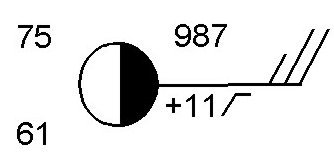
What is the temperature at this station
a)
75 degrees
b)
61 degrees
c)
987 degrees
d)
11 degrees
53.

Which rock may form when shale is exposed to extreme heat and pressure?

a)

Slate

b)

Schist

c)

Metaconglomerate

d)

Hornfels

54.
A rock formed from fragments of other rocks is a(n)
a)
Metamorphic Rock
b)
Sedimentary Rock
c)
Extrusive Rock
d)
Igneous Rock
55.

This metamorphic rock is...

a)

Foliated

b)

NonFoliated

c)

There is no way to tell

56.
How old is a bone that has 12.5% of the original amount of radioactive carbon-14 remaining?
a)
5,700 years
b)
11,400 years
c)
17,100 years
d)
22,800 years
57.
According to the graph, what is the half-life of this isotope?
a)
100 years
b)
150 years
c)
200 years
d)
300 years
58.
The surface temperature of which sample increased at the slowest rate?
a)
water
b)
basaltic sand
c)
copper pennies
d)
iron fragments
59.
The average rate of temperature change, in Fahrenheit degrees per hour, between 6 a.m. and noon was
a)
6 °/h
b)
8 °/h
c)
3 °/h
d)
18 °/h
60.
What is the density of this material?
a)
1.0 g/cm3
b)
5.0 g/cm3
c)
10.0 g/cm3
d)
20.0 g/cm3
61.
How many joules are required to evaporate 1 gram of boiling water?
a)
4
b)
334
c)
2260
d)
2594
62.
Which pie graph correctly shows the percentage of elements by volume in Earth's troposphere?
a)
1
b)
2
c)
3
d)
4
63.
New York State’s Catskills are classified as which type of landscape region?
a)
mountain
b)
plateau
c)
lowland
d)
plain
64.
The surface bedrock at which location is most likely to contain this fossil (Bothriolepis)
a)
Ithaca
b)
Old Forge
c)
Albany
d)
New York City
65.
Which ocean current warms the climate of northwestern Europe?
a)
North Atlantic Current
b)
North Equatorial Current
c)
Canary Current
d)
Labrador Current
66.
Which surface feature was produced by crustal movements at a transform plate boundary
a)
East African Rift
b)
Tasman Hot Spot
c)
Aleutian Trench
d)
San Andreas Fault
67.
Which list correctly classifies each rock type?
a)

1 - Sedimentary

2- Metamorphic

3 - Igneous

b)

1 - Sedimentary

2 - Igneous

3 - Metamorphic

c)

1 - Metamorphic

2 - Igneous

3 - Sedimentary

d)

1 - Igneous

2 - Metamorphic

3 - Sedimentary

68.
A stream flowing at a velocity of 100 centimeters per second can transport
a)
silt, but not sand, pebbles, or cobbles
b)
silt and sand, but not pebbles or cobbles
c)
silt, sand, and pebbles, but not cobbles
d)
silt, sand, pebbles, and cobbles
69.

Which igneous rock is dark colored, cooled rapidly on Earth's surface, and is composed mainly of plagioclase feldspar, olivine, and pyroxene

a)

Obsidian

b)

Rhyolite

c)

Gabbro

d)

Scoria

70.
Which sedimentary rocks are clastic and consist of particles that have diameters smaller than 0.006 centimeter?
a)
conglomerate and sandstone
b)
siltstone and shale
c)
bituminous coal and breccia
d)
fossil limestone and chemical limestone
71.
Which process most likely formed a layer of the sedimentary rock, gypsum
a)
precipitation from seawater
b)
folding of clay-sized particles
c)
solidification of magma
d)
melting of sand-sized particles
72.
The metamorphic rock at location A is most likely
a)
marble
b)
quartzite
c)
phyllite
d)
slate
73.
During which geologic time period did the coal-forming forests exist?
a)
Devonian
b)
Quaternary
c)
Mississippian
d)
Pennsylvanian
74.
Evidence indicates that 251 million years ago a mass extinction of many life-forms occurred on Earth. Which form of life became extinct at this time?
a)
Trilobites
b)
Dinosaurs
c)
Mammoths
d)
Eurypterids
75.
Which group of organisms has the shortest record of life on Earth?
a)
eurypterids
b)
birds
c)
graptolites
d)
placoderm fish
76.
The Palisades sill intruded as North America began the process of separating from Africa and Europe as Pangaea was breaking apart. Approximately when did these events occur?
a)
65 mya
b)
299 mya
c)
200 mya
d)
400 mya
77.
The inferred temperature and pressure of Earth's interior at a depth of 3,000 kilometers are approximately
a)
1000°C and 0.5 million atmospheres
b)
5000°C and 1.5 million atmospheres
c)
1000°C and 1.0 million atmospheres
d)
5000°C and 3.0 million atmospheres
78.
The distance from this seismic station to the epicenter of the earthquake is approximately
a)
1,600 km
b)
3,200 km
c)
4,400 km
d)
5,600 km
79.
If the air temperature is 20°C and the relative humidity is 58%, what is the dewpoint?
a)
5°C
b)
12°C
c)
15°C
d)
38°C
80.
An air temperature of 30°C is equal to
a)
–22°F
b)
–2°F
c)
74°F
d)
86°F
81.
A barometric pressure of 1021.0 millibars is equal to how many inches of mercury?
a)
29.88
b)
30.15
c)
30.25
d)
30.50
82.
Which weather station model shows the highest relative humidity?
a)
1
b)
2
c)
3
d)
4
83.
Which station model represents a location that is currently receiving some form of precipitation?
a)
1
b)
2
c)
3
d)
4
84.
The altitude of the ozone layer near the South Pole is 20 kilometers above sea level. Which temperature zone of the atmosphere contains this ozone layer?
a)
troposphere
b)
stratosphere
c)
mesosphere
d)
thermosphere
85.
A high air-pressure, dry-climate belt is located at which Earth latitude?
a)

b)
15° N
c)
30° N
d)
60° N
86.
Compared with our Sun, the star Betelgeuse is
a)
smaller, hotter, and less luminous
b)
larger, hotter, and less luminous
c)
larger, cooler, and more luminous
d)
smaller, cooler, and more luminous
87.
Which characteristic of the planets in our solar system increases as the distance from the Sun increases?
a)
equatorial diameter
b)
period of rotation
c)
eccentricity of orbit
d)
period of revolution
88.
Which two characteristics do all Jovian planets have in common?
a)
small diameters and low densities
b)
large diameters and low densities
c)
small diameters and high densities
d)
large diameters and high densities
89.
Which mineral is hard enough to scratch calcite but is not hard enough to scratch amphibole?
a)
muscovite mica
b)
olivine
c)
fluorite
d)
graphite
90.
Which of the following elements is not found in Plagioclase Feldspar?
a)
Na
b)
Al
c)
Si
d)
Pb
91.
Which season is taking place in the Northern Hemisphere in Position 3?
a)
Winter
b)
Spring
c)
Summer
d)
Fall
92.
What are the reasons for the season?
a)
Earth's tilt & rotation
b)
Earth's tilt & revolution
c)
Earth's rotation & rovolution
d)
Earth's tilt & resolution
93.
What happens when the area in which you live tilts away from the sun?
a)
It is summer.
b)
It is spring.
c)
It is winter.
d)
It is fall.
94.
What is the name of the process that continually adds new rock at the Mid Ocean Ridges and pushes old rock out, making an ocean larger?
a)
Sea Floor Spreading
b)
Sublimation
c)
Subduction
d)
Volcanism
95.
What is the theorized force that moves the plates?
a)
Subduction
b)
Sea Floor Spreading
c)
Convection
d)
Mid Ocean Ridge
96.
What type of boundary is this?
a)
Divergent
b)
Convergent
c)
Transform
97.
Which layer of Earth is LIQUID?
a)
upper mantle
b)
lower mantle
c)
outer core
d)
inner core
98.
Which body wave is pictured?
a)
P-Wave
b)
S-Wave
c)
Rayleigh Wave
d)
Love Wave
99.
Which city is closest to the epicenter?  
a)
A
b)
B
c)
C
100.

Identify the names of the tectonic plates at locations A and B.

a)

African and South American Plate

b)

Caribbean and South American Plate

c)

Pacific and South American Plate

d)

Nazca and South American Plate

101.
The OLDEST seafloor is located? 
a)
Closest to the mid-ocean ridge
b)
Farthest from the mid-ocean ridge
102.
These seismic waves can vibrate up and down or side to side at a 90 degree angle to the direction they travel:
a)
p-wave
b)
s-wave
c)
surface wave
d)
z-wave
103.

Maritime polar air masses are

a)

cold and dry

b)

cold and moist

c)

warm and dry

d)

warm and moist

104.

What forms when a cool and warm air mass meets?

a)

A front

b)

An air mass

c)

A storm

d)

A sunny day

105.
Which of the following happened most recently?
a)
A. Deposition of Unit C
b)
B. Deposition of Unit B
c)
C. Deposition of Unit F
d)
D. Tilting of C, D, E, and F
106.
What is the oldest rock in this diagram?
a)
B
b)
H
c)
I
d)
R
107.

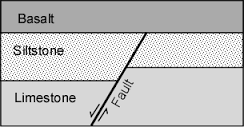
What are the relative ages of the features in order from oldest to youngest?

a)

Limestone, Basalt, Fault, Siltstone

b)

Siltstone, Fault, Basalt, Limestone

c)

Limestone, Fault, Basalt, Siltstone

d)

Limestone, Siltstone, Fault, Basalt

108.
How does the law of crosscutting explain the age of a fault?
a)
The fault is younger than the rocks above it.
b)
The fault is younger than the rocks it cuts through.
c)
The fault is older than the rocks above it.
d)
The fault is older than the rocks it cuts through.