
 Worksheets
9 Physics
Total questions: 39
Worksheet time: 28mins
Which of the following is not an electrical conductor
Gold
Copper
Aluminium
Rubber
Which of these is not an electrical insulator
Wood
Plastic
Silver
Glass
In an insulator, electrons transfer from atom to atom to allow electricity to pass through a wire
True
False
A conductor
Doesn't allow electricity to pass through it
Only conducts electricity in an open circuit
Does not light up a bulb if attached to a circuit
Allows electricity to pass through it
The best insulators are
Plastic, rubber, wood, glass
Silver, air, paper, silicon
Copper, aluminium, gold, steel
Ceramic, fabric, paper clip, cork
An insulator
Is usually a metal
Opposes electrical current meaning electric charges do not flow freely
Conducts electrical current very easily
Works by electrons jumping from atom to atom through a wire

What is the name of this component?
battery
cell
open switch
lamp

What is the name of this component?
battery
cell
open switch
lamp

What is the name of this component?
fuse
cell
bell
lamp

Is this an example of a series circuit?
yes
no
It is a parallel circuit

What type of circuit is this?
Series circuit
Kilowatt circuit
Parallel circuit
potential circuit
Voltage divided by Resistance
(V / R)
Current
Power
Ohms
Watts
(I X R)
Voltage divided by Current
(V / I)
Current
Power
Resistance
Watts
What is the name for the pressure that forces electrons to flow through a circuit?
Voltage
Capacitance
Resistance
Current
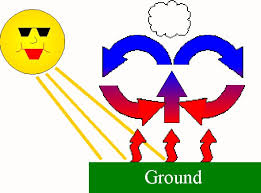


How is energy from the Sun transferred?
by radiation
by conduction
by convection
by the force of gravity
Cold water has ______________ density than warm water.
less
more
the same
When you touch hot sand, heat is transferred by _________ to your skin.
conduction
convection
radiation
After cooking an egg in boiling water, you cool the egg by putting it into a bowl of cold water. Which of the following explains the egg’s cooling process?
Temperature is transferred from the egg to the water.
Cold moves from the water into the egg.
Energy is transferred from the water to the egg.
Energy is transferred from the egg to the water.
If you put a metal spoon and a wooden spoon into a pot of boiling water, one will become too hot to touch. Why?
a. Metals conduct heat better than wood.
b. Wood conducts heat better than metals.
c. Metals pull in heat because heat is attracted to metals.
d. Wood isn’t as strong as metals.

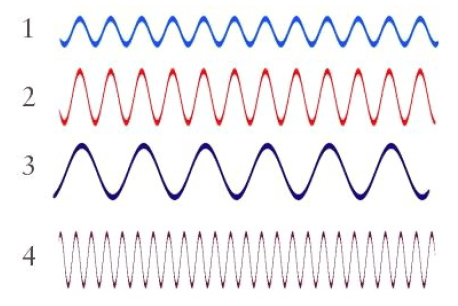
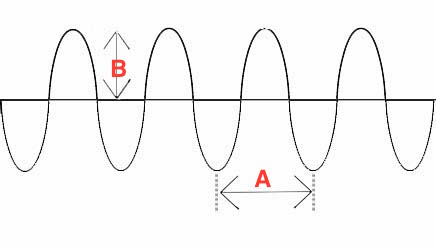
What is the unit for frequency?
Meters
Hertz
Decibels
Meters/Second
Waves that can travel through a vacuum and do no require a medium are called?
Transverse Waves
S-Waves
Mechanical Waves
Electromagnetic Waves
What is the crest of a transverse wave?
the lowest point of the wave
the middle of a wave
the highest point of a wave
nothing


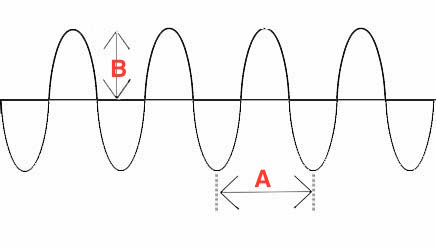
It is the high pressure part of the wave where the particles are close together. It is part A on this picture.
Compression
Amplituide
Rarefaction
Wavelength


