
Font size
 Worksheets
11. Humanistic Therapy
Total questions: 46
Worksheet time: 24mins
Abraham Maslow –
Need Hierarchy
Person Centered Theory
Carl Rogers –
Need Hierarchy
Person Centered Theory
Humanistic psychology
•Humanistic psychology emphasizes the present experience and essential worth of the whole person, promotes creativity, free choice and spontaneity, and fosters the belief that people can solve their own psychological problems.
“The functioning and experience of a whole human being”
•Humans have positive potentialities that they can develop themselves. The natural development of human beings is toward the “constructive fulfillment” of their inherent possibilities.
________________ is a psychological approach that emphasizes that study of a whole person, and and the uniqueness of each individual.
Existentialism
Humanism
________________ is a psychological approach that emphasizes the quest for personal meaning and determining personal values.
Existentialism
Humanism
•Humanistic psychology emerged from two philosophical orientations: ____________________ is an approach to understanding each person’s most immediate experience, the conditions of his or her existence, and the necessity of exercising freedom of choice in a world.
•_______________________- encourages consciousness and personal responsibility.
•Human freedom is defined not as freedom from responsibility but freedom to accept responsibility.
Existentialism
Phenomenology
•____________________________ involves an attitude of discovery that encompasses a search for essential issues, an emphasis on consciousness, the necessity of describing experience, and a desire to grasp reality as each individual uniquely perceives it.
•The only reality I can possibly know is the world as I perceive and experience it at this moment.
Existentialism
Phenomenology
Assumptions about nature of organism
The force for growth and development that is innate in all organisms.
Taft (1993) “ as living beings we are geared to movement and growth”
Examples:
•a plant’s innate tendency to grow
•a person’s tendency toward self-actualization (to become all that we can become)
1. Organism tends to actualize:
2.Tendency to actualize is both trustworthy and constructive:
Assumptions about nature of organism
Rogers (1961), “ the inner core of personality is the organism itself which is essentially both self preserving and social. Organismic valuing process: the inner vague feeling that choosing a certain career would be wrong for you even if everyone else approves of that choice.
1. Organism tends to actualize:
2.Tendency to actualize is both trustworthy and constructive:
•The human organism is viewed as a total being whose physical, psychological, and spiritual aspects cannot be separated.
•Inner sense within a person, which guides him or her in the directions of growth and health.
•For Rogers, as well as other humanistic theorists, the most important matter in the consideration of personality is the person as a whole, including the individual’s conscious awareness, freedom to choose, self determination, and quality of experiences.
•
ORGANISMIC APPROACH
Organismic Valuing Process
Locus of Evaluation
GENERAL ACTUALIZING TENDENCY
•When individuals rely freely on the evidence of their own senses to make value judgments. In contrast to a fixed system in which values are introjected and manifest through emphasis on “oughts” and “shoulds” and by what is “supposed to be” right and wrong.
ORGANISMIC APPROACH
Organismic Valuing Process
Locus of Evaluation
GENERAL ACTUALIZING TENDENCY
•When individuals rely freely on the evidence of their own senses to make value judgments. In contrast to a fixed system in which values are introjected and manifest through emphasis on “oughts” and “shoulds” and by what is “supposed to be” right and wrong.
ORGANISMIC APPROACH
Organismic Valuing Process
Locus of Evaluation
GENERAL ACTUALIZING TENDENCY
•The ________________________________ is the place from which interpretations of our experiences derive and the source for one’s standards and values; internal or external. The process of psychotherapy can help shift this locus from other people to the self, resulting in an empowered self-concept rather than one of passive victimhood.
ORGANISMIC APPROACH
Organismic Valuing Process
Locus of Evaluation
GENERAL ACTUALIZING TENDENCY
•All living things display the general actualizing tendency, “an inherent tendency of the organism to develop all its capacities in ways which serve to maintain or enhance the organism”
•This constructive biological tendency is the “one central source of energy in the human organism,” giving rise to all other motivations.
ORGANISMIC APPROACH
Organismic Valuing Process
Locus of Evaluation
GENERAL ACTUALIZING TENDENCY
Fully Functioning Person
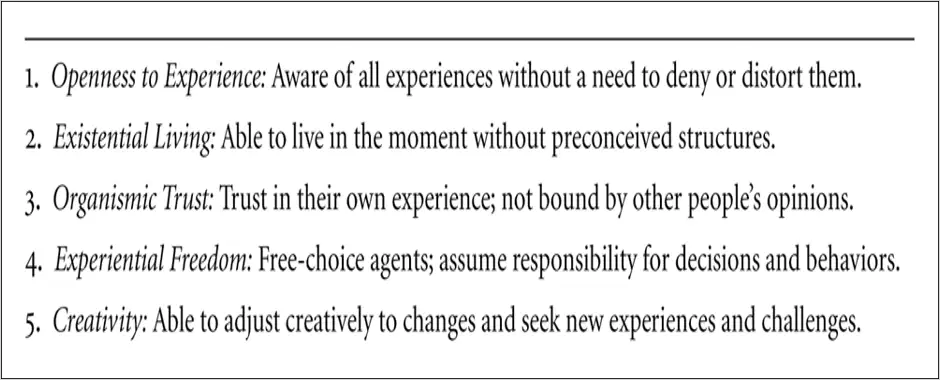
•A Fully Functioning Person is one who relies almost exclusively on organismic valuing processes.
•A person in process, a person continually changing.
•Changes are in the direction of congruence, fluidity, openness to experience and a creative or responsive adaptability to new situations.
•Process of self-actualization is associated with enhanced functioning in these areas:
Concept of psychological health
•Disappearance of incongruence or a return to congruence.
Including matching of three elements:
1.Experiencing
2.Awareness
3.Communication
•If I am accurately aware of what I am experiencing in the envelop of my own being, I am internally or intrapersonally congruent. Also, communicating accurately my awareness of my experiences.
Rogers’ Theory of Personality Summarized
•Behavior is best understood through the individual’s reality (perception of experiences)
•Personal growth occurs through decreased defensiveness
•Self-actualization is the organism’s one, basic tendency
•Experiences inconsistent with self-concept are threats leading to increased rigidity
•Therapy allows the individual to accept and integrate all of their experiences
•Belief in the importance of “self” is one of the distinguishing marks of humanistic psychology.
•Rogers defined self as “the organized, consistent, conceptual whole composed of perceptions of the characteristics of the “I” or “me” to various aspects of life.”
•The internal frame of reference (the Self) is the filter through which all experiences are interpreted and meanings are attached.
•ideal self – real self discrepancy
•incongruence
“Self”/self-concept
ORGANISMS ARE Self-preserving and social
Concept of psychological disturbance
•Away from façades and oughts.
•Away from meeting expectations and pleasing others.
•Towards trusting self, and self direction
•Towards openness to experience and acceptance of others.
•MOVEMENT FROM FIXITY TOWARDS FLUIDITY
“Self”/self-concept
ORGANISMS ARE Self-preserving and social
Concept of psychological disturbance
Three concepts describe client-centered thinking of psychological disturbances.
1.Conditions of worth
2.Incongruence
3.Locus of evaluation
“Self”/self-concept
ORGANISMS ARE Self-preserving and social
Concept of psychological disturbance
•A condition we believe we have to meet in order to receive love or respect (Rogers 1959)
•Living to meet perceived expectations of others is seen as major source of psychological disturbance.
Conditions of worth
Incongruence
Locus of evaluation
Change
•We are born integrated or congruent
•Introjected or internalized conditions of worth
•What we believe to be true about the world and ourselves leads to development of SELF CONCEPT OR PICTURE OF “WHO I AM”
•Ideal self – real self discrepancy (incongruence)
Conditions of worth
Incongruence
Locus of evaluation
Change
•The source of evidence - as to values.
•Locus of evaluation is internal if we are central to our own valuing process and external if we make others central to it.
•Largely external locus of evaluation leads to incongruence.
Conditions of worth
Incongruence
Locus of evaluation
Change
•Happens in relationship, and through communication.
•Movement from fixity towards fluidity.
•Change and fluidity in the way the people speak and in the language they use, in the way they think and their bodies and in their willingness to show their anger or sadness or joy, and in the way they relate to one another.
Conditions of worth
Incongruence
Locus of evaluation
Change
1.Two persons are in psychological contact
2.The first termed as client is in state of incongruence, being vulnerable or anxious.
3.The second person named as therapist is congruent or integrated in the relationship.
4.The therapist experiences unconditional positive regard for the client.
5.The therapist experiences an empathetic understanding of the client’s internal frame of reference and endeavors to communicate this experience to the client.
6.The communication to the client of the therapist’s empathetic understanding and unconditional positive regard.
Change results through one person’s experience of another’s unconditional acceptance.
Conditions for constructive personality change in therapy (RogerS, 1957)
Qualities of an Effective Therapist
Basic Skills
Rogers’ Core Conditions for the Therapeutic Environment (Therapist)
Rogers’ Core Conditions for the Therapeutic Environment (Client)
•Trustworthy
•Dependable
•Detached but available
•Therapist can judge his own feelings also
•Genuine
•Empathy
•Unconditional positive regard
•Competent
•Professional excellence
•Thorough knowledge of therapies
•Tone should be soft
•No sentence is given as assumption.
•He/she should be neutral
•Nonjudgmental attitude
•No racial discrimination
Conditions for constructive personality change in therapy (RogerS, 1957)
Qualities of an Effective Therapist
Basic Skills
Rogers’ Core Conditions for the Therapeutic Environment (Therapist)
Rogers’ Core Conditions for the Therapeutic Environment (Client)
●
1.Empathy
2.Congruence
3.Acceptance
Other than empathy, congruence, acceptance…
Consistency
Boundary
Awareness
Interpersonal Sensitivity
Conditions for constructive personality change in therapy (RogerS, 1957)
Qualities of an Effective Therapist
Basic Skills
Rogers’ Core Conditions for the Therapeutic Environment (Therapist)
Rogers’ Core Conditions for the Therapeutic Environment (Client)

Trust
Conditions for constructive personality change in therapy (RogerS, 1957)
Qualities of an Effective Therapist
Basic Skills
Rogers’ Core Conditions for the Therapeutic Environment (Therapist)
Rogers’ Core Conditions for the Therapeutic Environment (Client)

Trust
Conditions for constructive personality change in therapy (RogerS, 1957)
Qualities of an Effective Therapist
Basic Skills
Rogers’ Core Conditions for the Therapeutic Environment (Therapist)
Rogers’ Core Conditions for the Therapeutic Environment (Client)
Bottom Line
♦Congruence = psychological adjustment
♦Lack of Congruence = psychological maladjustment
How Did Carl Rogers Do Therapy?
Rogers tended to start sessions by giving himself and the client an opportunity to orient themselves to the task
Providing orientation:
Affirming attention:
Checking understanding:
Restating:
How Did Carl Rogers Do Therapy?
He frequently let his client know that he was present and listening, by leaning towards the client, saying ‘m-hm, m-hm’ or nodding affirmatively
Providing orientation:
Affirming attention:
Checking understanding:
Restating:
How Did Carl Rogers Do Therapy?
Often Rogers would check whether he had correctly understood the meaning of what the client was saying
Providing orientation:
Affirming attention:
Checking understanding:
Restating:
How Did Carl Rogers Do Therapy?
Sometimes Rogers’ words seemed directly to mirror what the client has said. On other occasions, a restatement would take the form of a short statement that clarified the core of what the client was expressing.
Providing orientation:
Affirming attention:
Checking understanding:
Restating:
How Did Carl Rogers Do Therapy?
This response involved making reference to feelings that were expressed in either nonverbal behavior or voice quality, but were not explicitly verbalized by the client.
Acknowledging client’s unstated feelings:
Turning pleas for help back to the client
Accepting correction:
How Did Carl Rogers Do Therapy?
When a client asked for guidance or answers. Rogers would often turn the request back to the person
Acknowledging client’s unstated feelings:
Turning pleas for help back to the client
Accepting correction:
How Did Carl Rogers Do Therapy?
When a client indicated that one of Roger’s responses was not accurate, he would accept the correction, try again to get it right and then move on.
Acknowledging client’s unstated feelings:
Turning pleas for help back to the client
Accepting correction:
•Therapy could help a person reconnect with his/her organismic valuing process
•Direction comes from the client rather than from the therapist’s insights, so referred to as nondirective therapy, later client-centered therapy
Person-Centered Theory - Therapy
Case conceptualizAtion
Goals of Therapy
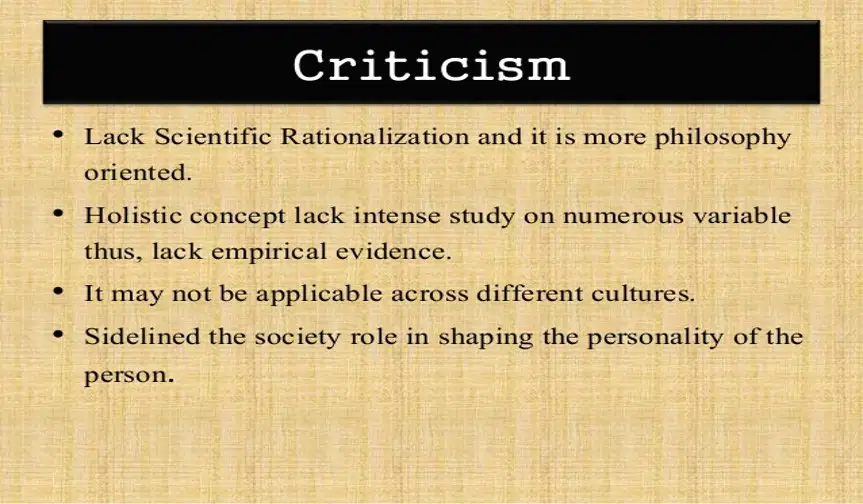
Criticisms of Rogers’s ThERAPY
•Client congruence: is the client aware of some discomfort or distress with therapy might help?
•Conditions of worth: what are the conditions the client believe he/she has to meet in order to be worthy of love, respect or attention?
•Locus of evaluation: where does the client look for judgment and evaluation about himself/herself, to others or self?
•Stage of process: looking at a client behavior, thinking and feeling where is he/she on a scale of fixity or rigidity to fluidity?
Person-Centered Theory - Therapy
Case conceptualizAtion
Goals of Therapy
Criticisms of Rogers’s ThERAPY
1.Establish relationship with client through rapport building and catharsis because it helps client to face anxiety and confusion which further helps in growth development. This will be challenging.
2.The goal is also to see, feel and experience the world as the client does.
3.To create insight.
4.Develop congruence
5.Movement from fixity to fluidity
6.Foster self-actualization, psychological wellness, and self-regard
Person-Centered Theory - Therapy
Case conceptualizAtion
Goals of Therapy
Criticisms of Rogers’s ThERAPY
Person-Centered Theory - Therapy
Case conceptualizAtion
Goals of Therapy
Criticisms of Rogers’s ThERAPY
¨A Fully Functioning Person is one who relies almost exclusively on organismic valuing processes.
Aware of all experiences without a need to deny or distort them.
Openness to experience
Existential living
Organismic trusting
Experiential freedom
Creativity
¨A Fully Functioning Person is one who relies almost exclusively on organismic valuing processes.
Able to Live in the moment without preconceived structures.
Openness to experience
Existential living
Organismic trusting
Experiential freedom
Creativity
¨A Fully Functioning Person is one who relies almost exclusively on organismic valuing processes.
Trust in their own experience; not bound by other people's opinions.
Openness to experience
Existential living
Organismic trusting
Experiential freedom
Creativity
¨A Fully Functioning Person is one who relies almost exclusively on organismic valuing processes.
Free choice agents; assume responsibility for decisions and behaviors.
Openness to experience
Existential living
Organismic trusting
Experiential freedom
Creativity
¨A Fully Functioning Person is one who relies almost exclusively on organismic valuing processes.
Able to adjust creatively and to seek new experiences and challenges.
Openness to experience
Existential living
Organismic trusting
Experiential freedom
Creativity

