
 Worksheets
super honor
Total questions: 52
Worksheet time: 26mins
Which of the below salt is soluble with water?
AgI
PbCl2
BaSO4
Ca(OH)2
The compound magnesium sulfate has the formula MgSO4. What is the relative formula mass of magnesium sulfate?
86
134
120
172
Which one of the following would you use to separate sand from iron filings?
a bar magnet
filter paper
hot plate
condenser
The separation technique that involves heating a solution until the liquid changes into a gaseous state, leaving behind a solid is known as:
chromatography
distillation
decanting
evaporation
Which method is used to obtain a concentrated solution of ethanol from a dilute solution of ethanol dissolved in water?
crystallisation
distillation
filtration
paper chromatography
Zinc sulfate is made by reacting an excess of zinc oxide with dilute sulfuric acid. The excess zinc oxide is then removed from the solution. Which process is used to obtain solid zinc sulfate from the solution?
crystallization
dissolving
filtration
fractional distillation
Which two gases are obtained from liquid air by fractional distillation?
carbon dioxide and oxygen
carbon dioxide and water vapour
nitrogen and oxygen
nitrogen and water vapour
The equation for the reaction between magnesium and dilute sulfuric acid is shown.
Mg +H2SO4→MgSO4+H2
Which mass of magnesium sulfate will be formed if 24 g of magnesium are reacted with sulfuric acid?
5g
10g
60 g
120 g
What is the concentration of a solution that contains 25.0 g NaOH in 50 cm3 of water?
12.5 mol/ dm3
0.800 mol/ dm3
1.25 mol/ dm3
3.20 mol/ dm3
A compound contains 34.5% calcium, 24.1% silicon and 41.4% oxygen by mass.
What is its empirical formula?
Ca2SiO3
CaSiO3
CaSi2O3
CaSiO6
When the following redox reaction is balanced with the lowest possible integer coefficients, what is the sum of the coefficients of all reactants and products?
Cr2O72-+H+ +Fe2+→Fe3++Cr3++H2O
6
18
36
30

A student used chromatography to analyze a green food colouring.
The chromatogram obtained is shown in Figure 1.
The table lists some yellow food dyes and their Rf values.
Which yellow food dye does the green food colouring contain?
Quinolene Yellow
Sunset Yellow
Tartrazine
Yellow 2G
15 mL of 0.25 mol L-1 aqueous silver nitrate reacts with 0.10 g of zinc as follows:
2 AgNO3 (aq) +Zn (s) →2 Ag (s) +Zn(NO3)2 (aq)
What mass of silver metal should the reaction produce?
0.16g
0.20 g
0.33 g
0.40 g
What is the empirical formula of an oxide of iron, formed by reacting 2.24 g of iron with 0.96 g of oxygen?
FeO
Fe2O
Fe2O3
Fe3O4
An aqueous cation reacts with aqueous sodium hydroxide to form a white precipitate. The precipitate is insoluble in excess sodium hydroxide. What is the aqueous cation?
aluminium ion
calcium ion
chromium ion
zinc ion
Salts can be made by adding different substances to dilute hydrochloric acid. For which substance could any excess NOT be removed by filtration?
copper(II) hydroxide
magnesium
sodium chloride
zinc hydroxide
What mass of cobalt(II) chloride hexahydrate(CoCl2·6H2O) must be used in order to make 500.0mL of a solution that has a chloride ion concentration of [Cl]=0.300 mol L-1?
9.74g
17.8g
35.7g
143g
Copper(II) carbonate is broken down by heating to form copper(II) oxide and carbon dioxide gas.
CuCO3 → CuO + CO2
31.0g of copper(II) carbonate are heated until all of the contents of the test-tube have turned from green to black. The yield of copper(II) oxide formed is 17.5g. What is the percentage yield?
19.02%
21.88%
56.50%
87.50%
Which sequence is used to separate a soluble salt from a mixture of a soluble and an insoluble salt?
add solvent, heat the mixture, crystallise the mixture
add solvent, heat the mixture, filter, crystallise the filtrate
heat the mixture, filter, crystallise the filtrate
heat the mixture, filter, add solvent, crystallise the filtrate
Which gas sample has the greatest mass?
5.0 moles of Cl2
10.0 moles of O2
15.0 moles of N2
20.0 moles of H2
A solution is 0.0240 mol L-1 KI and 0.0146 mol L-1 MgI2. What volume of water should be added to 100.0 mL of this solution to produce a solution with [I-] concentration of 0.0500 mol L-1?
106.4 mL
53.2 mL
6.4 mL
13.3 mL
An unknown amino acid contains 9.5 % nitrogen by mass as determined by elemental analysis. Which of the following could be the unknown amino acid
arginine C6H14N4O2
cysteine C3H7NO2S
histidine C6H9N3O2
glutamic acid C5H9NO4

Equal masses of a solid, X, are added in turn to an aqueous solution, Y.
The pH of the solution is measured after each addition until the pH becomes 7. The readings are plotted as shown in Figure 2. What are X and Y?
Cu, HCI
Mg, HCI
NH4CI, NaOH
Zn(OH)2, NaOH
Which property is not characteristic of a base?
It reacts with a carbonate to form carbon dioxide
It reacts with an acid to form a salt.
It reacts with an ammonium salt to form ammonia.
It turns universal indicator paper blue.
Which statement is not correct?
When a base reacts with an ammonium salt, ammonia is given off.
When an acid reacts with a base, neutralisation takes place.
When an acid reacts with a carbonate, carbon dioxide is given off.
When the acidity of a solution increases, the pH increases.
Which reaction is not characteristic of an acid?
It dissolves magnesium oxide.
It produces ammonia from ammonium compounds.
It produces carbon dioxide from a carbonate.
It produces hydrogen from zinc metal.
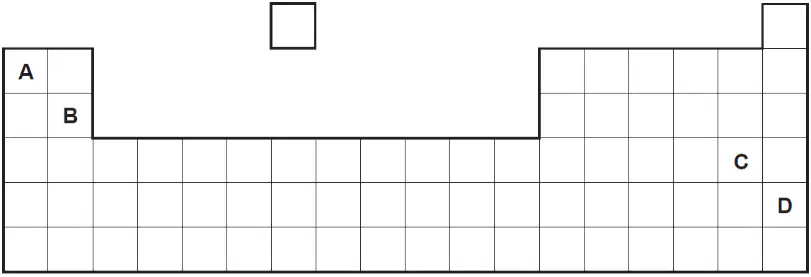
The positions in the Periodic Table of four elements are shown.
Which element is most likely to form an acidic oxide?
A
B
C
D
Which statements about alkalis are correct?
1. When reacted with an acid, the pH of the alkali decreases.
2. When tested with litmus, the litmus turns blue.
3. When warmed with an ammonium salt, ammonia gas is given off.
1, 2 and 3
1 and 2 only
1 and 3 only
2 and 3 only
What is used to test for chlorine?
a glowing splint
limewater
potassium manganate(VII) solution
damp litmus paper
The iodate ion (IO3-) can oxidize Fe2+ to Fe3+ in acid solution. If IO3- is reduced to iodide (I-) in this reaction, then the number of moles of Fe2+ that can be oxidized by 1 mole of IO3- is
2
6
4
5
Which compound is a saturated hydrocarbon?
Butanol
Butene
Butane
Butyne
Which formula represents an unsaturated hydrocarbon?
C4H8
C₄H₁0
C₃H₈
C₅H₁₂
Which statement about homologous series is not correct?
All homologous series are hydrocarbons.
Members of a homologous series have the same functional group.
Members of a homologous series have similar chemical properties.
The alkanes are an example of a homologous series.
Which of the compounds shown are in the same homologous series?
1. CH3OH 2. CH3CH2OH 3. CH3COOH 4. CH3CH2CH2OH
1, 2 and 3
1, 2 and 4
1, 3 and 4
2, 3 and 4
Which chemical equation for the substitution of an alkane with chlorine is correct?
C3H8 + Cl2 →C3H7Cl + HCl
C3H6 + Cl2 →C3H6Cl2
C3H8 + Cl2 →C3H6Cl2 + H2
C3H6 + Cl2 →C3H5Cl + HCl
Which statement about alkenes is correct?
Alkenes are saturated hydrocarbons.
Alkenes can be made by cracking other hydrocarbon compounds.
Alkenes change bromine water from colourless to brown.
Alkene molecules contain double bonds between carbon atoms and hydrogen atoms.
Ethanol is manufactured from ethene. What is an advantage of this process?
It is a continuous process.
It has high labour costs.
It needs high temperature and pressure.
It uses non-renewable materials
Which substance is in the same homologous series as methanol?
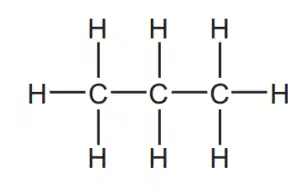
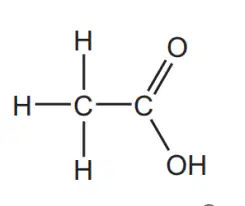
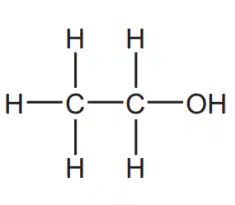
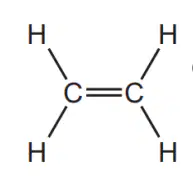
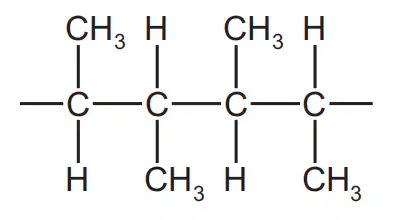
The partial structure of addition polymer X is shown in Figure 3.
Which monomer is used to form polymer X?
CH2=CH2
CH3CH=CH2
CH3CH=CHCH3
CH3CH2CH=CH2
Which statements about aqueous ethanoic acid are correct?
1. It is an alkane.
2. It reacts with sodium carbonate to form carbon dioxide.
3. It changes the colour of litmus solution from blue to red.
4. It is a hydrocarbon.
1 and 2
1 and 4
2 and 3
3 and 4
Which statements about aqueous ethanoic acid are correct?
1. Ethanoic acid contains the functional group –COOH.
2. Ethanoic acid reacts with carbonates to produce hydrogen.
3. Ethanoic acid turns Universal Indicator paper blue.
4. Ethanoic acid has a pH lower than pH 7.
1 and 2
1 and 3
1 and 4
2 and 4

The structure of compound R is shown in Figure 4.
What is R?
propane
propanoic acid
propanol
propene
Cooling will NOT increase the rate of dissolving salt in the water.
True
False
Stirring will allow more solute to be dissolved in a solvent.
True
False
CuSO4 is insoluble with water.
True
False
NH4+ is soluble together with all anions.
True
False
Milk is a very weak acid.
True
False
The ion Fe3+ forms a green precipitate with aqueous sodium hydroxide that dissolves in an excess of aqueous sodium hydroxide.
True
False
Fractional distillation is the process used to separate the fractions of crude oil.
True
False
Homologous series are groups which is largely responsible for a molecule’s chemical properties.
True
False
Alkyne are a series of hydrocarbons that contain at least one triple carbon-carbon bond.
True
False
A hydrocarbon contains only Hydrogen, Carbon and Oxygen.
True
False

