
 Worksheets
Motion
Total questions: 73
Worksheet time: 48mins
What is the speed of a car travelling 50m in 4s?
200 m/s
12.5 m/s
12.5 m
200m
How far does a lorry move if it is travelling at 12m/s for 180s?
2160 m
0.06 m
15 m
21.6 m
How long does it take a car to travel 40m at 12m/s?
4.8 s
480 s
3.33 s
33.3 s
The team of 8 rowers row 500 m in 180 s. If they keep going at the same speed, how long does it take them to row 2 km?
2.78 s
12 min
725 s
90000 s
1. Change in speed = 14 m/s; time taken = 2 seconds. The acceleration is....
6 m/s2
7 m/s
7m/s2
6 m/s
A car accelerates from rest (zero speed) up to a speed of 30 m/s in 12 seconds. Its acceleration is...
2.5 m/s2
360 m/s2
0.4 m/s2
0.4 m/s
A cyclist accelerates from 0 m/s to 8 m/s in 3 seconds. What is his acceleration?
24 m/s2
2.67 m/s2
0.375 m/s2
11 m/s2

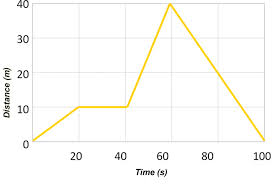

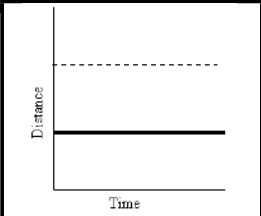
Match the description to the graph:
"The car is coming back."


Match the description to the graph:
"The car is traveling at a constant speed."
Match the description to the graph:
"The car is traveling at a constant speed."

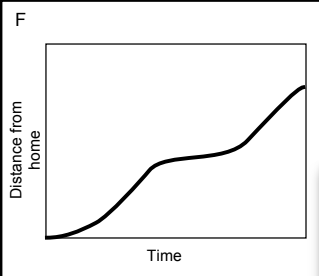
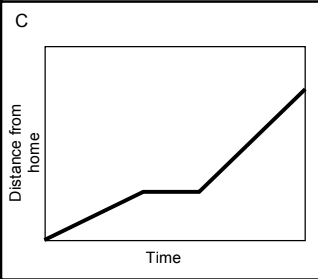
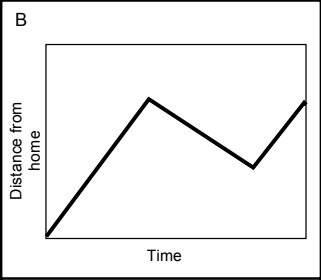
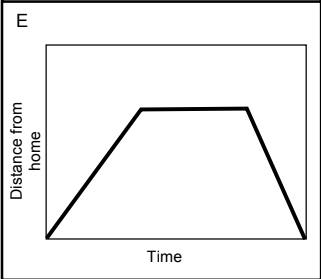


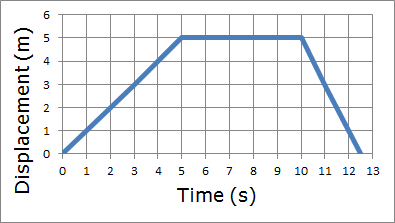

Opposite Tom's home is a hill. Tom climbed slowly up the hill, walked across the top, and then ran quickly down the other side.
Tom walked home then he stopped and waited to watch the sky. After that, he ran to get home .
Tom was walking to the park. He stopped and waited so the baby chicks could pass.
What variable should be placed on the x axis?
Distance
Time
Speed
Velocity
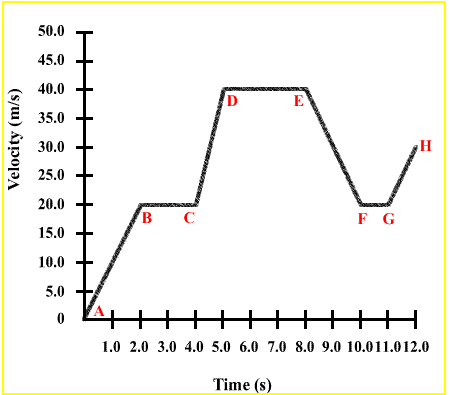
The gradient of a velocity-time graph represents (a) .
The area under a velocity-time graph represents (a) .
A flat section of a velocity-time graph represents (a) .

Describe the motion in section D.
(a)
A curve on a velocity-time graph shows that the acceleration is (a) .

Which section represents a steady speed?
A
B
C
D

Calculate the acceleration in section A
(a)

Calculate the acceleration in section C.
(a)

State the size of the acceleration in section B.
(a)

Calculate the distance travelled in section B.
(a)

Calculate the distance travelled in section D
(a)

Calculate the distance travelled in section C.
(a)


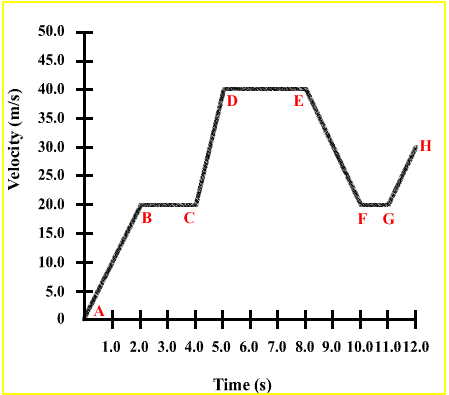


The gradient of a velocity-time graph represents (a) .
The area under a velocity-time graph represents (a) .
Calculate the distance travelled in section B.
(a)
Calculate the distance travelled in section C.
(a)
Just after she jumps out of the plane (before the parachute opens). The net force will be
zero
upward
downward

After the 60 seconds, the parachutist pulls the cord and opens her parachute.
Explain how the parachute reduces the speed of the parachutist when it is just opened.
The friction force decreases
The weight force decreases
The weight force increases
The friction force increases
When a parachute canopy is opened more drag is created because:
It has a large mass
It has a large surface area
It is travelling at terminal speed
The person is now vertical

Identify true statements:
The parachutist has just left the plane
Weight is increasing
There is no drag
Weight is constant
Deceleration


The graph shows the vertical speed of a parachutist. At which point did they open the parachute?
A
B
C
D
John, of 68kg dives out of an aeroplane
a) What is John's weight
b) What happens to John's weight as he falls?
a) 0.68N
b) stays the same
a) 680N
b) stays the same
a) 680N
b) increases
a) 0.68N
b) decreases
When a skydiver is falling what happens to
a) her velocity
b) the air resistance?
a) Increases
b) increases
a) increases
b) decreases
a) increases
b) stays the same
a) stays the same
b) increases
Explain why the skydiver will eventually stop accelerating
The air resistance continues to increase as long as the velocity increases. When the air resistance reaches the same value as the weight there will be no resultant force, hence no acceleration (F=ma)
The air resistance continues to decrease as long as the velocity increases. When the air resistance is larger than the weight there will be no resultant force, hence no acceleration (F=ma)
The air resistance stays the same so the velocity increases. There will be no resultant force, hence no acceleration (F=ma)
The air resistance continues to increase as long as the velocity increases. When the air resistance reaches the same value as the weight there will be an increase in acceleration


The unit of force is...
m/s
m
N
kg
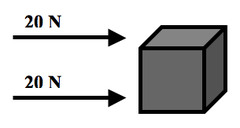
What is the resultant force?
40 N, Left
0 N, Balanced
400 N, Right
40 N, Right

What is the resultant force?
400 N, Up
400 N, Down
800 N, Up
800 N, Down

What is the resultant force?
17 N, Left
6N, Right
11N , Left
12N, Left

What is the resultant force?
40N, Left
40N, Right
0N, Balanced
75N, Right

