Wayground logo

Free Printable Worksheets

Font size

S
M
L
XL
Worksheets

Evolution/Taxonomy EOC Review

Total questions: 60

Worksheet time: 2hrs 30mins

Name
Class
Date
1.

Evolution is best defined as:

a)

the process which organisms die.

b)

the process which organisms change over time.

c)

the process which organisms that are extinct become revived.

d)

the process which non-living things fossilize.

2.

What type of evidence is shown in the image above?

a)

Fossils

b)

Vestigial structures

c)

Homologous Structures

d)

DNA

3.

Adaptations are:

a)

physical or behavioral tendencies.

b)

physical or behavioral characteristics that help an organisms survive and reproduce.

c)

physical or behavioral characteristics that do not help the organism in any way.

d)

genetic mutations that have gone wrong.
4.
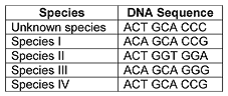
According to this data, the unknown bacterial species is most closely related to: 
a)
Species I
b)
Species II
c)
Species III
d)
Species IV
5.
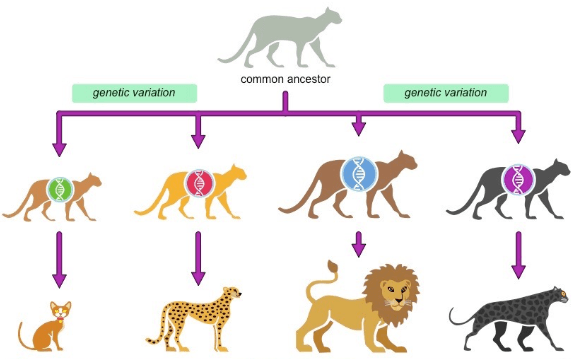
What process is being shown in this image?
a)
Variation
b)
Natural Selection
c)
Selective Breeding
d)
Homeostasis
6.

Which scientist is known for his work that he did on the Galapagos Islands to develop his theory of natural selection?

a)

Gregor Mendel

b)

Charles Darwin

c)

Anton Van Leewenhoek

d)

Robert Brown

7.

The process by which two populations of the same species become so different that they can no longer interbreed.

a)

natural selection

b)

artificial selection

c)

speciation

d)

fossilization

8.
In natural selection, the selective agent is the
a)
humans
b)
mutations
c)
breeders
d)
environment
9.
Mutations are important because they bring about
a)
death of the organism in which they develop
b)
genetic variation needed for a population to evolve
c)
benefits for the individual, not for the population
d)
Hardey-Weinberg equilibrium within a population
10.
Genetic differences between organisms of the same species
a)
Variation
b)
Adaptation
c)
Behavior
d)
Environment
11.
a)

A

b)

B

c)

C

d)

D

12.
a)

F

b)

G

c)

H

d)

J

13.
a)

A

b)

B

c)

C

d)

D

14.
a)

F

b)

G

c)

H

d)

J

15.
a)

A

b)

B

c)

C

d)

D

16.
a)

A

b)

B

c)

C

d)

D

17.
a)

F

b)

G

c)

H

d)

J

18.
a)

A

b)

B

c)

C

d)

D

19.
a)

A

b)

B

c)

C

d)

D

20.
a)

A

b)

B

c)

C

d)

D

21.
a)

A

b)

B

c)

C

d)

D

22.
a)

A

b)

B

c)

C

d)

D

23.
a)

A

b)

B

c)

C

d)

D

24.
a)

A

b)

B

c)

C

d)

D

25.
a)

A

b)

B

c)

C

d)

D

26.
a)

F

b)

G

c)

H

d)

J

27.
a)

A

b)

B

c)

C

d)

D

28.
a)

A

b)

B

c)

C

d)

D

29.
a)

F

b)

G

c)

H

d)

J

30.
a)

A

b)

B

c)

C

d)

D

31.
a)

A

b)

B

c)

C

d)

D

32.
a)

F

b)

G

c)

H

d)

J

33.
a)

A

b)

B

c)

C

d)

D

34.
a)

F

b)

G

c)

H

d)

J

35.
a)

A

b)

B

c)

C

d)

D

36.
a)

F

b)

G

c)

H

d)

J

37.
a)

A

b)

B

c)

C

d)

D

38.
a)

F

b)

G

c)

H

d)

J

39.
a)

F

b)

G

c)

H

d)

J

40.
a)

F

b)

G

c)

H

d)

J

41.
a)

A

b)

B

c)

C

d)

D

42.
a)

A

b)

B

c)

C

d)

D

43.
a)

F

b)

G

c)

H

d)

J

44.

Which is the Sun Bear more related to?

a)

Lesser Panda

b)

Giant Panda

c)

Brown Bear

d)

Spectacled bear

45.

Which is the Sun Bear more related to?

a)

Lesser Panda

b)

Giant Panda

c)

Raccoon

d)

Dog

46.

What are the levels in order of classification

a)

Kingdom, Phylum, Class, Order, Family, Genus, Species

b)

Kingdom, Class, Order, Family, Genus

c)

Taxonomy, Kingdom, Class, Family, Order, Genus, Species, Sub species

d)

Kingdom, Family, Species, Genus, Order, Class, Phylum

47.

What are the Kingdoms?

a)

Animals, Plants, Fungi, Bacteria, Marine animals, Protists

b)

Animal, Plant, Protist, Fungi, Bacteria, Chordata

c)

Animal, Plant, Eubacteria, Archaebacteria, Fungi, Protists

d)

Eubacteria, Archaebacteria, Fungi, Protists, Plants, Protobacteria

48.
Answer the Question. 
a)
A
b)
B
c)
C
d)
D
49.
A table of arachnid and insect characteristics is shown. Which characteristic could be used to distinguish between
arachnids and insects?
a)
Jointed legs
b)
Body segments
c)
Presence of eyes
d)
Presence of antennae
50.
An illustration and a dichotomous key are given. What is the correct classification for this organism?
a)
Class Insecta
b)
Order Amblygygi
c)
Order Araneae
d)
Order Scorpiones
51.
Who first proposed binomial nomenclature as a way of classifying organisms?
a)
Carl Linnaeus
b)
Carl's Jr.
c)
Charles Darwin
d)
Henry Groseclose
52.
Members of which kingdom are multicellular and heterotrophic?
a)
Plantae
b)
Protista
c)
Animalia
d)
Achaebacteria
53.
Which kingdoms contains members who are prokaryotic?
a)
Archaebacteria and Eubacteria
b)
Archaebacteria and Protista
c)
Eubacteria and Animalia
d)
Eubacteria  and Fungi
54.
The scientific name for an organism is made from the:
a)
class and family
b)
genus and species
c)
domain and kingdom
d)
kingdom and phylum
55.
a)

A

b)

B

c)

C

d)

D

56.
a)

A

b)

B

c)

C

d)

D

57.
a)

A

b)

B

c)

C

d)

D

58.
a)

F

b)

G

c)

H

d)

J

59.
a)

A

b)

B

c)

C

d)

D

60.
a)

A

b)

B

c)

C

d)

D