
 Worksheets
Protein Synthesis
Total questions: 65
Worksheet time: 33mins
Which of the following are differences in the structure between RNA and DNA
DNA uses deoxyribose sugar, RNA uses sugar ribose
DNA pairs Adenine with Uracil, RNA pairs Adenine with Thymine
DNA is a double helix, RNA is a single helix
DNA pairs Adenine with Thymine, RNA pairs Adenine with Uracil
During transcription, this type of ribonucleic acid is responsible for copying the DNA and brining it out of the nucleus.
tRNA
mRNA
rRNA
dRNA
When these bond together, they form a protein
Amino Acids
Peptide Bonds
Ribose
Nucleotides
These building blocks consist of a sugar, phosphate, and nitrogen base.
Ribose
Nucleotide
Gene
Protein
A string of nucleotides that contain the information to make a specific protein
Ribose
Amino Acids
tRNA
Gene
During translation, this type of ribonucleic acid is responsible for delivering amino acids to help make a protein.
mRNA
rRNA
tRNA
dRNA
There are a total of ____ different amino acids
20
1
4
unlimited
mRNA occurs during this process
Translation
Transcription
Replication
Delivery
How many amino acids are found on one tRNA?
20
4
1
3

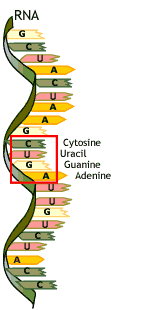
In what process is mRNA synthesized?
Transcription
Translation
DNA Replication
Mitosis

Why must transcription occur in the nucleus?
because DNA can't leave the nucleus
because ribosomes are in the nucleus
because DNA polymerase is found there
because helicase unzips the DNA
How are DNA and RNA different? (CHECK ALL THAT APPLY)
Only DNA can leave the nucleus
RNA contains Thymine; DNA contains Uracil
DNA is double stranded, RNA is a single stranded
DNA contains Thymine, RNA contains Uracil
Which organelle contains rRNA and reads the mRNA to synthesize a protein?
Ribosome
Nucleus
Cytoplasm
Nucleotide
Choose the sequence of the mRNA strand that would match up with to the following DNA strand:
GTACAT
CATGTA
GAUCUA
CAUGUA
CUTGTU

What brings the amino acids to the ribosome to assemble a protein?
DNA
How many nucleotides code for 1 amino acid?
1
2
3
4
When these bond together, they form a protein
Amino Acids
Peptide Bonds
Ribose
Nucleotides

Which anticodon would be placed in spot #2
GGC
CCA
GGA
GGT

Which process does this diagram illustrate?
transcription
DNA replication
translation
What determines the shape and function of a protein?
The sequence of amino acids
The type of ribosome that assembles the protein
The cell that manufactures the protein

True or False: mRNA contains anticodons and tRNA contains codons.
True
False
How can a mutation in the DNA sequence result in NO change to the protein that is made?
There are multiple codons that can code for the same amino acid and result in the same protein
There is always a change in the protein when a mutation occurs
Only the mRNA is used in protein synthesis so a mutation in the DNA would have no effect on the protein
The process of polymerization of amino acids to form a polypeptide chain is called (a)
The mRNA molecule is always translated in which polarity?
3' to 5'
5' to 3'
mRNA molecule is always complementary in nature to_____
cDNA
tRNA
3'-5' DNA
None of the above
The codon in the mRNA is read by ______ in the tRNA molecule
Nucleotides
Nitrogenous bases
Purines and pyramidines
Anticodon
Why are the codons in the tRNA molecules are called anticodons?
Because they are complementary to the sequence in the mRNA.
Because they are opposite of the codons.
Because they are non-nitrogenous bases
Which organelle in the cell is involved in making the proteins?
(a)
Why are tRNA molecules are called adapter molecules?
Because of its plug like appearence.
Because they carry amino acids from the amino acid pool to the site of protein synthesis.
Because of its clover leaf shape.
The process of adding amino acids to the tRNA molecule is called
Amino acylation of tRNA molecule.
Charging of the tRNA molecule.
Transfer of amino acid to the tRNA
Coding of amino acid to the tRNA
Which of the following is the characteristics of prokaryotic ribosomes?
60S larger subunit, 40S smaller subunit
50S larger subunit, 30S smaller subunit,
What does S in the name of the subunits of the ribosomes denotes?
(a)
What does Svedberg unit signifies?
(a)
The sequences of the entire genome which can be used either in the process of replication or translation is called___
Junk DNA
Non readable frames
Reading frames
Open reading frames
A sequence in the genome and in the RNA that can be used in the translation process is called an ORF
False
True
ORF stands for (a)
What is a translation unit in the mRNA?
A nucleotide sequence
A coded language of the proteins
A sequence which starts with a start codon and ends with a stop codon coding for a polypeptide sequence
A complementary sequence of the template DNA
UTR stands for
(a)
Does UTRs are used in the process of translation
No
Yes
Where are UTRs usually found in the mRNA sequence?
only before the start codon
nowhere in the mRNA sequence
only after the stop codon
before the start of the start codon and after the end of the stop codon
Addition of a formyl group to the amino acid methionine is called _____
Transfer reaction
Nucleophile substitution reaction
Formylation reaction
Ionization reaction
Formylated methionine tRNA acts a initiation amino acid in?
Eukaryotic organisms
Prokaryotic organisms

