
 Worksheets
BIG FAT PHYSICS QUIZ OF THE YEAR!
Total questions: 60
Worksheet time: 30mins
A step-up transformer has more turns on the primary coil than the secondary coil.
True
False
A transformer has 15 turns on its primary coil and 30 turns on its secondary coil. This is a....
step-up transformer
step-down transformer
Efficiency of a transformer is
(output current)/(input current) x100%
(output voltage)/(input voltage) x100%
(output loss)/(input loss) x100%
(output power)/(input power) x100%
A secondary coil of a transformer has 500 windings. It was supplied with 200 V. How many windings needed at primary coil to produce 100 V.
(a)
Transformer is device that
converts AC voltage to current
converts electrical energy to kinetic energy
converts AC voltage to a different level at the same amplitude
converts AC voltage to a different level at the same frequency
Select the facts about transformer.
Will not work with DC and AC
Will not work with DC
AC will produce change in magnetic field
AC will induce current


What type of current is being produced?
Alternating
Direct

Name the following law: A moving magnet creates an opposing magnetic field.
Ampere's Law
Faraday's Law
Lenz's Law
Coulomb's Law

Which activity will produce the highest current?
Move the magnet bar into the coil while the coil remains stationery
Move the coil into the magnet bar while the magnet remains stationery
Move the coil and magnet towards each other
Move the coil and magnet away from each other

A magnet is moved in and out of a coil of wire connected to a high-resistance voltmeter. If the number of coils doubles, the induced voltage
quadruples
doubles
is the same
halves
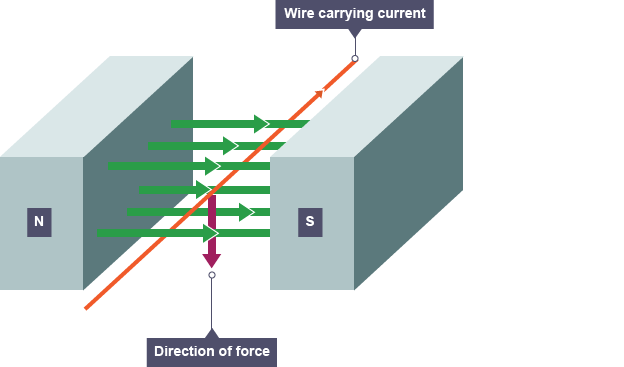
Why might a current-carrying wire be placed between a magnetic field?
To increase the current from the interaction of magnetic fields
To increase the voltage from the interaction of magnetic fields
To produce a force from the interaction of magnetic fields
What does the thumb indicate in flemings left hand rule?
Force
Motion
Current
Magnetic field direction
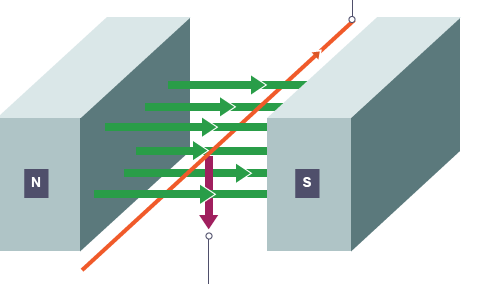
What direction is the force/motion in the following diagram?
Perpendicular to the magnets
Downwards
Parallel and through the magnets
Which rule can be used to work out which way a coil of wire rotates in a motor?
Fleming's left-hand rule
Fleming's right-hand rule
Give two ways you can reverse the direction of a basic dc motor?
Reverse the current
Keep the current the same
Reverse the magnetic field
Keep the magnetic field the same
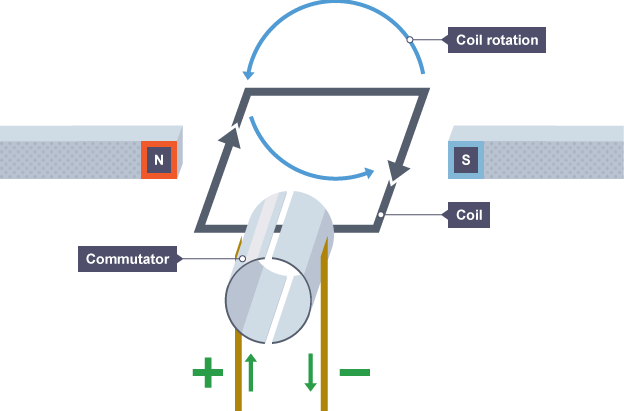
How does a split ring commutator work?
Swaps the contact evert full turn, so that the left-hand and right-hand arms of the coil always experience a force in the same direction.
Swaps the contact evert half turn, so that the left-hand and right-hand arms of the coil do not experience a force in the same direction.
Swaps the contact evert half turn, so that the left-hand and right-hand arms of the coil always experience a force in the same direction.
In Fleming's left hand rule, what does the second finger stand for?
Movement
Field
Current
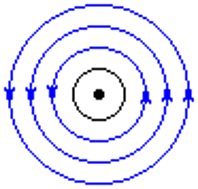
In this diagram, which way is the current flowing?
Into the page
Out of the page
Left to right
Right to left
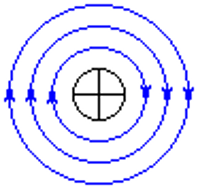
In this diagram which way is the current flowing?
Into the page
Out of the page
Left to Right
Right to Left
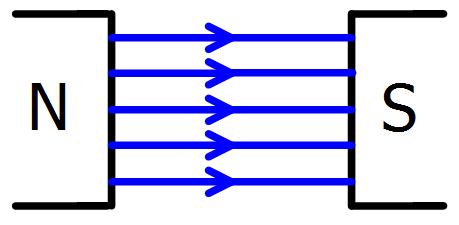
A magnetic field like this is called...
a parallel field
a distorted field
a uniform field
a paramagnetic field
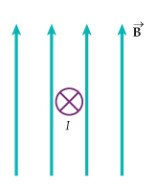
The diagram show the direction of magnetic field,B. The current is going into the page.
By using Fleming left hand rules, determine the direction of Magnetic force, F.
no force produced
right
into the page
out from the page

A current carrying wire is in a magnetic field. In which direction will there be a force on the wire?
up
down
left
right

The force on this current-carrying wire is upwards, what is the direction of the current in the wire?
from X to Y
from Y to X

A current-carrying wire has its (conventional) current flowing into the page. The wire is in a uniform magnetic field directed to the right (always N to S). What direction is the force on the wire?
up
down
left
right

An electron, traveling to the right, enters a magnetic field.
The magnetic field is uniform in the region and directed out of the page. What direction is the force that acts on the electron as it enters the field?
up
down
left
right

What factor of the ac current affects the frequency of the sound wave produced by a loud speaker?
Wavelength
Frequency
Amplitude
Voltage
The force experienced by the current-carrying conductor, when placed in a magnetic field is known as --------.
Lorentz Force
Faraday's Force
Hans Force
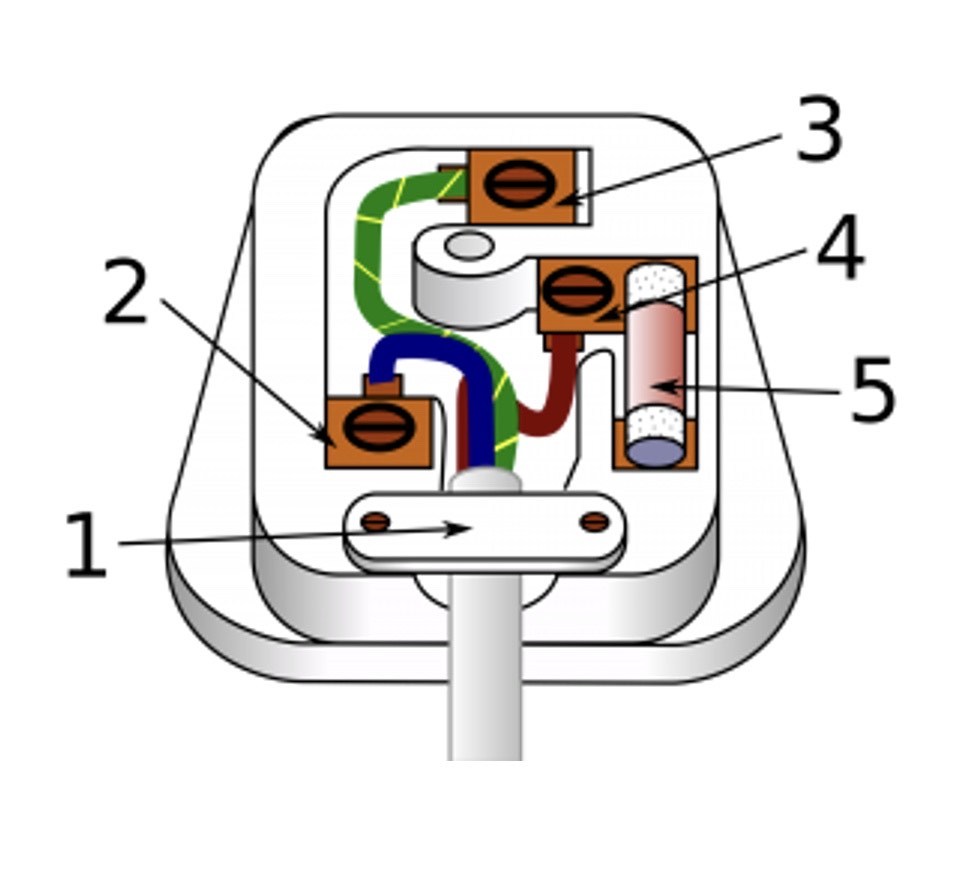
What is the name of the pin labelled 2 in the diagram?
Earth
Neutral
Live
What colour is the Earth wire in a plug?
Red
Red and black
Green
Green and yellow
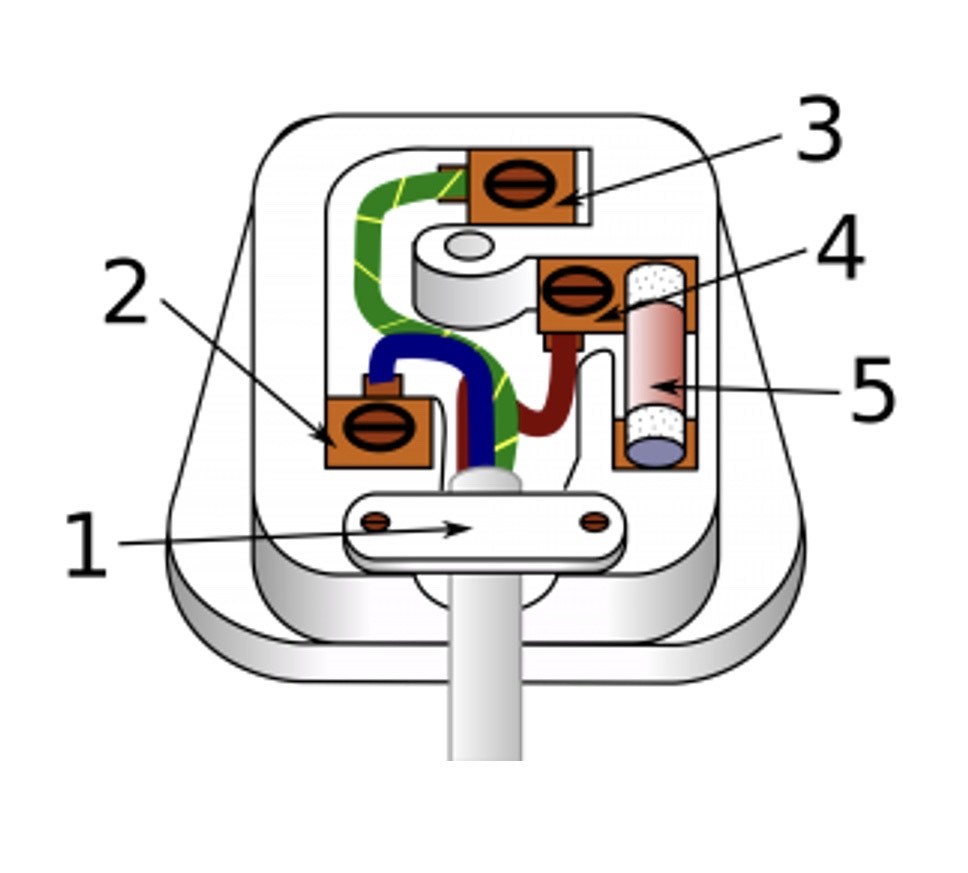
Which is the live wire in the diagram?
Number 2
Number 3
Number 4
Number 5
What is the potential difference of the mains electricity supply? (a) volts
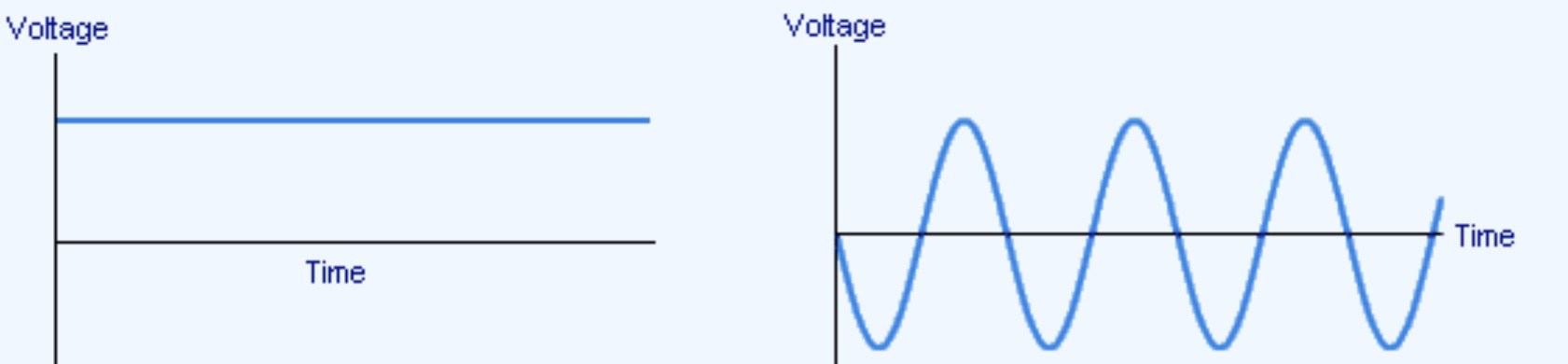
What does the graph on the left show?
direct current
alternating current

Imagine the diagrams are numbered 1,2,3,4 from left to right.
Which is the symbol for a fuse?
1
2
3
4
A higher resistance in a circuit causes a _____________.
higher voltage
larger current
smaller current
lower voltage
Which of the following is not a source of electrical energy?
ammeter
dry cell
mains
dynamo
A 2200W kettle is connected to the 230 V mains supply, Which fuse should be used?
3
5
9
13
Alternating current is used because...
it can be easily changed and therefore is suitable for long distance travel
it remains constant and is therefore suitable for long distance travel
it uses less energy than direct current and therefore less overall energy is used
it doesn't degrade the wires and therefore they last longer
How do you calculate resistance?
Divide voltage by current
Divide charge by current
Multiply current by voltage
Multiply voltage and current
What is the resistance if the voltage is 10V and the current is 2A?
20 Ω
5 Ω
12 Ω
8 Ω
How do you measure potential difference in a circuit?
Voltmeter
Ammeter
Thermistor
Battery pack

The total resistance in this circuit is
100 ohms
450 ohms
400 ohms
30 ohms
the formula to find current when the values of V and R are known is
I = V2R
I = V/R
I = R/V
I=VR
In a series circuit with a constant voltage, what happens to the current as you add more loads or more resistance?
Current increases
Current decreases
Current decreases then increases
Current remains the same
Which of the following is Ohm's Law?
Current is proportional to Voltage and inversely proportional to resistance.
Current is proportional to Resistance and inversely proportional to Voltage
Resistance, Current and Voltage are proportional to each other.


Which type of radiation releases an electron?
Alpha radiation
Beta radiation
Gamma radiation
Theta radiation
what do you find in the nucleus of an atom
Electrons and Protons
Protons and Neutrons
Neutrons and Electrons
none of these
calculate the half life if 12g of californium-237 reduces to 1.5g in 6 seconds
6 seconds
3 seconds
2 seconds
237 seconds

The Half Life of Californium 252 is 5 years.
TRUE
FALSE
A certain radioactive sample has a half life of 2 years. After 6 years, how much of the sample is left?
1/2
1/3
1/16
1/8
The half-life of Zn-71 is 2.4 minutes. If one had 100.0 g at the beginning, how many grams would be left after 4.8 minutes has elapsed?
100.0g
25.0g
12.5g
8.5g
Which material could be used to block gamma radiation?
Paper
Concrete
Water
Steel
What name is given to a radioactive sample which is used to detect damage in the body.
Indicator
Tracer
Diagnostic Sample
Nuclear tracker
Which product of nuclear decay is a form of electromagnetic radiation?
Alpha
αBeta
β
Gamma
γ
Which option describes an alpha particle?
An electron
A helium atom
A helium-4 nucleus
A neutron
What is the heaviest of all the products of nuclear decay?
Beta
Gamma
Alpha
Neutron

