
 Worksheets
VA Permit Practice Quiz🚙
Total questions: 70
Worksheet time: 57mins
You cannot turn right on red in what following conditions?
A sign reads "No Turn on Red"
If another vehicle has the right of way
A red arrow is pointed towards you.
You are stopped by the red light in front of you.
When are you allowed to turn left on red?
Never in the State of Virginia
Turning right on a one-way street
Turning left onto a one-way street or two-way street.
Turning left onto a one-way street
When are you not allowed to turn left on red?
It is not allowed to turn left on red at all
If a sign is posted at the intersection that states, "No Turn on Red"
A red arrow pointing to the left is displayed
When there are pedestrians crossing the street.
Before turning left on red, you have to..
Come to a complete stop and go when the road is clear
Yield to traffic and go when there is a clear intersection
Come to a complete stop and yield to any right-of-way pedestrians
Wait until the light turns green and proceed towards traffic
What does the red arrow specify?
You must stop if intending to move in the direction of the arrow
You are not allowed to go in that specific direction
There is construction happening ahead' to proceed with caution
You must stop and go another way.
When are you not allowed to proceed with a red arrow?
Never.
If a sign is posted to not enter in that specific direction
If a police officer is telling you to not proceed.
All of the above
What two signs allow you to proceed with a red arrow light?
“Right on Red Arrow After Stop”
“Left on Red Arrow After Stop.”
"Right on Red Only"
"Left On Red Only"
What does a flashing red light signify?
There is an ongoing police investigation up ahead, yield towards it.
Come to a complete stop and yield to vehicles and pedestrians
Danger Zone
"Do Not Enter". Turn your car around the other way.
True or False: At a railroad crossing, you must come to a complete stop at a flashing yellow light even if you don’t see a train.
(a)
What do you do when approaching a flashing red arrow?
You are not allowed to go into that direction
Make a U-Turn and go another direction
Yield to oncoming traffic and proceed with caution
Come to a complete stop and yield the right-of-way to vehicles coming from the other direction and pedestrians
What do yellow lights and arrows signify?
Yield to oncoming traffic and/or pedestrians
Caution warnings that the light is going to change
Cautiously go through the light before it turns red
All of the above
What are the steps with approaching a yellow light or arrow?
If you have entered the intersection, press on your brakes carefully. If it is unsafe to stop, go through it after the right-of-way. If you are already in the intersection, go through it.
If you have entered the intersection, go through it before it turns red carefully. If it unsafe to stop, cautiously go through it. If you are already in the intersection, go through it safely and cautiously.
If you have entered the intersection, brake immediately. If it is unsafe to stop, cautiously go through it. If you are already in the intersection, go through it cautiously.
If you have not entered the
intersection you have to stop. If it is unsafe to
stop, cautiously go through it. If
you are already in the intersection, go through it cautiously.
What does a flashing yellow light specify?
Yield to pedestrians and oncoming traffic
To slow down and proceed with caution.
Proceed with caution towards oncoming traffic
Yield to oncoming traffic until it is safe and clear to proceed.
Where are flashing yellow lights located?
Locations in dangerous, hazardous conditions
Locations near or on the tunnel
Locations with higher-than-normal hazardous conditions.
Locations with higher risk of accidents and/or road rage occurence
True or False: At a flashing yellow arrow, you may turn in the direction of the arrow, if the way is clear. Make sure to yield
the right-of-way to vehicles coming from the other direction and pedestrians in the intersection.
True
False
True or False: If a traffic light changes from red to flashing yellow arrow while a pedestrian is in the intersection, allow the pedestrian to cross the street before turning.
True
False
It is illegal to avoid these traffic controls by cutting through..
Any time.
Cutting through a parking lot or field
Cutting through the intersections of the road
Cutting off people in the road
Obey all signs and signals unless directed by..
A police officer
A construction worker
Firefighters
All of the above
At a red light, you are supposed to..
Come to a complete stop and then proceed to go when the light is green.
Stop and then proceed to go when the light is green
Press on the brakes aggressively.
Come to a complete stop
What happens if there is no stop line at the red light?
Stop closest to where the other cars are stopping near.
Stop before entering the intersection or crosswalk
Stop before the pedestrian crossing line
Stop right at the light.
True or False: Remain stopped as long as the signal is red, unless allowed.
(a)
Are you allowed to turn right on red? If so, when can you do so?
No. Because the light is red, you are supposed to wait until the light turns green
No. There is ongoing traffic on the freeway or highway that can be dangerous for you to make a turn on.
Yes. But, you must come to a complete stop. Look both ways and yield the right-of-way to pedestrians and other traffic.
Yes. You have the right-of-way to complete the right turn.
What does the green light and arrow specify?
You are allowed to go when it is clear to go.
You are allowed to go, for you have the right-of-way.
You are allowed to go after yielding to oncoming traffic
You are allowed to go until the light is turned red.
True or False: If you
are turning without a green arrow,
you still have the right-of-way
to vehicles coming from the other
direction and pedestrians in the
intersection.
(a)
What do you do when a traffic light changes from red to green while a pedestrian
is in the street?
Yield to the pedestrian then ongoing traffic then proceed onto the road.
You are able to go because you have the right of way.
Yield and/or stop to oncoming pedestrian on the road
Allow the pedestrian to cross before turning
When traffic signals are not working because of a power outage or other problem and not displaying any lights, what are you supposed to do?
Stop and pay attention to law enforcement or any authorized person directing traffic
Stop then proceed through the intersection as though it were an all-way stop
Drive carefully and cautiously as if you were at a four-way stop.
Wait until portable stop signs are in use.
What does the color and shape of a traffic sign communicate to drivers?
What is expected of that driver
What the sign is saying
Important information about the sign's message
All of the above
What do red used with white convey signs to a driver?
Wrong Way, Do Not Enter, "No"
"No", Stop, Wrong Way
Yield, Do Not Enter, Wrong Way
Stop, Yield, Do Not, and "No"
What do black used with white signs convey to drivers?
Regularly information
Guiding information
Sensory information
Important information
What does yellow used with black signs convey to drivers?
A caution
A warning
An emergency
To yield
Fill In The Blank: A specialized class of warning signs uses a strong_______ color with black to advise of school zone, pedestrian and/or bicyclist activities
Green/White
Yellow/Black
Yellow/Green
Yellow/White
What color signs are used to provide helpful information?
Blue and white
Brown and white
Green and white
All of the above
What does the green sign convey to drivers?
Provides destination types of information
Provides directions to your destination
Provides exits on the highways
Provides directory information to different states
What does the blue sign convey to drivers?
Inform to bicyclist only
Inform of emergency call numbers
Inform to motorist only
Inform regarding motorists services
What does the brown sign convey to drivers?
To advise of historical or cultural interests that might exist in the area.
To advise the driver of the dangers in the area
To advise the drivers of flood warnings
To advise the driver of road changes
Fill In The Blank: Orange and black and pink and black signs are used to advise and warn in _____(orange) and _____(pink) areas.
1. Construction
2. Incident
1. Incident
2. Construction
What does red markings mean on the road?
Indicate "Do Not Enter"
Indicate no parking zones
Indicate "Wrong Way"
Indicate "Stop"
What does red reflectors on the pavement mean on the road?
Show areas not to be entered or used
Show people going in the wrong direction of the road
Show and indicate the "Do Not Enter-Wrong Way" sign on the road
Show and indicate a danger zone.
What do yellow center lines mean on the road?
Two-way traffic flowing in opposite directions but can pass each other
Two-way traffic flowing in opposite directions.
Two-way traffic flowing in the same direction
Two-way traffic flowing in the same direction but able to merge
What do broken yellow center lines mean on the road?
Passing is not allowed
Passing on either side is allowed in either direction when the way ahead is clear.
Passing on the right is allowed in either direction when the way ahead is clear.
Passing on the left is allowed in either direction when the way ahead is clear.
What does a broken yellow line alongside a solid yellow line mean on the road?
Passing is allowed from the side of the solid line, but not from the side of the broken line
Passing is allowed from the side of the broken line, but not from the side of the solid line.
Passing is allowed from the side of either side
Passing is not allowed from either side of the road, for it can cause accidents
True or False: Vehicles on the solid yellow
line side may only cross the
line to pass pedestrians,
bicyclists, and riders of scooters or skateboards, when the opposite lane is clear and you can pass safely.
(a)
What do double solid yellow lines mean on the road?
Mark the end of the road and needing to merge in another line due to lane reduction
Mark the center of the road and separate traffic traveling in two different directions
Mark the side of the road; passing is allowed and allowed to merge
Mark the center of the road and separate traffic traveling in the same direction
True or False: Passing is not allowed in either direction for double solid yellow lines. You may
not cross the lines unless
you are making a left turn
or passing pedestrians, bicyclists, and riders of scooters or skateboards, when the opposite lane is clear and you can pass safely.
(a)
What do dotted white lines mean on the road?
Separate lanes of traffic going in the same direction. You may change lanes with caution.
Separate lanes of traffic going in opposite directions. Passing is not allowed
Separate lanes of traffic. Passing is allowed when way is clear
None of the above
True or False: Dotted white lines
are also used to denote the opening of a turn lane at an intersection and entrance/exit lanes at interchanges.
(a)
True or False: Many one-lane roads in Virginia do not have lane markings to separate the lanes.
(a)
Fill In The Blank: On an unmarked two-lane road, you may pass a ______ on the left side if there are no signs prohibiting passing.
Slow-moving vehicle
Fast-moving vehicle
True or False: Solid white lines show turn lanes and discourage lane changes near intersections, interchange/on- and off-ramps, and at other locations where lane changes might be dangerous.
(a)
Where are the solid white lines marked at on the road pavement?
Rear End
Left Edge
Right Edge
Front End
True or False: If you are in a lane marked with a curved arrow or a curved arrow and the word ONLY, you must not turn in the direction of the arrow.
(a)
True or False; If your lane is marked with both a curved and straight arrow at an intersection, you may turn or go straight.
(a)
What do the double solid white lines separate
Lanes of traffic going in the opposite direction
Lanes of traffic going in the same direction
Lanes of traffic going against each other
True or False: The Double Solid White Lines are mainly used to designate special use lanes from conventional lanes, such as High Occupancy Vehicle lanes
(a)
Are you allowed to cross the double solid white lines?
Yes
No
True or False: Yield line is a line of triangles extending across the roadway that may be used with a yield sign to show the point at which you must yield or stop, if necessary.
(a)
True or False: A yield line is often seen at the entrance of an intersection.
(a)
Fill In The Blank: On three-lane roads with traffic moving in both directions, road markings show when drivers may use the center lane for making left turns or for _______
Passing
Entering
Pulling Off
All of the above
True or False: If the center lane is marked by a single broken yellow line on both sides, drivers traveling in either direction may use the center lane for passing.
(a)
True or False: If both sides of the center lane are marked by a solid yellow line and a broken yellow line, drivers traveling in either direction may use the lane for making left turns.
(a)
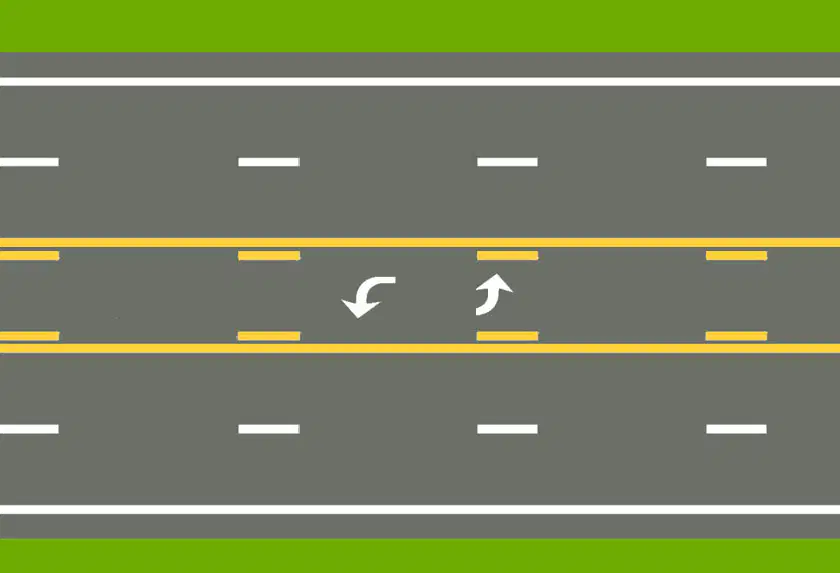
How many feet are you not allowed to travel through in the center marked lane by a solid yellow line and a broken yellow line
75
150
50
100
What does a shared lane marking or shadow consist of on the road?
Shared with motorcyclist symbol and cars
Shared with bicyclist symbol with a double chevron arrow above it and cars
Shared with trucks symbol with a single chevron and cars
Shared with pedestrians and cars
True or False: Sharrows clarify where bicyclists are encouraged to ride in the lane and remind drivers to expect bicyclists
on the road.
(a)
How are bicycle lanes indicated on the road?
By a solid green and white line with a bicycle system
By a dashed white line or pavement parking with the bicycle system
By a solid or dashed white line or green pavement markings, and a bicyclist symbol
By a dashed black and white line and pavement parking with a bicycle symbol
True or False: Drivers should not drive in the bicycle lane except when necessary to turn left or right.
(a)
On the road, how are bicycle boxes painted and what do they contain?
They are painted on the sidewalk of an intersection and contain a bright yellow bicycle symbol
They are painted on the road at intersections and contain a white bicycle symbol
They are painted on the side of the work at intersections and contain a white bicycle symbol
They are painted on the pedestrian side of the road and contain a black bicycle symbol
Fill In The Blank: Bike
boxes and
the bike lanes
approaching
and leaving
the box may be painted ____
Yellow
White
Red
Green
True or False: Drivers must stop for a red traffic signal in all bicycle boxes to reduce traffic and road rage
False
True
True or False: Right turns on red are allowed at bicycle box intersections. If turning right on a green light, drivers must signal and yield to bicycles on the right.
(a)
How are High Occupancy Vehicles (HOV) Lanes marked on highways?
Square shape in the center of the lane
Diamond shape in the center of the lane
Rectangular shape in the center of the lane
Circle shape in the center of the lane

