wayground logo

Free Printable Worksheets

Font size

S
M
L
XL
Worksheets

MAT-172 Exam Part 2 Review

Total questions: 70

Worksheet time: 4hrs 9mins

Name
Class
Date
1.

cos2x=\cos^2x=  

a)

1+sin2x1+\sin^2x  

b)

sin2x 1\sin^2x\ -1  

c)

1sin2x1-\sin^2x  

d)

1sec2x\frac{1}{\sec^2x}  

e)

1csc2x\frac{1}{\csc^2x}  

2.

sin(a + b)

a)

sin a sin b + cos a cos b

b)

sin a sin b - cos a cos b

c)

sin a cos b + cos a sin b

d)

sin a cos b - cos a sin b

3.

cos (a - b)

a)

cos a cos b + sin a sin b

b)

cos a cos b - sin a sin b

c)

cos a sin b - sin a cos b

d)

cos a sin b + sin a cos b

4.

tan (ab)=\tan\ \left(a-b\right)=  

a)

tanatan b1+tanatanb\frac{\tan a-\tan\ b}{1+\tan a\tan b}  

b)

tana+tanb1+tanatanb\frac{\tan a+\tan b}{1+\tan a\tan b}  

c)

tanatanb1tanatanb\frac{\tan a-\tan b}{1-\tan a\tan b}  

d)

tana+tanb1tanatanb\frac{\tan a+\tan b}{1-\tan a\tan b}  

5.

Solve for x

cos x = sin 50

a)

50

b)

130

c)

40

d)

-50

6.

sec (2x - 20)= csc (60)

a)

25

b)

40

c)

70

d)

60

7.

sin 2x=

a)

2 sinx

b)

cos2xsin2x\cos^2x-\sin^2x

c)

±1cosx2\pm\sqrt{\frac{1-\cos x}{2}}

d)

2 sin x cos x

8.

cos 2x=

a)

2 sinx cos x

b)

cos2x  sin2x\cos^2x\ -\ \sin^2x

c)

2cos2x 12\cos^2x\ -1

d)

12sin2x1-2\sin^2x

e)

12cos2x1-2\cos^2x

9.

sin (x2)\sin\ \left(\frac{x}{2}\right)  

a)

±1cosx2\pm\sqrt{\frac{1-\cos x}{2}}  

b)

±1+cosx2\pm\sqrt{\frac{1+\cos x}{2}}  

c)

1cos xsin x\frac{1-\cos\ x}{\sin\ x}  

d)

sin x1+cos x\frac{\sin\ x}{1+\cos\ x}  

10.

cos (x2)=\cos\ \left(\frac{x}{2}\right)=  

a)

sin x1+ cosx\frac{\sin\ x}{1+\ \cos x}  

b)

1cos xsin x\frac{1-\cos\ x}{\sin\ x}  

c)

±1cosx2\pm\sqrt{\frac{1-\cos x}{2}}  

d)

±1+cos x2\pm\sqrt{\frac{1+\cos\ x}{2}}  

11.

Given that cos(u)=3/5 and 0<u<pi/2. What is the sin(2u)?

a)

4/5

b)

8/5

c)

9/25

d)

24/25

12.

Use the half-angle formula to find the exact value of sin(15 degrees).

a)

+/- sqrt(1-(sqrt(3)/2))/2

b)

+/- sqrt(2 - sqrt(3))/2

c)

+/- 1-sqrt(3)/2

d)

+/- sqrt(1-sqrt(3))/2

13.
Use the information about the angle θ, 0≤θ<2π to find the exact value of 
sin (θ/2)
2. sin θ= 3/5 , 0<θ<π/2
a)
√10/10
b)
24/25
c)
25/7
d)
-7/25
14.
Use the Half-angle formulas to find the exact value of each expression
sin 22.5º
a)
√(2 + √3)/2
b)
√(2 - √2)/2
c)
√(2 + √2)/2
d)
√(2 - √3)/2
15.
Use the Half-angle formulas to find the exact value of each expression
cos 165º
a)
-√(2+√3)/2
b)
-√(2-√3)/2
c)
√(2+√3)/2
d)
√(2-√3)/2
16.

What is the equation of graph? 

a)
y = sin 5x
b)
y =  cos 5x
c)
y = 5 sin x
d)
y = 5 cos x 
17.

SinC+SinD=SinC+SinD=  

a)

2Cos(C+D2)Sin(CD2)2Cos\left(\frac{C+D}{2}\right)Sin\left(\frac{C-D}{2}\right)  

b)

2Sin(C+D2)Sin(CD2)2Sin\left(\frac{C+D}{2}\right)Sin\left(\frac{C-D}{2}\right)  

c)

2Cos(C+D2)Sin(CD2)2Cos\left(\frac{C+D}{2}\right)Sin\left(\frac{C-D}{2}\right)  

d)

2Cos(CD2)Sin(C+D2)2Cos\left(\frac{C-D}{2}\right)Sin\left(\frac{C+D}{2}\right)  

18.

Without using a calculator, find the exact value of

sin50°cos20°cos50°sin20°.\sin50\degree\cos20\degree-\cos50\degree\sin20\degree.  


(a)  

19.

tan( A+ B)

a)

2tanA tanBtanA tanB\frac{2\tan A\ \tan B}{\tan A\ -\tan B}

b)

tanA +tanB1tanA tanB\frac{\tan A\ +\tan B}{1-\tan A\ \tan B}

c)

tanA tanB1tanA tanB\frac{\tan A\ -\tan B}{1-\tan A\ \tan B}

d)

tanA tanB1+tanA tanB\frac{\tan A\ -\tan B}{1+\tan A\ \tan B}

20.

1cos2θ1+cos2θ =\sqrt{\frac{1-\cos2\theta}{1+\cos2\theta}}\ =  

a)

cotθ\cot\theta  

b)

tanθ\tan\theta  

c)

sinθ\sin\theta  

d)

cosθ\cos\theta  

21.

2cos(A+B2)sin(AB2)=2\cos\left(\frac{A+B}{2}\right)\sin\left(\frac{A-B}{2}\right)=  

a)

sinAsinB\sin A-\sin B

b)

cosAcosB\cos A-\cos B

c)

sin(AB)\sin\left(A-B\right)

d)

cos(AB)\cos\left(A-B\right)

22.

2cos(3A+3B2)cos(3A3B2) =2\cos\left(\frac{3A+3B}{2}\right)\cos\left(\frac{3A-3B}{2}\right)\ =  

a)

sin3Asin3B\sin3A-\sin3B  

b)

cos3A+cos3B\cos3A+\cos3B  

c)

cos(3A+3B)\cos\left(3A+3B\right)  

d)

sin(3A3B)\sin\left(3A-3B\right)  

23.

sin3θ =\sin3\theta\ =  

a)

4sin3θ3sinθ4\sin^3\theta-3\sin\theta  

b)

3sinθ+4sin3θ3\sin\theta+4\sin^3\theta  

c)

3sinθ4sin3θ3\sin\theta-4\sin^3\theta  

d)

4sin3θ+3sinθ4\sin^3\theta+3\sin\theta  

24.
(sinu)(cosv) + (cosu)(sinv) =
a)
cos(u - v)
b)
cos(u + v)
c)
sin(u - v)
d)
sin(u + v)
25.
(sinu)(cosv) - (cosu)(sinv) =
a)
cos(u - v)
b)
cos(u + v)
c)
sin(u - v)
d)
sin(u + v)
26.
(tanu + tanv)/(1-(tanu)(tanv))
a)
tan(u - v)
b)
(tanu)(tanv)
c)
tan(u + v)
d)
tanu - tanv
27.

Rewrite the expression as a sum or difference: cos2y sin 5y\cos2y\ \cdot\sin\ 5y  

a)

12sin7y+12sin3y\frac{1}{2}\sin7y+\frac{1}{2}\sin3y  

b)

12sin7y+sin3y\frac{1}{2}\sin7y+\sin3y  

c)

12sin7y12sin3y\frac{1}{2}\sin7y-\frac{1}{2}\sin3y  

d)

12sin7ysin3y\frac{1}{2}\sin7y-\sin3y  

28.

Find the exact value of the expression: sin165sin15\sin165\cdot\sin15  

a)

3+22\frac{\sqrt{3}+2}{2}  

b)

3+24\frac{-\sqrt{3}+2}{4}  

c)

322\frac{\sqrt{3}-2}{2}  

d)

324\frac{-\sqrt{3}-2}{4}  

29.

cos57°sin55°\cos57\degree\sin55\degree  

a)

cos112°cos2°2\frac{\cos112\degree-\cos2\degree}{2}  

b)

sin112°sin2°2\frac{\sin112\degree-\sin2\degree}{2}  

c)

sin2°+sin112°2\frac{\sin2\degree+\sin112\degree}{2}  

d)

sin112°cos 2°2\frac{\sin112\degree-\cos\ 2\degree}{2}  

30.

sin16θ+sin4θ\sin16\theta+\sin4\theta  

a)

2cos10θcos6θ-2\cos10\theta\cos6\theta  

b)

2sin10θcos6θ-2\sin10\theta\cos6\theta  

c)

2sin10θsin6θ-2\sin10\theta\sin6\theta  

d)

2sin10θcos6θ2\sin10\theta\cos6\theta  

31.

cos7θ+cos13θ\cos7\theta+\cos13\theta  

a)

2sin3θcos10θ-2\sin3\theta\cos10\theta  

b)

2cos3θcos10θ-2\cos3\theta\cos10\theta  

c)

2cos3θsin10θ-2\cos3\theta\sin10\theta  

d)

2cos10θcos3θ2\cos10\theta\cos3\theta  

32.

5 cos3θ+5cos7θ-5\ \cos3\theta+5\cos7\theta  

a)

10sin5θsin2θ-10\sin5\theta\sin2\theta  

b)

10sin5θcos2θ10\sin5\theta\cos2\theta  

c)

10sin2θcos5θ-10\sin2\theta\cos5\theta  

d)

10cos5θsin2θ10\cos5\theta\sin2\theta  

33.

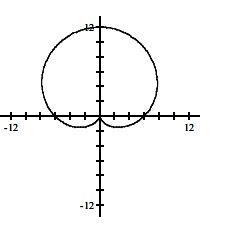
Which of the following could be the equation for...

a)

r = 6 + 6 sin θ

b)

r = 12 sin θ

c)

r = 6 - 6 sin θ

d)

r = 6 + 6 cos θ

34.

Match the given polar equation with its corresponding graph.

r=2r=-2  

a)

Line passing through origin

b)

circle with center NOT at (0,0)

c)

spiral

d)

circle with center AT (0,0)

35.

How do you write an ordered pair in polar coordinates?

a)

(x,y)\left(x,y\right)

b)

(θ,r)(θ,r)

c)

(r,θ)(r,θ)

d)

(y,x)(y,x)

36.

Which letter represents the point

(4,4π3)(-4,\frac{4π}{3})  ?

a)

F

b)

E

c)

B

d)

A

37.
Plot each point given in polar coordinates and find the other polar coordinates (r,θ) if the point which  r >0, -2π≤θ<0.
(-2,3π)
a)
(2, -2π)
b)
(-2, π)
c)
(2, 2π)
d)
(-2, -2π)
38.
Write the complex number in polar form
a)
3 ( cos 3π/2 + i sin 3π/2)
b)
3 ( cos π/2 + i sin π/2)
c)
9 ( cos 3π/2 + i sin 3π/2)
d)
3 ( cos 2π + i 2π)
39.
Convert the rectangular coordinate (0, -3) to polar coordinates.
a)
(3, -270o)
b)
(3, 270o)
c)
(-3, 270o)
d)
Not Possible
40.

Find the absolute value of the complex number. Also state the quadrant in which the point lies.

2 + 3i

a)

√13, Quadrant 1

b)

√5, Quadrant 1

c)

√11, Quadrant 2

d)

√11, Quadrant 3

41.
What quadrant would the point in polar form land in?
4 ( cos π /3 + i sin π /3)
a)
Quadrant 4
b)
Quadrant 1
c)
Quadrant 2
d)
Quadrant 3
42.
Find    
5(cos 2π /3 + i sin 2π /3)⋅2( cos π /3 + i sin π /3)
in polar form.  Then express your final answer in rectangular form.
a)
-10
b)
10
c)
-10i
d)
10i
43.
Find
 1/2 ( cos π /3 + i sin π /3)
÷ 3 ( cos π /6 + i sin π /6)
and express your final answer in rectangular form.
a)
√3/12 + 1/12 i
b)
12√3 + 12 i
c)
√3/12 - 1/12 i
d)
12√3 - 12i
44.
Find the indicated power using DeMoivre's Theorem 
a)
256
b)
4096i
c)
4096
d)
-4096
45.
Write x = 2t  and y = t2 + 3  in rectangular form .
a)
y = 4x2  + 3
b)
y = ¼ x2 + 3
c)
y = 4t+ 12
d)
y = (x - 2)2 + 3
46.

Eliminate the parameter.

x= 2+4t and y=-1+6t

a)

y=(3/2)x - 4

b)

t=(x-2)/4

c)

y=x - 4

d)

y= (2/3)x + 4

47.
Convert the rectangular coordinates to polar form
a)
(√2 , 7π/4)
b)
(2 , 3π/4)
c)
(4 , π/4)
d)
(4 , 5π/4)
48.
Convert the polar coordinates to rectangular form
a)
(1, 1)
b)
(1, -1) 
c)
(-1, 0)
d)
(-1, -1)
49.
Which point represents (3, 3π/4)?
a)
F
b)
E
c)
B
d)
A
50.

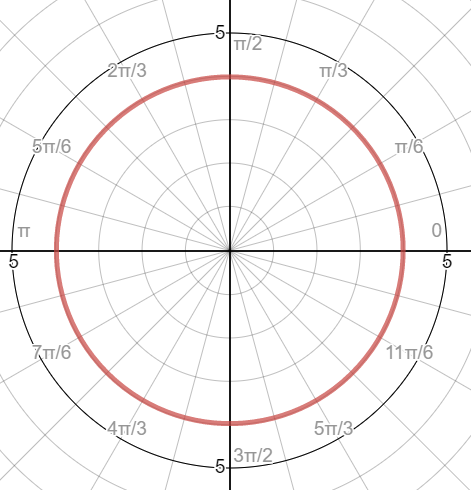
What is the equation?

a)

r = 4

b)

r = 8

c)

r = 4sin(Θ)

d)

r = 8sin(Θ)

51.

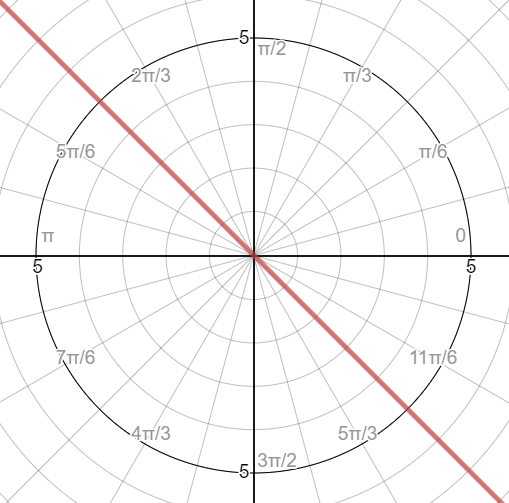
What is the equation?

a)

Θ = π/4

b)

Θ = -5π/4

c)

Θ = -3π/4

d)

Θ = 5π/4

52.

When converting between rectangular and polar coordinates,
y = ?

a)

rcosθr\cosθ  

b)

rsinθr\sinθ  

c)

x2+y2x²+y²  

d)

yx, x0\frac{y}{x},\ x≠0  

53.

Describe the symmetry of the polar curve.

r = 6 sin θ

Select all that apply

a)

About the Pole

b)

Over polar axis

c)

Over θ=π/2

d)

No polar symmetry

54.

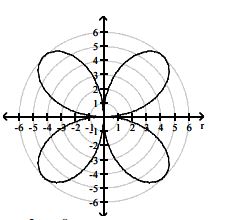
Which of the following could be the equation for...

a)

r = sin 4θ

b)

r = 6 sin 2θ

c)

r = 6 cos 2θ

d)

r = cos 4θ

55.
Find the dot product of <1, -2> and <3, 2>.
a)
1
b)
<3, -4>
c)
<4, 0>
d)
-1
56.
Find the angle between vectors <1,3> and <2,-5>.
a)
40.24°
b)
49.76°
c)
139.76°
d)
92.57°
57.
Find the angle between the two vectors:
a)
-0.789
b)
142.1
c)
100
d)
0.789
58.
Find the dot product of the given vectors:
a)
92
b)
0
c)
-92
d)
none of the above
59.
How do you know if two vectors are orthogonal?
a)
Their sum is 0.
b)
The dot product is 1.
c)
The angle between them is 0°.
d)
The dot product is 0.
60.
Find the direction angle of the resulting force of the combined vectors given magnitude and direction:
F1 : magnitude = 60 lbs, θ = 80°
F2 : magnitude = 80 lbs, θ = 20°
a)
121.66 lbs
b)
<85.6, 86.5>
c)
45.3°
d)
140 lbs
61.

Find the component form of AB with initial point A(1, -3) and terminal point B(1, 3)

a)

<2, 0>

b)

<0, 6>

c)

<-2, 0>

d)

<0, -6>

62.
If w = <2, -5> and y = <2, 0>, find 2w + y.
a)
<-10, 2>
b)
<4, -5>
c)
<-6, 10>
d)
<6, -10>
63.
Write the complex number in polar form
a)
√50 (cos π/2 + i sin π/2)
b)
50 (cos π/4 + i sin π/4)
c)
√50 (cos 5π/4 + i sin 5π/4)
d)
√50 (cos π/4 + i sin π/4)
64.
Find the square roots of 4√3 + 4i
a)
2.705 + .725i and - 2.705 - .725i
b)
- 2.705 + .725i and  2.705 - .725i
c)
2.799 + .0128i and - 2.799 - .0128i
d)
- 2.799 + .0128i and  2.799 - .0128i
65.
Express the point in polar form in rectangular form.
4 ( cos π /3 + i sin π /3)
a)
2 + 2√3 i
b)
2 + √3 i
c)
2 - 2√3 i
d)
-2 + 2√3 i
66.
Convert the polar equation to rectangular form
a)
x = 2 cos θ
b)
x = 2
c)
y = 2
d)
x² + y² = 2
67.

Which is the rectangular form of r=-18cosθ?

a)

(x+9)2+y2=81

b)

(x-9)2+y2=81

c)

(x-9)2+y2=-9

d)

x2+(y-9)2=81

e)

x2+(y+9)2=81

68.

Find three additional representations of the given polar coordinates using -2π<θ<2π. Choose all that apply.

a)

(3,-5π/6)

b)

(-3,π/6)

c)

(-3,-11π/6)

d)

(3,5π/6)

e)

(-3,-7π/6)

69.

Convert the polar coordinates to rectangular form (2, π4)\left(\sqrt{2},\ -\frac{\pi}{4}\right)  

a)

(1, 1)

b)

(1, -1) 

c)

(-1, 0)

d)

(-1, -1)

70.

Covert the rectangular equation to polar form y=x2y=x^2  

a)

r = cot θ csc θ

b)

r = tan θ csc θ

c)

r = tan θ sec θ

d)

r = 0