Wayground logo

Free Printable Worksheets

Font size

S
M
L
XL
Worksheets

Unit 9 Ecology- Part III Population Ecology

Total questions: 120

Worksheet time: 3hrs 4mins

Name
Class
Date
1.
A population is...
a)

A group of one species in one area

b)

Multiple species that live in one area

c)

All of the living and nonliving things in an area

d)

None of these

2.

The measure of individuals living in a defined area.

a)

population density

b)

population crash

c)

logistic growth

d)

limiting factor

3.

What does the graph represent?

a)

Emigration

b)

Exponential growth

c)

Immigration

d)

Logistic Growth

4.

Exponential Growth occurs when-

a)

populations have a lot of food/space

b)

low birth rates

c)

have many predators

d)

have no competition or predators

5.

The exponential graph is a graph that shows us population size increasing quickly, which one below shows us that

a)
b)
c)
d)
6.

An S-shaped curve is known as

a)

Exponential graph

b)

Logistic Graph

c)

Survivorship curves

7.

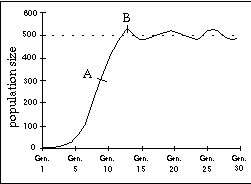
What is the carrying capacity of the graph?

a)

around 500

b)

more than 500

c)

less than 500

d)

around 600

8.

What point on the graph represents the carrying capacity?

a)

A

b)

B

c)

C

d)

D

9.

In a forest ecosystem, which is the best example of a limiting factor for a rabbit population?

a)

Squirrel Population

b)

Sunlight

c)

Grass available (disponible)

10.

Factors that do not depend on how many individuals are in the population including unusual weather events, natural disasters and human activities.

a)

density-independent limiting factors

b)

density-dependent limiting factors

c)

death rate

d)

clumped dispersion

11.

(Im)migration is ...

a)

the movement of organisms into an area

b)

The movement of organisms out of an area

c)

The migration process

d)

exponential graph

12.

A relationship that occurs when two or more organims of the same species need the same resource at the same time

a)

competition

b)

symbiosis

c)

predation

13.

Match the following levels of classification to the pictures:

a)
1.

Organism

b)
2.

Population

c)
3.

Community

d)
4.

Ecosystem

14.

What will happen to the population when the death rate is larger than the birth rate?

a)

increase

b)

decrease

c)

stay the same

d)

None

15.
What will happen to the population when the birth rate is larger than the death rate?
a)
grow
b)
shrink
c)
stay the same
16.

In a forest, the carrying capacity for squirrels is about 100. If humans cut down part of the forest to build houses, what will happen to the carrying capacity for the squirrels?

a)

it will increase

b)

it will decrease

c)

it will stay the same

17.

In a forest ecosystem, which of the following is the best example of a limiting factor for a rabbit population?

a)

Squirrel Population

b)

Sunlight

c)

Grass available

18.

A population of foxes has 36 individuals. In one year, 10 baby foxes are born and 6 older foxes die. The population at the end of the year is (a)   .

19.

Push Factors are conditions in migrants' home environment that drive them out

a)

True

b)

False

20.
Which of the following best describes an ecosystem?
a)
all the living organisms in an area and their physical surroundings
b)
a region with a distinct climate
c)
all the living organisms of the same species throughout the world
d)
all the living organisms in an area
21.
A pod of dolphins hunting and feeding on a school of fish is an example of
a)
an ecosystem interaction.
b)
a population interaction.
c)
a community interaction.
d)
a biome interaction.
22.
The animal species shown above would most likely be found wild in which of the following biomes?
a)
grassland
b)
temperate forest
c)
tropical rainforest
d)
arctic tundra
23.
The taiga biome that covers most of Alaska is pictured above.  Which of the following only lists biotic factors that can be found in this ecosystem?
a)
freezing temperatures, low precipitation, bogs, and acidic soil
b)
owls, poor soils, moss, and caribou
c)
moss, aspen trees, weasels, and raccoons
d)
birch trees, short summers, lichen ground cover, and bears
24.
What is the ultimate source of energy for all ecosystems?
a)
the Sun
b)
plants
c)
secondary consumers
d)
primary consumers
25.
The energy pyramid below shows a possible amount of energy, in kilocalories, available in the organisms at each trophic level in an ecosystem.  According to the law of conservation of energy, energy can neither be created nor destroyed.  If this is true, why is there less energy in the top of the energy pyramid than there is in the bottom of the energy pyramid?
a)
Energy is lost between each trophic level as heat.
b)
The law of conservation of energy does not apply to ecosystems.
c)
Organisms in the top of the energy pyramid use up energy the fastest.
d)
The extra energy in the bottom is slower to reach the top.
26.
Which of the following interactions is an example of symbiosis?
a)
an insect acts as a pollinator for a plant species
b)
a population of hummingbirds migrates during the summer
c)
a tropical bird performs a courtship dance for a mate
d)
a mother bear feeds and protects her cubs
27.
A farmer plants two species of grass with similar nutrient needs on the same small plot of land.  What kind of interaction will most likely occur between the two species?
a)
parasitism
b)
competition
c)
commensalism
d)
mutualism
28.
The diagram below depicts the water cycle.  Which process is represented by the number 2?
a)
precipitation
b)
evaporation
c)
surface runoff
d)
condensation
29.
The bodies of all living things are based on carbon.  Which of the following is the primary source of carbon in living things?
a)
carbon compounds stored in fossil fuels
b)
carbon compounds in the soil
c)
dissolved carbon dioxide in the biosphere
d)
carbon dioxide in the atmosphere
30.
An increase in the atmospheric levels of carbon dioxide (CO2) is the biggest contributor to which of the following?
a)
El Nino
b)
global warming
c)
wind storms
d)
ozone depletion
31.
Which human activity has had the greatest impact on climate change?
a)
building skyscrapers
b)
deforestation
c)
burning fossil fuels
d)
production of nuclear waste
32.
A __________ is a group of organisms that can reproduce fertile offspring.  Failure to reproduce fertile offspring will cause __________ of the group.
a)
genus, evolution
b)
species, extinction
c)
phylum, extinction
d)
species, evolution
33.
The graph below shows population data for two species.  What can be said about the relationship between species 1 and species 2?
a)
When the population of species 1 increases, the population of species 2 decreases.
b)
The population of species 1 and species 2 stay the same over the time period shown.
c)
The population of species 1 is not influenced by the population of species 2.
d)
When the population of species 1 increases, the population of species 2 increases.
34.
Overpopulation occurs when a population exceeds its carrying capacity.  White-tailed deer are considered to be an overpopulated species in the central United States.  What is one consequence of white-tailed deer exceeding their carrying capacity?
a)
People don't see deer as often in urban areas.
b)
The deer are less healthy and more prone to disease.
c)
There are more predators to eat the deer.
d)
The deer have stopped breeding.
35.
What two factors have been the GREATEST contributors to the exponential growth of the human population during the last two centuries?
a)
plentiful food and a mild climate
b)
the industrial revolution and peace
c)
agricultural developments and peace
d)
good sanitation and medical advances
36.
After a natural disaster such as a hurricane or tornado, what will happen in the damaged ecosystem?
a)
Nothing; it will remain uninhabited.
b)
A new, different ecosystem will evolve.
c)
An ecosystem like the previous one will be re-established.
d)
No one really knows what to expect after a natural disaster.
37.
78% of Earth's atmosphere is nitrogen gas. All living things need nitrogen as a part of DNA and RNA. Yet you and I, and other living things, cannot use the nitrogen in our atmosphere directly. One type of organism is responsible for "fixing" nitrogen or helping to put it in a form so other living things can use it. That organism is
a)
bacteria.
b)
fungi.
c)
plants.
d)
viruses.
38.
Grazing cows disturb the grass and cause insects to fly around the cows as they eat. In turn, birds swoop in and eat the insects. This type of feeding relationship is an example of
a)
commensalism.
b)
mutualism.
c)
parasitism.
d)
predation.
39.
In a simple food chain, small fish eat algae; bigger fish eat the smaller fish; bears eat the bigger fish. 
Using the above scenario, which of these would have the largest amount of energy?
a)
algae
b)
bears
c)
big fish
d)
small fish
40.
The animals that live in this valley have basic needs to survive. ALL BUT one of these non-living features is a basic need of the animals living here.
a)
food.
b)
oxygen.
c)
shelter.
d)
carbon dioxide.
41.
In the organization of living things, a ______________ would include the largest number of individuals.
a)
community
b)
population
c)
ecosystem
d)
species
42.
Microscopic, free-floating, autotrophic organisms that function as producers in aquatic ecosystems are called...
a)
plankton
b)
zooplankton
c)
phytoplankton
d)
bacteria
43.
Aquatic insects or other small organisms that have no backbone and are large enough to be seen without a microscope are called...
a)
bacteria
b)
zooplankton
c)
benthic macrovertebrates
d)
benthic macroinvertebrates
44.
Pollutants discharged from a single identifiable location (e.g., pipes, ditches, channels, sewers, tunnels, containers of various types).
a)
point source pollution
b)
stormwater runoff
c)
nonpoint source pollution
d)
thermal pollution
45.
Water pollution that does not have a specific point of origin is called ...
a)
point source pollution
b)
non point source pollution
c)
thermal pollution
d)
inorganic pollution
46.
Water that drains into a water source after a rain storm occurs. This is the number one cause of non point source pollution in Pennsylvania.
a)
thermal pollution
b)
point source pollution
c)
inorganic pollution
d)
storm water runoff
47.
An immediate increase in the amount of algae and other producers that results from a large input of nutrients is called...
a)
plant growth
b)
algal bloom
c)
phytoplankton growth
d)
aquatic bloom
48.
Overnourishment of aquatic ecosystems with plant nutrients (mostly nitrates and phosphates) because of human activities such as agriculture, urbanization, and discharges from industrial plants and sewage treatment plants.
a)
algal bloom
b)
cultural eutrophication
c)
oligotrophic
d)
littoral zone
49.
A measure of the buffering capacity of water
a)
acidity
b)
limnology
c)
limnetic
d)
alkalinity
50.
A habitat in which the fresh water of a river meets the salt water of the ocean.
a)
estuary
b)
swamp
c)
marsh
d)
fen
51.
What does water in the atmosphere react with to create carbonic acid?
a)
oxygen
b)
nitrogen
c)
phosphorous
d)
carbon dioxide
52.
In which biome do these plants (phytoplankton) not survive?
a)
freshwater
b)
coral reef
c)
ocean
d)
desert
53.
This biome occurs in topical waters near coasts, where water is warm, salty, and shallow:
a)
coral reef
b)
wetland
c)
freshwater
d)
ocean
54.
Headwaters are located in the 
a)
mountains
b)
between mountains and coast
c)
where fresh water meets salt water
55.
Which is NOT a freshwater wetland?
a)
estuary
b)
marsh
c)
bog
d)
swamp
56.
Estuaries form where 
a)
a lake evaporates
b)
a river meets the sea
c)
a river becomes dammed
d)
a wetland becomes filled in
57.
In which biome do these plants (seagrass) survive? 
a)
wetland
b)
ocean
c)
freshwater
58.
Important limiting factors in streams and rivers include
a)
amount of oxygen
b)
temperature of water
c)
all of the above
59.
The aphotic zone is
a)
the ocean's dark lower layer where photosynthesis cannot occur
b)
the sunlit upper layer of the ocean where photosynthesis occurs
c)
on the bottom of lakes, streams, and oceans.
d)
where benthos are found
60.
The photic zone
a)
extends to the bottom of the open ocean
b)
extends to a depth of about 200 meters
c)
is deep, cold, and permanently dark
d)
is where chemosynthetic bacteria are the producers
61.
zooplankton are
a)
tiny autotrophic organisms in water
b)
large plants
c)
tiny heterotrophic organisms in water
d)
large animals
62.
phytoplankton are
a)
tiny autotrophic organisms in water
b)
large plants 
c)
tiny heterotrophic organisms in water
d)
large animals
63.
If the number of births in a population is the same as the number of deaths in a population, what will happen to the growth of the population?
a)
It will increase.
b)
It will decrease.
c)
It will stay the same.
d)
It will fluctuate.
64.
Largest number of individuals of a population that the environment can support...  
a)
carrying capacity
b)
population crash
c)
lag phase
d)
mutualism
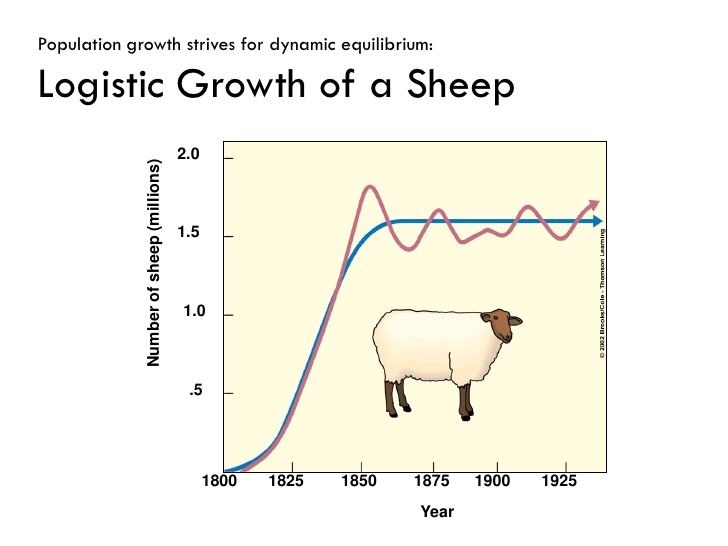
65.
What is the carrying capacity for this sheep population?
a)
1.8 million
b)
1.25 million
c)
1.6 million
d)
1.o million
66.
When a population grows past the ecosystem's carrying capacity, what happens to the population?
a)
Continues to grow
b)
The population starts to die off to return to carrying capcity
c)
The population will go extinct due to lack of resources
d)
The population grows then finds a new carrying capacity
67.
Food, water, sunlight, shelter, and space are resources that are often __________.
a)
limiting factors
b)
wet
c)
messy
d)
found in rocks
68.
Any thing or organism that regulates the size of a population of another organism is known as __________.
a)
a limiting measure
b)
a limiting factor
c)
factorization
d)
materialization of precipitation
69.
In a forest ecosystem, which of the following is the best example of a limiting factor for a rabbit population?
a)
Squirrel Population
b)
Sunlight
c)
Grass available
70.
which statement sounds accurate based on the graph data. 
a)
The zebra and lions do not affect each other
b)
when lions population increases, so does the zebra population
c)
When the zebra population increases, it causes the lion population to also increase
d)
when zebra populations go down, the zebra population goes up. 
71.
Which kind of growth does the human population follow? It is described as a J-shaped curve.
a)
Exponential Growth
b)
Logistic Growth
c)
Outstanding Growth
d)
Minimal Growth
72.
What type of growth is represented behind?
a)
exponential
b)
logistics
c)
a good kind
d)
representative
73.
What point on the graph represents the carrying capacity?
a)
A
b)
B
c)
C
d)
D
74.

Which of the following are density dependent factors?

a)

competition for resources

b)

predation

c)

disease

d)

natural disasters

75.

Which of the following are examples of a density independent factors?

a)

forest fire

b)

seasonal cycles

c)

storms

d)

disease

76.
largest number of individuals of a population that the environment can support  
a)
carrying capacity
b)
primary succession 
c)
denitrification
d)
mutualism
77.
All the living and non-living factors that interact in an area
a)
ecosystem
b)
carnivore
c)
niche
d)
population
78.
Which limiting factor would increase due to the number of individuals in a population?
a)
Unusual weather
b)
Natural disaster
c)
Births
d)
Disease
79.

What point on the graph does the population slow down tremendously due to limiting resources as it approaches the carrying capacity?

a)

A

b)

B

c)

C

d)

D

80.

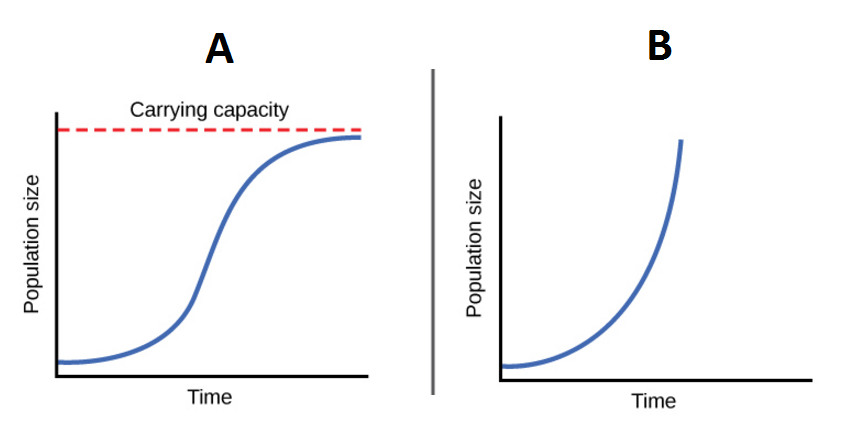
What type of growth model is shown in image A?

a)

Exponential

b)

Logistic

81.

At carrying capacity, a population __________.

a)

increases rapidly

b)

increases slowly

c)

decreases slowly

d)

is in dynamic equilibrium

82.
What is a producer?
a)
an organism that gets energy from eating other organisms
b)
an organisms that uses sunlight to make its own food
c)
an organism that gets energy from eating dead organisms, non-living material or waste
d)
an organism that uses chemical energy to make its own food
83.

Which of these organisms is the secondary consumer?

a)

Owl

b)

Mouse

c)

Grass

d)

Grasshopper

84.

Place the levels of environment in the correct order.

a)

biome, biosphere, population, organism, ecosystem,community

b)

organism, ecosystem, biosphere, population, community, biome

c)

organism, population, community, ecosystem, biome, biosphere

d)

population, community, organism, biome, ecosystem, biosphere

85.

How much energy is transferred between trophic levels?

a)

25%

b)

20%

c)

10%

d)

90%

86.
The diagram below shows the cycling of nutrients in an ecosystem.
The removal of which of the following groups would cause an immediate decrease in the amount of energy flowing through the system?
a)
Producers
b)
Consumers
c)
Decomposers
d)
Inorganic nutrients
87.
A food chain is illustrated below:
The arrows represented most likely indicate
a)
A. Energy released from metabolism into the environment as heat.
b)
B. Oxygen released from metabolism produced by cellular respiration.
c)
C. The absorption of energy from the environment that has been created.
d)
D. The transport of glucose away from the organism through photosynthesis.
88.
Nitrification happens in the ______
a)
Air 
b)
Soil 
c)
Ground Water 
d)
Plants 
89.

What converts nitrogen gas into a usable form for plants and animals?

a)

bacteria

b)

rain

c)

fungi

d)

car exhaust

90.

What process occurs when dead plant and animal matter decomposes and nitrogen is released back into the atmosphere?

a)

Assimilation

b)

Fixation

c)

Ammonification

d)

Denitrification

91.
Plants and animals need nitrogen to make __________.
a)
Protein
b)
Carbohydrates
c)
Lipids
d)
Minerals
92.

Dead plants, animals, and animal waste are converted to ammonium by _____________________

a)

plant roots

b)

lightning

c)

bacteria and fungi decomposers

d)

denitrifying bacteria

93.

Which nitrogen cycle process is occurring when plant roots absorb ammonium ions and nitrate ions for use in making molecules such as DNA, amino acids, and proteins?

a)

nitrogen fixation

b)

nitrification

c)

denitrification

d)

ammonification

e)

assimilation

94.

Which of these nitrogen cycle processes converts atmospheric nitrogen to a soil form of nitrogen that is usable by plants?

a)

nitrogen fixation

b)

nitrification

c)

denitrification

d)

ammonification

e)

assimilation

95.
Which of the following removes carbon from the atmosphere?
a)
Combustion
b)
Respiration
c)
Photosynthesis
d)
Death
96.

The reverse of photosynthesis - Sugars are used for metabolism and change “fuel” back into CO2.

a)

Diffusion

b)

Weathering

c)

Decomposition

d)

Respiration

97.
_____ brings phosphorous into our waterways. .
a)
precipitation
b)
runoff
c)
transpiration
d)
condensation
98.
Which of the following statements is true of the phosphorus cycle?
a)
Phosphorus enters the atmosphere as phosphates.
b)
The phosphorus cycle utilizes the processes of erosion, and weathering.
c)
Phosphates are used in carbohydrate and glucose storage.
d)
The phosphorus cycle utilizes bacteria to breakdown phosphates and make them available for plants.
99.
What role do decomposers play in the phosphorous cycle?
a)
absorb phosphorous 
b)
release phosphorous into atmosphere
c)
return phosphorous into the soil
d)
combustion
100.

Too much phosphorus in waterways (rivers, lakes) can lead to___________.

a)

eutrophication

b)

Nothing

c)

Death

d)

diseases

101.

An algal bloom is the rapid growth of a population of

a)

fungi

b)

protozoans

c)

algae

102.

Once inorganic phosphate has been released by weather of rocks, which of the following might be it's next step in the phosphorus cycle?

a)

it can become part of surface water and runoff into the ocean, and eventually become new rock at the bottom of the ocean through the process of sedimentation

b)

it can become part of the soil and be taken up by plant roots and used to make lipids, ATP, nucleic acids and other cellular molecules

c)

it can become part of groundwater and leech into the ocean, and eventually become new rock through the process of sedimentation

d)

all of the answers are possible pathways for phosphorus

103.

What is the original, and primary reservoir of inorganic phosphate (PO43-)in terrestrial ecosystems?

a)

live plants and animals

b)

groundwater

c)

the atmosphere

d)

rocks

104.

Why is phosphorus important to biology?

a)

it works alongside the nitrogen cycle to fertilize plants

b)

it is the primary component of mountains, which serve as habitats for animals

c)

it enhances decomposition of organic matter

d)

it is a component of many biological molecules, such as nucleic acids, some lipids, ATP, and bony structures

105.

Nitrogen and carbon are cycled on a global scale. Why does phosphorus cycling tend to occur more locally?

a)

it primarily involves the weather of rocks, which are mostly stationary

b)

it only involves land animals that cannot swim across oceans to transport the nutrient

c)

it occurs in areas where cloud formation is low, so it rarely gets trapped in water vapors

d)

all of the answers are correct

106.
For a pyramid of numbers, the width of the bar shows the__________ of organisms present in each trophic level at a particular time. 
a)
number
b)
biomass
c)
energy
d)
volume
107.
In this energy pyramid, which organisms have the most energy available?
a)
Producers
b)
Carnivores
c)
Herbivores
d)
Top Predator
108.
In an ecological pyramid, which type of organism always has the least amount of energy available?
a)
Producers
b)
Herbivores
c)
Carnivores
d)
Top Predator
109.
How much of the energy in each level of a ecological pyramid gets lost as heat or used by the organism so that it cannot be passed on to the next trophic level?
a)
80%
b)
90%
c)
10%
d)
20%
110.
If there are 100 Kcal of energy available in the producers, how much energy would be available in the herbivores?
a)
10 Kcal
b)
1 Kcal
c)
100 Kcal
d)
1000 Kcal
111.
A tertiary consumer has to be which type?
a)
Carnivore.
b)
Decomposer.
c)
Producer.
d)
Herbivore.
112.
The diagram represents a pyramid of energy in an ecosystem.  Which level would most likely contain organisms that do photosynthesis?
a)
A
b)
B
c)
C
d)
D
113.

Biodiversity

a)

The sum of the different forms of living things in a given area or population

b)

The alteration of the area and conditions in which an organism lives so that the organism can no longer live in them

c)

A force of nature that results in catastrophic consequences

d)

The development of an ecological community in a previously uninhabited location

114.

Climax Community

a)

The dynamically stable ecological community representing the final stage of ecological succession.

b)

A biotic or abiotic environmental factor that restricts the growth of a population

c)

The first plant species to grow during primary succession

d)

The development of an ecological community in an area that was once inhabited but experienced devastation.

115.

Habitat Destruction

a)

The alteration of the area and conditions in which an organism lives so that the organism can no longer live in them

b)

The development of an ecological community in an area that was once inhabited but experienced devastation.

c)

A force of nature that results in catastrophic consequences

d)

The sum of the different forms of living things in a given area or population

116.

Limiting Factor

a)

A biotic or abiotic environmental factor that restricts the growth of a population

b)

The dynamically stable ecological community representing the final stage of ecological succession.

c)

The development of an ecological community in a previously uninhabited location

d)

The development of an ecological community in a previously uninhabited location

117.

Natural Disaster

a)

A force of nature that results in catastrophic consequences

b)

A biotic or abiotic environmental factor that restricts the growth of a population

c)

The first plant species to grow during primary succession

d)

The development of an ecological community in a previously uninhabited location

118.

Pioneer Species

a)

The first plant species to grow during primary succession

b)

The sum of the different forms of living things in a given area or population

c)

A biotic or abiotic environmental factor that restricts the growth of a population

d)

The dynamically stable ecological community representing the final stage of ecological succession.

119.

Primary Succession

a)

The development of an ecological community in a previously uninhabited location

b)

The development of an ecological community in an area that was once inhabited but experienced devastation.

c)

The alteration of the area and conditions in which an organism lives so that the organism can no longer live in them

d)

The dynamically stable ecological community representing the final stage of ecological succession.

120.

Secondary Succession

a)

The development of an ecological community in an area that was once inhabited but experienced devastation.

b)

The dynamically stable ecological community representing the final stage of ecological succession.

c)

The first plant species to grow during primary succession

d)

The development of an ecological community in a previously uninhabited location