
 Worksheets
Sumer term review
Total questions: 121
Worksheet time: 1hrs 6mins
Chemical reactions occur when reacting particles....
collide
pass
interact
are mixed
The minimum energy particles must have to react is the
acting energy
active energy
activation energy
A reaction profile shows....
the relative difference in temperature of reactants and products
the relative difference in amounts of reactants and products
the relative difference in energy of reactants and products
the relative difference in volume of reactants and products
Bond making is
Endothermic
Exothermic
Bond breaking is..
Endothermic
Exothermic

Which letter shows the activation energy
A
B
C
What is the definition of activation energy? Two answers are required.
The energy needed to start a reaction
The temperature needed to start a reaction
The minimum energy that particles must have to react
The maximum energy that particles must have to react.
In a reaction the energy required to break bonds is less than the energy released when bonds are made. What type of reaction is this?
Exothermic
Endothermic
What would be the product at the negative electrode in the electrolysis of Sodium Chloride solution
Sodium
Chlorine
Hydrogen
Oxygen
What would be the product at the positive electrode in the electrolysis of Sodium Chloride solution
Sodium
Chlorine
Hydrogen
Oxygen
What would be the product at the negative electrode in the electrolysis of molten Sodium Chloride
Sodium
Chlorine
Hydrogen
Oxygen
What would be the product at the positive electrode in the electrolysis of molten Sodium Chloride
Sodium
Chlorine
Hydrogen
Oxygen
What would be the product at the negative electrode in the electrolysis of Silver Nitrate solution
Silver
Nitrogen
Hydrogen
Oxygen
What would be the product at the positive electrode in the electrolysis of Silver Nitrate solution
Silver
Nitrogen
Hydrogen
Oxygen
What is the name given to the negative electrode
(a)
What name is given to the positive electrode
(a)
What is the third product produced in the electrolysis of Silver Nitrate solution
Silver Nitrate
Water
Nitric Acid
Silver Hydroxide
What is the product at the negative electrode in the electrolysis of Copper Iodide solution
Copper
Iodine
Hydrogen
Oxygen
What is the product at the positive electrode in the electrolysis of Copper Iodide solution
Copper
Iodine
Hydrogen
Oxygen
What is the third product produced in the electrolysis of Copper Iodide solution
Copper Iodide
Copper Hydroxide
Water
Hydrogen Iodide
What particles carry the electrical charge through the electrodes
Electrons
Ions
Atoms
Molecules
What particles carry the electrical charge through the electrolyte
Electrons
Ions
Atoms
Molecules
What would you observe at the negative electrode in the electrolysis of Sodium Chloride solution
Bubbles of gas that burn with a squeaky pop
Bubbles of gas that relight a glowing splint
Bubbles of gas that bleach damp litmus paper
Solid deposits in the electrode
What would you observe at the positive electrode in the electrolysis of Sodium Chloride solution
Bubbles of gas that burn with a squeaky pop
Bubbles of gas that relight a glowing splint
Bubbles of gas that bleach damp litmus paper
Solid deposits in the electrode
What would you observe at the positive electrode in the electrolysis of Copper Sulphate solution
Bubbles of gas that burn with a squeaky pop
Bubbles of gas that relight a glowing splint
Bubbles of gas that bleach damp litmus paper
Solid deposits in the electrode
What would you observe at the negative electrode in the electrolysis of Copper Sulphate solution
Bubbles of gas that burn with a squeaky pop
Bubbles of gas that relight a glowing splint
Bubbles of gas that bleach damp litmus paper
Solid deposits in the electrode
What is the ore of aluminium called?
Baxite
Bauxite
Cryolite
Malachite
The electrodes in electrolysis of aluminium are made of
Steel
Anodes
Graphite
Plastic
What do you add to aluminium ore to reduce its melting temperature?
Dendrite
Malachite
Bauxite
Cryolite
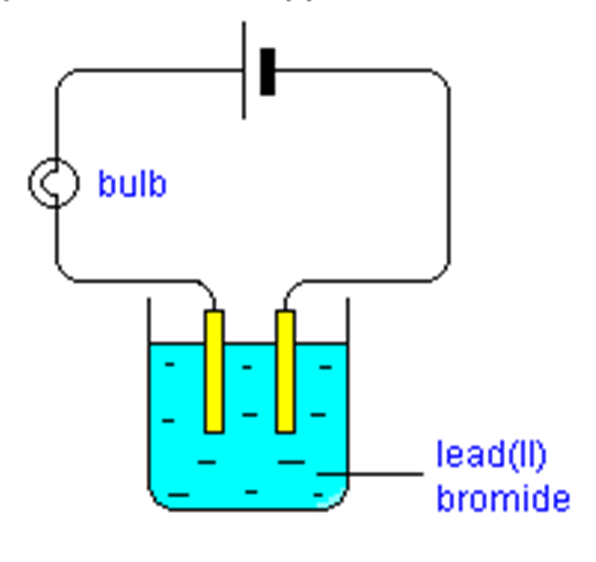
The diagram shows the electrolysis of lead(II) bromide using inert electrodes. Why does the bulb only light up when the lead(II) bromide is melted?
Bromine atoms in lead(II) bromide are converted to ions when it is melted
Electrons flow through the lead(II) bromide when it is melted
The ions in lead(II) bromide are mobile charge carriers in the molten state.
There are no ions in solid lead(II) bromide
In electrolytic cell that uses aqueous copper(II) sulfate as electrolyte and copper plates as electrodes, what is the product at the anode?
Oxygen gas and water
Copper metal
Copper(II) ions
Hydrogen gas
Anions get discharged by ________ electrons at the ___________
gaining, cathode
losing, anode
gaining, anode
losing, cathode
What is the gas produced at the anode during the electrolysis of very dilute hydrochloric acid?
water
oxygen
hydrogen
chlorine
Choose the half-equation that shows the discharge of aluminium ion.
Al3+ - 3e- --> Al
Al2+ + 3e- --> Al
Al3+ + 3e- --> Al
Al3+ --> Al + 3e-
What is the half-equation for the discharge of hydroxide ions?
2O2- --> O2 + 4e-
OH- --> OH + e
4OH- --> 2H2O + O2 + 4e-
2H2O + O2 + 4e- --> 4OH-
What factors do not affect the products of electrolysis in the electrolysis of aqueous magnesium chloride using graphite electrodes?
position of ions in the electrochemical series
concentration of ions in the solution
type of electrodes
What ions are present in molten aluminium oxide?
Al3+, O2-, H+, OH-
Al3+, O2-
Al3+, OH-

If the fork is to be electroplated with silver metal, what electrolyte should be used?
Molten silver chloride
Aqueous silver nitrate
Sodium chloride solution
Copper(II) sulphate solution

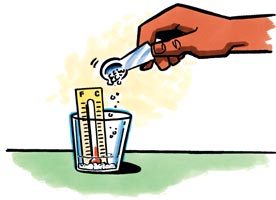





What instrument would you use to detect an endothermic or exothermic reaction?
triple beam balance
ruler
thermometer
Metal A is more reactive than Metal B. The following displacement reaction takes place.
Metal A + Metal B in compound ---> Metal B + Metal A in compound.
True or False.
True
False
A more reactive metal will displace a less reactive metal from a metal compound. Which metal is more reactive - copper or iron?
copper
iron
Copper is less reactive than iron. What do you expect to happen when copper is placed inside a solution of iron(II) sulfate?
No reaction takes place.
A reaction takes place. And a colour change is observed.
Copper is less reactive than iron. What do you expect to happen when iron is placed inside a solution of copper(II) sulfate?
No reaction takes place.
A reaction takes place. And a colour change is observed on the iron nail.
Iron + Hydrochloric acid --> ?
iron(II) sulfate + water
iron + hydrogen
iron(II) chloride + hydrogen
iron(II) chloride + water
Which gas gives out a 'squeaky pop' when a lighted splint is placed in it?
hydrogen
oxygen
carbon dioxide
nitrogen
Which equation correctly shows the displacement of copper from copper(II) sulfate by zinc?
copper + zinc sulfate --> copper(II) sulfate + zinc
zinc sulfate + copper --> copper(II) sulfate + zinc
copper(II) sulfate + zinc --> zinc sulfate + copper
copper(II) sulfate + zinc --> zinc sulfate + water
Which equation correctly shows magnesium displacing copper from it copper(II) sulfate?
2Mg + O2 --> 2MgO
Mg + CuSO4 --> MgSO4 + Cu
Mg + MgSO4 --> MgSO4 + Mg

A copper coil is placed inside a solution of silver nitrate. What would you expect to see after 5 minutes? Choose 2 options.
There is no visible change because no displacement reaction took place. Copper, being less reactive than silver, cannot displace silver from silver nitrate.


Silver crystals were formed on copper coil, because copper (being more reactive than silver) displaced silver from silver nitrate.

What is the most likely identity of the metal on the filter paper?
Copper, because it is grey.
Potassium, because it can be cut with a knife showing it is soft.
Iron, because it looks grey and all iron looks grey.

Read the underlined words carefully. Rank the metals according to decreasing reactivity (most reactive to least reactive).
Metal A, B, C, D
Metal A, C, B, D
Metal B, C, D, A
Metal D, B, C, A
Alkali metal + Water —> _____________ + ____________
metal hydroxide and oxygen gas
metal hydroxide and hydrogen gas
metal oxide and oxygen gas
metal oxide and hydrogen gas
Lithium + Oxygen —> _________________
Lithium hydroxide
Lithium oxide
Hydrogen gas
Oxygen gas
What is the correct decreasing order of metal reactivity with water ?
Mg > Na > Li > K
Mg > Li > Na > K
Na > Li > Mg > K
K > Na > Li > Mg
Which of the following does not react with water?
Copper
Lithium
Sodium
Potassium
Which of the following metals is the most reactive in dilute sulfuric acid?
Magnesium
Lead
Zinc
Potassium
Name the products formed when zinc reacts with hydrochloric acid?
zinc oxide and water
zinc oxide and water
zinc chloride and hydrogen gas
zinc hydroxide and hydrogen gas
Which one of the following metals reacts slowly with cold water?
Lithium
Copper
Silver
Calcium
Aluminium carbonate + Sulfuric acid —> _______________ + __________________ + water
Aluminium sulfide + Oxygen
Aluminium sulfate + Hydrogen
Aluminium sulfate + Carbon dioxide
Aluminium sulfide + Carbon dioxide
Which of the following metals easily get rusted to form brown deposits on it?
Lead
Gold
Aluminium
Iron
Which of the following metals does not displace hydrogen gas when reacts with dilute HCl or dilute H2SO4?
Lithium
Sodium
Magnesium
Copper
Arrange these metals in decreasing order of reactivity with dilute hydrochloric acid.
Mg, Fe, Ca, Zn, Cu
Ca > Mg > Zn > Fe > Cu
Ca > Mg > Zn > Fe > Mg
Fe > Mg > Zn > Ca > Mg
Zn > Fe > Mg > Ca > Mg
A reaction in which more reactive metal displaces less reactive metal is called ________________ reaction.
Endothermic reaction
Exothermic reaction
Displacement reaction
Combination reaction
Which of the following metals is kept under oil ?
Copper
Gold
Zinc
Potassium
Which of the following metals sink in the container filled with water and react to form hydrogen gas?
Potassium
Sodium
Lithium
Calcium
which of the following reaction would be possible ?
Zinc + Copper sulphate
Copper + Zinc sulphate
Silver + Zinc chloride
Lead + Iron nitrate
___________ electrode is an inert electrode.
Copper
Iron
Carbon
Zinc
Choose the half-equation that shows the discharge of aluminium ion.
Al3+ - 3e- --> Al
Al2+ + 3e- --> Al
Al3+ + 3e- --> Al
Al3+ --> Al + 3e-
Which equation shows what happen to chloride ions at the anode.
Cl- --> Cl + e-
2Cl- --> Cl2 + 2e-
Cl2 - -> 2e- + 2Cl-
Cl2 + 2e- --> 2Cl-
Ionic compounds do not conduct electricity when they are solid because,
their electrons are not free to move
their ions are free to move
their ions are not free to move
their electrons are free to move
Oxidation is loss of electron. Where does oxidation take place during electrolysis.
At anode
In the electrolyte
At the circuit
At cathode
The negatively charged ions are attracted to the ________.
anode
cathode
The diagram shows the electrolysis of lead(II) bromide using inert electrodes. Why does the bulb only light up when the lead(II) bromide is melted?
Bromine atoms in lead(II) bromide are converted to ions when it is melted
Electrons flow through the lead(II) bromide when it is melted
The ions in lead(II) bromide are mobile charge carriers in the molten state.
There are no ions in solid lead(II) bromide
What is the half-equation for the discharge of hydroxide ions?
2O2- --> O2 + 4e-
OH- --> OH + e
4OH- --> 2H2O + O2 + 4e-
2H2O + O2 + 4e- --> 4OH-
What ions are present in molten aluminium oxide?
Al3+, O2-, H+, OH-
Al3+, O2-
Al3+, OH-
Electroplating is an industrial process where objects are coated by a thin layer of a nonreactive metal by electrolysis. What should be used as the cathode in this process?
Graphite electrode
The electroplating metal
The object to be electroplated
Magnesium ribbon
If the fork is to be electroplated with silver metal, what electrolyte should be used?
Molten silver chloride
Aqueous silver nitrate
Sodium chloride solution
Copper(II) sulphate solution
What factors do not affect the products of electrolysis in the electrolysis of aqueous magnesium chloride using graphite electrodes?
position of ions in the electrochemical series
concentration of ions in the solution
type of electrodes

