
Font size
 Worksheets
Unit 4 The Muscular System Review
Total questions: 40
Worksheet time: 35mins
What part of skeletal muscle attaches to the bone that moves when a muscle contracts?
Origin
Body
Insertion
Which of the following is a way that the skeletal system is necessary for the muscular system's function?
the skeletal system has joints, which are what the muscular system pulls on to move
the skeletal system provides structure for the muscular system
the skeletal system provides calcium, which the muscles require along with ATP to contract
all of the above
The muscular system interacts with the skeletal system by:
smooth muscles are joined with spongy bone via cartilage
skeletal muscles pull on joints to permit movement
cardiac muscle is connected to the ribs
skeletal muscles are joined to one another via ligaments
Which parts of your muscular system are voluntary? Select ALL that apply.
cardiac muscle
skeletal muscle
smooth muscle
none of the above
Which of the following is a secondary function of the muscular system?
motion
oxygen circulation
support and protection
thermoregulation
The prime movers that allow your jaw to close so that you can chew your food are the
buccinator and orbicularis oris
orbicular oculi and masseter
masseter and temporalis
epicranius and temporails
The antagonists of the quadriceps, located in the posterior thigh.
Hamstrings
Quadriceps
femoris
Tibialis anterior
Adductors
The prime mover for forearm extension.
Quadriceps
femoris
Triceps brachii
Biceps brachii
Tibialis anterior

What type of movement is involuntary?
Mastication
Digestion
Adduction
Extension
All the muscle within the body has a relationship with the ______ system to produce movement and contraction.
Cardiovascular
Skeletal
Nervous
Respiration
In what range of motion does the limb move away from the median plane?
Abduction
Adduction
Extension
Flexion
What muscle extends the head?
Latissimus dorsi
Trapezius
Triceps brachii
Semitendinosus


Identify the highlighted muscle
Quadriceps
Biceps
Hamstrings
Extensor Carpi

Identify the highlighted muscle
Deltiod
Trapezius
Latissimus Dorsi
Sartorius
What type of muscle has striations? Choose all that apply.
Skeletal
Cardiac
Smooth
Cardiac muscle is ________ and ________.
smooth, voluntary
smooth, involuntary
striated, involuntary
striated, voluntary
The ORIGIN is the muscle attachment to the _______ bone.
Stationary
Movable
The muscle attachment to the movable bone is the:
Muscle belly
Muscle body
Insertion
Fascicle
What is an action of the gluteus maximus?
Flex the thigh.
Rotate the lumbar column.
Extend the thigh.
Abduct and adduct the humerus.
Which muscle elevates, retracts, and rotates the scapula? We use it to shrug our shoulders.
Subscapularis
Latissimus Dorsi
Deltois
Trapezius

What muscles is this?
Iliopsoas
Deltiods
Trapezius
Pectoralis
When muscles contract, it pulls_____
the insertion toward the origin
the origin toward the insertion
the less moveable end toward the more moveable end
The prime movers that allow your jaw to close so that you can chew your food are the
buccinator and orbicularis oris
orbicular oculi and masseter
masseter and temporalis
epicranius and temporails
The large triangular muscle of the lower back.
Diaphragm
Adductors
Latissimus dorsi
Tibialis anterior
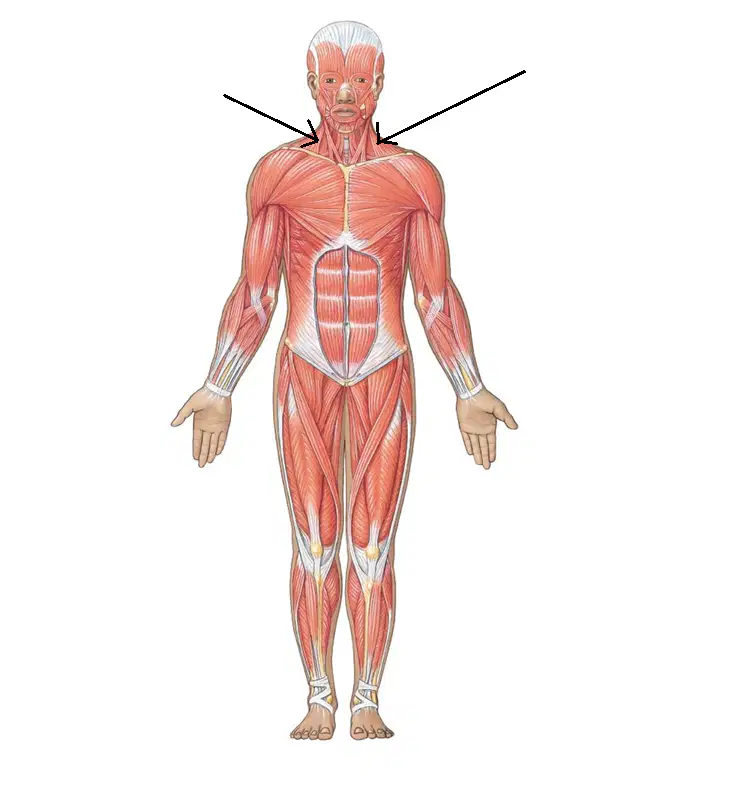
What muscle is this?
masseter
pectoralis major
deltoid
platysma
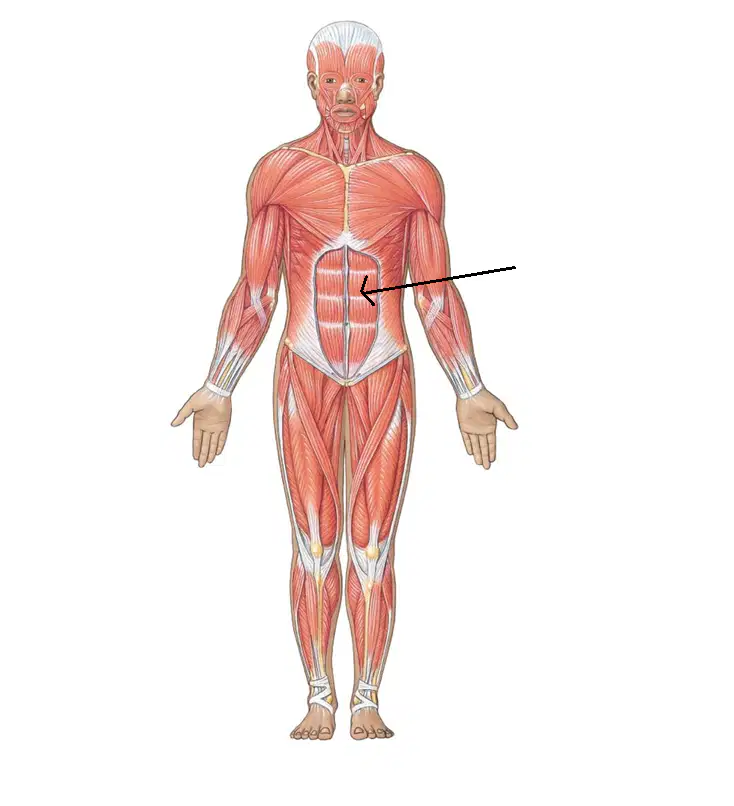
What muscle is this?
rectus abdominis
pectoralis major
intercostals
latissimus dorsi

What muscle is this?
quadriceps
hamstrings
sartorius
gastrocnemius
What is a ligament?
thick, connective tissue that holds bones to bones
thick, connective tissue that holds muscles to bones
a fatty, loose tissue that protects muscles
the tissue within bones that makes red blood cells
What is a tendon?
thick, connective tissue that holds bones to bones
thick, connective tissue that holds muscles to bones
a fatty, loose tissue that protects muscles
the tissue within bones that makes red blood cells

