
 Worksheets
CHEMISTRY FORM 4
Total questions: 50
Worksheet time: 4hrs 10mins
This scientist classified elements according to certain groups such as gases, non-metals, metals and metal oxides.
Johann W. Dobereiner
Antoine Lavoisier
John Newlands
Lothar Meyer
Johann W. Dobereiner propose the Law of Octaves
True
False
This scientist plotted the graph of atomic volume against atomic mass of elements. He found that the elements at equivalent positions on the curve of the graph had similar chemical properties.
John Newlands
Johann W. Dobereiner
Dmitri Mendeleev
Lothar Meyer
Elements in the Periodic Table of Elements are arranged in
descending order of proton numbers
descending order of atomic sizes
ascending order of proton numbers
ascending order of nucleon numbers
The number of ___________________ will determine the
position of the group of an element.
total electrons
protons
valence electrons
The electron arrangement of Aluminium is 2.8.3. In which group does Aluminium belongs in Periodic Table of Elements?
Group 3
Group 13
This element has 6 valence electrons and its proton number is 8. In which period does the element located in Periodic Table of Elements?
Period 2
Period 6
Period 8
Proton number of Silicon is 14. In which group does Silicon belongs to in Periodic Table of Elements?
Group 4
Group 3
Group 14
how many groups/families are on the table
15
16
17
18
A row on the Periodic Table of Elements
family
period
row
isotope
Proton number of fluorine is 9. State the period of fluorine.
2
7
17
3
Proton number of argon is 18. State the group of argon.
8
3
13
18
Proton number of carbon is 6. State the correct group for carbon.
6
4
14
16
Proton number of boron is 5. State the correct position for boron.
Group 3, period 1
Group 3 , period 2
Group 13, period 2
Group 15,period 2
Proton number of potassium is 19. State the correct position for potassium
Group 11, Period 4
Group 4, Period 1
Group 19, Period 4
Group 1, Period 4
Which of the following steps are carried out after the data collection?
I Making observation
II Making conclusion
III Making hypothesis
IV Writing report
I and III
I and IV
II and III
II and IV
A student carries out an experiment to determine the rate of dissolving salt at different sizes.Which of the following apparatus is essential for the experiment?
Conical flask
Stopwatch
Evaporating dish
Bunsen burner
How many atoms are there in 2 mol of chlorine gas?
[Avogardo constant: 6.02 x 10²³ mol-1]
1.204 x 1024
2.408 x 1024
3.612 x 1024
4.816 x 1024
Calculate the relative formula mass of Zn(NO3)2.
[Relative atomic mass: Zn=65, N=14, O=16]
127
175
189
254


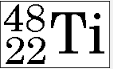
An atom has 12 protons and 13 neutrons in its nucleus. Which is the correct symbol?


Isotopes of an element have a different number of...
Protons
Neutrons
Electrons
Mass
How many total hydrogen atoms are found in 2H2O?
5
4
2
0
A patient is diagnosed with a damage in the thyroid gland.
Which isotope is used to treat the patient?
Copper-64
Cobalt-60
Carbon-14
Iodine-131
Atom P
Proton No: 6
Nucleon No: 14
What is the number of neutrons in atom P?
6
7
8
12

What is the emperical formula for this oxide?
JO
J2O
J2O3
J3O2
Which of the following statements explain why the melting point and boiling point of Group 1 element decreases when going down the group in the periodic table?
The number of proton increase.
Size of atom increases.
The relative mass of atom increases.
The number of valence electron increases.
The chemical formula for potassium hexacyanoferrate(III) is K3Fe(CN)6. What is its relative formula mass?
[Relative atomic mass: C=12, N=14, K=39, Fe=56]
121
199
251
329
What is the meaning of Avogadro constant, NA?
Mass of one mole of a substance
Pressure of one mole of a substance
Volume occupied by one mole of gas
Number of particles in one mole of a substance

The diagram shows two balloons filled with oxygen gas and hydrogen gas respectively.
Which of the following statements is true about the two gases?
Recap: Both oxygen and hydrogen molecules contain two atoms inside a molecule, bonded by covalent bond.
The number of mole of oxygen gas is greater than hydrogen gas
The number of moles of oxygen gas and hydrogen gas are equal
The number of oxygen gas molecules is greater than hydrogen gas molecules
The number of oxygen gas molecules is fewer than hydrogen gas molecules
How many molecules are there in 150 cm3 of carbon dioxide, CO2 at room condition?
[Avogadro constant, NA = 6.02x10²³
mol-1; Molar volume of gas is 24 dm3 mol-1 at room conditions]
3.76x10²¹
3.76x1024
9.63x10²²
9.63x10²¹
Which of the following gases contains 0.4 mol of atoms at room condition?
[1 mol of gas occupies the volume of 24dm3 at room condition]
Tips: Consider number of atoms of each gas.
4.8 dm3 He
4.8 dm3 H2
4.8 dm3 SO3
4.8 dm3 CO2

Diagram above shows the composition of coral reef.
What is the empirical formula of the compound in the coral reef?
[Relative atomic mass: X=40, Y=12, Z=16]
XYZ
XYZ3
XYZ4
X3YZ
Which compound has the empirical formula of CH2O?
HCOOH
CH3COOH
CH3COOCH3
HCOOC2H5
The ionic formula of calcium nitrate and potassium phosphate are Ca(NO3)2 and K3PO4 respectively.
What is the ionic formula of calcium phosphate?
CaPO4
Ca2PO4
Ca2(PO4)3
Ca3(PO4)2
Which chemical equation is correctly balanced?
K(s) + O2(g) → K2O(s)
K(s) + Cl2(g) → KCl(s)
Zn(s) + HCl(aq) → ZnCl2(aq) + H2(g)
Zn(s) + H2SO4(aq) → ZnSO4(aq) + H2(g)
Which chemical compound is correctly named ?
MgO - magnesium oxide
SO3 - sulphur oxide
CO - carbon oxide
Fe2O3 - Iron(II) oxide
The ionic formula of calcium nitrate and potassium phosphate are Ca(NO3)2 and K3PO4 respectively.
What is the ionic formula of calcium phosphate?
CaPO4
Ca2PO4
Ca2(PO4)3
Ca3(PO4)2
What is the number of nitrate ions, NO3- in 2 mol of iron(III) nitrate, Fe(NO3)3?
[Avogadro constant : 6.02x10²³ mol-1]
Tips: Calculate the total number of nitrate ions first.
1.204x1024
1.806x1024
3.010x1024
3.612x1024
The following chemical equation shows the complete combustion of ethane gas.
2C2H6(g) + 7O2(g) → 4CO2(g) + 6H2O(l)
What is the volume of ethane needed to produce 2.2 g of carbon dioxide at standard temperature and pressure?
[Molar mass of CO2 is 44 gmol-1,
molar volume of gas at STP is = 22.4 dm3 mol-1]
0.05 dm3
0.10 dm3
0.56 dm3
1.12 dm3
The following equation shows the decomposition reaction of copper(II) carbonate when heated at room condition.
CuCO3(s) → CuO(s) + CO2(g)
Which of the following is not true when 1 mol of copper(II) carbonate is decomposed?
[Relative atomic mass: C=12, O=16, Cu=64 and 1 mol of gas occupies the volume of 24dm3 at room condition]
1 mol of copper(II) oxide is formed
1 molecule of carbon dioxide gas is given off
80g of copper(II) oxide is formed
24dm3 of carbon dioxide gas is given off
The following equation represents a chemical reaction.
Na2CO3(aq) + CaCl2(aq) → CaCO3(s) + 2NaCl(aq)
Which statement is correct?
Two moles of sodium carbonate react with one mole of calcium chloride
The products are solid calcium carbonate and sodium chloride solution
The reactants are solid sodium carbonate and calcium chloride solution
Two moles of calcium carbonate and one mole of sodium chloride are formed
The nucleon number of element X is 19. Element X has 10 neutrons. Which element has the same chemical properties as element X? [proton number: O=8, Na=11, Cl=17, Ar=18]
Nombor nukleon unsur X ialah 19. Unsur X mempunyai 10 neutron. Unsur yang manakah mempunyai sifat kimia yang sama dengan unsur X? [nombor proton: O=8, Na=11, Cl=17, Ar=18]
oxygen
oksigen
sodium
natrium
chlorine
klorin
argon

Which element is a metal?
Unsur yang manakah merupakan logam?
W
X
Y
Z
Neon gas is used to provide an inert atmosphere for welding. Which of the following explains this property of neon?
Gas neon digunakan sebagai gas inert dalam perkimpalan. Antara berikut yang manakah menerangkan ciri-ciri neon?
It has a stable electron arrangement
Ia mempunyai susunan elektron yang stabil
It is placed in Group18 of the Periodic Table
Ianya terletak dalam Kumpulan 18 Jadual Berkala
It exists as monoatomic gas
Ia wujud sebagai gas monoatom
It has low melting and boiling points
Ia mempunyai takat lebur dan takat didih yang rendah

