wayground logo

Free Printable Worksheets

Font size

S
M
L
XL
Worksheets

Psychology Unit 1: Research & the brain-2023

Total questions: 44

Worksheet time: 46mins
Name
Class
Date
1.
Name (last name, first name)
4 lines
2.
1. What is the most important reason for understanding research methods?
a)
so you can be a psychologist when you grow up
b)
so you can have something interesting to say on blind dates
c)
so you can evaluate information and make informed decisions
d)
so you can get a good grade in this class
3.
2. Which of the following scans provide detailed information about the structure and tissues of the brain?
a)
PET and EEG
b)
case studies and causational analysis
c)
MRI and CAT
d)
Gage scans and cortical scans
4.
3. Which of the following brain scans involves magnetic fields and radio waves that provide information about different structures in the brain?
a)
PET
b)
EEG
c)
CAT
d)
MRI
5.
4. All of the incoming sensations from our senses (except smell) go through which brain structure first before being distributed to the rest of the brain?
a)
hippocampus
b)
reticular formation
c)
medulla
d)
thalamus
6.
5. The difference between the highest and lowest scores in a distribution is called the:
a)
standard deviation.
b)
median.
c)
range.
d)
frequency distribution.
7.
6. Which of the following brain structures connects the right and left hemisphere?
a)
cerebellum
b)
cerebral cortex
c)
amygdala
d)
corpus callosum
8.
7. The ________ the standard deviation, the more spread out scores are; the ________ the standard deviation, the more closely the scores are packed near the mean.
a)
higher; smaller
b)
more negative; more positive
c)
smaller; higher
d)
more positive; more negative
9.
8. Why is a frequency distribution helpful?
a)
It allows you to know how likely a result occurred by chance alone.
b)
It allows you to compare one score with the scores of an imaginary group of 100 people.
c)
It allows you to measure the strength of a relationship between two variables.
d)
It allows you to determine at a glance how the scores cluster and what the most common scores are.
10.
9. Doctors investigating whether a person has a tumor in his or her brain might use which kind of brain scan?
a)
EEG
b)
PET
c)
MRI
d)
EKG
11.
10. The wrinkled outer surface of the brain covering the lower level structures is called the:
a)
cerebellum.
b)
cerebral cortex.
c)
amygdala.
d)
corpus callosum.
12.
11. A case study is:
a)
a research technique in which one person is studied in depth.
b)
an outdated research method not used in current psychology.
c)
research conducted by experimenters who observe a participant in the natural environment without interfering with her in any way.
d)
a set of specific responses from one participant out of a large group.
13.
12. Researchers who study single individuals in depth in order to uncover general principles of thinking and behavior are using which research method?
a)
experimentation
b)
correlational study
c)
naturalistic observation
d)
case study
14.
13. Which of the following brain scans is a series of x-rays combined into computerized pictures of the brain?
a)
PET
b)
EEG
c)
CAT
d)
MRI
e)
Option 5
15.
14. The independent variable in an experiment is:
a)
the effect of random chance on the results.
b)
the most important variable the experimenter could not control or take into account.
c)
the variable the experimenter manipulates in order to examine its effect on the dependent variable.
d)
the variable the experimenter measures in order to see if it was affected by the change in the dependent variable.
16.
15. The dependent variable in an experiment is:
a)
he effect of participant and researcher bias on the results of the experiment.
b)
the variable that depends on the experimenter's hypothesis.
c)
the variable the experimenter manipulates in order to examine its effect on the independent variable.
d)
the variable the experimenter measures in order to see if it was affected by the change in the independent variable.
17.
16. A researcher studying sleep disorders and how brain waves change during sleep cycles would most likely use the ________ scan.
a)
PET
b)
CAT
c)
MRI
d)
EEG
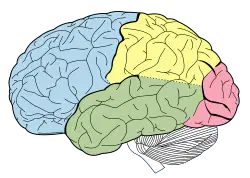
18.
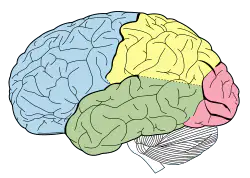
Name the lobe that appears pink in this image.
a)
occipital
b)
frontal
c)
temporal
d)
parietal
19.
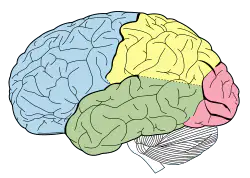
Name the lobe that appears yellow in this image.
a)
occipital
b)
frontal
c)
temporal
d)
parietal
20.
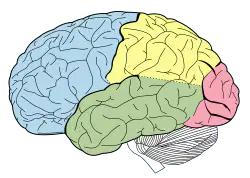
Name the lobe that appears green in this image.
a)
occipital
b)
frontal
c)
temporal
d)
parietal
21.
Name the lobe that appears blue in this image.
a)
occipital
b)
frontal
c)
temporal
d)
parietal
22.
Apply this unit 1 to your daily life..........what are 1-2 topics that you learned that you can apply to what you do ........example (I was unaware that the Frontal lobe was.......)
4 lines
23.

In an experiment, the _________________ variable is tested by the researcher to observe its effect(s) on the _________________ variable.

a)

A.independent; dependent

b)

B.first; second

c)

C.dependent; independent

d)

D.research; results

24.

A type of observation conducted in the participants' normal environment without interference from the researchers.

a)

Controlled observation

b)

Naturalistic observation

25.
This research method is a descriptive technique in which one individual or group is studied in depth in the hope of revealing universal principles
a)
Case Study
b)
Survey
c)
Observational
d)
Correlational
e)
Experiments
26.
This is a method of research where an investigator manipulates one or more factors (independent variables) to observe the effect on some behavior or mental process (the dependent variable).
a)
Experiments
b)
Case Study
c)
Survey
d)
Observational
e)
Correlational
27.
The advantage of this descriptive method of research is that it creates an immense amount of data to be gathered quickly and inexpensively.
a)
Survey
b)
Observational
c)
Correlational
d)
Experiments
e)
Case Study
28.

Identify the type of relationship between weight and price.

a)

The price is never 0 on the graph

b)

As weight increases, price increases

c)

There is a negative linear correlation between weight and price

d)

The price gets high at the end of the graph

29.
Independent variable is to dependent variable as _________ is to ____________.
a)
hypothesis | conclusion
b)
effect | cause
c)
cause | effect.
d)
conclusion | hypothesis
30.

Cardinal rule of naturalistic observation:

a)

Setting up dependent and independent variables

b)

Research and find enough participants

c)

Not disturbing participants in the study

d)

Getting enough different age groups for study

31.

An individual suffered a major traumatic brain injury after getting in a bad accident at work. If a psychologist wants to know the effects of the trauma, what method would be best?

a)

Naturalistic observation

b)

Case study

c)

Experimental research

d)

Survey

32.
Makes decisions, plans, reasons, and carries out behaviors
a)
Frontal Lobe
b)
Parietal Lobe
c)
Occipital Lobe
d)
Temporal Lobe
33.

The ______________ is the largest part of the brain

a)

cerebrum

b)

cerebellum

c)

thalamus

d)

hypothalamus

34.

Which part of the brain controls feelings, personality, and complex thought?

a)

Cerebellum

b)

Frontal Lobe

c)

Brain Stem

d)

Parietal Lobe

35.

If you were having trouble balancing, what part of your brain might be affected?

a)

Occipital Lobe

b)

Brain Stem

c)

Cerebellum

d)

Frontal Lobe

36.

You actually do 'have eyes in the back of your head' because this region of the brain responsible for visual processing is right above the cerebellum!

a)

temporal lobe

b)

parietal lobe

c)

occipital lobe

d)

frontal lobe

37.

When Ebony patted her friend’s cat she was surprised by the softness of the fur. This tactile information was initially received by the

a)

Frontal lobe

b)

Parietal lobe

c)

Occipital lobe

d)

Temporal lobe

38.

Who will win the Super Bowl next year?

a)

The Chicago Bears

b)

LA Rams

c)

Cincinnati Bengals

d)

The Chicago Bears

39.

Hemisphere that is associated with logical abilities

a)
Left Hemisphere
b)
Right Hemisphere
40.

Hemisphere of the brain that is most associated with artistic abilities

a)

Left

b)

Right

41.

The Occipital Lobe is responsible for what?

(check all that apply)

a)

Emotions

b)

Creative thinking

c)

Sensory functions

d)

Visual information

42.

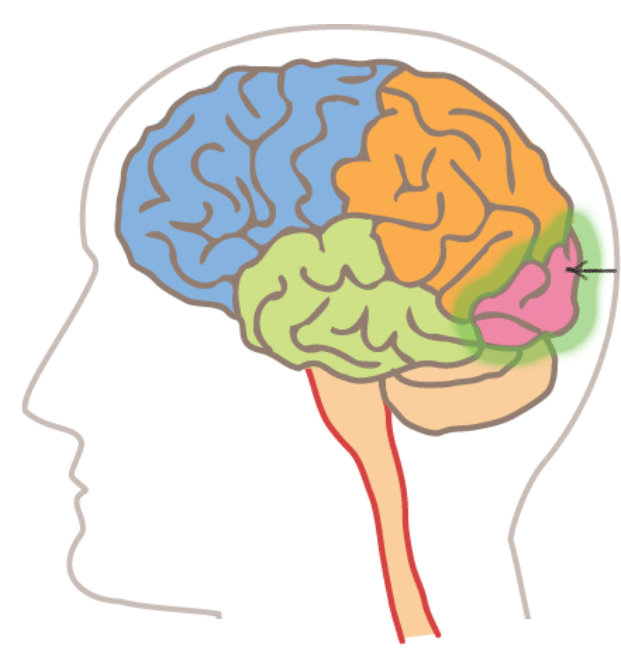
Identify the lobe of the brain highlighted.

a)

Frontal lobe

b)

Parietal lobe

c)

Occipital lobe

d)

Temporal lobe

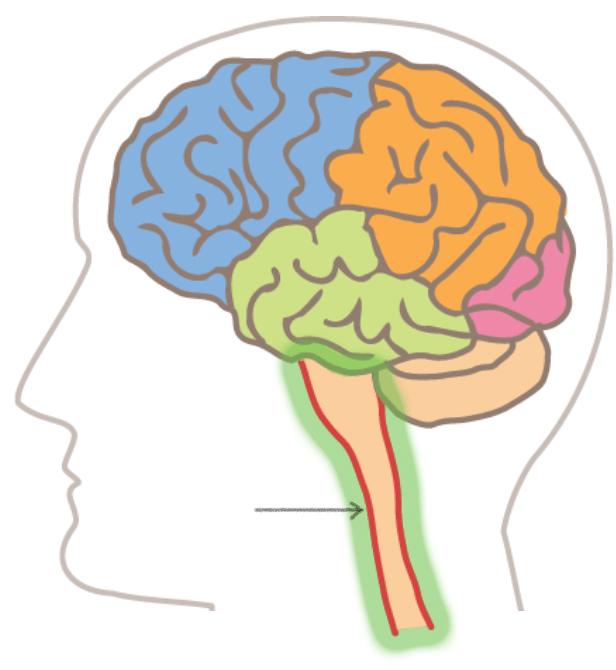
43.

Identify the area of the brain highlighted.

a)

Brain stem

b)

Cerebellum

c)

Spine

d)

Medulla oblongata

44.

Responsible for integrating sensory information, including touch, temperature, pressure and pain.

a)

Frontal lobe

b)

Parietal lobe

c)

Occipital lobe

d)

Temporal lobe