wayground logo

Free Printable Worksheets

NEW

Font size

S
M
L
XL
Worksheets

Unit 1 Biochemistry Review

Total questions: 46

Worksheet time: 1hrs 10mins

Name
Class
Date
1.
What is the function of the vacuole?
a)
Sac that stores water, nutrients, and waste products
b)
Sac filled with digestive chemicals
c)
Jelly-like substance within the plasma membrane
d)
stack of membranes that packages chemicals
2.
I make proteins for the cell. What am I?
a)
ribosome
b)
mitochondria
c)
chloroplast
d)
lysosome
3.

Thick, clear, gel-like fluid that fills the region between the cell membrane and the nucleus

a)

Mitochondria

b)

Cytoplasm

c)

Chloroplast

d)

Nucleus

4.

An organelle that forms a maze of passageways in which proteins and other materials are carried from one part of the cell to another

a)

Cell Wall

b)

Endoplasmic Reticulum

c)

Golgi Appartus

d)

Cytoplasm

5.

Organelle in a cell that receives proteins and other newly formed materials from the endoplasmic reticulum, packages them, and distributes them to other parts of the cell

a)

Golgi Apparatus

b)

Lysosome

c)

Endoplasmic Reticulum

d)

Chloroplast

6.

Semipermeable membrane, surrounding a cell that controls what goes into and out of the cell

a)

Cell Wall

b)

Lysosome

c)

Nucleus

d)

Cell Membrane

7.
The cell spends most of it's life in ________________.
a)
Mitosis
b)
Cytokinesis
c)
Interphase
d)
None of the above
8.
In the S stage of interphase....
a)
The cell grows
b)
The nucleus divides
c)
The cell membrane divides
d)
The DNA is replicated
9.
When an animal cell goes through cytokinesis....
a)
A cell plate forms dividing the 2 new nuclei.
b)
The cell membrane pinches off the 2 new cells.
c)
4 new cells are formed.
d)
Sister chromatids are seperated
10.
a)
Anaphase
b)
Cytokinesis
c)
Telophase
d)
Metaphase
11.
a)
Cytokinesis
b)
Interphase
c)
Anaphase
d)
Metaphase
12.
Cancer creates abnormal cells by disrupting
a)
the cell cycle
b)
red blood cell formation
c)
DNA replication
d)
ATP synthesis
13.
During which part of the cell cycle does the cell divide?
a)
Interphase
b)
Mitosis
c)
S phase
14.
Nucleolus and nuclear membrane start to disappear, chromatin condenses into chromosomes, and spindle fibers start to form. Name that Stage!
a)
Interphase
b)
Prophase
c)
Metaphase
d)
Anaphase
15.
Which of the following is the correct order for the phases of the cell cycle?
a)
G1, M, G2, C, S
b)
S, G1, G2, M, C
c)
G1, G2, S, M, C
d)
G1, S, G2, M, C
16.

What is the purpose of the cell cycle?

a)

Growth of an organism and Repair of damaged tissue

b)

To help the body get rid of extra cells

c)

To increase the amount of classwork you have to do

d)

To get rid of the nucleus

17.
Cancer creates abnormal cells by disrupting
a)
the cell cycle
b)
red blood cell formation
c)
DNA replication
d)
ATP synthesis
18.

Which of these cells never divides?

a)

Skin cell

b)

Liver cell

c)

Nerve cell

d)

Blood cell

19.
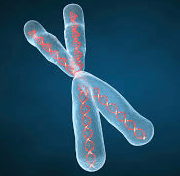
Each identical side of a chromosome is the 
a)
centromere
b)
chromatin
c)
centriole
d)
chromatid
20.
The structure that holds two chromosomes together until they separate for cell division is the
a)
chromatid
b)
chromatin
c)
centromere
d)
cytoplasm
21.

A _________ is DNA tightly coiled around proteins.

a)

gene

b)

chromosome

c)

trait

d)

mutation

22.
Proteins are made of monomers called ___________
a)
Nucleotides
b)
Monosaccharides
c)
Amino Acids
d)
Glycerol and fatty acids
23.
DNA and RNA are examples of 
a)
Carbohydrates
b)
Lipids
c)
Proteins
d)
Nucleic Acids
24.
Nucleotides are monomers of
a)
Carbohydrates
b)
Lipids
c)
Proteins
d)
Nucleic Acids
25.
Monosaccharides are monomers of
a)
Carbohydrates
b)
Lipids
c)
Proteins
d)
Nucleic Acids
26.
Which macromolecule stores energy, insulates us, and makes up the cell membrane?
a)
lipids
b)
proteins
c)
carbohydrates
d)
nucleic acids
27.
Lipids can be digested into what smaller subunits?
a)
nucleic acids
b)
amino acids
c)
fatty acids
d)
glucose
28.
Which group of biomolecules provide quick energy to organisms?
a)
proteins
b)
carbohydrates
c)
lipids
d)
nucleic acids
29.
All polymers are made up of...
a)
monosaccharides
b)
monomers
c)
proteins
d)
None of these
30.
Enzymes are..
a)
nucleic acids 
b)
carbohydrates 
c)
lipids 
d)
proteins 
31.

Which macromolecule is shown?

a)

lipid

b)

protein

c)

nucleic acid

d)

carbohydrate

32.

Enzymes are an example of

a)

Lipids

b)

Carbohydrate

c)

Protein

d)

Nucleic Acid

33.
What is the purpose  of an enzyme?
a)
give permission for the reaction
b)
raise activation energy
c)
speed up reactions
d)
control how many reactions occur
34.
Enzymes are capable of increasing the rate of a chemical reaction within a living cell.  Enzymes accomplish this through which of the following means?
a)
reducing the number of products   
b)
reducing the activation energy
c)
increasing the temperature of the cell
d)
increasing the concentration of reactants 
35.
Each enzyme only has 1 substrate that will fit its active site.  What is this called?
a)
reusable
b)
catalyst
c)
specific
d)
fragile
36.
What 3 letters do enzymes typically end in?
a)
-ose
b)
-ase
c)
-ese
d)
-tic
37.
Any substance that is acted upon by an enzyme is called a(n)?
a)
Coenzyme
b)
Substrate
c)
Vitamin
d)
Polypeptide
38.
After the enzyme and substrate bind together and perform the reaction, what does the substrate become?
a)
a substrate
b)
an enzyme
c)
a product
d)
an active site
39.
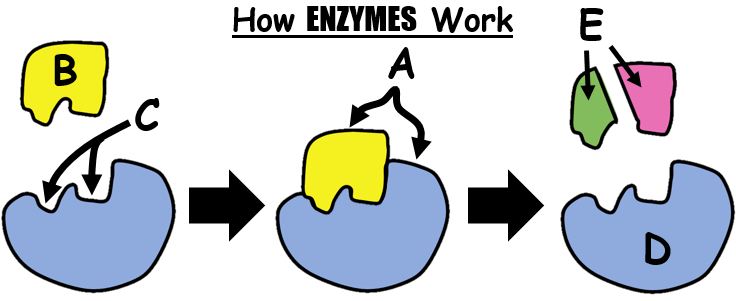
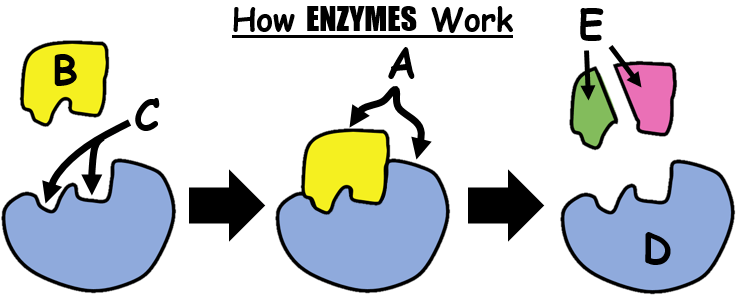
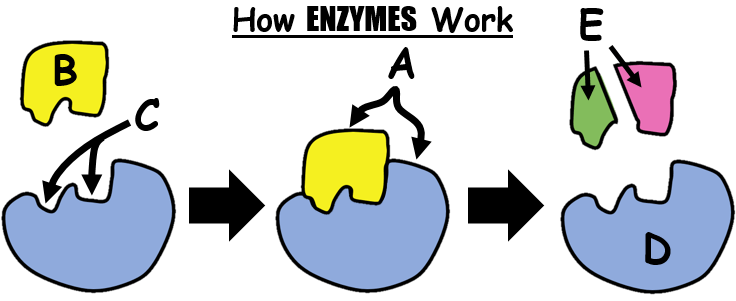
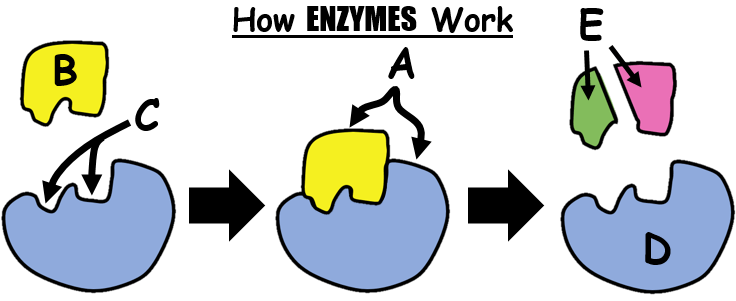
In the diagram, what is letter A? 
a)
product
b)
substrate
c)
enzyme-substrate complex
d)
active site
40.
Letter D...
a)
active site
b)
enzyme
c)
substrate
d)
products
41.
Letter B...
a)
active site
b)
enzyme
c)
substrate
d)
products
42.
Letter C...
a)
active site
b)
enzymes
c)
substrate
d)
products
43.
Letter E...
a)
active site
b)
enzyme
c)
substrate
d)
products
44.
Enzymes provide a site where reactants called substrates can be brought together in an enzyme-catalyzed reaction. The site is called the
a)
enzyme substrate complex.
b)
reaction site.
c)
active site.
d)
lock and key.
45.
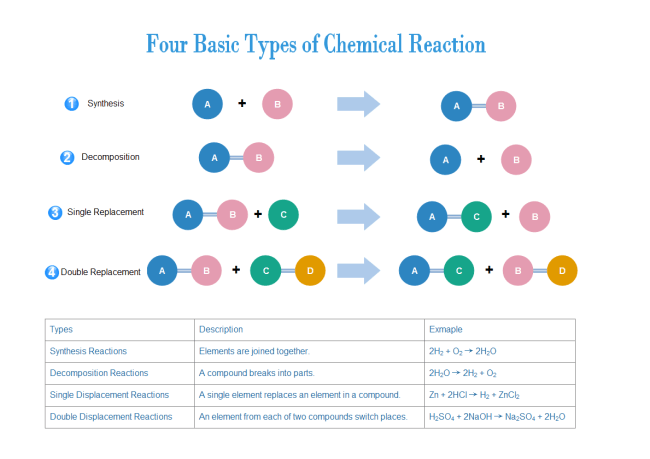
Chemical reactions always involve
a)
the breaking of bonds in reactants.
b)
the formation of new bonds in products.
c)
the breaking of bonds in reactants and the formation of new bonds in products.
d)
enzymes. 
46.
An enzyme speeds up a chemical reaction in the cell but can only be used once.  True or False? 
a)
true
b)
false