
NEW
Font size
S
M
L
XL
 Worksheets
Electron Configuration Orbital Diagram and Noble Gas Practice
Total questions: 36
Worksheet time: 2hrs 41mins
Name
Class
Date
1.
What atom matches this electron configuration?
1s22s22p63s23p64s23d10
1s22s22p63s23p64s23d10
a)
Zinc
b)
Copper
c)
Nickel
d)
Germanium
2.
What atom matches this electron configuration?
1s22s22p63s23p64s23d10
1s22s22p63s23p64s23d10
a)
Zinc
b)
Copper
c)
Nickel
d)
Germanium
3.
The electron configuration of an atom is 1s22s22p6. The number of electrons in the atom is
a)
3
b)
6
c)
8
d)
10
4.
Which electron configuration belongs to Chlorine (Cl)?
a)
1s2 2s2 2p6 3s2 3p5
b)
1s2 2s2 2p6 3s2 3p6
c)
1s2 2s2 2p6 3s2 3p7
5.
Identify the Electron Configuration for Aluminum (Al)
a)
1s2 2s2 2p6 3s2 3p1
b)
1s2 2s2 2p6 3s2 3p3
c)
1s2 2s2 2p6 3s2 4p1
6.
Electrons occupy orbitals of lowest energy first is part of what electron configuration rule?
a)
Hund’s Rule
b)
Aufbau Principle
c)
Pauli Exclusion Principle
7.
What is the maximum number of electrons that an S orbital can have?
a)
1 electron
b)
2 electrons
c)
3 electrons
d)
4 electrons
8.

How many valence electrons are represented here?
a)
7
b)
5
c)
2
d)
8
9.
How many electrons can the d sublevel(orbital) hold?
a)
8
b)
10
c)
2
d)
4
10.
What is this element?
1s22s22p63s23p64s23d104p6
a)
Argon
b)
Krypton
c)
Selenium
d)
Bromide
11.
How many valence electrons does Chlorine have?
a)
5
b)
2
c)
7
d)
5
12.
Which of the following is a p block element?
a)
Ca
b)
Ar
c)
Re
d)
Au
13.
Which electron configuration belongs to Copper (Cu)?
a)
1s2 2s2 2p6 3s2 3p6 4s2 3d8
b)
1s2 2s2 2p6 3s2 3p6 4s2 3d9
c)
1s2 2s2 2p6 3s2 3p6 4s2 3d10
14.
Which area on the periodic table represents the electrons in the "d" sublevel?
a)
representative elements
b)
columns 3-8
c)
rare earth elements
d)
transition elements
15.
How many electron can be found in a p orbital?
a)
2
b)
3
c)
4
d)
6
16.

How many electrons can the first energy level hold?
a)
1
b)
2
c)
8
d)
0
17.
Each row on the periodic table represents:
a)
an energy level
b)
a sublevel
c)
an electron
d)
an orbital
18.

What's a valence electron?
a)
electrons in the second energy level
b)
electrons in the outermost energy level
c)
the atomic number
d)
electrons in the first level
19.

Which element is depicted from this orbital diagram
a)
Fluorine
b)
Neon
c)
Chlorine
d)
Argon
20.

Which is associated with more energy?
a)
2p
b)
2s
c)
3p
d)
1s
21.

Which element is pictured?
a)
neon
b)
fluorine
c)
magnesium
d)
argon
22.

This orbital diagram represents:
a)
C
b)
B
c)
N
d)
O
23.
Which element is depicted from this orbital diagram
a)
Fluorine
b)
Neon
c)
Chlorine
d)
Argon
24.
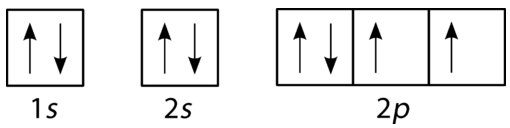
This orbital diagram represents:
a)
C
b)
B
c)
N
d)
O
25.

What is incorrect about this orbital diagram?
a)
Both arrows in the 2p box should be pointing up
b)
There is nothing incorrect with this diagram
c)
In the 2p box there should only be 1 electron in the first 2p box and one in the 2nd 2p box
d)
All the arrows should be pointing up.
26.

Which orbital shows a violation of Hund's Rule?
a)
A
b)
B
c)
C
d)
D
27.
Which orbital shows a violation of Hund's Rule?
a)
A
b)
B
c)
C
d)
D
28.

Which orbital shows a violation of the Pauli Exclusion Principle?
a)
A
b)
B
c)
C
d)
D
29.
What is the noble gas configuration for beryllium?
a)
[He]1s2
b)
[He]2s2
c)
[Li]2s1
d)
[Li]2s2
30.
What is the noble gas configuration for Sulfur?
a)
[Ar] 3p4
b)
[He] 3s2 3p4
c)
[Ne] 3s2 3p4
d)
[Na] 3s2 3p4
31.
[Ne]3s1 is the noble gas configuration for which element?
a)
sodium
b)
lithium
c)
fluorine
d)
aluminum
32.
[Ne]3s23p1 is the noble gas configuration for which element?
a)
scandium
b)
boron
c)
nitrogen
d)
aluminum
33.
What is the noble gas configuration for Argon?
a)
[Ne]2s22p6
b)
[He]2s22p6
c)
[He]3s23p6
d)
[Ne]3s23p6
34.
What does the 1 in "1s" stand for?
a)
energy level
b)
s orbitals
c)
p orbitals
d)
the number of electrons
35.
What is the noble gas configuration for Cobalt?
a)
[Kr] 4s2 3d7
b)
[Kr] 4s2 4d7
c)
[Ar] 4s2 3d7
d)
[Ar] 4s2 4d7
36.
Orbitals can hold a maximum of two electrons each with opposite spins is which rule?
a)
Aufbau Principle
b)
Pauli Exclusion Principle
c)
Hund's Rule
Reset

