wayground logo

Free Printable Worksheets

NEW

Font size

S
M
L
XL
Worksheets

Atomic Theory

Total questions: 71

Worksheet time: 4hrs 33mins
Name
Class
Date
1.
J.J. Thomson provided evidence that an atom...
a)
is the smallest particle of matter
b)
contains negatively charged particles
c)
has an overall negative charge
d)
has an overall positive charge
2.
Rutherford discovered the...
a)
electron
b)
proton
c)
neutron
d)
nucleus
3.
Isotopes are elements with a different amount of
a)
protons
b)
neutrons
c)
electrons
d)
atoms
4.
Which particle does not contribute mass to the atom?
a)
Proton
b)
Neutron
c)
Electron
d)
Nucleus
5.
an element will always have the same number of 
a)
neutrons
b)
protons
c)
isotopes
d)
atoms
6.
An ______________ is the same element, with the same number of protons, but different numbers of neutrons
a)
Atom
b)
Isotope
c)
Atomic Number
d)
Mass Number
7.
The smallest particle into which an element can be divided and still be the same substance
a)
neutron
b)
atom
c)
electron
8.
What scientist first developed 4 rules for atomic theory, and helped kick start modern chemistry?
a)
J.J. Thomson
b)
Ernest Rutherford
c)
John Dalton
d)
Democritus
9.
Niels Bohr suggested that electrons.......
a)
are found in specific orbits
b)
electrons are scattered throughout the atom
c)
electrons move according to their energy level
d)
electrons are positive
10.
In a correctly written symbol what would be located in the "A" position?
a)
number of neutrons
b)
atomic number
c)
number of electrons 
d)
mass number
11.
How many protons are in this element?
a)
79
b)
196
c)
117
d)
Cannot be determined
12.
What is the atomic mass (rounded to the nearest whole number) of this element
a)
196
b)
196.95
c)
197
d)
79
13.
Because atoms are neutral, the number of protons will be equal to the number of __________ in an atom.
a)
Positrons
b)
Neutrons
c)
Electrons
d)
Nuclei
14.
The three main subatomic particles are electrons, protons and ____________.
a)
photons
b)
neurons
c)
neutrons
d)
quarks
15.
What are the two main parts of the atom?
a)
nucleus and cytoplasm
b)
nucleus and electron cloud
c)
core and electron cloud
d)
protons and neutrons
16.
The conservation of ___ explains the process of nuclear decay reactions.
a)
mass
b)
definite
c)
multiple
17.
Identify letter A
a)
Nucleus
b)
Neutrons
c)
Protons
d)
Electrons
18.
Identify letter B
a)
Nucleus
b)
Neutrons
c)
Protons
d)
Electrons
19.
Identify letter C
a)
Nucleus
b)
Neutrons
c)
Protons
d)
Electrons
20.
Identify letter D
a)
Nucleus
b)
Neutrons
c)
Protons
d)
Electrons
21.
Which scientist developed the atomic theory
a)
Aristotle
b)
Dalton
c)
Democritus
22.
The smallest unit of a pure substance that has the properties of that substance
a)
element
b)
atom
c)
neutron
d)
compound
23.
Atoms are made up of three basic parts, which are -
a)
Protons, neutrons, electrons
b)
neutrinos, protons, neutrons
c)
quarks, protons, electrons
d)
electrons, neutrons, and quarks
24.
The nucleus is made up of -
a)
neutrons and electrons
b)
protons and neutrons
c)
protons and electrons
d)
electrons and quarks
25.
Protons have this charge -
a)
positive
b)
negative
c)
neutral
d)
no charge
26.
Electrons have this charge - 
a)
positive
b)
negative
c)
neutral
d)
no charge
27.
Neutrons have this charge -
a)
positive
b)
negative
c)
neutral
d)
They don't exist
28.
What scientist is best known for his "Plum Pudding" model of the atom?
a)
J.J. Tomson
b)
Ernest Rutherford
c)
John Dalton
d)
Democritus
29.
Place the following scientists in order, from earliest to latest: 
A) Ernest Rutherford
B) J.J. Thomson
C) John Dalton
a)
B,C,A
b)
C,A,B
c)
A,C,B
d)
C,B,A
30.
An atom's overall charge is ________.
a)
positive 
b)
depends
c)
neutral 
d)
negative 
31.
J.J. Thomson provided evidence that an atom...
a)
is the smallest particle of matter
b)
contains negatively charged particles
c)
has an overall negative charge
d)
has an overall positive charge
32.
Rutherford's gold foil experiment provided evidence that...
a)
negative and positive charges are spread evenly throughout the atom.
b)
alpha particles have a positive charge.
c)
gold is not a dense as previously thought.
d)
there is a dense positively charged nucleus at the center of an atom.
33.
An atom's overall charge is ________.
a)
positive 
b)
depends
c)
neutral 
d)
negative 
34.
Ernst Rutherford discovered which part of the atom through the use of gold foil?
a)
Proton
b)
Neutron
c)
Electron
d)
Orbitals
35.
The particles that are found in the nucleus of an atom are
a)
neutrons and electrons
b)
electrons only
c)
protons and neutrons
d)
protons and electrons
36.
"Everything is composed of atoms" was stated by:
a)
Democritis
b)
Dalton
c)
Moseley
d)
Einstein
37.
John Dalton stated:
a)
elements are made of atoms
b)
atoms of a given element are identical
c)
atoms cannot be subdivided, created, nor destroyed
d)
all of the above
38.
The scientist responsible for "discovering" the nucleus is:
a)
Bohr
b)
Rutherford
c)
Schroedinger
d)
Einstein
39.
The nucleus of an atom can be described as:
a)
spacious and negatively charged
b)
dense and positively charged
c)
spacious and positively charged
d)
dense and negatively charged
40.
Electrons are not factored into atomic mass because:
a)
They are so small their mass is negligible
b)
They're not in the nucleus
c)
They're too big
d)
They move so quickly their mass is zero
41.
How did Rutherford discover the proton?
a)
Cathode tube ray experiment
b)
Gold Foil Experiment
c)
Planetary Model
d)
Plum Pudding Model
42.
What does the nucleus of an atom contain?
a)
Electrons and neutrons
b)
Protons and neutrons
c)
Neutrinos and positrons
d)
DNA and RN
43.
True or False: The majority of an atom is made up of empty space
a)
True
b)
False
44.
The word "atom" comes from a Greek word that means
a)
Invisible
b)
Indivisible
c)
Undivided
45.
Electrons can be found in
a)
The protons
b)
The nucleus
c)
Electron Clouds
46.
Who stated that atoms cannot be divided?
a)
Democritus
b)
Dalton
c)
Thomson
d)
Bohr
47.
In an atom, electrons move in definite orbits around the nucleus.
a)
Thomson
b)
Rutherford
c)
Bohr
d)
Democritus
48.
What scientist is best known for his "Plum Pudding" model of the atom?
a)
J.J. Thomson
b)
Ernest Rutherford
c)
John Dalton
d)
Democritus
49.
What contribution did John Dalton make to atomic theory? 
a)
He discovered that every atom was positively charged. 
b)
He discovered that every element consisted of one type of atom that couldn't be divided. 
c)
He discovered that atoms had nuclei. 
d)
He discovered that atoms could be divided into smaller parts. 
50.
Place the following scientists in order, from earliest to latest: 
Rutherford, Dalton, Bohr, Thomson
a)
Dalton, Rutherford, Bohr, Thomson
b)
Thomson, Dalton, Rutherford, Bohr
c)
Dalton, Thomson, Rutherford, Bohr
d)
Bohr, Dalton, Rutherford, Thomson
51.
Rutherford's gold foil experiment provided evidence that...
a)
negative and positive charges are spread evenly throughout the atom.
b)
alpha particles have a positive charge.
c)
gold is not a dense as previously thought.
d)
there is a dense positively charged nucleus at the center of an atom.
52.
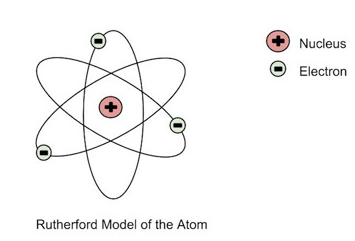
Who came up with the model of an atom pictured?
a)
J.J. Thompson
b)
Ernest Rutherford
c)
Neils Bohr
d)
James Chadwick
53.
The first person to propose a theory about an atom called the Atomos Theory was
a)
Democritus
b)
Rutherford
c)
Dalton
d)
Aristotle
54.
Who discovered the nucleus using the gold foil experiment?
a)
Democritus
b)
Robert Millikan
c)
James Chadwick
d)
Ernest Rutherford
55.
He discovered the electron using cathode ray tube experiment.
a)
Joseph Thomson
b)
John Dalton
c)
Ernest Rutherford
d)
Robert Millikan
56.
His atomic model was depicted similar to a planetary/solar system
a)
Niels Bohr
b)
Joseph Thomson
c)
Ernest Rutherford
d)
Democritus
57.
He first measured the mass and charge of an electron using the oil drop experiment.
a)
Joseph Thomson
b)
Robert Millikan
c)
John Dalton
d)
Niels Bohr
58.
How did Thomson build upon Dalton's model? 
a)
His model was the same.
b)
He put electrons in orbitals.
c)
He discovered the nucleus.
d)
He discovere subatomic particles (electron).
59.
Who's model is this? 
a)
Millikan
b)
Rutherford
c)
Thomson
d)
Bohr
60.
How did each model of the atom help to develop the atomic theory? 
a)
Each model provided opinions that were added.
b)
Each model showed different properties of the same structure. 
c)
Each model showed new particles that had been discovered.
d)
Each model built upon the other to show new particles or properties of previously discovered particles. 
61.

Electrons orbit a certain distance from the nucleus. Either radiate or absorb energy when jumping orbitals.

a)

Dalton

b)

Thomson

c)

Rutherford

d)

Bohr

62.

The atom is mostly large empty space with a small, dense nucleus at the center

a)

Dalton

b)

Thomson

c)

Rutherford

d)

Bohr

63.

Atom is a positively charged cloud with embedded negative electrons

a)

Dalton

b)

Thomson

c)

Rutherford

d)

Bohr

64.

Atoms are indivisible (cannot be broken down)

a)

Dalton

b)

Thomson

c)

Rutherford

d)

Bohr

65.

What scientist proposed this atomic model?

a)

Dalton

b)

Thomson

c)

Rutherford

d)

Bohr

66.

What scientist proposed this atomic model?

a)

Dalton

b)

Thomson

c)

Rutherford

d)

Bohr

67.

What scientist proposed this atomic model?

a)

Dalton

b)

Thomson

c)

Rutherford

d)

Bohr

68.

What scientist proposed this atomic model?

a)

Dalton

b)

Thomson

c)

Rutherford

d)

Bohr

69.

In a famous experiment conducted by Ernest Rutherford, positively charged alpha particles were scattered by a thin gold foil. Which of the following is a conclusion that resulted from this experiment?

a)

The nucleus is negatively charged

b)

The atom is a dense solid and is indivisible

c)

The mass is conserved when atoms react chemically

d)

The nucleus is very small and the atom is mostly empty space

70.

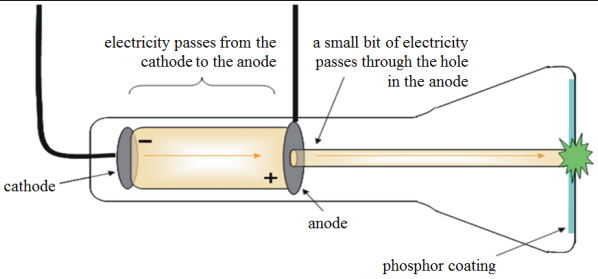
What subatomic particle was discovered in the cathode ray tube experiment?

a)

Proton

b)

Neutron

c)

Electron

d)

Nucleus

71.

What evidence led Niels Bohr to believe that electrons occupy specific energy levels in atoms?

a)

Excited electrons emit colored light at every possible wavelength.

b)

Excited electrons emit colored light at only certain wavelengths.

c)

Electrons emit colored light only when in an excited state.

d)

Electrons emit colored light only when in ground state.