wayground logo

Free Printable Worksheets

Font size

S
M
L
XL
Worksheets

Physical Science Review

Total questions: 72

Worksheet time: 1hrs 23mins

Name
Class
Date
1.

When there is a change in motion, the forces are

a)

balanced

b)

unbalanced

c)

equal

d)

happening

2.

An object in motion will stay in motion and an object at rest will stay at rest unless acted upon by an outside force.  Which law does this describe?

a)

Newton's 1st Law

b)

Newton's 2nd Law

c)

Newton's 3rd Law

d)

None of the above

3.

If you are driving forward and suddenly break, what would happen to your body and which law does that demonstrate?

a)

go back, 1st law

b)

move forward, 1st law

c)

go back, 2nd law

d)

move forward, second law

4.

If there is a big mass, it would need a stronger force to accelerate it.  Which law does this describe?

a)

Newton's 1st Law

b)

Newton's 2nd Law

c)

Newton's 3rd Law

d)

None

5.

What is the unit for force?

(a)  

6.

What units are used for mass?

(a)  

7.

In a football game, two players tackle each other so hard that they both fly in opposite directions after they hit each other.  What law of motion is this an example of?

a)

Newton's 1st

b)

Newton's 2nd

c)

Newton's 3rd

d)

None

8.

If you want to increase the acceleration of a baseball when you throw it, what must you increase to make this happen?

a)

force

b)

acceleration

c)

mass

d)

none

9.

If a dog pulls a 5 kg bike with a force of 70N, how quickly did it accelerate?

a)

350 m/s2

b)

50 m/s2

c)

35 m/s2

d)

14 m/s2

10.

If your dog travels 52 m South in 2 hours, what is his velocity?

a)

26 m/h south

b)

22 m/h south

c)

20 m/h south

d)

25 m/h south

11.

What is inertia?

a)

amount of mass an object has

b)

resistance of change

c)

movement of an object

d)

none

12.

Which law is the law of acceleration?

a)

Newton's 1st

b)

Newton's 2nd

c)

Newton's 3rd

d)

none

13.

The greater the force applied, the greater the

a)

mass

b)

acceleration

c)

force

d)

none

14.

Which law deals with action and reaction forces?

a)

Newton's 1st

b)

Newton's 2

c)

Newton's 3

d)

None

15.

Newton's third law states there is an _________ and __________ reaction for every action

(a)  

16.
What will cause an object to move?
a)
Applied forces
b)
Balanced forces
c)
Unbalanced forces
17.
What is the net force?
a)
10 N
b)
0 N
c)
25 N
d)
1 N
18.
You and your dad are moving the couch from one side to another. Your dad pushes with a force of 35 N to the right and you push with a force of 25 N right. What is the net force on the couch?
a)
60 N right
b)
10 N left
c)
60 n right
d)
50 N left
19.

Suppose that an astronaut throws a baseball in outer space at a location far from significant influences of gravity and air resistance. One would expect that the baseball would ____.

a)

eventually stop since all objects ultimately "lose their steam"

b)

eventually stop as its inertia slowly becomes used up

c)

continue in motion with the same speed and direction

d)

either a, b, or c -- depending on whether the astronaut continues to push it

20.

A skateboard rolls down a hill, reaches the level surface and eventually comes to a stop. The fact that the skateboard ultimately stops is best explained by ____.

a)

an unbalanced force would be required to keep the sled moving forward at constant speed

b)

the presence of an unbalanced force (e.g., friction) can cause a moving object to stop

c)

the presence of inertia causes it to stop

d)

the natural tendency of any object is to ultimately stop

21.
Acceleration depends on mass and the _______ acting on it.
a)
mass
b)
volume
c)
force
d)
speed
22.
If you sit on a chair, the chair pushes up with a ________ force
a)
stronger
b)
weaker
c)
equal 
23.
To increase acceleration of an object you reduce its ______ and/or increase the applied force
a)
mass
b)
volume
c)
length
d)
density
24.
If you increase the mass on an object, its acceleration
a)
decreases
b)
stays the same
c)
also increases
d)
stops
25.
What is the magnitude (size) and direction of the net force?
a)
15 N to the left
b)
15 N to the right
c)
1 N to the left
d)
1 N to the right
26.

What evidence did you collect that supports the idea that mass and acceleration are inversely proportional?

a)

When the same strength force was applied on two identical carts, the cart

with the greater mass decreased at a slower rate. Thus, the greater the mass, the greater the acceleration

b)

When the same strength force was applied on two identical carts, the cart

with the greater mass decreased at a slower rater, Thus, the greater the mass, the smaller the acceleration

c)

When the same strength force was applied on two identical carts, the cart

with the smaller mass decreased at a slower rater, Thus, the smaller the mass, the smaller the acceleration
27.
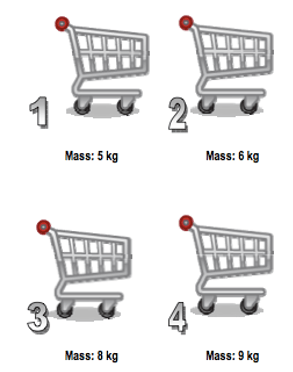
A force of 90N is applied to each cart below, which one will accelerate the fastest?
a)
Cart 1
b)
Cart 2
c)
Cart 3 
d)
Cart 4
28.
Is this a balanced or unbalanced force?
a)
Balanced
b)
Unbalanced
c)
Neither
d)
Both
29.
Is this a balanced or unbalanced force?
a)
Balanced
b)
Unbalanced
c)
Neither
d)
Both
30.
What is the net force?
a)
11 N left
b)
11 N right
c)
3 N left
d)
3 N right
31.
Carey left a bowling ball and kickball outside on a windy day. Which best explains why the kickball moved but the bowling ball did not?
a)
The kickball has less mass so it was easier to move.
b)
The force of gravity acting on the bowling ball is greater.
c)
The mass of the kickball is greater so it is easier to move.
d)
The force of gravity acting on the kickball is less. 
32.
Pam ran down the sidewalk to school with her empty backpack. After school Pam's backpack was loaded with books. Which best describes the force required to carry the book bag home?
a)
It took the same amount of force both times.
b)
It took more force when the book bag was loaded.
c)
It took less force with the bookbag was loaded.
d)
It took more force to carry the empty book bag.
33.
Matt had a toy truck weighing 15 g and a toy car weighing 6 g. Using the same amount of force on each toy, he pushed them both across his desk. The car reached the other side of the desk in 1.5 seconds, but it took the truck 3.5 seconds to reach the other side of the desk. Why did the car travel the same distance in a shorter amount of time?
a)
The car had more mass and traveled at a faster speed than the truck
b)
The car had more mass and traveled at a faster speed than the car.
c)
The car had less mass and traveled at a faster speed than the truck.
d)
Friction slowed the toy truck down.
34.
What happens when unbalanced forces act on an object at rest?
a)
the object remains at rest
b)
the object begins moving in an unpredictable direction
c)
the object begins moving in the direction of the net force
d)
the object begins moving opposite to the direction of net force
35.
Which of these is not accelerating?
a)
Running at a constant speed to the bus stop
b)
Running to the bus stop, but slowing down to watch the sunrise
c)
Running up and down hills
d)
Walking in a zig zag to the bus stop
36.
Which shopping cart will have more acceleration?  
a)
The empty shopping cart
b)
The shopping cart that's full
c)
They will be the same
37.
If you push a basketball and a bowling ball with the same amount of force, which one will accelerate more?
a)
Basketball
b)
Bowling ball
c)
They will accelerate at the same rate
38.
Why would one ball accelerate more than the other when pushed with the same amount of force?
a)
Different weights
b)
Different forces
c)
Different masses
d)
Different sizes
39.
Will it take more force to push an empty shopping cart or a shopping cart that is full?
a)
The empty shopping cart
b)
The full shopping cart
c)
They will take the same amount of force
40.

a motor converts electrical current into

a)

chemical energy

b)

chemical force

c)

mechanical force

d)

mechanical life

41.

Motor or Generator?

a)

Motor

Input: electrical

Output: mechanical

b)

Generator

Input: electrical

Output: mechanical

c)

Motor

Input: mechanical

Output: electrical

d)

Generator

Input: mechanical

Output: electrical

42.

Motor or Generator?

a)

Motor

Input: mechanical

Output: electrical

b)

Generator

Input: mechanical

Output: electrical

c)

Motor:

Input: electrical

Output: mechanical

d)

Generator

Input: electrical

Output: mechanical
43.
Electric motors are devices that convert _____ energy into  _____ energy.
a)
electrical; mechanical
b)
mechanical; electrical
c)
chemical; potential
d)
mechanical; kinetic
44.
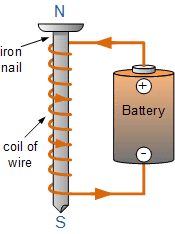
What device is made of coils of wire with an electrical current passing through it in order to generate a magnetic field?  
a)

Electromagnet 

b)

Generator

c)

Electron Magnet 

d)

Magneto's Helmet

45.
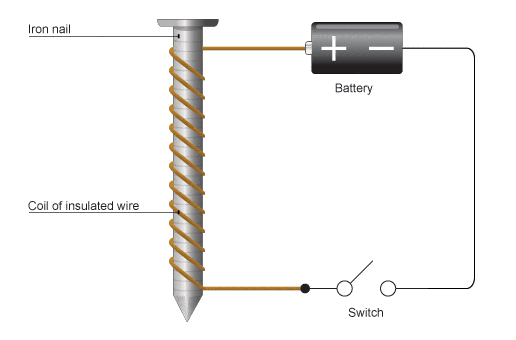
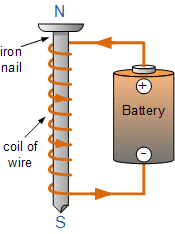
What is most likely to happen when the switch is closed?
a)
A magnetic field should be produced
b)
The nail will rust
c)
The battery will explode
d)
The wire will catch on fire
46.
In order for an electromagnet to be formed, an __________ current must pass through a coil of __________ wrapped around an ________ core.
a)
wire, iron, electric
b)
electric, wire, iron
c)
iron, electric, wire
d)
excited, hair, apple
47.
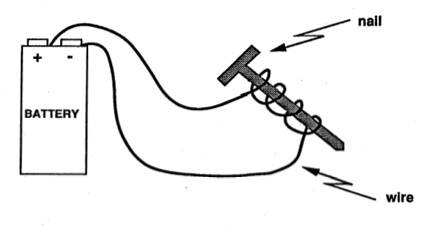
This is a picture of a simple electromagnet. How can the electromagnet be made stronger?
a)
Add more coils of wire to the nail.
b)
Use a smaller battery.
c)
Reverse the poles of the magnet.
d)
Remove all the coils and the nail.
48.

Which electromagnet will pick up MORE paperclips?

a)

A

b)

B

49.

Which electromagnet will pick up LESS paper clips?

a)

A

b)

B

50.

Which electromagnet will pick up LESS paper clips?

a)

A

b)

B

51.

Which electromagnet is stronger?

a)

A

b)

B

52.

Which of the following will increase the strength of an electromagnet?

a)

Increase the voltage of the battery

b)

Decrease the voltage of the battery

c)

Wrap the coils around the core less times

53.

The following image is a.....

a)

Transformer

b)

Generator

c)

Motor

d)

Galvanometer

54.

A generator converts ______ into ______.

a)

Electrical energy, mechanical energy

b)

mechanical energy, electrical energy

c)

electrical energy, solar energy

d)

Solar energy into electrical energy

55.
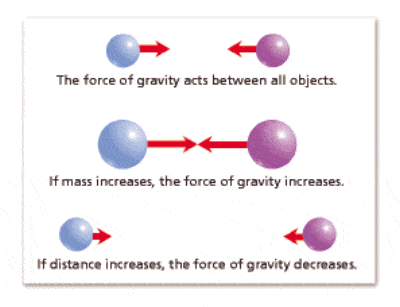
As mass increases, what happens to gravitational force?
a)
increases
b)
decreases
c)
stays the same
d)
i don't know
56.
Which model has greater gravitational attraction (if any)
a)
Model A
b)
Model B
c)
Both Model A and Model B (same gravity)
57.

Two objects of the same mass are placed at the distance shown. Which pair has the greatest gravitational force between them?

a)

The pair 2 m apart

b)

The pair 3 m apart

c)

They have the same gravitational force

d)

There is no gravitational force between them

58.

What happens to the magnetic force when the distance between two magnets increases?

a)

The force will be weaker.

b)

The force will be stronger.

c)

The force will be unchanged.

d)

The force would reverse the poles.

59.

A ball rolls down from the top of a grassy hill, reaches the bottom of the hill, continues to roll, and then starts to slow down and comes to a stop. What forces caused this ball's motion?

a)

Frictional force caused the ball to roll down the hill, but air resistance caused the ball to slow down and stop.

b)

Magnetic force caused the ball to roll down the hill, but gravity caused the ball to slow down and stop.

c)

The force of the hill caused the ball to roll down it, but gravity caused the ball to slow down and stop.

d)

Gravity caused the ball to roll down the hill, but frictional force caused the ball to slow down and stop.

60.
These particles orbit around the nucleus of an atom.  What are they called?
a)
electrons
b)
protons
c)
neutrons
d)
photons
61.
Where are electrons of an atom found?
a)
Nucleus
b)
Electron Cloud
c)
Some are in the nucleus and some in the electron cloud.
d)
They are moving everywhere.
62.
From the diagram, which particles are indicated with the arrow?
a)
electrons and protons
b)
protons and neutrons
c)
electrons and neutrons
d)
photons and nucleons
63.

Why is the overall charge of an atom neutral (0)?

a)

They have the same number of protons and neutrons.

b)

They have the same number of protons and electrons.

c)

They have the same number of electrons and neutrons.

64.

Which arrow points to the protons?

65.

A neutron is found in the ​ ​ (a)   and has a ​ (b)   charge.

Choose from the below words
positive
negative
neutral
electron cloud
nucleus
66.
How many neutrons does the isotope of lithium have?
a)
8
b)
3
c)
4
d)
5
67.

The number 18 represents the

a)

Atomic number

b)

Neutrons

c)

Element Name

d)

Element symbol

68.

The mass number of an atom =

a)

protons + neutrons

b)

protons - neutrons

c)

electrons - neutrons

d)

neutrons + electrons

69.

How many neutrons does nitrogen have?

a)

7

b)

14

c)

0

d)

6

70.

If Carbon-14 has 6 protons, how many neutrons does it have?

a)

6

b)

7

c)

8

d)

14

71.

How do isotopes of the same element differ?

a)

Different number of protons

b)

Different number of electrons

c)

Different number of neutrons

d)

Different atomic numbers

72.

An isotope of nitrogen has 7 protons and 8 neutrons. What is its mass number?

a)

7

b)

8

c)

15

d)

22