
 Worksheets
Cell Unit review/remediation
Total questions: 45
Worksheet time: 43mins



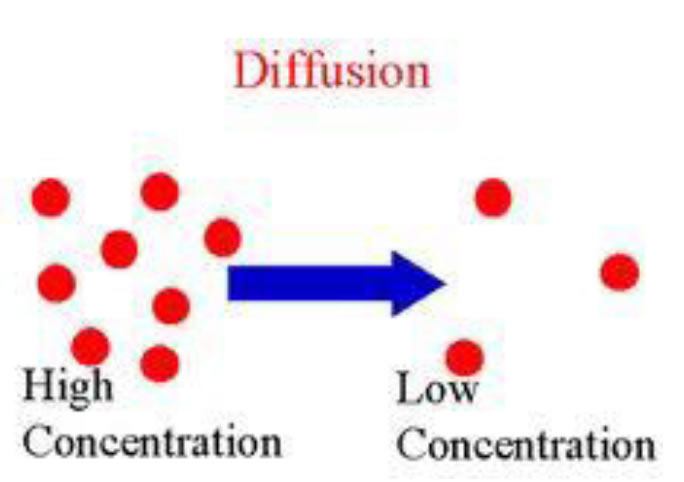
The ability to maintain a stable internal environment is called ________________.
Metabolism
Mitosis
Heterozygous
Homeostasis

Cell have several mechanisms for regulating their internal environments. Which of these mechanisms involved in maintaining homeostasis requires energy?
osmosis
diffusion
active transport
passive transport

F
G
H
J

F
G
H
J

A
B
C
D

F
G
H
J

A
B
C
D

Materials are provided to students to build modes of a prokaryotic cell, a eukaryotic cell, and a virus. The material and the structures they represent are listed in the table shown. Which materials would be used in all three models?
Yellow paper oval
Gray paper hexagon
Blue yarn
Purple buttons
Viruses can be transmitted through air, water, food, insect bites, and direct skin contact. Once a virus gains entry to the body, it invades a host cell in order to -
deactivate the host cell's defenses
synthesize antibodies for defense
metabolize host proteins and grow
access cellular process for replication
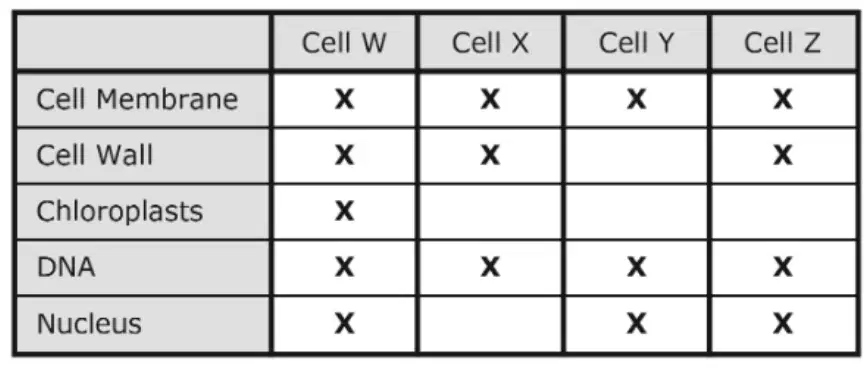
Students use a microscope to look for structures present in four different cells. The students placed an X for each structure that was viewed for each cell on the table shown.
Which cell that was viewed is most likely a prokaryote?
Cell W
Cell X
Cell Y
Cell Z

A table comparing the characteristics of four samples is shown.
Which sample most likely contains viruses?
Sample 1
Sample 2
Sample 3
Sample 4

Some students used vinegar to dissolve away the shells of three eggs and used the eggs as models of human red blood cells. The students observed the changes in the eggs when they were placed in different solutions. (View Image)
Which statement best describes the role of the cell membrane in this model?
The cell membrane is an impermeable barrier that prevents water from entering the cell.
The cell membrane allows solutes to enter the cell, which causes the cell to shrink.
The cell membrane allows water to enter and leave the cell.
The cell membrane removes solutes from the environment.

Which of these correctly identifies the two cells described in the table?
Cell 1 is Eukaryotic, Cell 2 is Prokaryotic
Cell 1 is Prokaryotic, Cell 2 is Eukaryotic
Both cell 1 and cell 2 are Eukaryotic
Both cell 1 and cell 2 are Prokaryotic
The cellular process known as the sodium-potassium pump was discovered in the 1950's by Jens Christian Skou, a Danish Scientist. This process is a form of active transport that moves three sodium ions to the outside of the cell for every two potassium ions that it moves into the cell. Which of these best explains why energy is needed for active transport?
Ions are negatively charged
Ions are attached to large proteins
Ions are trapped inside the plasma membrane
Ions are moved against the concentration gradient

A student groups different types of cells as shown. Which table headings should the student use for the two groups?


The diagram illustrates the activity of vesicles during a cellular process. Which statement best explains the function of the vesicles?
Delivering packaged materials to the golgi apparatus for protein synthesis.
Exchanging genetic information between the Golgi apparatuses of separate cells.
Extracting portions of the Golgi apparatus to be represented for growth within the cell
Transporting packaged molecules from the Golgi apparatus to be released out of the cell

The diagram shows cellular activity across a cell membrane. Which two process does this diagram most directly model?
Energy conversions and the synthesis of new molecules
Synthesis of new molecules and homeostasis
Transport of molecules and energy conversions
Homeostasis and transport of molecules
The human immunodeficiency virus (HIV) often infects and destroys CD4 T cells. These CD4 T cells are one of many kinds of white blood cells that are an important part of the immune system. The most common danger related to the destruction of CD4 T cells is _
an increase in the risk of high blood pressure
an increase in the threat of diseases caused by microorganisms and viruses
a decrease in the flow of blood to vital organs
a decrease in the amount of oxygen being transported to tissues

Models of the human immunodeficiency virus (HIV) and an animal cell are shown below. What is the difference in the function of the glycoprotein structures of an HIV virion and the cilia of an animal cell?
The glycoprotein structures are used for attachment, and the cilia are used to move fluids surrounding the cell.
The glycoprotein structures are used to obtain nutrition, and the cilia are used to secrete proteins.
The glycoprotein structures are used to provide physical support for the viral envelope, and the cilia strengthen the cell membrane.
The glycoprotein structures are used for defense, and the cilia for locomotion.

H1N1 flu is a highly contagious viral infection caused by the influenza A (H1N1) virus. The symptoms of H1N1 flu are listed in the box above. An antiviral agent administered within 48 hours of the appearance of symptoms can reduce the severity of the illness. Why is it important to administer an antiviral agent to an infected person within 48 hours of the appearance of symptoms?
The H1N1 virus is dormant in cells.
The H1N1 virus replicates quickly.
The H1N1 virus does not mutate.
The H1N1 virus is transmitted through a vector host, such as a mosquito.
Which of the following describes how viruses and cells are similar?
They both contain protein
They both use and obtain energy
At the end of the lytic cycle (the cycle that makes viruses)...
The host cell is destroyed (lysis)
Antibiotics work to cure viruses?
True
False

Why do viruses have projections on the outside?
To send signals to other viruses.
To maintain their structure.
To attach to the host cell.
To reproduce.

What is F on the diagram?
Tail
Head
DNA
Neck
Base Plate

