
 Worksheets
HBS 1.1 (New)
Total questions: 84
Worksheet time: 7hrs 25mins
A _____ wound might require medical attention whereas a _____ cut or scratch would just need basic bandages.
superficial, deep
deep, superficial
Your lungs are LATERAL to your heart.
True
False
The eyes and nose are on the ______ surface of the body.
posterior
anterior
The stomach is ______ to the heart.
superior
inferior
The hand is PROXIMAL to the shoulder.
True
False
What does it mean when the doctor says he/she is about to dissect the distal end of the popliteal artery?
The doctor is going to dissect an artery at the front of the knee at the end closest to the hip.
The doctor is going to dissect an artery at the front of the knee at the end that is further away from the hip.
The doctor is going to dissect an artery at the back of the knee at the end closer to the hip.
The doctor is going to dissect an artery at the back of the knee at the end that is further away from the hip.
What are the 4 types of bones?
Flat, Long, Irregular, Short
Flat, Irregular, Clumped, Long
Irregular, Raised, Long, Flat
Long, Flat, Irregular, Small


What is an example of a short bone?
Phalanges
Carpals
Patella
Vertebrae
The humerus is what type of bone?
Long Bone
Short Bone
Flat Bone
Irregular Bone
Sesamoid Bone
LABEL THE LONG BONE
METAPHYSIS
EPIPHYSIS
DIAPHYSIS
YELLOW BONE MARROW
MEDULLARY CAVITY
SPONGY BONE
BLOOD VESSEL
COMPACT BONE
PERIOSTEUM
toward or at the front of the body
anterior
dorsal
deep
distal

Toward the head end of upper part of body
Medial
Inferior
Lateral
Superior
toward the midline of the body
distal
lateral
medial
inferior

Away from the midline
Medial
Lateral
Distal
Proximal

Toward a structure's origin or point of attachment to the trunk
Lateral
Proximal
Distal
Medial
Away from the head.
Inferior
Lateral
Deep
Distal
Toward the back of the body.
Superficial
Distal
Superior
Posterior
Away from the trunk.
Superior
Distal
Lateral
Anterior
back of the body
ventral
dorsal
medial
lateral
Posterior
behind
in front
away from midline
further from trunk
Front of the body
Ventral/ Anterior
Dorsal/ Posterior
Superior
Sagittal
The thigh is ____ to the shoulder.
distal
inferior
superior
posterior
Proximal means????
Closer to the origin.
Further away from origin.
A ____________ wound might require medical attention whereas a ________________ cut or scratch would just need basic bandages, a band aid, or a hug.
A: Superficial, Deep
Deep, Superficial
The auxiliary region is ______ to the hip
Medial
Distal
Superior
Lateral
The big toe is ______ to the little toe
Medial
Distal
Superior
Lateral
The scapular region is ______ to the vertebral region
Medial
Distal
Superior
Lateral
The proper anatomical position the subject is...
Lying down
Arms placed above the head
Standing upright with palms facing backwards
Standing upright with palms facing forward
Give the anatomical term for the thigh
popliteal
patellar
crural
femoral
What is the anatomical term for the armpit?
sternal
axillary
acromial
brachial
What is the common name for the umbilical?
stomach
belly button
thigh
pelvis

The cavity surrounded by a box is?
Abdominal Cavity
Pelvic Cavity
Pleural Cavity
Cranial Cavity

What body cavity represents the area of the head?
Cranial Cavity
Pleural Cavity
Pericardial Cavity
Vertebral Canal

The cavity surrounded by a box is?
Thoracic Cavity
Abdominal Cavity
Pelvic Cavity
Vertebral Canal


This image represents the __________ skeleton.
appendicular skeleton
axial skeleton
What region represents the fingers and toes?
Tarsal
Carpal
Digital
Axillary
What region represents behind the knee?
Patellar
Axillary
Antecubital
Popliteal
What region represents the knee?
Patellar
Tarsal
Carpal
Buccal
What region represents the ankle?
Carpal
Tarsal
Patellar
Axillary
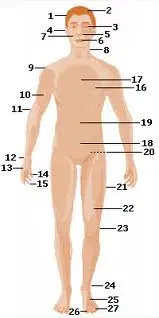
What region does #9 represent?
Oral
Buccal
Acrominal
Orbital
What region does #7 represent?
Oral
Buccal
Acrominal
Orbital
What region does #3 represent?
Oral
Buccal
Acrominal
Orbital
What are your phalanges? Check all that apply.
toes
ribs
spine
fingers
What is your kneecap called?
manible
patella
calcaneus
tarsals
What is your collarbone called?
scapula
radius
femur
clavicle
What is your jaw called?
mandible
ilium
metacarpals
ischium
The femur is the long bone located in your ________?
head
arm
leg
back
What are bones in your ankle called?
femur
carpals
metatarsals
tarsals
What are the names of the two bones in your lower arm? Check all that apply.
radius
diameter
tibia
ulna
What are your wrist bones called?
metacarpals
carpals
tarsals
metatarsals
The tibia and fibula are located in your _______?
neck
leg
arm
spine
The long arm bone is called ___________?
clavicle
humerus
radius
ulna
What is your shoulder blade called?
clavicle
ulna
sternum
scapula
The bones in the middle of your hand are called?
carpals
tarsals
metacarpals
metatarsals

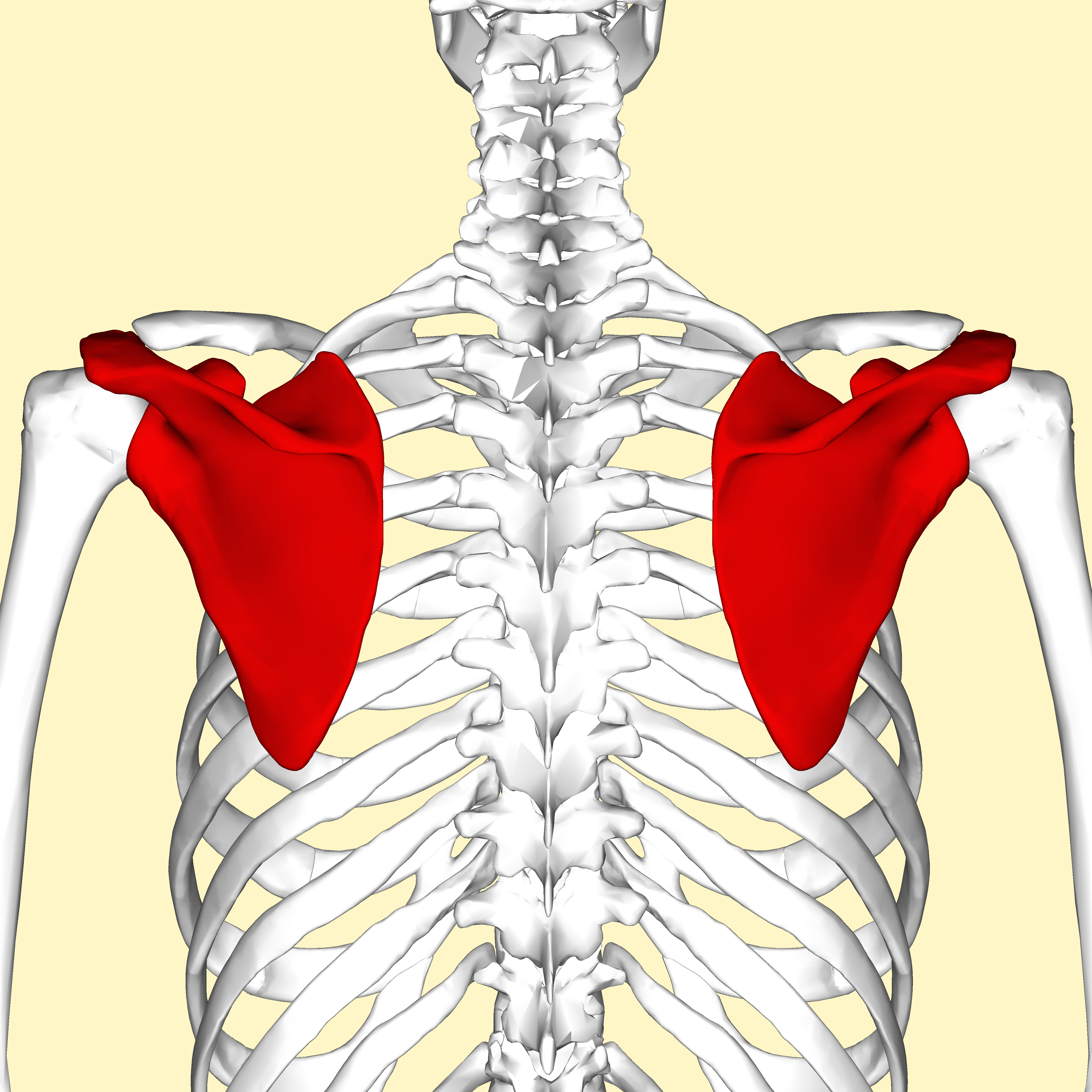
What bone is the arrow pointing to?
rib
spine
scapula
clavicle

What bone is the arrow pointing to (the bone closest to the thumb)?
ulna
humerus
radius
vertebrae


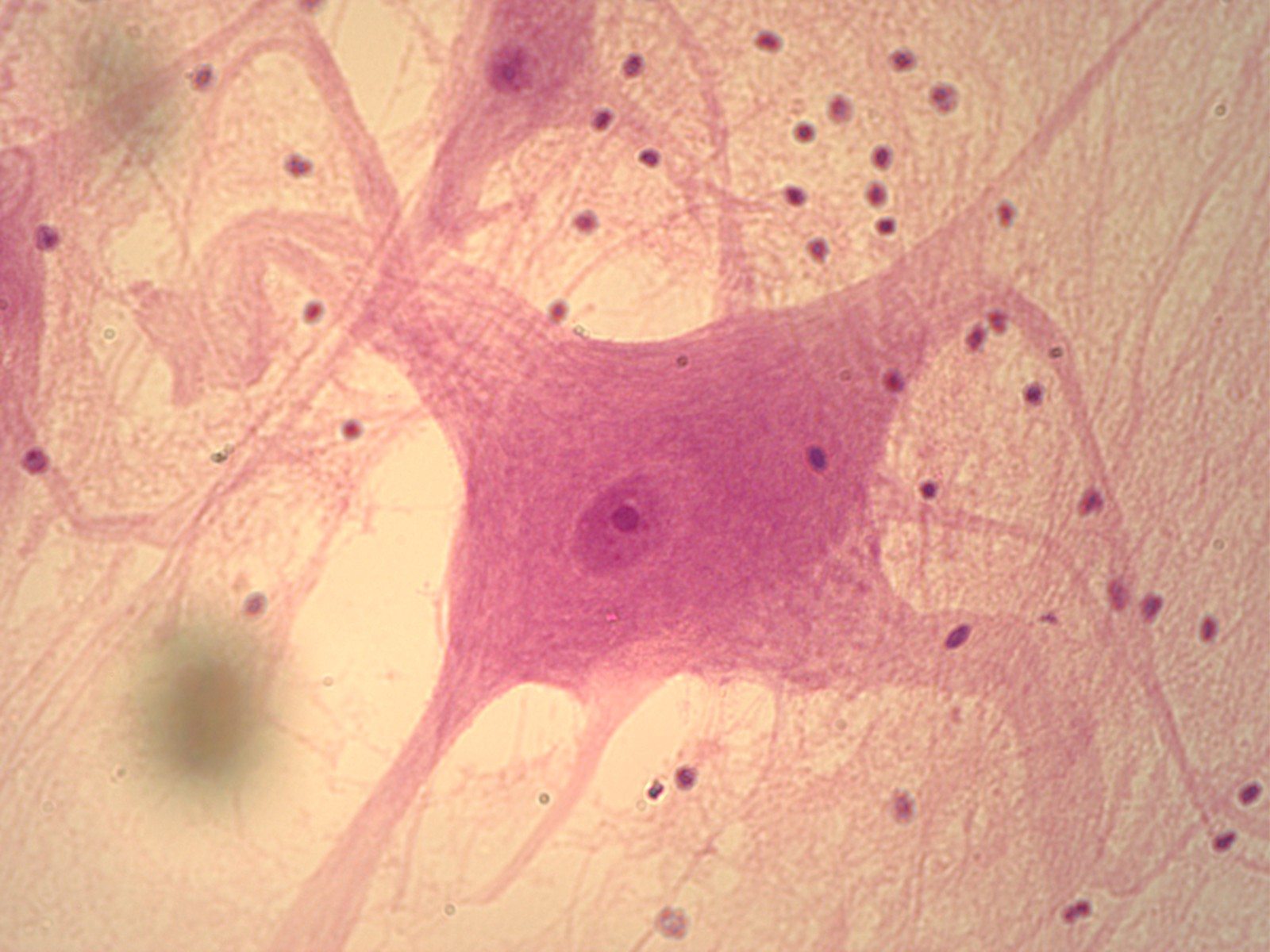
This type of tissue provides support for the body and connects all its parts.
Epithelial
Connective
Muscle
Nerve
This tissue covers the surface of the body inside and out.
Epithelial
Connective
Muscle
Nerve
This tissue allows the brain to communicate with the rest of the body through electrical impulses.
Connective
Epithelial
Nerve
Muscle
This tissue is made of special cells that contract and expand causing movement in the body.
Connective
Epithelial
Muscle
Nerve
Examples of this type of tissue are bone, tendons, ligaments, cartilage, blood, and fat.
Connective
Epithelial
Nerve
Muscle
Examples of this type of tissue are skeletal, smooth, and cardiac.
Muscle
Epithelial
Connective
Nerve
Examples of this type of tissue are brain, spinal cord, and nerves.
Connective
Epithelial
Nerve
Muscle
Examples of this kind of tissue are skin, lining of the digestive tract, and lining of the inside of organs
Epithelial
Connective
Nerve
Muscle
This type of tissue cannot be replaced. Once it is damaged your body cannot make more.
Nerve
Muscle
Epithelial
Connective
This type of connective tissue connects muscle to bone.
tendon
ligament
cartilage
joint
This type of connective tissue is liquid and it transports oxygen to your body.
Blood
Cartilage
Bone
Ligaments
This type of muscle is attached to your skeleton and you can control its movement
Skeletal
Cardiac
Smooth
Which muscle is the kissing muscle?
Sternocleiodomastoid
Zygomaticus
Buccinator
Orbicularis oris
What muscle allows you to wink?
Orbicularis oculi
Orbicularis oris
Frontalis
Masseter
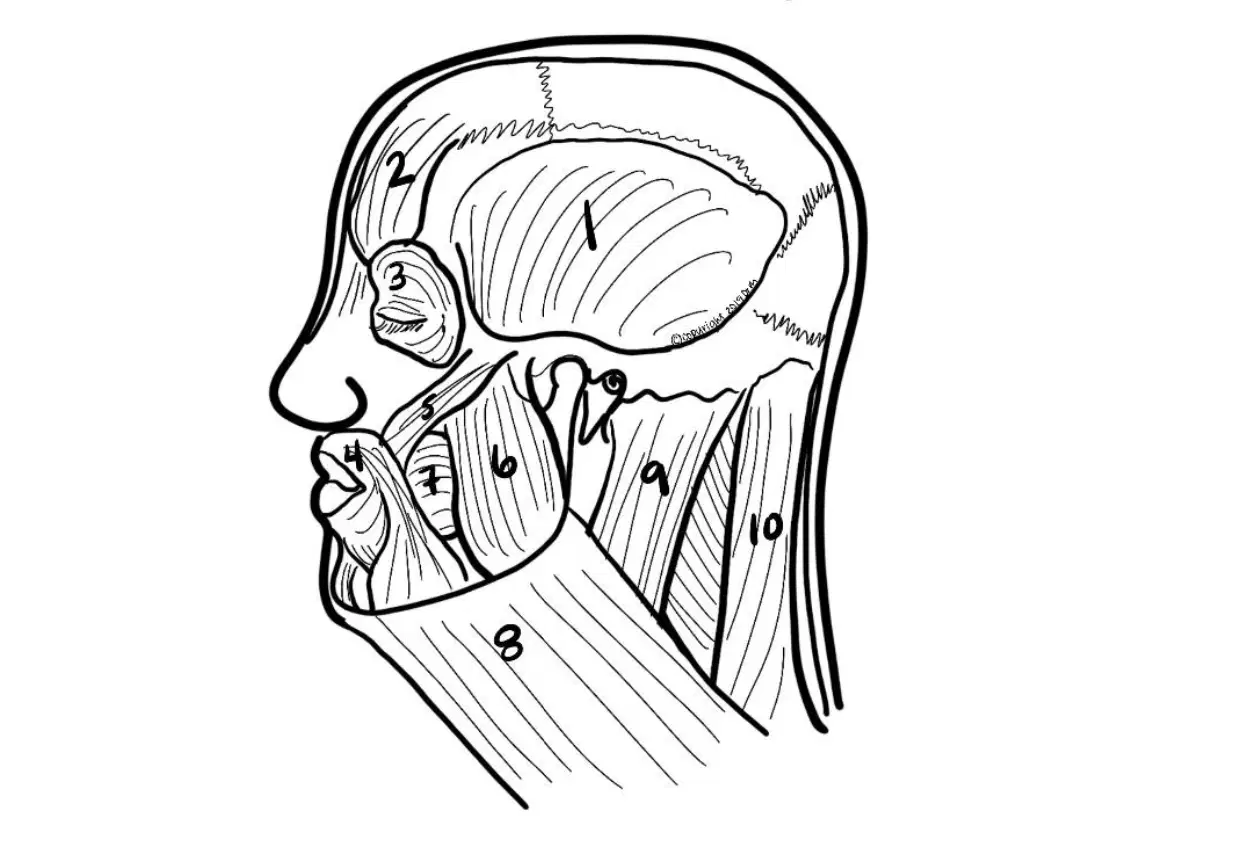
Which muscle is the temporalis?
1
2
8
9

