
 Worksheets
Unit 2 Part 1 Review (P.8.1-8.4)
Total questions: 61
Worksheet time: 58mins
A 1,000-mL sample of ethanol is tested. It's boiling
point is determined to be 78.4°C. What is the most
reasonable prediction of the boiling point for a
100-mL sample of ethanol?
0.0784°C
0.784°C
7.84°C
78.4°C

Boiling water was placed in containers made of four different materials. A table is provided.
Based on the data, which material was the best insulator of heat?v
Material 1
Material 2
Material 3
Material 4
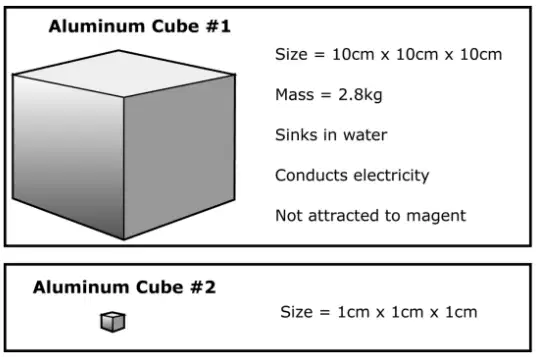
Diego and Mariah have a block of aluminum 10 cm by 10 cm by 10 cm. They conducted some tests and recorded their results. An image is provided.
The students found a smaller block of aluminum that is only 1 cm by 1 cm by 1 cm.
Which property do we expect to observe in the smaller block?
Has a mass of 2.8 kg
Floats in water
Conducts electricity
Attracted to a magnet

Jolie is trying to classify a substance. The substance melts between the temperatures of 1025 ̊C and 1080 ̊C. It has a hardness of about 2–3 on the Mohs scale. The substance is also non reactive with HCl (hydrochloric acid).
Jolie uses the table below to classify the substance. Which element in the table comes closest to having the same properties as the substance that Jolie is trying to classify?
Calcium
Gold
Lead
Platinum
A student pours vegetable oil and distilled water into a clear glass beaker and stirs them together until they appear well mixed. Three minutes later the oil is floating on top of the water.
Which physical property is different between oil and water that allows the oil to float on top of the water?
Mass
Boiling Point
Solubility
Density
Pete is investigating the effects of magnetism on objects. He takes a magnet and uses a hammer to break a small piece off. Which statement best explains what Pete noticed about the pieces of magnet?
The smaller pieces of magnet lost the ability to attract objects because
they were crushed by the hammer.
The smaller pieces of magnet increased in magnetism because there were more combined pieces.
The larger piece of magnet has a stronger magnetic attraction.
Their magnetism effect remains the same because the material never
changed.
Lil T mixed his favorite drink blue kool-aid, pineapple juice and lemon juice. He decided to make it decorative by adding cherries to the drink. He was shocked to see that the cherries floated on the top of the drink. What property of matter is Lil T observing with the cherries?
Solubility
Density
Magnetism
Malleability
Chiamaka was trying to make gravy for her dinner. She noticed that when she added flour to her water the flour clumped and blended very slowly.
Which physical property of matter is she observing in her gravy?
Solubility
Density
Magnetism
Malleability
In an experiment, the one variable that is changed is called the
dependent variable
independent variable
experimental variable
controlled variable

A scientist hypothesizes the the temperature at which an alligator's egg is incubated will determine whether the alligator will be male or female. The independent variable is
the male alligators
the gender of the alligator
the temperature
the incubator

A scientist hypothesizes the the temperature at which an alligator's egg is incubated will determine whether the alligator will be male or female. The dependent variable is
the temperature
the size of the baby alligators
the incubator
the gender of the baby alligators

What is being kept constant?
amount of fertilizer
amount of water
height
Your weight on the moon is about one-sixth of your weight on Earth. Why do you weigh less on the moon?
The moon exerts a greater gravitational force because it is more dense than Earth
The moon exerts a smaller gravitational force because it has less mass than Earth
The moon exerts a greater gravitational force because it is closer to Earth than the sun
The moon exerts a smaller gravitational force because objects are closer to its center than on Earth

The picture shows a density column that Jim created by pouring four different liquids, each with a different density, into a graduated cylinder. If Jim had previously found the mass of each individual liquid and used what he observed in the column to determine each liquid's density, which table correctly shows what Jim recorded about the liquids' densities?


The picture shows a density column that Jim created by pouring four different liquids, each with a different density, into a graduated cylinder. If Jim had previously found the mass of each individual liquid and used what he observed in the column to determine each liquid's density, which table correctly shows what Jim recorded about the liquids' densities?
Vince’s mass on Earth is 79 kg and his weight on Earth is 174 pounds. If Vince was to travel to the moon, how would his mass and weight change?
Vince’s mass would increase as well as his weight.
Vince’s mass would decrease as well as his weight
Vince’s mass would stay the same but his weight would increase
Vince’s mass would stay the same but his weight would decrease

Matthew has six cubes of different materials. Each cube has a mass of 10 grams (g). Matthew sorts the cubes into two groups using one physical property. Which physical property did Matthew most likely use to sort the cubes into two groups?
density
magnetism
melting point
electrical conductivity

Listed are the densities of four different metal cubes. Each cube has a volume of 4 cm3. D=M/V. Which cube will have the greatest mass?
Brass
Gold
Iron
Lead
Your weight on Jupiter is about 2.5 times of your weight on Earth. Why do you weigh more on Jupiter?
Jupiter exerts a greater gravitational force because it is more dense than Earth
Jupiter exerts a smaller gravitational force because it has less mass than Earth
Jupiter exerts a greater gravitational force because it is closer to Earth than the sun
Jupiter exerts a smaller gravitational force because objects are closer to its center than on Earth

Ashley wants to compare the solubility of three materials: salt, sand and flour. She fills three beakers with 500 mL of water each. She then adds the same amount of each solute to the three beakers below. Based on Ashley’s observations what statement can she make about the solubility of the three materials?
Sand is the most soluble
Flour is the most soluble
Salt is the most soluble
All are equally soluble
James has three blocks with the same size. He places the blocks in water and observes them. Block A floats in the middle, blocks B sinks to the bottom and C floats to the top of the water. Which statement below can James make about the density of each of the blocks?
Block A is less dense than block B
Block C is more dense than block B
Block B is more dense than block C
Block C is more dense than block A
Which is true of an objects weight and gravitational pull? (8.P.8.2)
An objects weight will change on different planets.
An objects weight will stay the same on different planets.
An objects weight is the same as the mass, and therefore will change on different planets.
An objects weight is not the same as the mass, and therefore will not change on different planets.
The two factors that affect gravity are: (8.P.13.2)
mass and speed
mass and inertia
mass and volume
mass and distance
Which of the following would be the best way to separate the salt and the iron filings?
Which of the following would be the best way to remove the water so that you're left with only salt?
A. Add water to the container and stir to dissolve the salt.
B. Heat the water until it evaporates and leaves the salt.
C. Remove the iron pellets with a magnet.
D. Collect the floating foam pellets and the glass ones that have stuck to the bottom.
Which answer choice puts these steps in the correct order?
Chloe and her sister loved to get into the car when there was fog on the windows. They enjoyed dragging their fingers over the window to spell out their names. Which of the terms best describes why the fog appears on the car windows?
Melting
Freezing
Condensation
Evaporation
Janice found two sea shells when she went to the beach. They appear to be almost the same size, but they have different shapes. How could she figure out if their volume is the same?
Weigh each one on a scale to see which is heaviest.
Fill each one with water to see which will hold the most.
Drop each one in a beaker of water to see which raises the water level the most.
Measure the length of each one with a measuring tape to see which is longest.
Susan blew up a balloon until it was completely full and as big as a soccer ball. Which of the following correctly describes the air inside the balloon?
The air is a gas that cannot be compressed by any means.
The air is a gas that always forms a round shape when compressed
The air is a gas that expands to evenly fill the space inside the balloon.
The air is a gas that will flow evenly and steadily from inside the balloon if punctured.
Dan brought some chocolate chips in a plastic container with his lunch one day. He decided to save them and eat them while he waited for the bus after school. All afternoon his lunch bag sat on the warm windowsill in his classroom. When he finally took the container out after school, the chocolate chips had turned into a hard chunk of chocolate shaped like the bottom of the container. What happened to his chocolate chips?
They started as a solid, melted, and then became solid again
They changed from a solid to a gas before becoming solid once again.
They were a cool solid to start, then became a warm solid before cooling again.
They went from being a hard solid to a gas, a liquid, and then to a hard solid again.

If two objects balance like the ones shown below, what must be true?
Object A has more mass than object B.
Both objects have the same mass.
Object A has more volume than object B.
Both objects have the same volume.
Both cookies and gelatin desserts are solids although their textures are very different. What do they have in common that makes them solids?
They both may be eaten.
They both keep their own shape.
They both can move around in a container.
They both are made of solids such as sugar.

The states of matter differ in many ways, including shape and volume. The following three figures show the particles in a solid, a liquid, and a gas.
Which of the following correctly identifies the state of matter?
3: gas
2: solid
1: liquid
2: liquid
Emily made flow charts to show the changes in states of water. In each, she listed the original state, the process that results in a change in state, and the resulting state. Which of these correctly describes a change in state of water?
liquid water, melts, solid water
liquid water, boils, water vapor
solid water, condenses, liquid water
water vapor, evaporates, liquid water

The following poster shows changes in state of water. Some of the information is missing.
What word belongs on arrow 2?
condensation
evaporation
freezing
melting
There are three main states of matter: liquid, solid, and gas. Which statement describes the shape of a solid?
It has its own shape.
It does not have shape.
It takes the shape of its container.
It changes shape with temperature.
There are different characteristics for each of the states of matter. Which statement describes a difference between liquids and solids?
Temperature can change a solid to a liquid, but it cannot change a liquid to a solid.
Solids have definite volume and liquids do not have definite volume.
The particles in a solid are much closer together than the particles in a liquid.
Solids take the shape of their containers and liquids maintain their own shapes.
Jakob studied drawings of the particles in the same substance. The drawings show the substance in different states and temperatures. Which drawing most likely shows the substance at the highest temperature?


Soryana’s teacher gave her a test tube of liquid. Which tool should Soryana use to measure the volume of the liquid?


Matter may be a gas, solid, or liquid. It can change from one state to another. Which change most often causes matter to change state?
change in mass
change in color
change in volume
change in temperature
Riley and Jill are studying what happens to matter when it changes state. They found this list of statements. Which of these statements is true?
When matter changes state, new matter may be created.
When matter changes state, it is still the same type of matter.
When matter changes state, its boiling point might also change.
When matter changes state, the space between particles in the matter stays the same.
Lina needs to make a list of the physical properties of matter. Which of these should Lina include in her list?
balance
graduated cylinder
temperature
thermometer
Each state of matter has certain physical properties. Which is a physical property of a gas?
It has definite shape.
It can be compressed.
It has a definite texture.
Its particles vibrate in place.
During an experiment, Carlos heated a beaker of water over a hot plate burner. After a period of time, the beaker was empty. Which statement describes what happened?
The water froze.
The water melted.
The water condensed.
The water evaporated.
Kaitlyn grew bean plants outside in different soils for her school science fair. She completed her experiment three times. For each trial, Kaitlyn recorded the height of each plant daily and also wrote observations in her experiment log. Kaitlyn noticed that the second time she completed the experiment, her data was very different from the data in the other two experiments. Which of the following observations in Kaitlyn’s experiment log best explains the difference?
She watered her plants the same amount each day.
She followed her procedure very carefully each time.
It rained for three days during the second experiment.
The plants were all grown on the patio behind her house
The melting point of water in degrees Celsius is---
100
32
0
212
100 degrees Celsius is the ----- of water.
Melting point
Freezing point
Boiling point
Malleability, the ability to be flattened into thin sheets, is a ---property.
Physical
Chemical
The freezing point of water in degrees Celsius is---
0
32
212
100
Something will FLOAT when...
... the mass is equal to the volume
... the mass is less than the volume
... the mass is greater than the volume
Something will SINK when...
... the mass is equal to the volume
... the mass is less than the volume
... the mass is greater than the volume

What can you conclude from the picture?
The rock and the cork have similar density.
The rock is less dense than the cork, because the rock sank and the cork floats.
The cork is more dense than the water.
The cork is less dense than the rock or water.

What could you conclude from the picture?
The edible oil is less dense than the lamp oil, but it is more dense than the milk.
The milk is more dense than the dishwashing liquid, but less dense than the sugar syrup.
The lamp oil is the most dense liquid shown.
The water is more dense than the oils, but has equal density to the dishwashing liquid.

How might you separate the jellybeans?
Evaporation
Magnetism
Condensation
None of the above.


Amanda investigated physical and chemical changes in science class and then classified her changes into two columns shown. Column A are the chemical changes and Column B are the physical changes. Which statement below best explains why the processes in Column B are physical changes?
The change has formed new substances
The shape of the substance has changed
The change that occurred can be reversed easily
The characteristics of the original substance have not changed

