
Font size
 Worksheets
Unit 1 | Particulate view of matter | review
Total questions: 34
Worksheet time: 43mins
Label the diagram.

A heterogeneous mixture means ______?
All mixtures look the same
I can see the difference
I can sometimes see the difference
I cannot see the difference
Which is a heterogeneous mixture?


Which statement is true about compounds?
a pure substance where two or more elements are chemically combined
a homogenous mixture of 2 or more elements
a pure substance containing only one type of atom
a heterogeneous mixture of 2 or more elements chemically combined

Another name for a homogenous mixture is?
colloid
suspension
solution
compound

Sugar is...
compound
homogenous mixture
heterogenous mixture
pure substance

Tin is
element
compound
alloy
mixture

What are the two factors that affect the phase of a substance.
pressure and sunlight
pressure and temperature
sunlight and temperature
cannot be determined from the diagram


What is the reading of the meniscus?
36mL
45mL
35.0mL
30.5mL
Exothermic changes
Absorb Heat
Release Heat
During an endothermic change particles will move
Faster
Slower
Condensation is an example of
Particles moving faster/endothermic change
particles moving slower/endothermic change
particles moving faster/exothermic change
particles moving slower/exothermic change
Boiling is an example of
Particles moving faster/endothermic change
particles moving slower/endothermic change
particles moving faster/exothermic change
particles moving slower/exothermic change

What term goes on the y-axis? (A)
Heat(Energy)
Temperature
Phase
Type of Matter
What phase of matter exists in part C of the graph?
Gas
Liquid
Solid
Plasma
What phase of matter exists in part D of the graph?
Gas
Liquid
Solid
Plasma
On which parts of the graph does the temperature remain the same?
Between C and D
Between D and E
At C, D, or E
On both flat sections

Match the letter in the picture with the word
A
all solid
B
melting/
freezing
C
all liquid
D
vaporizing/
condensing
E
all gas
How close a measurement is to the true value is called..
Accuracy
Precision
Significant
Estimate
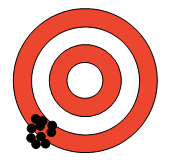
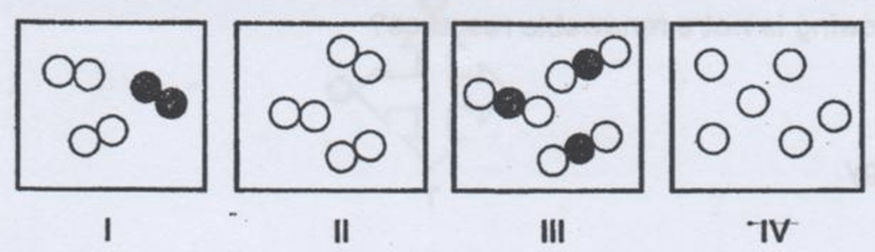
In the diagrams provided, the circles of different colors represent the atoms of different elements. Which diagram represents a mixture?
I
II
III
IV

Which beaker contains only one type of element?
A
B
C
D

Which beaker contains a compound?
A
B
C
D
0.00345
How many significant figures does the following number have?1.2500 x 10³
Ambiguous: 3 or 5
7
(12.470)(271)

What is the mass and uncertainty indicated by this electronic balance?
198.61 ± 0.01 g
198.61 ± 0.02 g
198.61 ± 0.05 g
198.61 ± 0.005 g
The weight of a table measured by a student is 20 Kg. The actual weight of the table is 23 Kg. What is the percent error in the student's measurement?
43 %
3%
15%
13%

