
NEW
Font size
 Worksheets
Physical Science Test 1 Review
Total questions: 69
Worksheet time: 7hrs 47mins


Corn syrup 1.37 g/mL
Vegetable oil 0.91 g/mL
Honey 1.42 g/mL
Lamp oil 0.81 g/mL


At what temperature does the solubility of NaCl, match the solubility of K2Cr2O7?
60
30
83
50

Which solute does not increase in solubility as the temurature increases?
NaCl
SO2
KClO3
KNO3

When 40 grams of KCl is dissolved at 50 ºC, the solution can be described as
Saturated
Supersaturated
Unsaturated
None

When 20 grams of KNO3 is dissolved at 80 ºC, the solution can be described as
Saturated
Unsaturated
Supersaturated
None

How many grams of SO2 can dissolve at 50 ⁰C?
5 g
10 g
20 g
39 g

What is the maximum temperature where at least 60 g of HCl can dissolve?
35 ⁰C
45 ⁰C
55 ⁰C
65 ⁰C

Which salt is LEAST soluble at 0 ºC?
KNO3
Ce2(SO4)3
K2Cr2O7
KClO3

How much KNO3 solute is saturated at 40 degrees?
75
55
65
85
How much C12H22O11 solute is saturated at 40 degrees?
240
220
230
250

Which solute is MOST likely a gas?
KNO3
NaNO3
KCl
Ce2(SO4)3
At what temperature can you fully dissolve 140g of NaNO3?
62
73
81
You cannot determine this
What type of a solution is 260g sugar at 50ºC in 100g H2O?
Saturated
Unsaturated
Supersaturated
What type of a solution is 25g NaCl at 70ºC in 100g H2O?
Saturated
Unsaturated
Supersaturated


At what temperature can you fully dissolve 120g of NaBr?
70
20
100
You cannot determine this

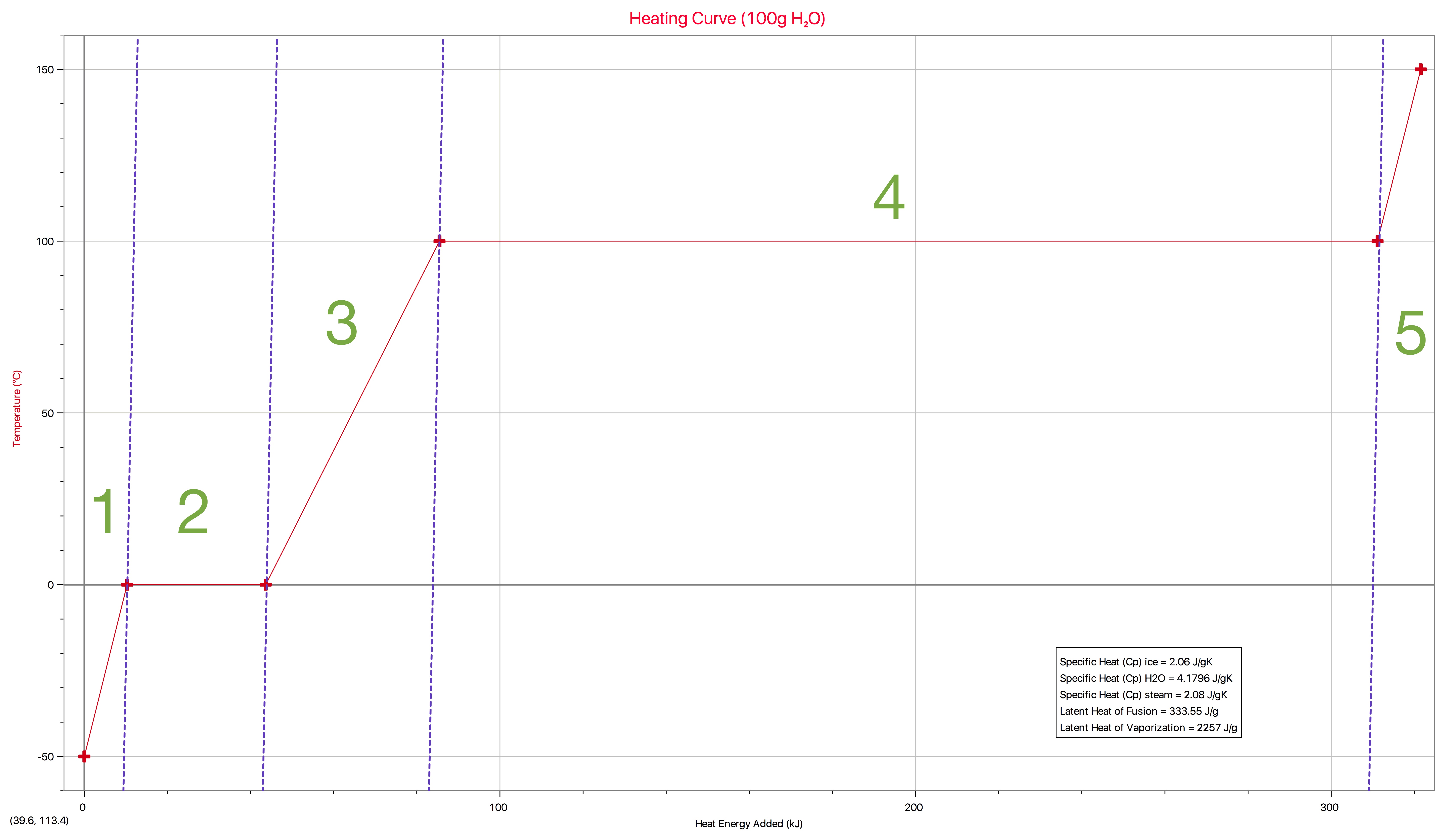
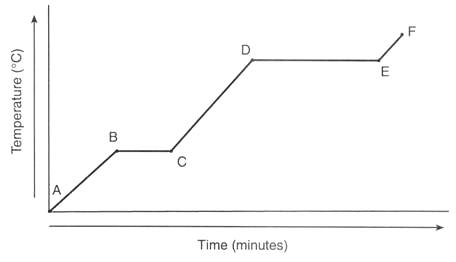

Given the heating curve of a solid being heated at a constant rate, what is the boiling point of this substance?
20°C
50°C
110°C
170°C

Given the heating curve of water, what is happening to potential and kinetic energy during segment CD?
the potential energy and kinetic energy both increase
the potential energy increases while the kinetic energy decreases
the potential energy is constant while the kinetic energy increases
the potential energy increases while the kinetic energy is constant

NaCl(s) was heated up starting at an initial temperature of 0°C. The heating curve is shown in the picture. What is the melting point of this substance?
0°C
801°C
1000°C
1465°C

Given the heating curve of a solid being heated at a constant rate, how much total time was required to boil this substance after it reached its melting point?
3 minutes
4 minutes
10 minutes
14 minutes

This curve indicates what about the heat energy?
Heat energy is being added or absorbed
Heat energy is being released

In which region(s) of the graph would the substance be melting?
No melting occurs on this graph
Region C-E
Region E-G
Region G-I
Region I-K
What is the freezing point of the substance?
0oC
60oC
120oC
180oC
From point A to point F, the sample is going through an __________ process by __________.
exothermic, releasing heat to the surroundings
exothermic, absorbing heat from the surroundings
endothermic, releasing heat to the surroundings
endothermic, absorbing heat from the surroundings
From point A to point F, the sample is going through an __________ process by __________.
exothermic, releasing heat to the surroundings
exothermic, absorbing heat from the surroundings
endothermic, releasing heat to the surroundings
endothermic, absorbing heat from the surroundings
What is the freezing point of the substance?
0oC
60oC
120oC
180oC
Given the heating curve of water, what is happening to potential and kinetic energy during segment CD?
the potential energy and kinetic energy both increase
the potential energy increases while the kinetic energy decreases
the potential energy is constant while the kinetic energy increases
the potential energy increases while the kinetic energy is constant

