
 Worksheets
Science 8 SEP Unit Test Review
Total questions: 61
Worksheet time: 57mins

To avoid dangerous fumes the student should _______the odor toward his nose.
blow
waft
raft
stir

No food in the lab
Open flame
Dispose of wrappers properly
Be careful to avoid explosions

Which safety symbol should she have paid attention to before starting the lab?


Before starting an investigation or lab procedure, you should
try an experiment on your own
open all containers and packages
read all directions and make sure you understand them
handle all the equipment to become familiar with it
If you get hurt or injured in any way, you should
tell your teacher immediately
find bandages or a first aid kit
go to the principal's office
get help after you finish the lab
If you have unused liquids after finishing your procedure, you should
mix them together in a bucket
put them back into their original containers
put them away where your teacher tells you to put them
When working with a flame or heat source, you should
tie back long hair that hangs in front of your eyes
heat substances or objects inside a closed container
touch an object with your bare hand and see how hot it is
throw hot objects into the trash when you are done with them
Goofing around in the lab is acceptable
True
False

"I like KFC more than McDonalds!"
Is this a claim, evidence or reasoning?
Claim
Evidence
Reasoning

"Rhinos have horns"
Is this a claim, evidence or reasoning?
Claim
Evidence
Reasoning
"Plants need sunlight, water and carbon dioxide to make food."
Is this a claim, evidence or reasoning?
Claim
Evidence
Reasoning
"Material A is a better conductor of heat. It gained heat faster than Material B. Good conductors of heat gains heat quickly."
Which of these statement is an Evidence?
Material A is a better conductor of heat.
It gained heat faster than Material B.
Good conductors of heat gains heat quickly.
What is the claim?
Mass does not affect how quickly an object falls. In our experiment, the blocks had different masses, 20 g., 30 g., 44 g., 123 g and 142 g but the time for all five blocks to fall was about the same. It took between 1.5 and 1.8 seconds for them to fall. Since the blocks had different masses but took about the same time, I know that mass does not affect how quickly something falls.
In our experiment, the blocks had different masses, 20 g., 30 g., 44 g., 123 g and 142 g but the time for all five blocks to fall was about the same. It took between 1.5 and 1.8 seconds for them to fall.
Mass does not affect how quickly an object falls.
Since the blocks had different masses but took about the same time, I know that mass does not affect how quickly something falls.
What is the evidence?
Mass does not affect how quickly an object falls. In our experiment, the blocks had different masses, 20 g., 30 g., 44 g., 123 g and 142 g but the time for all five blocks to fall was about the same. It took between 1.5 and 1.8 seconds for them to fall. Since the blocks had different masses but took about the same time, I know that mass does not affect how quickly something falls.
In our experiment, the blocks had different masses, 20 g., 30 g., 44 g., 123 g and 142 g but the time for all five blocks to fall was about the same. It took between 1.5 and 1.8 seconds for them to fall.
No, mass does not affect how quickly an object falls.
Since the blocks had different masses but took about the same time, I know that mass does not affect how quickly something falls.
What is the reasoning?
Mass does not affect how quickly an object falls. In our experiment, the blocks had different masses, 20 g., 30 g., 44 g., 123 g and 142 g but the time for all five blocks to fall was about the same. It took between 1.5 and 1.8 seconds for them to fall. Since the blocks had different masses but took about the same time, I know that mass does not affect how quickly something falls.
In our experiment, the blocks had different masses, 20 g., 30 g., 44 g., 123 g and 142 g but the time for all five blocks to fall was about the same. It took between 1.5 and 1.8 seconds for them to fall.
No, mass does not affect how quickly an object falls.
Since the blocks had different masses but took about the same time, I know that mass does not affect how quickly something falls.

Which of the following is a claim from the image?
The American woman won first place at the Olympics
The ribbon around the medal is purple
They are wearing tight ponytails
Which of the following is evidence from the image?
1 American with a gold medal, 2 Russians with bronze and silver
They are three good friends hanging out
They are wearing nice jackets
Is the following sentence an example of a claim or evidence?
Two out of three high school students fail to get enough sleep.
Claim
Evidence
Glass. Glass should be used as a window so people can see into the room as it is transparent and allows light to pass through.
Which of these statement is a Reasoning?
Glass.
It is transparent and allows light to pass through.
Glass should be used as a window so people can see into the room.
Which of the following is NOT a claim?
California is the best state in the USA.
Twinkies taste better than other snack cakes because of their texture, their creamy filling, and their golden appearance.
The school year began on August 18 and will end on June 4
Christmas is the best holiday of the year.
The vertical axis should be labeled as
X-Axis
Y-Axis
The horizontal axis should be labeled as
X-Axis
Y-Axis
Which variable can you CHANGE or manipulate?
Independent Variable
Dependent Variable
Constant Variable
The X-Axis and Y-Axis should have a scale.
True
False
One step to create a graph is to plot the data points and connect the dots.
True
False
When you construct a graph, it is not necessary to include a title.
True
False
Which items SHOULD be included in a graph? Check all that apply.
Title
Axis Labels
Data
Your Opinion
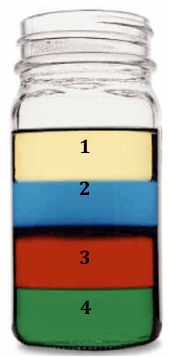

Which box has a higher density?
A
B
They are the same


The amount of water displaced is the same as the volume of the object. What is the VOLUME of the object?
An object is is placed into 45 mL of water. The water rises to 48 mL. What is the volume of the object?
3 mL
93mL
8 mL
83 mL


The density of a material is 2 g/cm3. The volume is 24 cm3 . What is the mass?
There are 4 objects listed with their densities. Which of the following will float on water? (SELECT 2)
Object A:
0.7 g/cm3
Object B:
1.2 g/cm3
Object C:
0.25 g/cm3
Object D:
11.4 g/cm3
If an object has a density of 6 g/mL and you put it into water, will it sink or float?
What decreases when temperature increases?
mass
volume
density
What happens to particles when temperature increases?
They get further apart.
They get closer together
They stay the same.
What is the measurement of the amount of space an object takes up?
mass
volume
density
What is the measurement of the amount of matter in an object?
mass
volume
density
What happens to an object that is less dense than the liquid it is in?
floats
sinks


How much liquid is represented?
24 mL
20.4 mL
29 mL
35 mL
What is the density of water?
0.1 g/mL
1 g/mL
100 g/mL
10 g/mL
If you doubled the amount of an object or cut it in half, the density of that object would
increase
decrease
remain the same
none of the above

Both variables increase
Direct relationship
Indirect relationship
static relationship
cyclic relationship

One variable increases, while the other decreases
Direct relationship
Indirect relationship
static relationship
cyclic relationship

Each variable increases and decreases
Direct relationship
Indirect relationship
static relationship
cyclic relationship

The independent variable increases, the dependent variable stays the same
Direct relationship
Indirect relationship
Constant or static relationship
cyclic relationship

