
 Worksheets
Unit 1 Practice GHS
Total questions: 120
Worksheet time: 5hrs 38mins


What is the definition of a force?
Net force equal 0N and there is no change in the object's motion
the overall force acting on an object after all forces are combined
a push or a pull that acts on an object
The force does not equal 0N, the object accelerates
What is the definition of net force?
a push or a pull that acts on an object
Net force equal 0N and there is no change in the object's motion
the sum of all forces acting on an object
The force does not equal 0N, the object accelerates
What do we call a force that has a net force of zero Newtons and the object does not change its motion?
balanced force
unbalanced force
acceleration force
net force
What do we call a force that causes an object to accelerate?
net force
moving force
acceleration force
unbalanced force

What is the magnitude and direction of the force in the free body diagram shown?
70 N right
70 N left
50 N right
50 N left

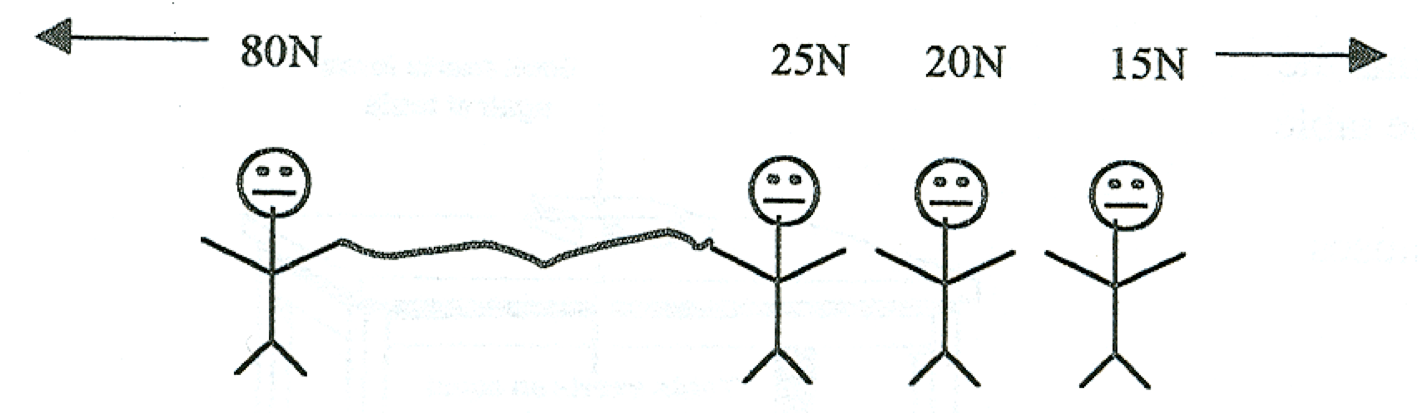
What is the magnitude and direction of the force in the free body diagram shown?
20 N, no change in motion
20 N right
20 N left
0 N , no change in motion

What is the magnitude and direction of the force in the free body diagram shown?
2000 N forward
800 N backward
1200 N forward
2800 N forward

What is the magnitude and direction of the force in the free body diagram shown?
35 N right
17 N right
11 N right
5 N right

What is the magnitude and direction of the force in the free body diagram shown?
5 N down
0 N, no change in movement
15 N up
15 N down

What is the magnitude and direction of the force in the free body diagram shown?
2 N right
2 N left
4 N right
2 N up and 2 N right

In the free-body diagram, which of the following is the gravitational force acting on the balloon?
5120 N
950 N
1520 N
4050 N


The biker travels at constant velocity. All of the following are true except-
he has a net force acting on him.
the normal force is equal to his weight.
the force of friction acts opposite the direction of his motion.
the force of friction is equal to the forward force he applies.
The sum of all forces acting on an object and direction is called the
Balanced Force
Net Force
Unbalanced Force
Contact Force
Forces have both ________ and direction.
Magnitude
Speed
Gravity
Height

Name the missing force.
Gravitational Force
Normal Force
Friction Force
Applied Force

Name the missing force.
Normal Force
Push/Pull Force
Friction Force
Tension Force

Name the missing force.
Normal Force
Friction Force
Gravitational Force
Push/Pull Force

Name the missing force.
Gravitational Force
Normal Force
Tension Force
Friction Force
The force that keeps objects on top of surfaces instead of letting them sink into the surface is known as:
Normal Force
Gravitational Force
Friction Force
Air resistance

This diagram can be used to indicate which of the following? (TWO correct answers)
An object at rest
An object accelerating
An object decelerating
an object moving at a constant velocity (speed)
(Trick question -- there is only one correct answer)

Which of the following is true about this free-body diagram?
the forces are balanced
the object is moving upward
the object is free-falling
the forces are unbalanced
Newton's First Law: An object in motion will stay in motion and an object at rest will stay at (a) unless acted on by an outside force.
A leftward force is applied to a crate to push it across the floor at a constant speed. Which is the correct force diagram?


A rightward force is applied to a dresser to accelerate it to the right across the bedroom floor.


A 12 kg ball is accelerated at a rate of 2.0 m/s2. Calculate the force.
F = m x a
.16 N
6 N
24 N
24kg

If a force of 26 N is exerted on two balls, one with a mass of 0.52 kg and the other with a mass of 0.78 kg, which ball will have the greater acceleration? (F=ma)
The one with a mass of .78 kg will have the greatest acceleration.
The one with a mass of .52 kg will have the greatest acceleration.
They will both accelerate at the same rate.
A 20 kg bike accelerates at 10 m/s2. what was the force?
F = m x a
25 Newtons
20 Newtons
200 Newtons
10 Newtons

A quantity with both a magnitude and direction
Vector
Speed
Newton
Newton's Second Law
The amount of matter in an object
Mass
Force
Velocity
Acceleration
How quickly an object moves along a path
Speed
Acceleration
Force
Mass
The law which states that force equals mass
times acceleration. F = ma
Newton's Law of Gravitation
Newton's 1st Law of Motion
Newton's 2nd Law of Motion
Newton's 3rd Law of Motion
The constant acceleration on an object because
of gravitational force.
Balanced Force
Velocity
Speed
Acceleration due to gravity
A force that resists the relative motion of two
objects or substances sliding against one another
Frictional Force
Gravitational Force
Balanced Force
Net Force
A situation where the net force on a system is not
zero
Balanced Force
Unbalanced Force


Whenever an object is moving, there is always this force opposing the motion:
inertia
momentum
friction
applied force
The force that keeps objects on top of surfaces instead of letting them sink into the surface is known as:
normal
abnormal
static
inertia
The force exerted by ropes and chains is called
tension
normal
elastic
mechanical
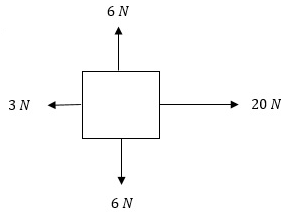
What is the NET FORCE of this diagram?
17 N, right
17 N, left
23 N, right
12 N, up
What is the appropriate way to indicate Gravity in a diagram?


Determine the net force and direction:
11 N Left
11 N Right
0 N Left
5 N Left

Determine the force at G:
30 N
20 N
50 N
0 N


FN=100N, Ff=20N
μ=5.0
μ=0.2
μ=1.2
μ=0.1
A box with a mass of 275 kg is pulled along a level floor with constant velocity. If the coefficient of friction between the box and floor is 0.64, what horizontal force is required to start moving the box?
176 N
429.68 N
970.2 N
1724.8 N
A horizontal force of 350.0 N is required to continue pulling a 2060 N trunk across the floor at constant speed. Find the frictional coefficient of kinetic friction?
0.17
0.6
5.89
57.68
If 7000 N of force is exerted on a 1300 Kg car. What is the acceleration caused by the net force if the kinetic friction force is 2400 N?
3.54 m/s2
3.54 m/s
7.08 m/s2
7.08 m/s
A horizontal force of 15.0 N is required to continue pulling a 26 N baby shark plushie across the floor at constant speed. Find the frictional coefficient of kinetic friction?
0.147
1.73
0.576
390
A block of ice with a mass of 605 kg is pulled along a level floor with constant velocity. If the coefficient of static friction between the ice and floor is 0.18, what horizontal force is required to start moving the box?
108.9 N
5929 N
1067.22 N
32938.8 N
How much force must be applied to push a 2.00 kg book across the deck at constant speed if the coefficient of sliding friction is 0.40?
0.8 N
3.92 N
7.84 N
19.6 N
A 200 kg commuter is standing on a train accelerating at 5.00 m/s2.
What coefficient of friction must exist between the commuter's feet and the floor to avoid movement? (Hint: Make the frictional force equal the Net force by the train)
0.025
0.51
1000
1960
A 2500.0 N force is exerted on a 400.0 kg crate to move it across the floor. If the coefficient of kinetic friction is 0.180, what is the crate's acceleration?
3920 m/s2
705.6 m/s2
1794.4 m/s2
4.486 m/s2
A 700.0 N force is exerted on a 35.0 kg cart that is already moving. If the coefficient of kinetic friction is 0.390, what is the cart's new acceleration?
2.04 m/s2
357 m/s2
566.23 m/s2
16.178 m/s2
A 60.0 N force is exerted on a 5.0 kg ball that is already moving. If the ball's new acceleration is 8 m/s^2, what is the coefficient of kinetic friction?
0.49
0.41
1.5
0.62


A net force of 1400 N acts to stretch an extension spring. How far will the spring stretch if its spring constant is 700 N/m?
1.0
0.5m
1.5 m
2.0 m
Newtons law states that for every action, there is an_________ reaction
unequal and opposite
stronger and opposite
equal and similar
equal and opposite

Force always come in________
waves
triplets
pairs

When a heavy football player and a light one run into each other, who exerts more force? (pushes harder)
The light one
They exert the same force on each other
The heavy one
When a small car pushes a big truck, the truck applies an equal and opposite force on the car.
False
True
You can't exert a force on anything unless it also exert a force on you
False
True
When a cannon fires a cannonball we observe Newton's third law. Which results from the reaction force?
The cannon moving forward
The cannon moving backwards
The cannonball moving backwards
The cannonball moving forward
When you step on a small pebble, the pebble applies an equal and opposite force on your foot.
True
False
Action-reaction pairs can cause a change in motion.
True
False
When the person pushes the ground with their foot, the equal and opposite reaction force is
the ground pushing back on their foot
when they start to move forward


What happens to the balloon if the air is released ?
Balloon goes right
Balloon goes up
Balloon goes down
Balloon goes left
The two paired forces in Newton's third law:
act on different objects
are equal in size
are opposite in direction
are the same type
all of the above
A baby elephant is being lifted up by a bunch of balloons. What is the reaction force?
The elephant falls down
The elephant pulls down on the balloons
The balloons exert a normal force on the elephant
If the force is a bat hitting a baseball, what is the reaction force?
The baseball hitting the bat.
The baseball flying toward center field.
The bat hitting the player’s hands.
A fast-moving truck hits a bug that is hovering over the road. Which experiences more force?
The truck
Both experience the same force
the bug

who is pulling harder?
the man
the elephant
they both pull with the same force

two ice skaters push away from each other. The man weighs more than the woman. Which is true
the woman pushes the man harder than he pushes her
they both push with the same force
the man pushes the woman harder than she pushes him

