
Font size
 Worksheets
1-A Test Review
Total questions: 63
Worksheet time: 1hrs 3mins
Responding (Dependent)Variable
Manipulated (Independent) Variable
Controlled Variable
A summary of the experiment that includes whether hypothesis was supported or not.
Hypothesis
Results
Conclusion
Independent Variable
graphs
controlled variables
manipulated (independent) variables

Students used various temperatures of water to see which one dissolved candy faster.
What was the manipulated (independent) variable?

1. Place 20 spinach leaves into the container
2. Put the carbon dioxide sensor in and close the container
3. Turn on the light and wait 20 minutes
4. Check the carbon dioxide levels
5. Repeat experiment with different amounts of time under the light
What is the dependent (responding) variable?
The information you collect while doing your experiment is called
conclusions
data
hypotheses
procedures
What is a constant/control in an experiment?
Things that do not change in a experiment. It's the variable that stays the same. You can have many variables stay the same.
It's the variables that the scientist changes in the experiment
It's the variables that are being measured in an experiment
What can the responding variable also be called
manipulated variable
controlled variable
independent variable
dependent variable
The variable that you keep the same to ensure that your experiment is valid.
manipulated (independent) variable
responding (dependent) variable
controlled variable
required variable
Which step of the scientific method is this example-
1- water =14.0 mL, ice =14.8 mL
2-water=20.0 mL, ice= 20.8 mL
3-water= 24.0 mL, ice=24.9 mL
question
hypothesis
experiment
data
conclusion
What 2 measurements are used for DENSITY
Mass and Weight
Mass and Acceleration
Mass and Volume
Length and Width

Which box has a higher density?
A
B
They are the same

In the experiment pictured, a student is testing the effect of the amount of fertilizer on plant growth. What is the manipulated or independent variable?
In science, a hypothesis must be
correct.
manipulated.
controlled.
testable.
What can the manipulated variable also be called?
responding variable
independent variable
dependent variable
controlled variable
During which step would you graph your data?
Conclusion
Problem
Hypothesis
Analyze Data
Ms. Gordon is testing what type of candy the middle school likes best. She buys three types of candy and asks the students to choose their favorite type out of a bowl.
What is an example of a hypothesis for Ms. Gordon's experiment?
The chocolate candy was liked the best
Jolly Ranchers are the eighth graders favorite candy
In the middle school, 10 students liked chocolate best, 15 liked starburst best, and 20 liked smarties the best
If more students choose chocolate candy, then the middle school likes chocolate the best
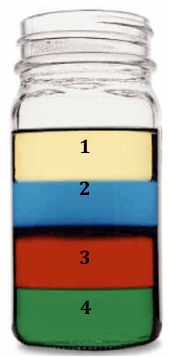
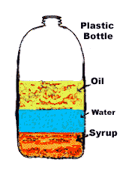
In a density column, is the substance with the highest density on the bottom or the top?
Bottom
Top

Which object has the highest density in this picture?
A
B
C

You calculated the density of an unknown substance to be 5.7g/cm3. According to the chart, which of the substances do you most likely have?
Aluminum
Iron
Tin
Zinc

Which of the following substances would float in water? (Hint: water has a density of 1g/cm3)
gold
rubber
water
cork
Which is the SI unit of measurement for mass?
Grams
Cubic Centimeters
Pounds
Kilopounds

If plants are exposed to sunlight, then they will grow taller.
What part of the scientific method is this an example of?
Procedure
Hypothesis
Question
Results

Graphing data can help you recognize
predictions
patterns
inferences
bias
Bella has two rocks and she wants to know which has the most volume. Which tool is the best to measure volume?
Microscope
Tape Measure
Graduated Cylinder
Balancing Scale

What scientific instrument does the picture show?
Thermometer
Balance Scale
Scale
Graduated Cylinder

The flower is 8 cm tall.
qualitative data
quantitative data

The center of the flower is yellow and fuzzy.
qualitative data
quantitative data
The bug was 5cm long.
Qualitative
Quantitative

The flower has 25 petals.
qualtitative data
quantitative data

Ben makes five paper helicopters with different wing lengths. He drops them the same way from a height of two meters for five trials each. He records the amount of time it takes for each helicopter to fall to the ground.
What is the independent variable?
Dropping the same way
Wing Length
Amount of time it takes the helicopter to hit the floor
Dropping from the same height
Ben makes five paper helicopters with different wing lengths. He drops them the same way from a height of two meters for five trials each. He records the amount of time it takes for each helicopter to fall to the ground.
What are two controlled variables? (Select 2 answers)
Dropping the same way
Wing Length
Amount of time it takes the helicopter to hit the floor
Dropping from the same height
What is a hypothesis?
the thing changed on purpose in the experiment
an explanation about what you observed
using your 5 senses to gather data
an educated guess about the outcome of an experiment
What two words should be in your hypothesis?
I think
If ...then...
It will
No idea
Choose the correctly written hypothesis for "What is the effect of putting Pam Cooking Spray on the bottom of a sled?"
I think the sled will slide faster.
If I put Pam Cooking Spray on the bottom of my sled, then I will win the race."
If I put Pam Cooking Spray on the bottom of my sled, then I will slide faster.

"If a student gets 10 hours of sleep, then his/her test scores will improve because rest effects grades" is a(n)...
scientific fact
testable question
hypothesis
old wives tale

The volume of the water is 40 mL. An object was placed inside the graduated cylinder and it now reads 65 mL. The mass of the object is 125 g. What is the DENSITY of the object?
25 mL
5 mL

Use the figure above, to answer the following question. Pic the answer that puts the objects in order from MOST DENSE to LEAST DENSE.
B, A, C, D
D, C, A, B
A, B, C, D
D, C, B, A

Series of steps followed by scientists to answer questions.
hypothesis
experiment
scientific method
conclusion

