
 Worksheets
REVISION QUIZ
Total questions: 134
Worksheet time: 3hrs 49mins
What is the far point for human eye?
(a)
What is the near point for human eye?
(a)
•To see nearby objects,the ciliary muscle ---------and the eye lens become -------
(a)
•The ability of eye to see far as well as near by objects is called (a)

Which part of eye is responsible for eye colour ?
(a)

Which type of lenses are used in upper and lower part?
(a)

label 3
(a)
Rods distinguish colours and cones distinguish bright and dim light.
true
false

Identify the defect and how it is corrected?
Myopia ,convex lens
Myopia ,concave lens
Hypermetropia ,convex lens
Hypermetropia ,convex lens

-------- is corrected by using convex lens.
(a)

label 4
(a)
This defect is caused due to elongation of eye ball.
(a)
Convex lens is used to correct this defect.
(a)
bifocal lens is used to correct this defect.
Myopia
hypermetropia
cataract
presbyopia
this defect is also known as old age defect.
(a)
this problem arises due to foggy or cloudy lens .
presbyopia
myopia
cataract
hypermetropia
which colour bends the most on refraction through a triangular prism?
red
blue
green
violet
This phenomenon is responsible for rainbow formation.
refraction
dispersion
internal reflection
all of these
angle of deviation in a triangular prism is angle between
incident ray and refracted ray.
refracted ray and emergent ray.
extended incident and emergent ray
none of these
The type of lens present in the human eye is.........
concave lens
convex lens
concavo-convex
plane lens
Nature of the image formed on the retina ...........
real and erected
virtual and inverted
virtual end erect
real and inverted
If a student cannot see the black board clearly even in sitting in the first bench. The type of defect of his eye is ........
Myopia
hypermetropia
presbyopia
cataract
When a white light falls on a triangular prism, the colour of light which will deviate the least is
violet
green
blue
red
Which of the following is the best example of white light?
Danger signals
laser light
sun light
sodium lamp
Formation of rainbow is due to..........
refraction of light
scattering of light
dispersion of light
atmospherics refraction
Atmospherics refraction explains the natural phenomena
twinkling of stars
Sky appears blue
Refraction of light through a prism
rainbow formation
Assertion: Planets do not twinkle
Reason: Light rays do not come from planet
Assertion and reason are true. Reason is the correct explanation of Assertion
Assertion and reason are false
Assertion is false, but reason is true
Assertion is true, but reason is false
Advanced sunrise and delayed sunset is due to
Scattering of light
Atmospheric refraction
dispersion of light
reflection of light
The angle between angle of incidence and the angle of emergence is called...........
angle of emergence
angle of prism
angle of deviation
critical angle
When white light enters a prism, it gets split into its constituent colours. This is due to
different refractive index for different wavelength of each colour
each colours has same velocity in the prism.
prism material have high density.
Scattering of light
The air layer of atmosphere whose temperature is less then the hot layer behave as optically
denser medium
rarer medium
inactive medium
either denser or rarer medium
The deflection of light by minute particles and molecules of the atmosphere in all direction is called ____________ of light.
scattering
interference
tyndell effect
Reflection
At noon the sun appears white as [NCERT Exemplar Problems]
light is least scattered
all the colours of the white light are scattered away
blue colour is scattered the most
red colour is scattered the most
The danger signals installed at the top of tall buildings are red in colour. These can be easily seen from a distance because among all other colours, the red light
moves fastest in air
is absorbed the most by smoke or fog
is scattered the least by smoke or fog
is scattered the most by smoke or fog
Scattering of light by colloidal solution is known as
Scattering
Dispersion
Tyndall effect
Stability
The colored light that refracts most while passing through a prism is
Red
Yellow
Blue
Violet
Which of the following is a natural phenomenon which is caused by the dispersion of sunlight in the sky?
Rainbow
Twinkling of stars
Advanced sunrise and delayed sunset
Stars seem higher than they actually are
The depth of a pond when seen from above appears to be less.
True
False
The incident ray refracted ray and normal all lie in the same plane.
This law is called Snell's law of refraction.
When light travels from air to glass:
the angle of incidence > angle of refraction
the angle of incidence < angle of refraction
the angle of incidence = angle of refraction
can't say

A lens is a piece of transparent material bounded by two curved surfaces. There are two types of lenses convex lens and concave lens.
A small bulb is placed at the focal point of a converging lens. When the bulb is switched on, the lens produces
a convergent beam of light
a divergent beam of light
a parallel beam of light
a patch of colored light
The refractive index of glass is maximum for (a) light.

In which of the following cases will no dispersion takes place when sunlight passes through it
a
b
c
d
Twinkling of stars is due to atmospheric
dispersion of light by water droplets
refraction of light by different layers of varying refractive indices
scattering of light by dust particles
internal reflection of light by clouds.
The clear sky appears blue because
blue light gets absorbed in the atmosphere.
ultraviolet radiations are absorbed in the atmosphere.
violet and blue lights get scattered more than lights of all other colours by the atmosphere
light of all other colours is scattered more than the violet and blue colour lights by the atmosphere.
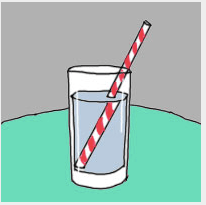
Why does the straw appear to be bent?
light is reflected
light is absorbed
light is turned
light is refracted
flint glass n=1.70
barium glass n=1.60
crown glass n=1.523
water n=1.33
diamond n=2.45
When white light enters a prism, it gets split into its constituent colours. This is due to
different refractive index for different wavelength of each colour
each colours has same velocity in the prism.
prism material have high density.
Scattering of light
The deflection of light by minute particles and molecules of the atmosphere in all direction is called ____________ of light.
scattering
interference
tyndell effect
Reflection
The danger signals installed at the top of tall buildings are red in colour. These can be easily seen from a distance because among all other colours, the red light
moves fastest in air
is absorbed the most by smoke or fog
is scattered the least by smoke or fog
is scattered the most by smoke or fog
When a white light falls on a triangular prism, the colour of light which will deviate the least is
violet
green
blue
red
Advanced sunrise and delayed sunset is due to
Scattering of light
Atmospheric refraction
dispersion of light
reflection of light

What is the time difference between actual sunset and apparent sunset ?
2 seconds
20 seconds
2 minutes
20 minutes
Which of the following is a natural phenomenon which is caused by the dispersion of sunlight in the sky?
Rainbow
Twinkling of stars
Advanced sunrise and delayed sunset
Stars seem higher than they actually are
When white light passes through a prism,
red bends more, violet bends least
red bends least, violet bends most
dispersion doesn't occur
refraction doesn't occur
The splitting of white light into the seven colors when it passes through a transparent material is called
Refractrion
Dispersion
Reflection
Diffraction


Why is the component of color in a rainbow can be seen when light passes through a glass prism?
phenomena of scattering of light
phenomena of dispersion of light
phenomena of reflection of light
phenomena of diffraction of light

Why is the spectrum of light separated into its components of color when white light is directed to a prism?
Because light reflects off the prism's surface
The incident white light refracts and separates into its constituent colors
The white light is absorbed by the prism, separating its colors
The light speeds up as it moves from air into the denser plastic material

Look at the diagram given. This is the first prism. What happen if A SECOND inverted prism is placed behind the first prism?
the various colors pass through it and form brighter spectrum
the various colors pass through it and form a white light back
the various colors pass through it and form an opposite spectrum colors
nothing will happen
This is the example of dispersion of light
sky looks bright orange in the evening
shadow
Pool seems shallower
rainbow
these are examples of phenomenon of scattering of light except
Sky appears blue at midday
Sky appears reddish in the evening
Rainbow after rain
Why does scattering of light occur?
Light rays are reflected by atmospheric molecules and scatter in all directions
Light rays are blocked and refracted to all directions by the clouds or particles in the air
Light rays are transmitted and refracted in all directions by the clouds or particles in the air


Name the light phenomenon above.
Reflection
Refraction
Dispersion
Scatteting
Which of the following is example light scattering ?
( There CAN be more than 1 answer)


Which of the following natural phenomenons occur due to light dispersion.


Stars appear to be higher in the sky than actually they are because of
Scattering of light
Atmospheric refraction
Dispersion
Recombination of light
Which statement is true?
Red light moves fastest
Blue light moves faster than green light
All the colors of white light move with same speed
Yellow light moves with the mean speed as that of red and violet light
We can see the sun before the actual sunrise about
5 mins
2 mins
4 mins
1 min
As light from a far off star comes down towards the earth
it bends away from the normal
it bends towards the normal
it does not bend
it is reflected back
The stars twinkle but the planets do not twinkle at night because
The stars are small but the planets are large
The stars are large but the planets are small
The stars are much nearer but the planets are far away
The stars are far away but the planets are much nearer
Did you understand all the topics
yes
no
only some
What type of lens is wider in the middle than on the edges?
Concave
Convex
Objective
Ocular
When light passes through a convex lens, it does this.....
Diverge, or spread apart
Converge, or come together
Reflect, or bounce off
Create a rainbow
The point at which light rays converge after passing through a convex lens is called what.
The Horizon Point
The Point Break
The Focal Point
The Perspective
When light waves move from passing through air to passing through a glass lens when happens to them?
They slow down and change direction
They speed up and change direction
They maintain the same speed and change direction
They maintain their same speed and direction
What type of lens do you have in your eye?
Concave
Prismatic
Objective
Convex
The angle of the incoming rays of light are also called the.....
Angle of reflection
Angle of refraction
Angle of incidence
Wave angle
The distance between a convex lens and its focal point is called what?
The focus
The focal length
The wave length
The amplitude
The thicker the convex lens, the ___________________ its focal length.
Shorter
Longer
Thicker
Thinner
The thicker the convex lens, the ___________________ its focal length.
Shorter
Longer
Thicker
Thinner
As light passes from air into water it ________________________.
speeds up
continues at the same speed
slows down
forms a mirage

Which lens is concave?
a
b

Which lens can produce a real image?
a
b

Which lens always produces an image that is upright?
a
b

Which lens is the type of lens that is used in a hand lens?
a
b
The best definition of refraction is ____.
passing through a boundary
bouncing off a boundary
changing speed at a boundary
changing direction when crossing a boundary

The radius of curvature of a convex lens is 20cm. What is its focal length?
10 cm
20 cm
30 cm
40 cm
Name the type of mirrors used in the following situations:
(i) Used by Dentist.
(ii) Rear-view mirror of vehicle
(i) Diverging mirror
(ii) Converging mirror
(i) & (ii) Both Converging mirror
(i) Converging mirror
(ii) Diverging mirror
(i) & (ii) Both Diverging mirror.

In the given ray diagram, which of the following path of the refracted ray is correct?


An object is kept at a distance of 4m in front of a spherical mirror, which forms its erect image at a distance of 1m
from the mirror. What is the magnification? Is the mirror concave or convex?
m = +4
Concave Mirror
m = -4
Convex mirror
m = - 1/4
Convex Mirror
m = +1/4
Convex Mirror
A concave mirror produces a three times magnified image on a screen. If the object is placed 20cm in front of the mirror, What is the image distance?
-20 cm
-40cm
-60 cm
-10 cm
Calculate the power of a lens whose focal length is +40 cm. Also Identify the nature of the lens.
P = +0.25 D
Concave lens.
P = +2.5 D
Convex lens
P = +0.25 D
Concave lens
P = +2.5 D
Convex Lens

Complete the path of the refracted ray of the given incident light on the given convex lens.


The image of a candle flame placed at a distance of 30cm from a mirror is formed on a screen placed in front of the mirror at a distance of 60cm from its pole. What is the nature of the mirror? Find its focal length.
F = - 20 cm
Concave Mirror
Real & Inverted Image
F = + 20 cm
Concave Mirror
Virtual & Erect Image
F = - 20 cm
Convex Mirror
Real & Inverted Image
F = + 20 cm
Convex Mirror
Virtual & Erect Image
A child is standing in front of a magic mirror. She finds the image of her head bigger, the middle portion of her body of the same size and that of the legs smaller. The following is the order of combinations for the magic mirror from the top.
Plane, convex and concave
Convex, concave and plane
Concave, plane and convex
Convex, plane and concave
The refractive indices of glass and water with respect to air are 3/2 and 4/3 respectively. If the speed of light in glass is 2 x 10⁸ m/s, find the speed of light in water.
0.5 x 10⁸ m/s
3 x 10⁸ m/s
2.25 x 10⁸ m/s
2 x 10⁸ m/s
A concave lens has focal length of 15 cm. At what distance should the object from the lens be placed so that it forms an image at 10 cm from the lens? Also, find the magnification.
u = + 30 cm
m = - 0.33
u = + 20 cm
m = - 1.33
u = - 20 cm
m = + 1.33
u = - 30 cm
m = + 0.33
A convex mirror used for rear view on an automobile has a radius of curvature of 3 m. If a bus is located at 5 m from this mirror. Find out the position, nature and size of the image.
v = - 1.15 m
m = - 0.23
Virtual & Erect
v = - 1.5 m
m = + 0.23
Real & Inverted
v = + 1.5 m
m = + 2.3
Real & Inverted
v = + 1.15 m
m = + 0.23
Virtual & Erect
An object is placed at a distance of 10 cm from a convex mirror of focal length 15 cm. Find the nature, size and position of the image formed.
v = - 6 cm
m = - 0.6
Real & Inverted
v = + 6 cm
m = + 0.6
Virtual and Erect
v = - 6 cm
m = - 0.6
Virtual and Erect
v = + 6 cm
m = + 0.6
Real & Inverted
Which of the following lenses would you prefer to use while reading small letters of newspaper?
A convex lens of focal length 50 cm.
A concave lens of focal length 5 cm.
A concave lens of focal length 50 cm.
A convex lens of focal length 5 cm.
An object 5 cm in size is placed at a distance of 20 cm in front of a convex mirror of radius of curvature 40 cm. Find out the position, size and nature of the image formed.
v = + 10 cm
h' = + 2.5 cm
Virtual, Erect and smaller in size.
v = - 20 cm
h' = - 0.5 cm
Real, Inverted and enlarge in size.
v = + 20 cm
h' = + 0.5 cm
Real, Inverted and enlarge in size.
v = - 10 cm
h' = - 2.5 cm
Virtual, Erect and smaller in size.
A concave lens has focal length of 20 cm. At what distance from the lens a 5 cm tall object be placed so that it forms an image at 15 cm from the lens? Also calculate the size of the image formed.
u=-60; h' =(5/4)
u=-60; h' =(4/5)
u= +60; h' =(5/4)
u=+60; h' =(4/5)
A concave mirror of focal length 20 cm forms an image having twice the size of object. For the virtual position of object, the position of object will be at:
25 cm
40 cm
10 cm
At infinity
If a man’s face is 25 cm in front of concave shaving mirror producing erect image 1.5 times the size of face, focal length of the mirror would be:
75 cm
25 cm
15 cm
60 cm
The refractive index of water is 1.33. The speed of light in water will be:
1.33 × 10^8 m/s
3 × 10^8 m/s
2.66 × 10^8 m/s
2.26 × 10^8 m/s
You are given three media A, B and C of refractive index 1.33, 1.65 and 1.46. The medium in which the light will travel fastest is
A
B
C
Equal in all media
A 10 mm long awl pin is placed vertically in front of a concave mirror. A 5 mm long image of the awl pin is formed at 30 cm in front of the mirror. The focal length of this mirror is
-10 cm
20 cm
-30 cm
-40 cm
Which of the following statements is/are true?
A convex lens has 4 dioptre power having a focal length 0.25 m
A convex lens has -4 dioptre power having a focal length 0.25 m
A concave lens has 4 dioptre power having a focal length 0.25 m
A concave lens has – 4 dioptre having a focal 0.25 m
A point object is placed at a distance of 20 cm from a convex mirror of focal length 20 cm. The image will form at:
at infinity
at focus
at pole
behind the mirror.
If the power of a lens is – 2 D, what is its focal length?
+50 cm
-100 cm
-50 cm
+100 cm
A ray of light is travelling from a rarer medium to a denser medium. While entering the denser medium at the point of incidence, it:
goes straight into the second medium
bends towards the normal
bends away from the normal
does not enter at all

The above lens is a type of ___.
diverging lens
converging lens
divergent lens
convergent lens
Which lens represents the path light takes through a diverging lens?


Which figure represents the path light takes through a converging lens?
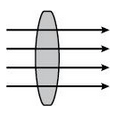
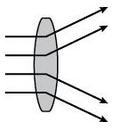
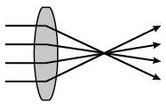
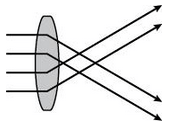
Which optical device bends light inward?
convex lens
concave lens
plane mirror
convex mirror
What type of lens is wider in the middle than on the edges?
Concave
Convex
Objective
Ocular
When light passes through a convex lens, it does this.....
Diverge, or spread apart
Converge, or come together
Reflect, or bounce off
Create a rainbow
The distance between a convex lens and its focal point is called what?
The focus
The focal length
The wave length
The amplitude
What type of lens do you have in your eye?
Concave
Prismatic
Objective
Convex
The angle of the incoming rays of light are also called the.....
Angle of reflection
Angle of refraction
Angle of incidence
Wave angle
The thicker the convex lens, the ___________________ its focal length.
Shorter
Longer
Thicker
Thinner
Which lens always produces an image that is upright?
a
b

What type of lens is used in the shown instrument?
concave lens
convex lens
reflection lens
reduction lens

