
 Worksheets
M5 Science - Physics - Electricity
Total questions: 136
Worksheet time: 1hrs 8mins
Which statement best explains electric current?
It is the flow of positive charges in a circuit.
It is the flow of atoms in a circuit.
It is the flow of electrons in a circuit.
It is the flow of neutrons in a circuit.
Which of the following is the SI unit for electric current?
Ohm
Watt
Ampere
Volt
A higher resistance in a circuit causes a _____________.
higher voltage
higher current
lower current
lower voltage
The instrument that measures electric current is called ___________.
a resistor
a voltmeter
an ammeter
an electrometer

Which device or devices could be removed without breaking the electric circuit?
Only the bulb
Only the switch
The battery and the switch
The bulb and the switch
A material in which electrons are ABLE to move easily...
circuits
insulators
resistors
conductors
A material in which electrons are NOT ABLE to move easily...
circuits
insulators
resistors
conductors
voltage
direct current
alternating current
series circuit
Electric current that reverses its direction of flow in a regular pattern.
voltage
direct current
alternating current
parallel circuit
The flow/movement of electric charges is...
voltage
resistance
current
circuit
What is a closed path that electric current follows?
voltage
current
resistance
circuit
What is the tendency for a material to oppose the flow of electrons?
voltage
current
resistance
circuit
According to this law, the current in a circuit equals the voltage divided by the resistance.
Law of Conservation of Energy
Ohm's Law
Law of Conservation of Charges
Newton's First Law
The current has only has one loop to flow through in this circuit.
series circuit
parallel circuit
This circuit contains two or more branches for current to move through.
series circuit
parallel circuit


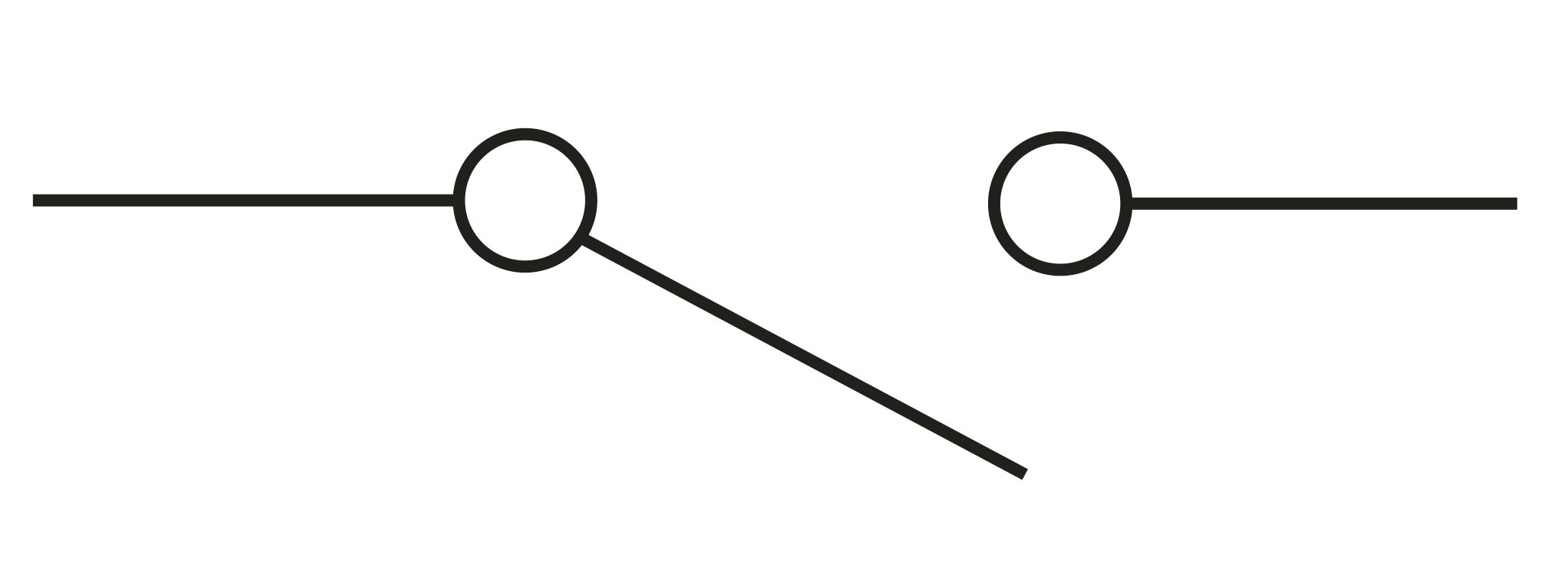
This is the symbol for a _____.
switch
light
battery
wires

The other bulbs will go out.
The other bulbs will get dimmer.
The other bulbs will get brighter.
The battery will become stronger.
Voltage is an energy source that causes electrons (e-) to flow.
True
False
What is electricity?
an object that electrons do not flow through
energy created by moving charged particles
when two objects repel each other
a circuit that has only one path for electricity to flow

This picture shows a circuit that is...
closed
open
an insulator
static electricity
What is the purpose of a fuse?
to break the circuit and turn the power off if there is too much power being run
to add more power to the circuit
to be a conductor
to be an insulator
A parallel circuit has more than one path for electricity to flow.
True
False
If the light bulb turns ON in a circuit, that means the circuit is...
open
closed
Items that have the same charge will do what?
attract
repel
Items that have opposite charges do what?
attract
repel
nothing changes
What type of electric circuit only has ONE path for the electricity to flow?
series
parallel
open
closed
Electricity that flows in a closed path is called a...
path
current
circuit
What is the flow of electricity in a circuit?
current
flow
circuit
To complete a circuit the switch must be...
unattached
open
closed
True
False
If the lights are on, the circuit is...
closed
open
If the lights are off, the circuit is...
closed
open
In a parallel circuit the current...
makes one circle.
stays in one path.
splits and goes through two or more paths.
Two types of circuits are...
parallel and magnetic.
electromagnetic and series.
series and parallel.
The flow of electricity requires a(n)...
complete path.
incomplete path.
insulated current.
A circuit that has more than one path for electricity to follow is a ________ circuit.
series
static
broken
parallel
Copper is used in wiring because it is an excellent ______________ of electricity.
circuit breaker
conductor
insulator
fuse
When a switch is turned on, you close a circuit so that it is ___________.
incomplete
inactive
complete
broken
The only charges that can move from one object to another are ___________ charges.
electric
neutral
positive
negative
The thin wire inside a light bulb is called the filament.
True
False
True
False
True
False


Opposite charges _______________.
attract
repel
nothing changes

Like charges _______________.
attract
repel
nothing changes

Identify the part of the circuit that is labeled 1.
battery
wire
switch
bulb

Identify the part of a circuit that is labeled 2.
battery
wire
switch
bulb

Identify the part of a circuit that is labeled 3.
battery
wire
switch
bulb
What supplies the energy or power in an electric circuit?
light bulb
wire
battery

If the light is on, the circuit is _________________.
closed
open

If the light is off, the circuit is ______________.
closed
open
A/an _________________ is a material that will NOT allow electricity to flow through it.
insulator
conductor

How could you make this circuit work?
Close the switch
Take out the bulbs
Add another battery
Add another bulb
The unit for current is the...
Volt
Ohm
Electron
Amp
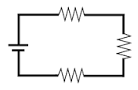


Is the image shown a series or a parallel circuit?
series
parallel

In the image, what type of circuit is shown?
series
parallel

What type of circuit is shown in the image?
series
parallel

What type of circuit is shown in the image?
series
parallel

What will happen to the 2 magnets if they are released?
attract
repel
Electricity that flows in a closed path is called a...
path
current
circuit
battery
What is the flow of electricity in a circuit?
current
flow
voltage
resistance
The unit for current is the...
Volt
Ohm
Electron
Amp
What voltage is needed to cause a 50A current flow through a 10Ω resistor?
15V
500V
500 kV
0.2V

What is the name of this electrical component called?
Ammeter
Voltmeter
Bulb
Resistor

What is the name of this electrical component called?
Bulb
Resistor
Voltmeter
Ammeter

What is the name of this electrical component called?
Resistor
Battery
Switch
Resistor

What is the name of this electrical component called?
Bulb
Resistor
Switch
Battery

What is the name of this electrical component called?
Ammeter
Voltmeter
Resistor
Bulb

The circuit diagram shows 3 light bulbs in series. What happens when one of the light bulb breaks?
The remaining bulbs remain on.
The remaining bulbs are off.
The remaining bulbs becomes brighter.
The remaining bulbs becomes dimmer.

The circuit shows three bulbs in parallel. What happens when one of the light bulbs breaks?
The remaining bulbs remain on.
The remaining bulbs are off.
The bulbs become brighter.
The bulbs become dimmer.

What is the name of this electrical symbol?
Variable voltmeter
Variable resistor.
Variable ammeter.
Variable switch.
How are an ammeter and voltmeter connected in a circuit?
Ammeter: in series
Voltmeter: in parallel
Ammeter: in parallel
Voltmeter: in parallel
Ammeter: in series
Voltmeter: in series
Ammeter: in parallel
Voltmeter: in series
What physical quantity does a voltmeter measure?
Power
Voltage
Current
Resistance
What physical quantity does an ammeter measure?
Voltage
Current
Resistance
Power
What is the formula to find voltage?
I=RV
R=IV
V=I×R
An object with equal amounts of positive and negative charges is called...
Positive
Neutral
Negative
Neutron
What is the formula for resistance?
R=I×V
R=VI
R=IV
R=I2V
What is the resistance if the voltage is 9V and the current is 3A?
0.33Ω
27Ω
6Ω
3Ω
What is the current if the resistance is 20 ohms, and the voltage 100V?
20A
5A
0.2A
2000A
What is a disadvantage of a series circuit?
If one bulb goes out they all go out.
If one bulb goes out, the others do not.
If two bulbs go out, the third one will work.
A magnet moving inside a coil of wire causing induction is an example of a...
Motor
DC Circuit
Voltmeter
Generator
According to Ohm's Law, the potential difference across the ends of a resistor is directly proportional to the ……… through it, provided its ............ remains constant.
current, temperature
temperature, current
physical condition, temperature
physical condition, current
The electrical resistance of insulators is...
zero
low
high
infinitely high

What particles are found in the nucleus?
Neutrons
Protons and electrons
Protons and neutrons
Neutrons and electrons
What is one benefit of using a parallel circuit?
There are not any benefits.
It is simpler.
If one part breaks, it does not affect the others.

