
 Worksheets
End of year quiz
Total questions: 131
Worksheet time: 2hrs 57mins
What speed do all parts of the EM spectrum travel?
3x10⁸ ms-1
2x10⁸ ms-1
340 ms-1
300 000 ms-1
Cell phones and televisions use this type of EM wave. It has the longest wavelength with the lowest frequency.
radio wave
tv wave
gamma wave
ultraviolet wave
What speed do all parts of the EM spectrum travel?
3x10⁸ ms-1
2x10⁸ ms-1
340 ms-1
300 000 ms-1
Cell phones and televisions use this type of EM wave. It has the longest wavelength with the lowest frequency.
radio wave
tv wave
gamma wave
ultraviolet wave


Which has the longest wavelength?
Gamma Rays
Visible Light
Microwaves
Radiowaves
Which has the highest frequency?
Gamma Rays
Visible Light
Microwaves
Radiowaves
Which of the following could be used as a detector for radio waves?
aerial
thermistor
photographic file
our retinas
Which of the following could be used as a detector for microwaves?
aerial
thermistor
water
our retinas
Which of the following could be used as a detector for infrared radiation?
aerial
thermistor
water
our retinas
Which of the following could be used as a detector for visible light?
aerial
thermistor
water
our retinas
Which of the following could be used as a detector for ultraviolet radiation?
aerial
thermistor
fluorescent materials
our retinas
Which of the following could be used as a detector for x-rays?
photographic film
thermistor
fluorescent materials
our retinas
Which of the following could be used as a detector for gamma radiation?
photographic film
thermistor
fluorescent materials
Geiger-Muller tube
Which of the following could be a source of radio waves?
radio mast
magnetron
hot objects
LED's
Which of the following could be a source of microwave radiation?
radio mast
magnetron
hot objects
LED's
Which of the following could be a source of infrared radiation?
radio mast
magnetron
hot objects
LED's
Which of the following could be a source of visible light?
radio mast
magnetron
hot objects
LED's
Which of the following could be a source of ultraviolet radiation?
radio mast
the sun
hot objects
aerials
Which of the following could be a source of x-ray radiation?
a collision between high energy electrons and a metal target
lasers
high-speed collisions
mobile phones
Which of the following could be a source of gamma radiation?
a collision between high energy electrons and a metal target
lasers
high-speed collisions
radioactive substances
When a skydiver is falling through the air, they are always in free fall.
True
False
If we drop a steel sphere and a ping pong ball with the same mass, the steel sphere will...
hit the ground first because it has more mass
hit the ground second because it takes longer to accelerate
hit the ground at the same time as the ping pong ball
The resultant force is
The force you feel when you catch a fish in a net
The force acting upward on a sky diver
the combination of all of the forces acting on an object
always unbalanced
The force of gravity on a person or object on the surface of a planet is called
mass.
weight.
terminal velocity
free fall.
The force that one surface exerts on another when the two rub against each other is called...
friction.
inertia.
acceleration
gravity
Forces can be added together only if they are
acting on the same object
unaffected by gravity
balanced forces
substantial
According to Newton’s third law of motion, when a hammer strikes and exerts force on a nail, the nail
creates a friction with the hammer.
disappears into the wood.
exerts an equal and opposite force on the hammer.
moves at a constant speed.
According to Newton’s third law of motion, the strength of a reaction force is ____________________ the strength of the action force.
equal to
negative to
positive to
greater than

A skydiver with a mass of 70 kg accelerates to Earth at a rate of 9.8 m/s2 due to gravity. What is the downwards force on the skydiver?
79.8 Newtons
7.14 Newtons
0.14 Newtons
690 Newtons

Compare the acceleration of the 1-kg object with that of the 2-kg object.
1kg object has more acceleration because it has less mass
1kg object has less acceleration because it has less mass
2kg object has more acceleration because it has more mass
2kg object has less inertia because it has more mass
Acceleration equals the change in speed, divided by...
Speed
Distance
Time
Initial Speed
Velocity consists of both...
Time & Distance
Speed & Direction
Time & Direction
Speed & Distance
When an object speeds up it is considered...
Negative Acceleration
Neutral Acceleration
Initial Speed
Positive Acceleration
When an object slows down it is considered...
Positive Acceleration
Final Velocity
Negative Acceleration or deceleration
Hitting the brakes
To find average speed of an object, you must know...
Distance & Time
Distance & Velocity
Time & Speed
Distance & Acceleration
What is speed?
The rate at which an object changes position
The rate at which an object slows down
How fast an object is moving at any given moment
A speedometer
What is average speed?
The rate at which an object moves
The speed of an object at any given moment
The distance an object travels per unit of time
Speed with direction
Which of the following must be true if an object is accelerating?
It is going really fast.
It is moving away from the frame of reference point.
Balanced forces are acting upon it.
Unbalanced forces are acting upon it.
A student drops a ball onto the floor and it bounces. Which of the following statements about the interaction between the ball and the floor is correct?
The floor applies the same amount of force to the ball that the ball applies to the floor, which causes the ball to bounce.
The floor applies a larger amount of force to the ball than the ball applies to the floor, which causes the ball to bounce.
The floor applies a larger amount of force to the ball than the ball applies to the floor because it is a part of the Earth.
The ball applies a larger amount of force to the floor than the floor applies to the ball because the ball bounces.
Sami wants to build the fastest racing bike possible. What is one way they can change the bike, so they have a better chance of winning the race?
reduce the force of the bike so it accelerates more quickly
put on smoother tires to eliminate friction with the race track
increase the mass of the bike to increase its gravitational field
replace metal parts with plastic to decreases its magnetic field
A student kicks a soccer ball in gym class. Which of the following is correct?
The student applies the same force to the ball that the ball applies to the student, and the ball accelerates.
The student applies a larger force to the ball than the ball applies to the student, and the ball accelerates.
The student applies a larger force to the ball than the ball applies to the student because the ball has less mass than the student.
The ball applies a larger force to the student than the student applies to the ball because the ball can move.

The force diagram for an object that is being dragged across the floor is shown to the right. The object is experiencing an acceleration of 2 m/s2 as it moves under the influence of the forces shown. Use the diagram to determine the force of friction acting on the object.
The force of friction is 30 newtons.
The force of friction is 50 newtons.
The force of friction is 20 newtons.
The force of friction is 150 newtons.

direction


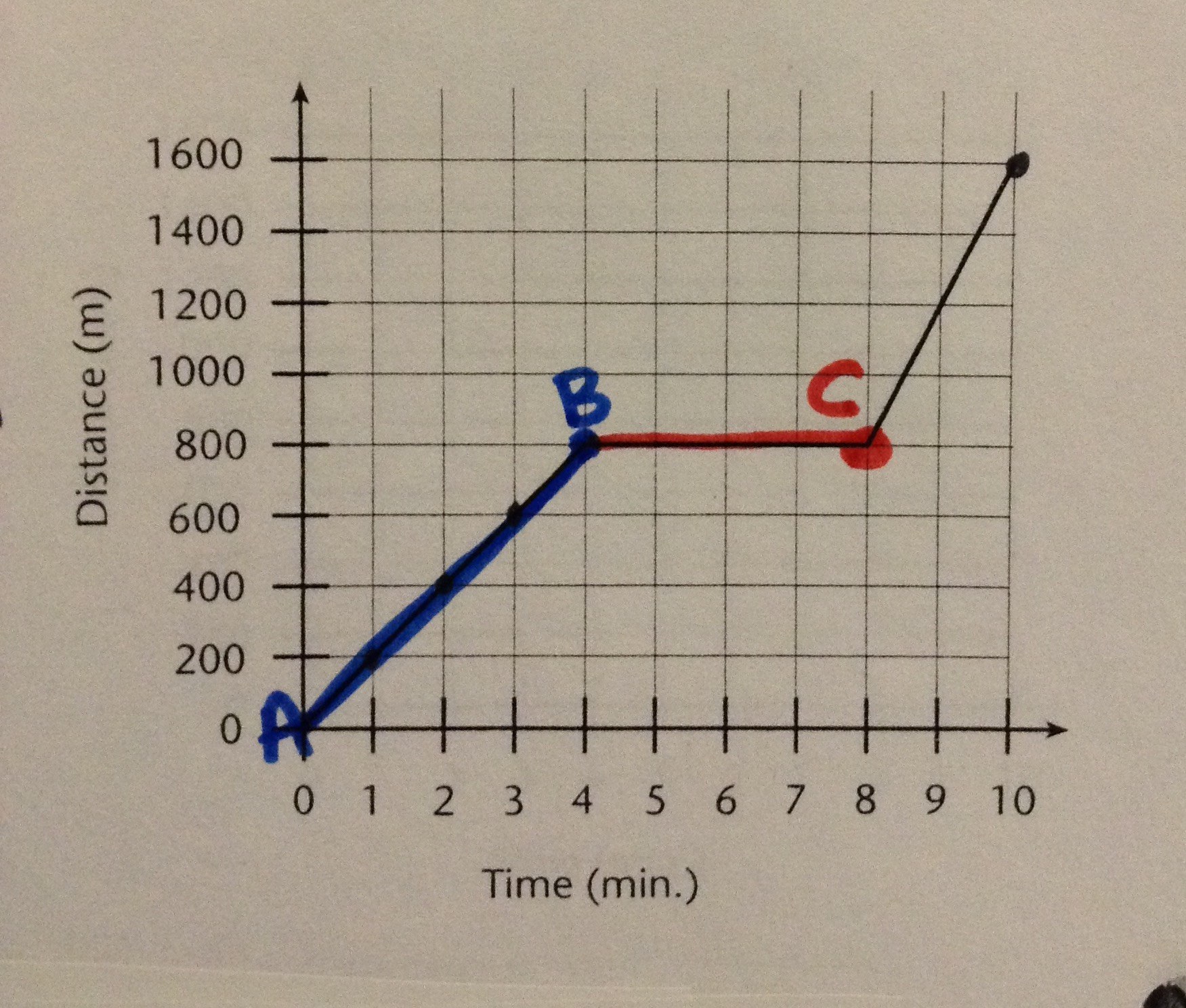
What is occurring from point A to point B?


The average speed of this object between points C and D is
0.375 kms-1
0.375 ms-1
2.67 kms-1
2.67 ms-1
A ball rolls down a steep hill. It travels 500 m in 1 minute. It then rolls on a flat surface for an additional 3 minutes and travels 300 m. What is the average speed of the ball?
0.5 m/min
100 m/min
200 ms-1
200 m/min
A car starts from a stoplight and is traveling with a velocity of 10 m/sec east in 20 seconds. What is the acceleration of the car?
0.5 ms-2
0.5 ms-1
2 ms-2
2 ms-1
You and your dad are moving the couch from one side to another. Your dad pushes with a force of 35 N to the right and you push with a force of 25 N right. What is the net force on the couch?
60 N right
10 N left
60 N left
50 N left

Mark slams on the brakes after traveling 25 m/s. It takes him 3 seconds to come to a complete stop. What is his acceleration?
8.33 m/s2
-8.33 m/s2
75 m/s2
-75 m/s2
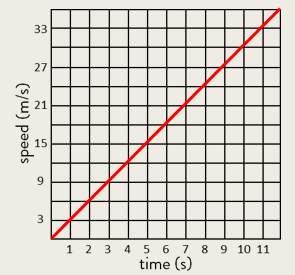
Calculate the distance travelled by the object in the first 5 seconds.
75m
0m
3m
37.5m
The % energy efficiency of an appliance is
total energy input/ useful energy output x 100
useful energy output /total energy input x100
total energy input x useful energy input x100
useful energy output /total energy input x50
A torch battery releases 50J of energy as heat and 240J as light, What is the total energy released from the battery?
250J
280J
290J
300J
A Radio releases 250J of energy 10J is released as heat , How much is released as sound?
200J
220J
240J
260J
Complete the statement about the principal of Conservation of Energy.
Energy can be changed for one form to another but the total amount of energy
always increases
always decreases
does not change
varies according to the reaction
Cycles put oil in the axles of their bicycle to reduce friction. This is called
Condesation
Friction
Oil formation
Lubrication
You can reduce friction by doing the following:
Fabrication
Lubrication
What is the name of the region where a mass experiences a force?
(a)
Select the correct definition of weight.
It is the force of gravity acting on the object.
It is the amount of matter in an object.
Select the correct definition of mass.
It is the amount of matter in an object.
It is the force of Earth's gravity on an object.
Weight is measured in.....
Kilogram
Newtons
Kilometer
Mass is measured in.....
Kilograms
Kilometers
Newtons
My weight would change on different planets.
True
False
My mass would change on different planets.
True
False
There is a force of gravity on the Moon.
True
False
There is an atmosphere (air) on the Moon.
True
False
Gravity is pulling you to the (a) of the Earth

In this force diagram, which arrow is representing Friction?
A
B
C
D
A car at the top of the drop on a roller coaster has ________ energy.
potential
kinetic
chemical
sound
A car rolling down the drop of a roller coaster has ________ energy.
potential
kinetic
chemical
sound
We receive ________ and heat energy from the Sun.
sound
mechanical
light
kinetic
A hot drink has...
Kinetic Energy
Heat Energy
Thermal Energy
Nuclear Energy

Coal and oil are?
Non-Renewable energy resources
Renewable energy resources
None of the above

___________ energy comes directly from the sun.
Warm
Solar
Hydro
Bio-fuels

Bio-fuel and geothermal energy are examples of?
Non-renewable energy resources
Hydro energy
Renewable energy resources
None of the above
In this force diagram, which arrow is representing Friction?
A
B
C
D
___________ forces always cause an object's motion to change.
balanced
unbalanced
contact
non-contact
______________ is a force that always acts in the direction opposite of motion.
applied
friction
gravity
normal
Which of the following is a unit of speed ?
J/s
kg/m
m/s
kg/s
Dave runs a 400 m race with a speed of 4 m/s. How long will it take him to finish the race?
400 seconds
100 minutes
100 seconds
1600 seconds
Anna rides her bike to school every day. Today she rode her bike for 20 minutes, then stopped at the store for 5 minutes for a snack. She continued to ride her bike to school afterwards. Select the graph that accurately shows her movement.



