
 Worksheets
physical science semester 2
Total questions: 131
Worksheet time: 2hrs 53mins
Name
Class
Date
1.
ammonium chloride
a)
NH3Cl2
b)
NH4Cl
c)
NH4ClO3
d)
NH4Cl2
2.
calcium phosphate
a)
CaPO4
b)
Ca2(PO4)3
c)
Ca3PO4
d)
Ca3(PO4)2
3.
sodium nitrate
a)
NaNO2
b)
Na3N
c)
Na3NO
d)
NaNO3
4.
phosphorus trichloride
a)
KCl3
b)
PCl3
c)
K3Cl
d)
P3Cl
5.
barium hydroxide
a)
Ba(OH)2
b)
Ba2OH
c)
BaOH
d)
Ba2OH
6.
silicon dioxide
a)
SO2
b)
NaO2
c)
SiO2
d)
SiO
7.
magnesium carbonate
a)
Mg2C
b)
Mg2CO4
c)
Mg2(CO3)2
d)
MgCO3
8.
copper(II) chloride
a)
CuCl2
b)
CuCl
c)
Cu2Cl
d)
Cu2Cl2
9.
potassium hydroxide
a)
KH
b)
KOH
c)
K2OH
d)
K(OH)2
10.
zinc sulfate
a)
ZnSO3
b)
ZnSO4
c)
ZnS
d)
Zn(SO4)2
11.
diphosphorus pentoxide
a)
P2O5
b)
PO5
c)
P5O2
d)
P2O6
12.
calcium iodide
a)
CaI
b)
Ca2I
c)
CaI2
d)
Ca2I3
13.
iron(III) chloride
a)
FeCl3
b)
FeCl
c)
Fe3Cl2
d)
Fe2Cl3
14.
sodium nitride
a)
NaNO3
b)
NaN
c)
NaN3
d)
Na3N
15.
CaCO3
a)
calcium monocarbon trioxide
b)
calcium carbide
c)
calcium carbonite
d)
calcium carbonate
16.
CF4
a)
carbon fluoride
b)
monocarbon tetrafluoride
c)
carbon tetrafluoride
d)
carbon tetrafluorine
17.
Cu2CO3
a)
copper II carbonate
b)
copper I carbonate
c)
copper carbonate
d)
copper carbon trioxide
18.
Al(NO3)3
a)
aluminum trinitrate
b)
aluminum nitrite
c)
aluminum nitrate
d)
aluminum III nitrate
19.
Name this compound
PH3
PH3
a)
triphosphorus trihydride
b)
Phosphorus hydride
c)
Trihydrogen monophosphide
d)
Phosphorus trihydride
20.
Name this compound.
N2O
N2O
a)
Dinitrogen monoxide
b)
Dinitrogen oxide
c)
Nitrogen oxide
d)
Nitrogen dioxide
21.
Name this compound.
Li3PO4
Li3PO4
a)
lithium phosphorus tetroxide
b)
lithium phosphate
c)
lithium phosphite
d)
trilithium phosphate
22.
Name this compound.
CF4
CF4
a)
carbon fluoride
b)
tetracarbon tetrafluoride
c)
carbon tetrafluoride
d)
carbon tetrafluorine
23.
What is the correct term for "atom with more electrons than protons"?
a)
positive ion (cation)
b)
negative ion (anion)
c)
neutral atom
d)
stable atom
24.
What is the correct term for "atom with more protons than electrons"?
a)
positive ion (cation)
b)
negative ion (anion)
c)
neutral atom
d)
stable atom
25.

Which of these is covalent?
a)
NaCl
b)
Pb(NO3)2
c)
CO2
d)
AlCl3
26.
What is the name of the following molecule, N2O5?
a)
nitrogen oxide
b)
dinitrogen oxide
c)
dinitrogen pentoxide
d)
nitrogen pentoxide
27.
What is the name of the compound LiOH?
a)
lithium hydrogen oxide
b)
lithium hydroxide
c)
lithium hydride
d)
lithium oxide hydride
28.
What is the correct name for the compound Al2S3?
a)
Aluminum sulfide
b)
Dialuminum trisulfide
c)
Trisulfur dialuminide
d)
Aluminum sulfur
29.

What element is represented in this Bohr Model?
a)
Carbon
b)
Hydrogen
c)
Aluminum
d)
Lithium
30.

Which atom is this?
a)
Boron
b)
Carbon
c)
Nitrogen
d)
Lithium
31.
A substance made up of two or more elements.
a)
Element
b)
Compound
c)
Atom
d)
Matter
32.
A horizontal row of elements on the periodic table.
a)
Period
b)
Group
33.
The vertical columns on the periodic table
a)
Period
b)
Group
34.
In the modern periodic table, elements are arranged by:
a)
atomic mass
b)
atomic number
c)
valence electrons
d)
number of isotopes
35.

How many protons are in Beryllium?
a)
4
b)
9
c)
5
d)
2
36.
_______ are the ROWS on the periodic table.
a)
Families
b)
Groups
c)
Periods
d)
Elements
37.
________ are the COLUMNS on the periodic table and are organized by similar properties.
a)
Classifications
b)
Groups
c)
Periods
d)
Elements
38.
As you move from left to right across the periodic table, the atomic number increases.
a)
True
b)
False
39.
What is the element symbol for boron?
a)
B
b)
Bo
c)
Bn
d)
W
40.
Each element is unique based on its number of protons, also known as the...
a)
atomic mass
b)
valence number
c)
atomic symbol
d)
atomic number
41.

Mass?
a)
13
b)
26.982
c)
Al
d)
Aluminum
42.

atomic number?
a)
13
b)
26.982
c)
aluminum
d)
Al
43.
What are the negatively charged particles in an atom called?
a)
Proton
b)
Neutrons
c)
Electrons
44.

Which item on this element square is the chemical symbol?
a)
Copper
b)
29
c)
Cu
d)
63.546
45.

GOLD
a)
Al
b)
Ag
c)
Ar
d)
Au
46.

CARBON
a)
C
b)
Ca
c)
Cl
d)
Cu
47.

OXYGEN
a)
O
b)
Ox
c)
Oy
d)
Og
48.
Can an element be broken down into a simpler substance
a)
yes
b)
No
49.

what does the 6 represent?
a)
Atomic mass
b)
atomic number
c)
chemical symbol
d)
element name
50.

What does the C represent?
a)
atomic mass
b)
atomic number
c)
element name
d)
chemical symbol
51.
What does the atomic number tell us?
a)
number of protons
b)
number of neutrons
52.
A one or two letter abbreviation used to represent an element is called a(n) ________
a)
chemical symbol
b)
element sign
53.
What charge does a proton have?
a)
Negative
b)
Positive
c)
Neutral
d)
Visa
54.

What is K?
a)
potassium
b)
berkelium
c)
sodium
d)
cacium
55.

What does Si stand for?
a)
scandium
b)
chronium
c)
sulfur
d)
silcon
56.

Where is most of the mass in an atom located?
a)
in the nucleus
b)
in the protons
c)
in the neutrons
d)
in the electrons
57.

The particles with no charge in an atom are the _______.
a)
electrons
b)
neutrons
c)
protons
d)
protons and neutrons
58.

What is the mass number of this element?
a)
5
b)
27
c)
32
d)
59
59.
Which statement best describes an electron?
a)
Smaller mass than a proton and a negative charge
b)
Smaller mass than a proton and a positive charge
c)
Greater mass than a proton and a negative charge
d)
Greater mass than a proton and a positive charge
60.

Oxygen’s atomic number is 8. This means that an oxygen atom must have
a)
8 electrons
b)
8 protons
c)
8 neutrons
d)
a mass number of 8
61.

An element can be identified by its unique number of –
a)
ions
b)
electrons
c)
protons
d)
neutrons
62.

The reactivity of an atom is determined by –
a)
its number of valence electrons
b)
the radius of the atom's nucleus
c)
its atomic mass of the element
d)
the orbital path of its electrons
63.

The table provides information for four elements. Based on the information shown, it can be concluded that -
a)
carbon was discovered first
b)
iodine is the most reactive
c)
oxygen has the most neutrons
d)
nitrogen is the better insulator
64.
How many Valance electrons does Iodine Have?
a)
6
b)
16
c)
7
d)
17
65.
An element with five valence electrons is
a)
phosphorus
b)
oxygen
c)
beryllium
d)
rubidium
66.
Rows on the period table are called _____ while columns are called _____.
a)
groups, families
b)
groups, periods
c)
periods, groups
d)
families, groups
67.

How many electrons does Si contain? (click to see image)
a)
14
b)
28
c)
2
d)
None of these
68.

What element is represented in this Bohr Model?
a)
Carbon
b)
Hydrogen
c)
Aluminum
d)
Lithium
69.

Where on the periodic table are most of the nonmetals found?
a)
Right Side
b)
Along the Zig Zag Line
c)
Left Side
70.
How many electrons are in the outer shell of Carbon (C)?
a)
4
b)
6
c)
8
d)
10
71.

How many electrons are in the outer shell of Sodium (Na)?
a)
3
b)
1
c)
2
d)
4
72.
Protons determine an element's __________.
a)
Reactivity
b)
Nucleus
c)
Identity
d)
Color
73.
Which element is found in group 2 period 4?
a)
Strontium (Sr)
b)
Barium (Ba)
c)
Calcium (Ca)
d)
Beryllium (Be)
74.
Which group of the periodic table is composed of inert (not reactive) gases?
a)
alkali metals
b)
alkaline earth metals
c)
halogens
d)
noble gases
75.
Atoms with similar properties are most likely located...
a)
in the same period.
b)
in the same group.
c)
in different periods.
d)
to the right and left of each other.
76.
If an atom had the same properties as fluorine (F), it would probably be located in
a)
period 1.
b)
period 2.
c)
group 2.
d)
group 17.
77.

Which Period would this element be found on just by looking at the shells/levels?
a)
1
b)
2
c)
3
d)
4
78.
The first energy level can hold up to how many electrons?
a)
8
b)
4
c)
2
d)
5
79.
which is a physical change
a)
freezing water
b)
sublimation
c)
melting sugar
d)
all of these
80.
which of these is a chemical change
a)
melting sugar
b)
tearing paper
c)
boiling water
d)
none of these
81.
salad is an example of which type of mixture
a)
heterogeneous
b)
homogeneous
82.
which mixture is homogeneous?
a)
milk
b)
sand in water
c)
chocolate chip ice cream
d)
chicken noodle soup
83.
if I increase size of a sample, measurements of extensive properties of the matter will
a)
increase
b)
decrease
c)
stay the same
84.
which does not belong
a)
melting point
b)
color
c)
reactivity
d)
solubility
85.
which is an element
a)
carbon
b)
water
c)
steel
d)
tnt (trinitrotoulene)
86.
which is a compound
a)
gold
b)
salt water
c)
CO2
d)
koolaid
87.
which is a chemical change?
a)
bending a wire
b)
cutting a wire
c)
copper turning green outside
d)
sugar dissolving in water
88.
which type of property can not be observed without changeing the material?
a)
physical
b)
chemical
c)
intensive
d)
extensive
89.
iron is a(n)
a)
element
b)
compound
c)
mixture
d)
none of these
90.
Melting point is
a)
physical property
b)
chemical property
91.
sodium fluoride is a(n)
a)
element
b)
compound
c)
solution
d)
mixture
92.
Density (mass divided by volume)
a)
Physical Property
b)
Chemical Property
93.
Mass (amount of matter in an object)
a)
Physical Property
b)
Chemical Property
94.
Volume (amount of space an object takes up)
a)
Physical Property
b)
Chemical Property
95.
Reactivity with Acid
a)
Physical Property
b)
Chemical Property
96.
Odor
a)
Physical Property
b)
Chemical Property
97.
Tendency of of matter to corrode
a)
Physical Property
b)
Chemical Property
98.
Red Color
a)
Physical Property
b)
Chemical Property
99.
Flammability (ability of a substance to burn)
a)
Physical Property
b)
Chemical Property
100.
Bitter Taste
a)
Physical Property
b)
Chemical Property
101.
Milk souring
a)
Physical Property
b)
Chemical Property
102.
Pancakes cooking on the eyes of the stove
a)
Physical Property
b)
Chemical Property
103.
Wood rots and decomposes
a)
Physical Property
b)
Chemical Property
104.

What do the lines around this magnet represent?
a)
North Pole
b)
South Pole
c)
Magnetic Declination
d)
Magnetic Field
105.
Magnetism is generated by moving
a)
protons.
b)
electrons.
c)
neutrons.
d)
elements.
106.

If you place the North pole of a magnet next to the South pole of another magnet, they will:
a)
Attract
b)
Repel
c)
Do nothing
d)
Shatter
107.
An electromagnet's poles may be reversed by:
a)
decreasing the voltage of the coil
b)
increasing the number of coils
c)
changing the direction of current flow
d)
altering the material used to make the coils
108.
On Earth, where is Magnetic North approximately located?
a)
The Equator
b)
The North Pole
c)
The South Pole
d)
New Brighton
109.
If you cut a magnet in half, what happens to the poles?
a)
One half gets the North Pole, the other half gets the South Pole
b)
Both halves get only a North Pole
c)
Both halves get only a South Pole
d)
Both halves get a North pole and a South Pole
110.
What is responsible for the Magnetic Field around Earth?
a)
The Earth's crust
b)
The Earth's molton iron core
c)
The Earth's mantel
d)
The Sun
111.
A refrigerator magnet is an example of a:
a)
magnetic material
b)
permanent magnet
c)
horseshoe magnet
d)
temporary magnet
112.
What would we call a nail that can pick up a paperclip because it is touching a magnet?
a)
temporary magnet
b)
poles
c)
force
d)
detector
113.

What will happen when these magnets are brought close together?
a)
They will attract each other.
b)
They will repel each other.
c)
Both magnets will turn to the left
d)
Both magnets will turn to the right
114.
Iron, Nickel and cobalt are all __________________ materials
a)
Shiny
b)
poles
c)
magnetic
d)
cold
115.
Where is the strongest attraction force of the magnet?
a)
at the poles
b)
in the middle
c)
above the magnet
d)
below the magnet
116.
Which object would a magnet attract?
a)
a glass bottle
b)
a piece of paper
c)
a metal paper clip
compass
compass
d)
a rubber eraser
magnetic field
magnetic field
117.
Which of the following is true about a bar magnet?
a)
Its magnetic field is strongest near its center.
b)
It is surrounded by a magnetic field.
c)
The north pole is stronger than the south pole.
d)
The south pole is stronger than the north pole.
118.
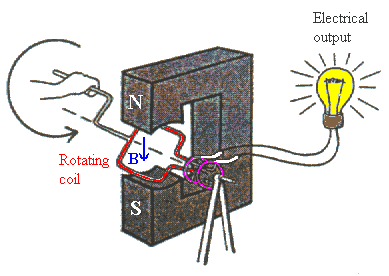
What is the transfer of electricity in a generator?
a)
Mechanical to Electrical
b)
Physical to Potential
c)
Electrical to Mechanical
d)
Yogurt to Light
119.
Generators are devices that convert _____ energy into _____ energy.
a)
chemical; mechanical
b)
mechanical; electrical
c)
electrical; mechanical
d)
potential; kinetic
120.
Magnets have a north and a south ___________
a)
shape
b)
color
c)
pole
d)
region
121.

a)
2
b)
3
c)
5
122.

a)
2
b)
8
c)
3
d)
13
123.

a)
12
b)
7
c)
8
d)
14
124.

a)
1
b)
2
c)
3
d)
4
125.

a)
16
b)
32
c)
6
d)
4
126.

a)
3
b)
13
c)
4
d)
14
127.

a)
10
b)
2
c)
8
d)
18
128.

a)
7
b)
5
c)
2
d)
15
129.

a)
4
b)
6
c)
16
d)
34
130.

a)
4
b)
8
c)
18
d)
36
131.

a)
1
b)
5
c)
37
d)
48
100 %

