
 Worksheets
Dasar- Dasar Ekonomi
Total questions: 40
Worksheet time: 42mins
The factors of production that change in the short-run production theory are ...
Labor
Capital
Raw Material
Land
The factors of production that change in the long-run production theory are ...
Capital and Land
Capital and Labor
Labor and Land
Labor dan Skill
we increase the number of variable factors of production, initially the total production will be more and more. However, after reaching a certain level, the increase in production decreases...
The Law of Diminishing Return
The Law of Diminishing Marginal Utility
The Law of Diminishing Demand
The Law of Diminishing Supply
A curve depicting the combination of labor and capital that produces a certain level of production called...
Isocost Curve
Budget Line
Indifference Curve
Isoquant Curve
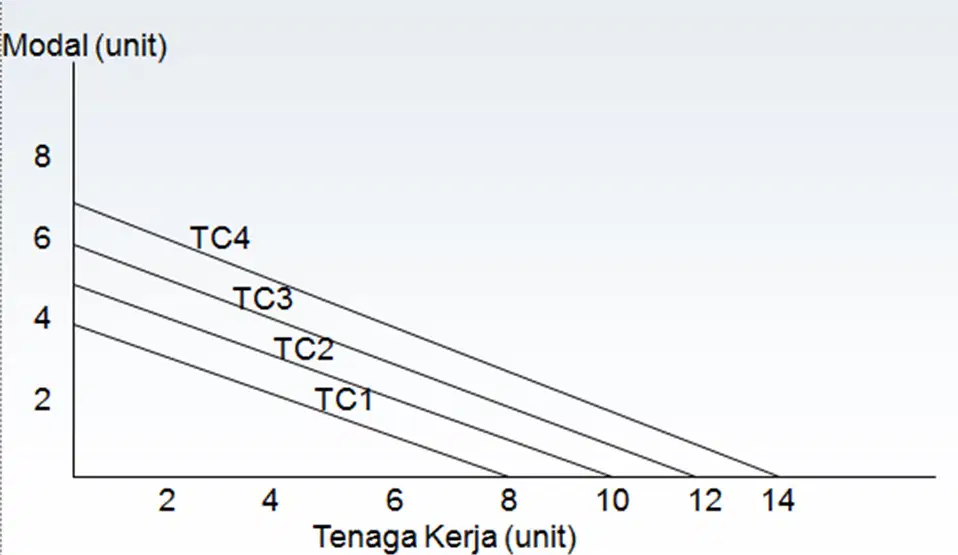
Choose the most efficient isocost is...
TC1
TC2
TC3
TC4
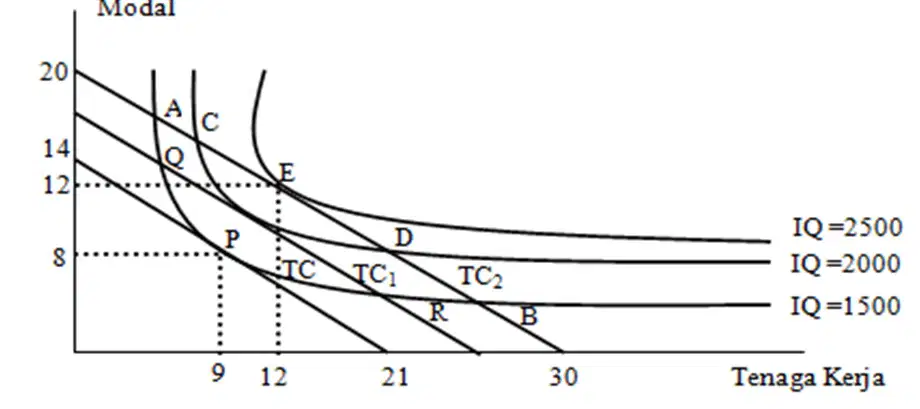
Choose the isoquant that produces the maximum product is...
A
P
E
B
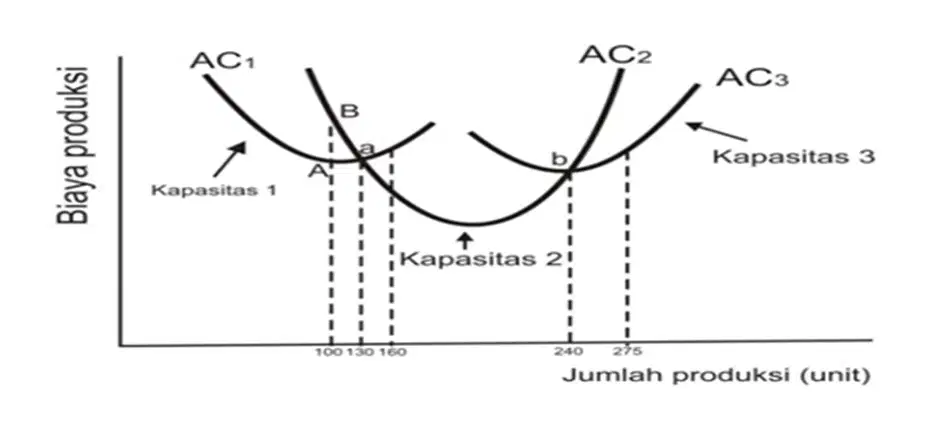
if a manufacturer is going to produce 100 units, the most efficient production cost when using a capacity machine ....
1
2
3
1 dan 3
The correct statement about the theory of use value is ...
The lower the satisfaction with a good, the higher its use value.
The higher the satisfaction with a good, the lower its use value.
The higher the satisfaction with a good, the higher its use value.
The lower the satisfaction with a good, the lower its use value.
The more we increase the consumption of goods/services continuously, the less the satisfaction will be. statement of the law....
The law of diminishing marginal utility
The law of diminishing marginal return
The law of diminishing demand
The law of diminishing marginal utility
A curve that shows the various combinations of consumption of goods that yield the same level of satisfaction called...
Indifference Curve
Isoquant Curve
Isocost Curve
Budget Lina
The difference between the satisfaction obtained by a person in consuming a certain amount of goods and the payment that must be made called
Produsen Surplus
Consumer Surplus
Distributor Surplus
Consumer Deficit
Qd = 40 -2p
Qs = 4p – 50
Find the equilibrium price...
16
18
15
14
The number used to determine the demand responseof a good due to changes in the price of the good called....
Elasticity of supply
Coefficeient of Demand Elasticity
Coefficeient of Supply Elasticity
Elasticity of demand
•if the percentage change in the quantity of goods demanded is greater than the percentage change in price or if the coefficient value> 1. an example of such an item....
goods for which there is no replacement
items for which there is a substitute
luxury items
supplementary items
an image showing perfect elasticity of demand is ....


an image showing unitary elasticity of demand is ....


factors that do not affect the elasticity of demand...
substitute goods
taste
frequency of purchase
population number
factors affecting supply elasticity...
market entry barriers, total inventory of goods, taste
market entry barriers, total inventory of goods, storage endurance
frequency of purchase, total inventory of goods, storage endurance
total inventory of goods, market entry barriers, frequency of purchase,
which includes the main problems of economics are ...
what, how, for whom
how, when, for whom
for whom, what, which
who, for whom, what
which includes the main problems of economics are ...
what, how, for whom
how, when, for whom
for whom, what, which
who, for whom, what
which includes the main problems of economics are ...
what, how, for whom
how, when, for whom
for whom, what, which
who, for whom, what
factors affecting human needs are...
Tecnology, Age, Natural Income
Tecnology, Education, Age
Education, Age,Natural Factor
Education, Age, Income
The producer sets the price of salt at IDR 14,000 per kg. At this price level, 60 kg of the good is demanded. When the price of salt drops to Rp12,000 the amount of salt demanded remains at 60 kg. From the data, determine the coefficient of elasticity of demand...
0
0,4
1
1,5
The price of a VCD player at an electronics store has increased from Rp500,000 to Rp.1,000,000. The price change is followed by an increase in the number of goods demanded from 150 units to 100 units. The elasticity coefficient of demand can be calculated as follows...
1
0,4
4
0
When the price of kerosene in District X is Rp10,000 per liter, 1,100 liters of kerosene are demanded. When the supply of kerosene is increased by the government to 1,800 liters at the same price all of the kerosene supply is purchased. Find the coefficient of demand elasticity...
∞
0
1
2
When the price is Rp20,000, the number of vegetables offered is 100. However, when the price drops to Rp10,000, the number of vegetables offered is 50. Based on the above case, what is the elasticity of supply of these vegetables....
0
1
0,4
4
the correct statement about the law of demand is ...
Quantity of goods is directly proportional to demand
The quantity of goods is always proportional to the demand
The quantity of a good demanded is directly proportional to its price
the quantity of a good demanded is inversely proportional to its price
If people's income rises, their demand for a good will...
stabilized
up
comparable
down
Factors that influence supply...
Prices of substitute and complementary goods
Consumer tastes
Total population
Cost of production
If the price of a good increases, cateris paribus, it will...
Movement along the supply curve
A shift of the demand curve for the good to the left
A leftward shift of the supply curve for that good
Inflation
Which of the following options does not shift the demand curve to the right....
An increase in consumer appetite for the product
An increase in people's income
Consumer expectation that there will be inflation next month
A decrease in the price of the goods themselves
An increase in the price of a good that is followed by an increase in the quantity of the good offered is appropriate...
The law of economics
Ceteris paribus
The coefficient of elasticity of the good
Law of supply
The nature of the ratio of the quantity offered to the price is...
Inversely proportional
Directly proportional
Fixed
Same
mproved technology will lead to...
The supply curve shifts to the right
The total production curve shifts to the right
The supply curve shifts to the left
The demand curve shifts to the right
he correct wording of the law of demand is...
The higher the selling price of a good, the more the good is offered
The higher the selling price of a good, the less the good is demanded
The lower the selling price of a good, the less the good is demanded
The higher the selling price of a good, the less the good is offered
Market equilibrium will occur when...
Factors of production can be used in a balanced way
Factors of production can be used equally
The quantity of goods demanded is equal to the quantity of goods offered
The demand curve is parallel to the supply curve
The following are factors that can shift the demand curve to the right, except...
Consumer income
The price of other goods
The price of the good itself
Estimated future price
Market equilibrium will occur when...
Factors of production can be used in a balanced way
The quantity of goods demanded is equal to the quantity of goods offered
The demand curve is parallel to the supply curve
Factors of production can be used equally
When the elasticity coefficient of demand is less than one (Ed < 1), it is a type of elasticity...
In perfectly elastic
Elastic
Inelastic
Perfectly elastic
he government has raised the price of subsidized gasoline/BBM by Rp 2,000. The price increase will have the following effects, except...
Shift the demand curve of firstx gasoline to the right
Shift the demand curve of subsidized fuel to the left
Shift the demand curve for cars to the left
Shift of aggregate supply curve to the left

