
 Worksheets
Classification Quiz
Total questions: 31
Worksheet time: 51mins
What is TAXONOMY?
The classification of animals
The classification of all living things
The name of a famous scientist
A funny word
scientist who's classification system we still use today
Carl Linnaeus
Aristotle
John Ray
Charles Darwin
Listen the levels of classification from broadest to most specific.
Species
Class
Genus
Family
Domain
Order
Kingdom
Phylum
There are three domains. What are the names of these? Select three answers.
Archaea
Plantae
Eukarya
Protista
Bacteria

Why do scientists refer to organisms by their species name, rather than using the common name, e.g. "mountain lion"?
It makes the organism sound more scientific
It ensures that everyone knows which species is being referred to
It is a legal requirement of journals and newspapers
It displays how clever the scientist is

Which option shows the correct formatting of the species name of a mountain lion?
A
B
C
D

Which phylum does the red fox belong to? Give your answer as a single word with no period at the end.
(a)
Which genus does the red fox belong to? Give your answer as a single word with no period at the end.
(a)

Use the dichotomous key to identify this leaf:
Carya illionoinensis
Magnolia virginiana
Ilex aquifolium
Vicia americana
Each node on a cladogram represents...
the last point at which two groups shared a common ancestor.
the point at which one or more species became extinct.
the most recent point at which a trait was lost in a certain clade.
the point at which two clades joined and became monophyletic.
Each node on a cladogram represents...
the last point at which two groups shared a common ancestor.
the point at which one or more species became extinct.
the most recent point at which a trait was lost in a certain clade.
the point at which two clades joined and became monophyletic.
What do phylogenetic trees show us?
What is a taxon?
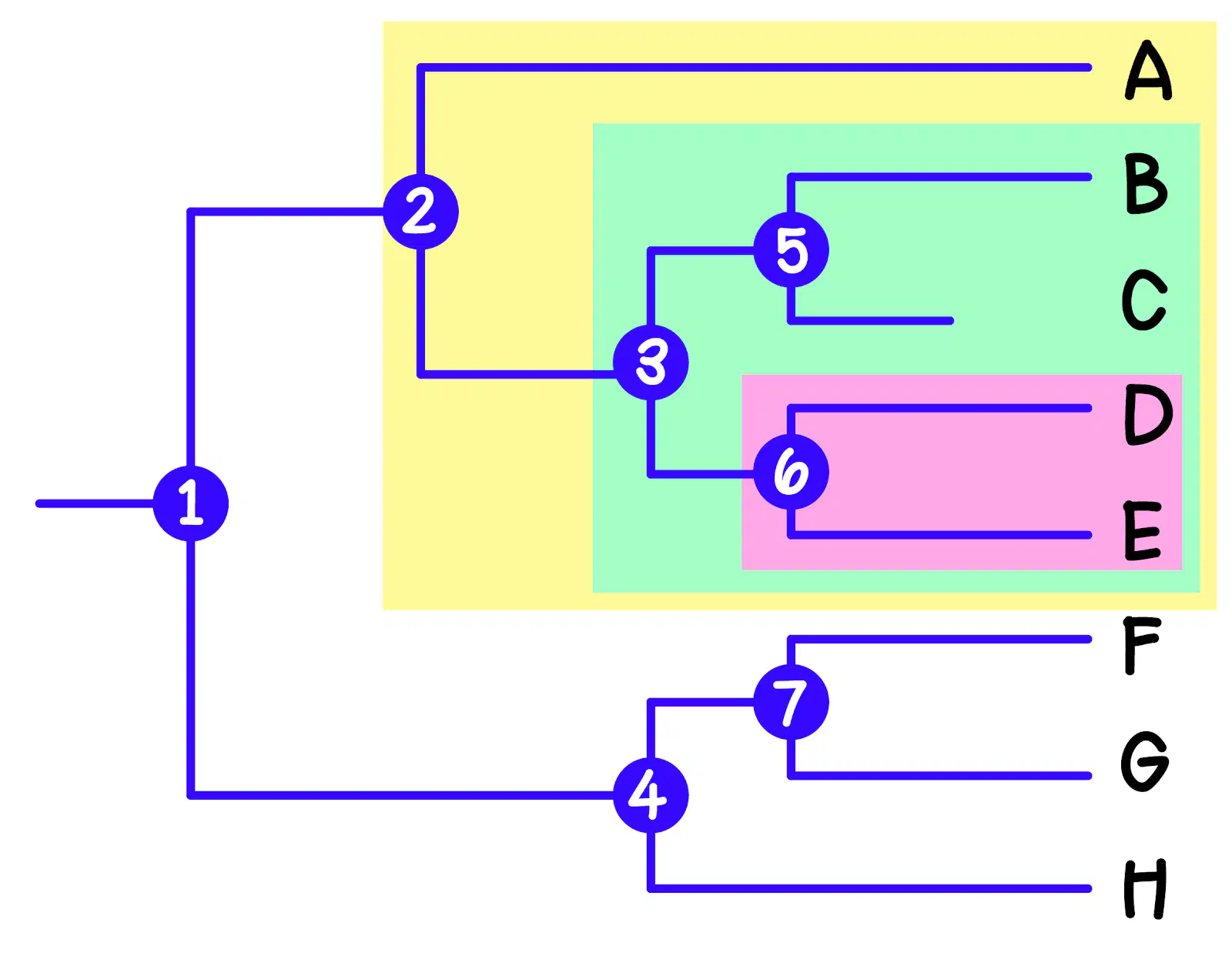
This is an image of a generic phylogenetic tree. The black letters A - H represent taxa. The numbers 1-7 in blue circles represent common ancestors.
Common ancestors are represented by numbers written in circles. These are positioned where one branch splits into two branches. What is the name of the place where one branch splits into multiple branches?
Clade
Taxa
This is an image of a generic phylogenetic tree. The black letters A - H represent taxa. The numbers 1-7 in blue circles represent common ancestors.
The highlighted boxes show us common ancestors and all of their descendants. What is the name for these groups?
Clade
Taxa
This is an image of a generic phylogenetic tree. The black letters A - H represent taxa. The numbers 1-7 in blue circles represent common ancestors.
Which taxon is the sister taxon of C?
Taxon A
Taxon B
Taxon D
Taxon E
This is an image of a generic phylogenetic tree. The black letters A - H represent taxa. The numbers 1-7 in blue circles represent common ancestors.
Which number shows us the last common ancestor of all of the taxa? Write your answer as a single number with no period or letters.
(a)
This is an image of a generic phylogenetic tree. The black letters A - H represent taxa. The numbers 1-7 in blue circles represent common ancestors.
Which number indicates the last common ancestor of B and D? Write your answer as a single number with no period or letters.
(a)
This is an image of a generic phylogenetic tree. The black letters A - H represent taxa. The numbers 1-7 in blue circles represent common ancestors.
Which taxon is extinct? Write your answer as a single capital letter with no period.
(a)
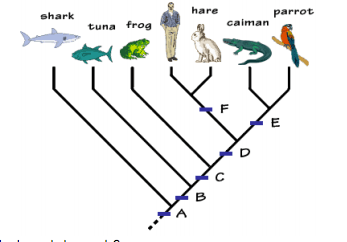
On the cladogram, which organism is the closest relative of the parrot?
Frog
Hare
Caiman
Parrot

Who is most closely related to Taxidea taxus?
Lutra lutra
Panthera pardus
Canis latrans
Canis lupus

Which group of animals on this tree are most closely related to birds?
Saurischian dinosaurs
Ornithischian dinosaurs
Crocodiles
None of these are related to birds
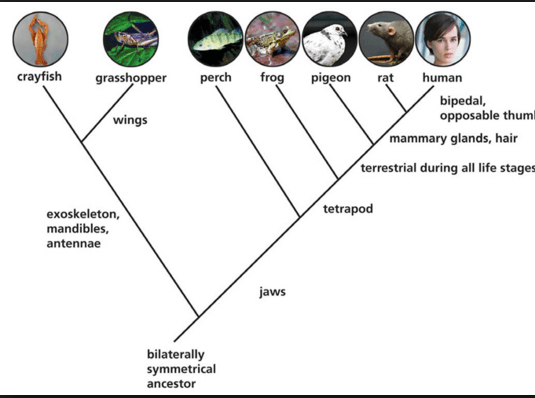

From the picture above, What do the species all have in common?
Back bone
Same father
Common ancestor
Feathers
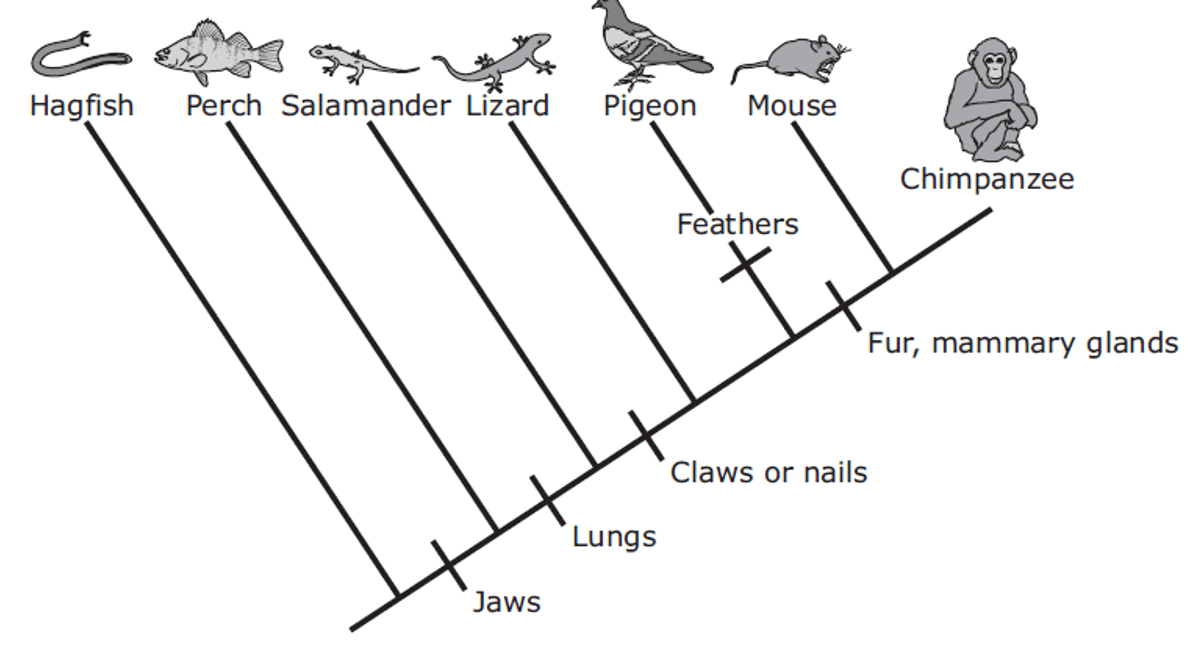
All the animals to the right of the salamander would have the common characteristic of...
Fur
Claws or nails
Lungs
Jaws

The lizard has all these derived characteristics EXCEPT
Jaws
Lungs
Bipedal

Where is the alligator and T. rex's common ancestor?
Point A
Point B
Point C
Point D

What do amphibians, birds, prosimians and humans all have in common? Check all that apply.
Hair
Endothermic
Eukaryotic
Tetrapod
Vertebrate

Which trait should go where A is on the cladogram?
eyes
feet
lips
hat

