wayground logo

Free Printable Worksheets

Font size

S
M
L
XL
Worksheets

reconstruction and progressive era

Total questions: 51

Worksheet time: 28mins

Name
Class
Date
1.
Which event occurred immediately after the Reconstruction period ended?
a)
Freedman's Bureau 
b)
Federal Troops were removed from the South
c)
Civil War ends
d)
15 amendment gives African Americans the right to vote
2.
Which amendment abolished slavery?
a)
15th
b)
19th
c)
14th
d)
13th
3.
Which group of people were most affected by the passing of the 14th Amendment?
a)
Plantation owners
b)
White Politicians
c)
African Americans
d)
Immigrants
4.
Which amendment gives all people equal protection under the law?
a)
14th 
b)
15th
c)
19th
d)
13th
5.
"I'm looking to buy up your plantations and influence your government for my own personal gain of wealth and power."
Which group of people does the picture above make reference to during the Reconstruction Era?
a)
Northern Politicians
b)
Carpetbaggers
c)
Southern Military Leaders
d)
Freed African Americans
6.
Which statement bests represents a Black Code?
a)
African Americans were not allowed to move to another state
b)
African Americans were not allowed to gather in groups in public places
c)
African Americans were not allowed to be sharecroppers
d)
African Americans were not allowed to own land
7.
Frederick Douglass fought for the adoption of constitutional amendments that guaranteed--
a)
rights to bear arms
b)
voting rights
c)
freedom of speech
d)
freedom of religion
8.
What was the result of passing the 15th Amendment during reconstruction?
a)
Rights were taken away from plantation owners
b)
African American rights increased
c)
Women received equal rights
d)
Expanded rights for First Americans
9.
How can the provisions stated in the 13th, 14th, and 15th amendments best be summarized?
a)
Protection is only provided for male citizens under the law 
b)
Protection is guaranteed for all citizens under the law
c)
Protection is only provided for certain ethnic groups under the law
d)
Protection is not guaranteed to enslaved citizens under the law
10.
The constitutional amendments that were adopted during Reconstruction --
a)
provided political and legal rights for African Americans
b)
increased the rights of southern soldiers
c)
limited the number of years in a presidential term
d)
allowed federal money to be spent on building construction
11.
"No state shall make or enforce any law which shall abridge the privileges . . . of citizens . . . nor shall any state deprive any person of life, liberty, or property, without due process of law . . ."
The excerpt above is taken from the --
a)
13th Amendment
b)
14th Amendment
c)
15th Amendment
d)
19th Amendment
12.
Which is the best description of Reconstruction?
a)
rebuilding the US after a big earthquake
b)
a period of rebuilding in the US after the Revolutionary War
c)
a period of rebuilding in the US after the Civil War
d)
unfair treatment of African Americans after the Civil War
13.
Southern states created the Black Codes to do what?
a)
limit African Americans rights
b)
expand Confederate rights
c)
give women voting rights
d)
jail Carpetbaggers
14.
The Ku Klux Klan was a group that believed...
a)
in white supremacy
b)
in equality for all
c)
in black supremacy
d)
in southern supremacy
15.
Carpetbaggers were...
a)
Newly freed slaves
b)
Southern Republicans
c)
Confederate Soldiers
d)
Northerners who took advantage of southern economic hardships 
16.
Scalawags were...
a)
Northerners who took advantage of southern economic hardships 
b)
Southern Republicans
c)
former Confederate Leaders
d)
African Americans
17.
Jim Crow Laws passed after Reconstruction took away African American Voting Rights using...
a)
Voter Registration Laws
b)
Political Gerrymandering
c)
Voter Identification Laws
d)
Poll Taxes and Literacy Tests
18.

Jim Crow laws were upheld by which Supreme Court case in 1896?

a)
RHS vs. BGHS
b)
Brown vs. Board of Education
c)
Clymore vs. Kiser
d)
Plessy vs. Ferguson
19.
Reconstruction ended in ____ with a compromise over the election of 1876.
a)
1865
b)
1900
c)
1861
d)
1877
20.
Black Codes were intended to...
a)
help African Americans gain land.
b)
limit the economic and physical freedom of former slaves.
c)
to remove Federal troops from their region.
d)
to give African Americans a code to communicate.
21.
Which was a policy of Reconstruction?
a)
Freedmen's Bureau was declared unconstitutional
b)
Southern military leaders could not hold public office
c)
all Civil Rights Laws were repealed
d)
Southern military leaders were encouraged to hold public office
22.

How would the Southerners feel about Northern carpetbaggers?

a)

resented them

b)

welcomed them

23.

By 1910 where did the majority of African-Americans live?

a)

The South

b)

The North

c)

The East

d)

The West

24.

What two (2) things were African-Americans looking for when they did move?

a)

Segregation and a Better Life

b)

Lost Family and A Better Life

c)

Discrimination and More Opportunities

d)

More Opportunities and a Better Life

25.

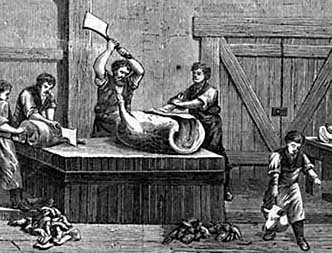
Which of the following was NOT an area where African-Americans were able to get jobs in the North.

a)

Sharecropping

b)

Steel Industry

c)

Automotive Factories

d)

Meatpacking Plants

26.

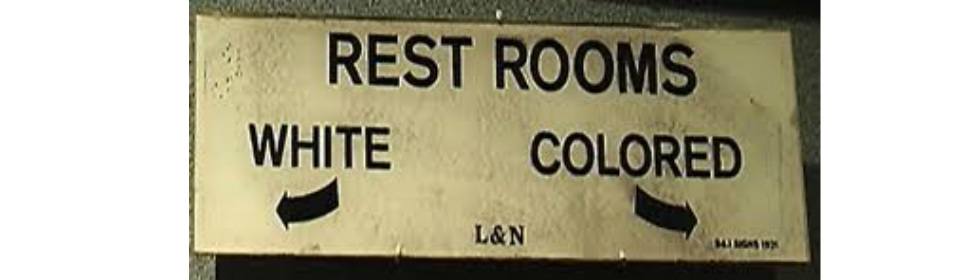
What part of the Jim Crow laws were African-Americans mostly trying to get away from? Hint: One of these has always been around the other was created by these new laws

a)

Discrimination

b)

Segregation

27.
What does it mean to migrate?
a)
To move from one place to another
b)
To sleep all winter
c)
To hunt for food
d)
To change houses
28.

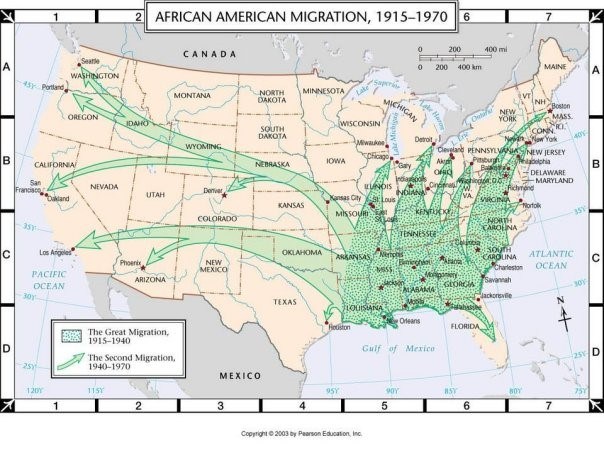
Which of the following is not a result of the Great Migration?

a)

Many arriving in the North found prejudice in trying to rent apartments.

b)

Many began to work together in a “Back to Africa” movement.

c)

New arrivals found mostly low-paying factory jobs available.

d)

Racial tensions grew and race riots broke out in several cities.

29.
The Great Migration refers to the shift of the African­American  population from the
a)
rural South to the rural North
b)
rural North to the rural South
c)
urban South to the urban North
d)
rural South to the urban North
30.

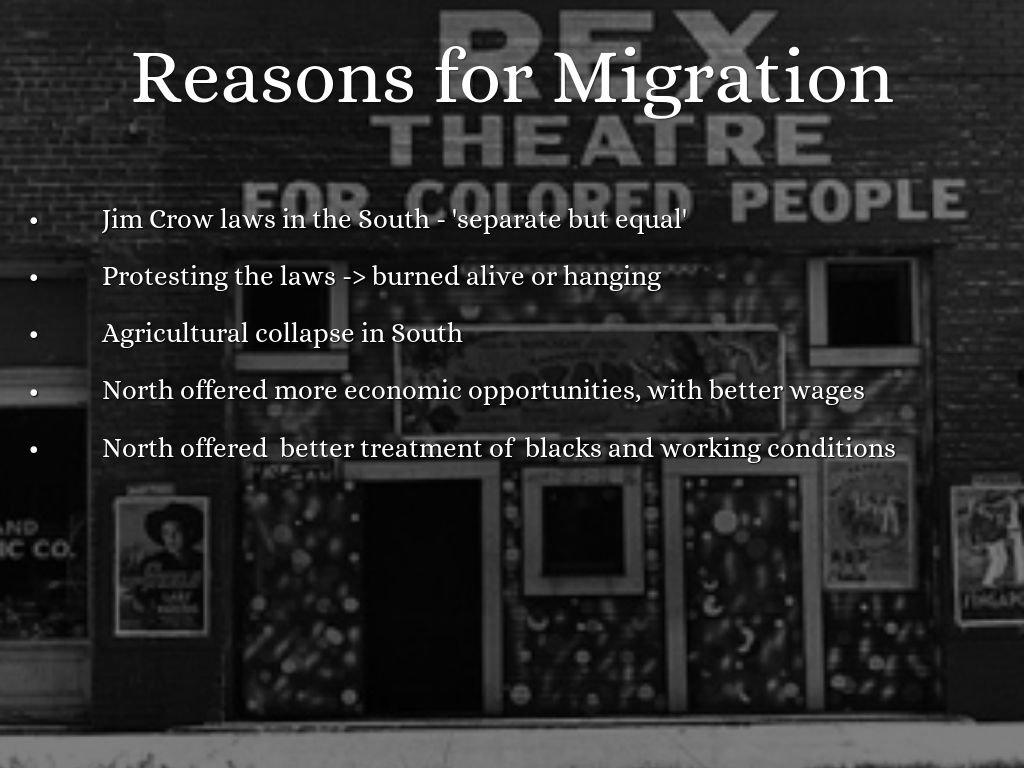
Which of the following was a pull factor that led to African-Americans migrating out of the South during the Great Migration?

a)

Job opportunities in factories

b)

Social terror

c)

Lack of voting opportunities

d)

A decrease in wages

31.

What Supreme Court case ruled "separate but equal" was legal?

a)

Texas vs. Johnson

b)

Tinker vs. DesMoines

c)

Brown vs. Board of Education

d)

Plessy vs. Ferguson

32.

Which of the following BEST explains the purpose of the Jim Crow system?

a)

Keep public facilities cleaner

b)

keep African-Americans as second-class citizens

c)

keep the races pure

d)

keep African-Americans from voting

33.

Tests given to African Americans at the voting polls.

a)

Literacy Tests

b)

Voting tests

c)

Government Tests

d)

Poll tests

34.
Beginning as a social club for former Confederates, this organization terrorized African Americans across the country.
a)
Fraternal Order of Elks
b)
Ku Klux Klan
c)
Freemasons
d)
Illuminati
35.

What were the 9th and 10th cavalry units called?

a)

The cavalry units

b)

The Buffalo Soldiers

c)

Nothing

36.
Buffalo Soldiers got their name from
a)
The Native Americans
b)
Japanese
c)
White Americans
37.

How was the service of Black soldiers after World War II different from their service early in the founding of buffalo soldiers?

a)

When the buffalo soldiers were founded, they served in regiments in the West, but after World War II, they were commanded by the French army.

b)

When the buffalo soldiers were founded, they served in all black units, but after World War II, black soldiers eventually joined white regiments.

c)

When the buffalo soldiers were founded, black soldiers could only serve in wars, but after World War II, black soldiers could serve in times of peace.

d)

When the buffalo soldiers were founded, black soldiers were discriminated against, but after World War II, black soldiers endured less racism.

38.
What battle did the Rough Riders, Buffalo Soldiers and Americans defeat the Spanish?
a)
Battle of Cuba
b)
Battle of San Juan Hill
c)
Battle of Trenton
d)
Battle of Spain
39.
-Born into slavery on a plantation in Virginia -Believed equality could be achieved through vocational education -Organized the Tuskegee Institute for agricultural and industrial education
a)
W.E.B. Du Bois
b)
Rosa Parks
c)
Martin Luther King, Jr.
d)
Booker T. Washington
40.
Which person accepted social separation and believed racial equality could be achieved through vocational education?
a)
 Booker T. Washington
b)
Martin Luther King, Jr. 
c)
. W.E.B. Du Bois                               
d)
William Lloyd Douglas
41.
Which of the following believed in full political, civil, and social rights for African Americans?
a)
William Lloyd Douglas
b)
W.E.B. Du Bois
c)
George Washington     
d)
Booker T. Washington
42.

Booker T Washington and WEB DuBois both agreed

a)

white people are superior

b)

the telephone is the best invention

c)

Education for African-Americans is important

d)

Equal rights for all

43.

WEB DuBois

a)

founded the NAACP

b)

worked in a salt mine at age 9

c)

was born in Tennessee

d)

taught job skills to African-Americans

44.

WEB DuBois believed in

a)

African-Americans needed to be educated and involved in politics

b)

believed job skills were most important

c)

being a slave was fun

d)

having a job was not important

45.

NAACP stands for

a)

National Association for African People

b)

National Association for the Advancement of Colored People

c)

National Association for Americans to Color People

d)

National Association for African-American Men

46.

Proposed the idea of a "Talented Tenth"- college education for 10% of the leading African Americans

a)

Booker T. Washington

b)

WEB Dubois

47.

Which one of Garvey’s movements interested thousands of people in the diaspora?

a)

Civil Rights Movement

b)

The “Reform” Movement

c)

Abolitionism

d)

The “Back to Africa” Movement

48.

What did Garveyism symbolize?

a)

Nothing

b)

Marcus Garvey

c)

the transformation of the way black people looked at themselves and their place

d)

Marcus Garvey’s movements

49.
What country did Haiti gain its independence from ___?
a)
France
b)
England
c)
 Spain
d)
The United States
50.
Sugar plantations were introduced to Haiti in 1700, this _____ the demand for slaves?
a)
Increased
b)
Decreased
c)
Demand was unchanged
d)
All of the above
51.
The grand blancs were ____.
a)
Plantation owners
b)
British
c)
Large Shopkeepers
d)
Traders