
 Worksheets
Periodic Table Review
Total questions: 112
Worksheet time: 1hrs 11mins
Membership in a group is based on the number of

Number of valence electrons
Atomic number
Atomic mass
Number of neutrons


transition metals
alkali metals
–I am a metal.
–I am in period three.
–I have a +2 charge.
Sulfur
Magnesium
Calcium
Sodium
What is the atomic number of magnesium?
12
25
24
55
–I am a nonmetal.
–I am found in the p block of the periodic table.
–I have 6 valence electrons.
–My most common isotope has 45 neutrons.
Rhodium
Scandium
Bromine
Selenium
How many protons does selenium have?
34
79
45
6
How can you tell how many valence electrons an element has?
It is the same as the group number.
It is the same as the atomic number.
It is the "A" number listed above the periodic table.
It is the number listed at the left of the periodic table.
–I am a nonmetal.
–I have a full valence shell.
–I have four energy levels.
Potassium
Krypton
Calcium
Bromine
What is the mass of the most common isotope of krypton?
36
48
83
84
How can you tell how many shells (energy levels) an element has?
It is the "A" number above the periodic table.
It is listed on the left side of the periodic table.
It is the same as the group number.
It is the same as the atomic number.
–I am a metal.
–I am located in the fifth period of the periodic table.
–My valence electron is located at 5s2.
Rubidium
Barium
Strontium
Xenon
How many dots are in the Lewis dot structure for strontium?
2
5
38
8
How can you tell how many dots to draw for an element's Lewis dot structure?
It is listed on the left side of the periodic table.
It is the same as the valence electrons.
It is the same as the atomic number.
It is the same as the group number.
What periodic table group(s) can be found in the "s" block of the periodic table?
Alkali metals only.
Alkali metals and halogens.
Alkaline earth metals only.
Alkali metals and alkaline earth metals.
Alkali metals, alkaline earth metals, and halogens.
What periodic table group(s) can be found in the "p" block of the periodic table?
Halogens.
Alkali metals and halogens.
Alkaline earth metals only.
Alkali metals and alkaline earth metals.
Alkali metals, alkaline earth metals, and halogens.
–I am an alkali metal.
–I produce a bright pink flame when burned.
–I have two energy levels.
Strontium
Beryllium
Lithium
Potassium
What is the mass of the alkaline earth metal in the same period lithium is in?
9.012
6.941
18.998
1.008
None of these.
I am a halogen.
I am the most reactive element in my group.
I have the highest electronegativity of any element.
Chlorine
Fluorine
Francium
Beryllium
Astatine
I form an anion with a charge of -1.
I am a liquid at normal earth conditions.
My gaseous form is more dense than air.
My atomic radius is larger than fluorine.
Chlorine
Potassium
Bromine
Lithium
I am diatomic.
I have 5 valence electrons.
My radius is larger than fluorine.
My properties are similar to arsenic.
Nitrogen
Oxygen
Strontium
Phosphorus
Selenium
–I am radioactive!
–I am an alkaline earth metal.
–In order to follow the Octet Rule, I will lose electrons.
Francium
Radium
Astatine
Cesium
AFTER it forms an ion to follow the octet rule, how many TOTAL electrons will radium have?
88
90
86
8
–I have two energy levels.
–I have 5 valence electrons.
–I am the most common gas in the atmosphere.
Hydrogen
Oxygen
Beryllium
Nitrogen
What is the most common isotope of nitrogen?
Nitrogen-14
Nitrogen-7
Nitrogen-15
Nitrogen-14.007
Nitrogen-28
–My most common isotope has a mass of 108.
–I am located in the same period as strontium.
–I am in group 11 of the periodic table.
–I am a transition metal used in jewelry.
Barium
Rubidium
Silver
Iodine
Copper
How many more electrons does silver have than the alkali metal in the same period has?
10
47
9
18
–I am an alkaline earth metal.
–I am found in bones, teeth, and cave formations like stalactites.
–I will give away (lose) two electrons in order to have a full valence shell.
–My radius is smaller than both strontium’s and potassium’s.
Potassium
Calcium
Barium
Rubidium
Fluorine
When calcium forms a cation with a +2 charge, how many valence electrons does it have?
2
8
4
22
–I have similar properties to bromine and chlorine.
–I am usually a purple solid, but I form a purple gas when heated.
–I am diatomic.
–My electronegativity is lower than chlorine but highest in my period.
Iodine
Strontium
Fluorine
Argon
Bromine
Which of the following is TRUE?
Every atom on the periodic table wants 8 electrons in its valence shell.
There are 8 diatomic gases.
Atomic Radius increases from left to right on the periodic table.
Ionization energy increases from left to right on the periodic table.
Electronegativity increases as you increase energy levels down the periodic table.
Which of the following is listed in order from HIGHEST TO LOWEST?
Atomic Radius: Lithium, sodium, potassium
Electronegativity: Barium, strontium, calcium
Ionization energy: Iodine, bromine, chlorine
Atomic radius: Nitrogen, oxygen, fluorine
Electronegativity: Sodium, magnesium, aluminum
Which of the following is NOT listed in order from LOWEST TO HIGHEST?
Atomic Radius: Lithium, sodium, potassium
Electronegativity: Barium, strontium, calcium
Ionization energy: Iodine, bromine, chlorine
Ionization energy: Helium, neon, argon
Electronegativity: Sodium, magnesium, aluminum
Which metals are in group 1 of the periodic table?
Alkali metals
Alkaline earth metals
Metalloids
Transition metals
Which metals are in group 2 of the periodic table?
Alkali metals
Alkaline earth metals
Metalloids
Transition metals
Which of the following is NOT an alkali metal?
Sodium
Lithium
Francium
Hydrogen
Which of the following is NOT an alkaline earth metal?
Sodium
Beryllium
Radium
Calcium
Which of the following is unstable (radioactive)?
Lithium
Calcium
Rubidium
Francium
Which of the following has two valence electrons?
Potassium
Strontium
Cesium
Francium
Which element has a valence electron configuration of 6s2?
Barium
Potassium
Cesium
Molybdenum
What is the valence electron configuration of potassium?
1s4
4s1
4s19
1s2
Predict the most likely electron configuration for hydrogen.
2s1
1s2
1s1
1p3
Which of the following is the most reactive?
Lithium
Cesium
Sodium
Potassium
Which of the following is the most reactive?
magnesium
barium
beryllium
strontium
Which of the following lists a pair of elements in order of weakest reactivity to strongest reactivity?
sodium, magnesium
potassium, sodium
barium, cesium
cesium, magnesium
Which of the following might not be a metal?
carbon
lithium
barium
rubidium
Which of the following has the highest electronegativity?
magnesium
calcium
strontium
barium
Which of the following has the lowest electronegativity?
cesium
lithium
potassium
rubidium
Which of the following is listed in order from smallest radius to largest radius?
lithium, sodium, cesium
barium, strontium, magnesium
rubidium, strontium
cesium, barium, lithium
Which of the following is listed in order from smallest radius to largest radius?
lithium, sodium, beryllium
barium, strontium, magnesium
strontium, rubidium
cesium, barium, lithium
Which of the following has the lowest ionization energy?
Francium
Cesium
Rubidium
Lithium
Which of the following will turn black fastest in air?
Cesium
Potassium
Calcium
Magnesium
Which of the following will take the longest to turn black in air?
Cesium
Potassium
Calcium
Magnesium
Which is untrue about alkali metals?
They are explosive in water.
They are less reactive than alkaline earth metals.
They are very malleable.
They are softer than alkaline earth metals.
Which of the following is untrue about alkaline earth metals?
They are harder than alkali metals.
They will turn black when exposed to air more quickly than alkali metals will.
They are more dense than alkali metals.
They are more reactive when they have more energy levels.
The periodic table is arranged according to:
Properties and protons
Mass and neutrons
Alphabetical order
The order in which the elements were discovered.
An unknown element has a valence electron configuration of 3s2. How many valence electrons does the element have?
3
2
5
6
An element has the noble gas configuration of [Ar] ?s1. Name the element and provide the missing number in the configuration.
potassium, 3
sodium, 3
potassium, 4
sodium, 4
calcium, 4

NAME the element that is depicted in this orbital diagram.
(a)

Type the SYMBOL of the alkali metal in the same period as the element depicted in the diagram.
(a)

Type the NAME of the ALKALINE EARTH METAL in the same period as the element depicted in the image.
(a)
Highly reactive nonmetals
Alkali metals
Alkaline Earth metals
Halogens
Noble gases
Lanthanide metals
These elements do not react with other elements
Alkali metals
Alkaline Earth metals
Halogens
Noble gases
Transition metals
This group has 8 valence electrons are stable elements
Alkali metals
Alkaline Earth metals
Halogens
Noble gases
Transition metals
The most reactive metals on the periodic table
Alkali metals
Alkaline Earth metals
Halogens
Noble gases
Lanthanide metals
Highly reactive with water - explosive
Alkali metals
Alkaline Earth metals
Halogens
Noble gases
Actinide metals
Soft, shiny metals that can easily be cut with a knife
Alkali metals
Alkaline Earth metals
Halogens
Noble gases
Transition metals
Great conductors of heat and electricity
Alkali metals
Alkaline Earth metals
Halogens
Noble gases
Transition metals
Which group has a varying number of valence electrons?
Alkali metals
Alkaline Earth metals
Halogens
Noble gases
Transition, Lanthanide, and Actinide metals
Poor conductors of heat and electricity
Alkali metals
Alkaline Earth metals
Halogens
Transition metals
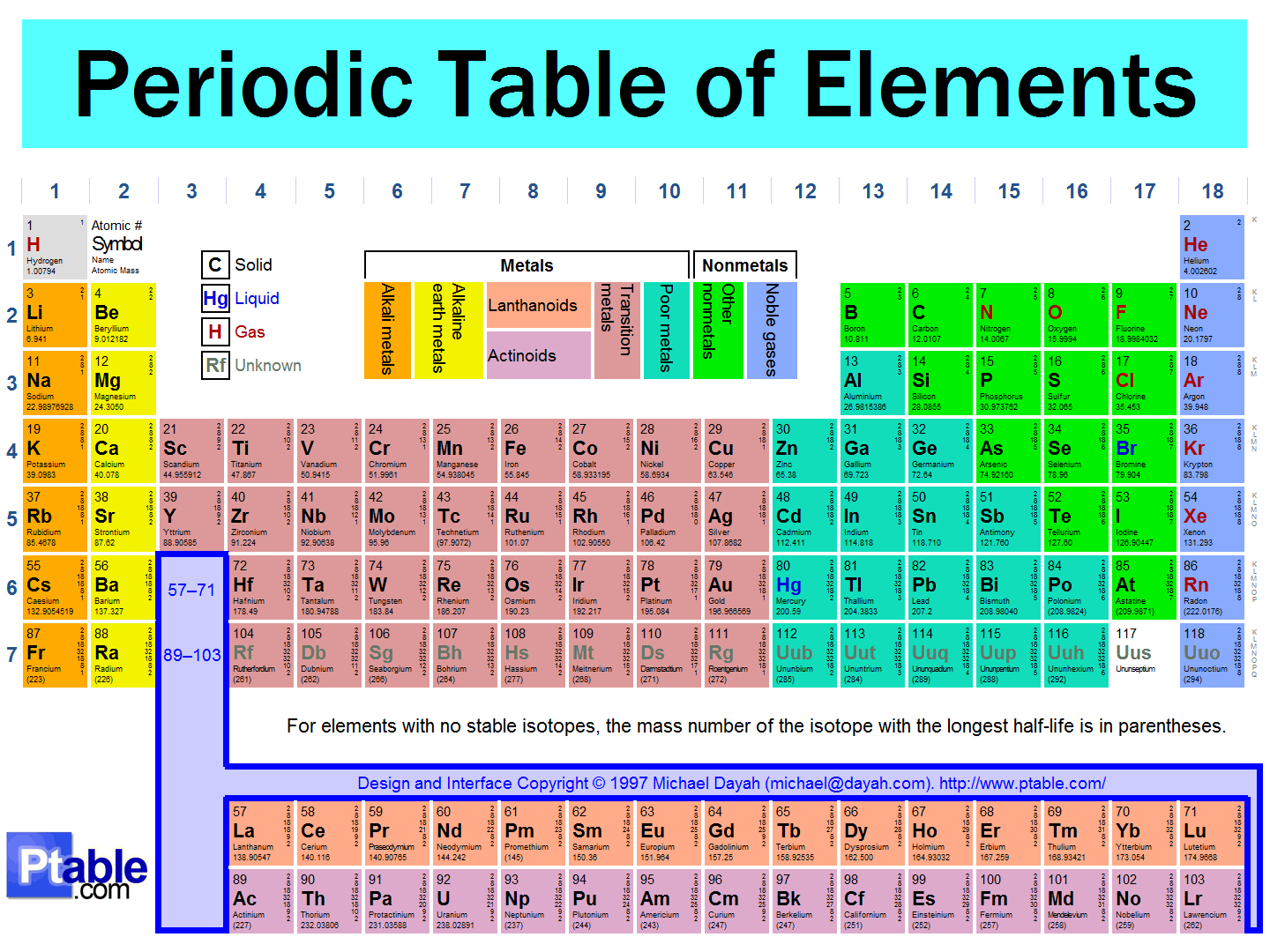

Which group of the periodic table is Neon a part of?
answer choices
alkali metals
alkaline earth metals
halogens
noble gases

Which is a halogen?
Helium
Chlorine
Oxygen
Neptune

Calcium
Lithium
Phosphorus
Copper

Iron
Oxygen
Neon
Barium
True or False: The reactivity of metals tends to decrease as you move from left to right across the periodic table.
True
False
Name this group: These metals are the most reactive.


Name this group: These metals are the second most reactive.


Which of the following could be properties of nonmetals?
Poor electrical conductivity
Poor thermal conductivity
Dullness
Brittleness
Find this family: This family contains very reactive nonmetals like fluorine and chlorine.


Name this group: These elements, also known as inert gases, tend to be nonreactive.
Halogen family
Noble gases
Carbon family
Nitrogen family

Which color on the image of the periodic table corresponds with the halogens.
red
black
blue
orange
Which color on the image of the periodic table corresponds with the noble gases.
red
black
blue
orange
Which color on the image of the periodic table corresponds with the transition metals.
red
black
blue
orange

Which letter is the Metalloids?
A
B
C
D
E

